Call CA Tally HelpDesk
+91 9205471661,
7428779101
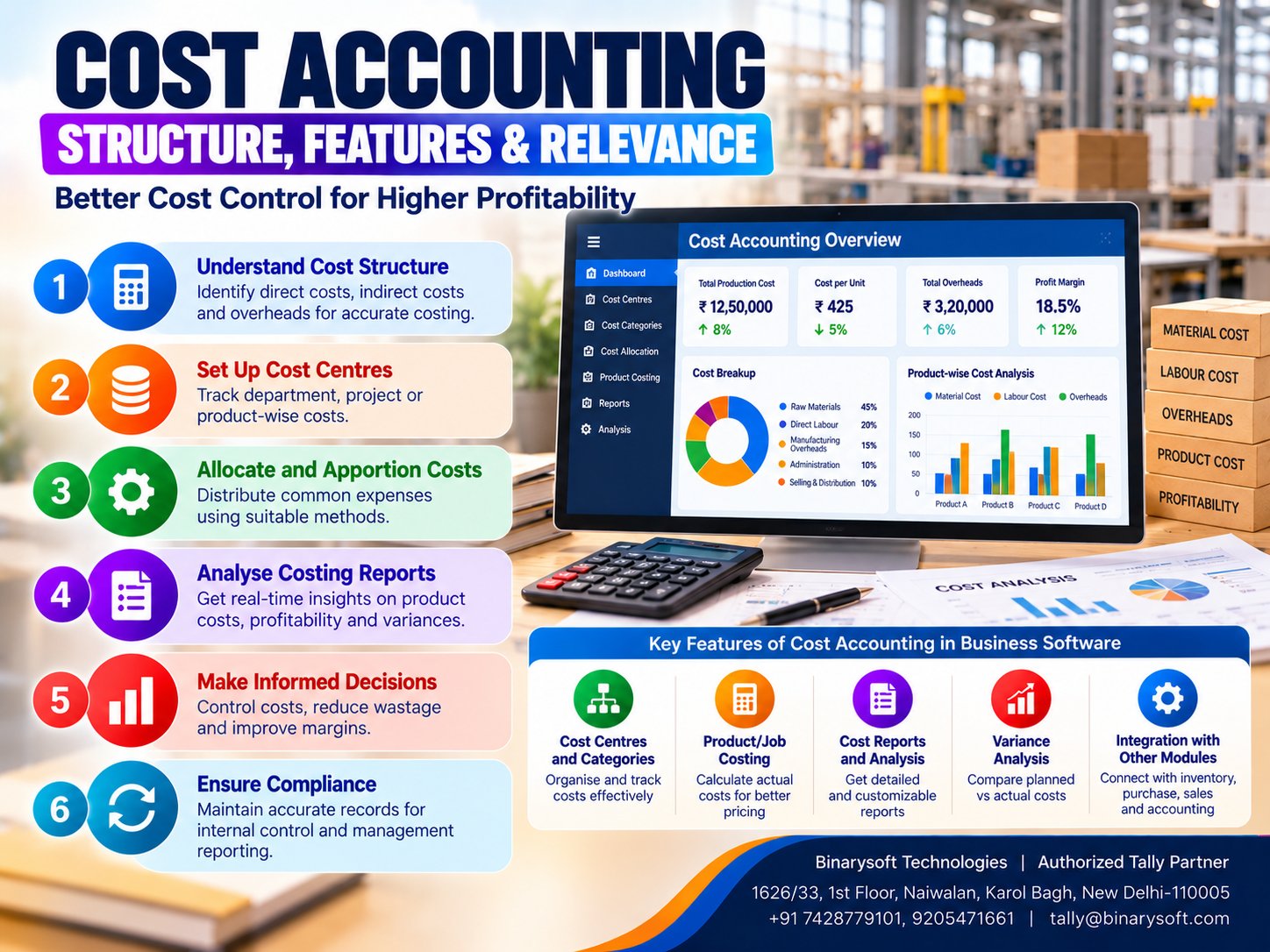
Introduction: Why Every Business Must Understand Its Real Costs
Every business owner wants to increase sales, reduce unnecessary expenses and improve profitability.
However, growing revenue does not always mean increasing profits.
A manufacturing company may receive more orders but struggle with rising raw material costs. A wholesale distributor may achieve record sales while losing money through excessive transportation expenses. A retailer may offer attractive discounts without understanding their impact on margins.
These situations reveal an important business challenge: many organizations know how much they sell but do not clearly understand how much their products or services actually cost.
Cost accounting helps businesses solve this problem.
It involves identifying, recording, classifying, analyzing and controlling costs associated with business operations.
Unlike financial accounting, which primarily reports overall financial performance and position, cost accounting focuses on understanding where expenses arise and how resources are consumed.
For Indian small and medium enterprises, cost accounting can support better pricing, budgeting, inventory planning and profitability analysis.
Businesses using Tally Prime can maintain structured expense records, allocate relevant costs through cost centres and review financial information.
With suitable accounting procedures, management can use this information to make better operational decisions.
This guide explains the meaning, structure, features, objectives, methods and importance of cost accounting, along with practical examples and applications of Tally Prime.
A Business Owner's Story: When Increasing Sales Failed to Improve Profits
Ramesh operated a small manufacturing unit in Faridabad, Haryana.
His company produced metal components supplied to industrial equipment manufacturers across Delhi NCR.
The business had grown steadily over the years.
Ramesh employed skilled workers, purchased modern machinery and maintained long-term relationships with customers.
When a major client offered him a large production contract, he accepted it enthusiastically.
The order promised significant revenue.
He increased production, hired additional workers and purchased more raw materials.
For several months, the factory operated at full capacity.
Ramesh believed the business was entering its most successful phase.
However, when his accountant prepared the quarterly financial statements, the results were disappointing.
Sales had increased, but profits had declined.
Ramesh was confused.
He had negotiated competitive material prices and ensured that production targets were met.
Where was the money going?
A detailed review revealed several problems.
Raw material wastage had increased.
Some machines consumed more electricity than expected.
Overtime expenses were rising.
Transportation costs were not included properly when evaluating product profitability.
The company had been calculating selling prices mainly using direct material and labour costs.
Several indirect expenses were being overlooked.
Ramesh realized that his business needed a more systematic approach to cost analysis.
He introduced cost classification, production cost reviews and regular comparisons between estimated and actual expenses.
Over time, the company gained better visibility into its operating costs.
Ramesh could identify which products generated healthy margins and which required pricing or process improvements.
The experience changed his understanding of business success.
High sales can create excitement, but accurate cost information helps determine whether that growth is financially sustainable.
This is an illustrative story based on common business challenges.
What Is Cost Accounting?
Cost accounting is a branch of accounting concerned with identifying, measuring, recording, analyzing and controlling the costs of producing goods or delivering services.
Its primary purpose is to provide management with useful information for planning and decision-making.
Cost accounting helps answer important questions:
-
How much does it cost to manufacture one product?
-
Which department is generating excessive expenses?
-
What is the cost of raw materials and labour?
-
How should indirect expenses be allocated?
-
Which products are most profitable?
-
How can operating costs be reduced?
Cost accounting is particularly useful for manufacturing companies, wholesalers, retailers, service providers and project-based businesses.
The methods used depend on the nature of the organization.
Simple Example of Cost Accounting
Consider a company manufacturing office chairs.
The estimated cost of producing one chair is:
| Cost Component | Amount |
|---|
| Raw materials |
₹1,200 |
| Direct labour |
₹400 |
| Factory overhead |
₹250 |
| Administrative overhead |
₹100 |
| Selling and distribution expenses |
₹150 |
| Total Cost |
₹2,100 |
If the chair sells for ₹2,700, the estimated profit is:
₹2,700 − ₹2,100 = ₹600
The profit margin on sales is approximately 22.22%.
This simplified calculation assumes that the listed costs are appropriately allocated and excludes any other applicable expenses.
Structure of Cost Accounting
A cost accounting system organizes expenses into meaningful categories.
This structure helps businesses understand how costs arise and how they should be assigned to products, services, departments or projects.
1. Cost Identification
The first step involves identifying expenses associated with business operations.
These may include raw materials, employee wages, electricity, rent, maintenance and transportation.
2. Cost Classification
Expenses are classified according to their nature, behavior or purpose.
For example, costs may be classified as direct or indirect, fixed or variable, and production or administrative.
3. Cost Allocation
Costs that can be directly associated with a particular product, department or project are assigned accordingly.
For example, materials used exclusively for a specific product may be charged directly to that product.
4. Cost Apportionment
Common expenses may need to be distributed across multiple departments or cost objects using reasonable allocation bases.
Factory rent, for example, may be apportioned according to floor area where appropriate.
5. Cost Absorption
Relevant overhead costs are assigned to products or services using established costing methods.
6. Cost Analysis
Actual costs are reviewed and compared with budgets, standards or previous periods.
7. Cost Control
Management investigates significant differences and introduces corrective measures.
Important Features of Cost Accounting
1. Detailed Expense Classification
Cost accounting separates expenses into categories that support meaningful analysis.
Businesses can distinguish material costs, labour expenses and overheads.
2. Product-Wise Cost Calculation
Organizations can estimate the cost of producing individual products.
This supports pricing and profitability decisions.
3. Department-Wise Expense Tracking
Costs can be assigned to relevant departments or operating units.
Management can identify areas where expenditure requires attention.
4. Budgeting and Cost Control
Cost accounting supports planned expenditure and comparisons with actual results.
5. Inventory Valuation Support
Appropriate costing methods help determine material, work-in-progress and finished goods costs.
6. Profitability Analysis
Businesses can evaluate the contribution and profitability of products, services, projects or departments.
7. Management Decision Support
Cost information can support pricing, outsourcing, production planning and resource allocation.
8. Performance Measurement
Organizations can compare actual performance with established targets.
9. Waste Identification
Detailed cost analysis may reveal excessive material consumption, idle time and avoidable expenses.
10. Continuous Improvement
Regular cost reviews help businesses improve operating procedures over time.
Objectives of Cost Accounting
The main objectives of cost accounting are to determine costs accurately and provide information that supports management decisions.
Cost Ascertainment
Determine the cost of products, services and activities.
Cost Control
Identify unnecessary expenditure and improve resource utilization.
Cost Reduction
Find sustainable ways to reduce costs without compromising essential quality or performance.
Pricing Decisions
Support selling-price calculations using relevant cost information.
Profit Planning
Help management understand the relationship between costs, sales and profitability.
Budget Preparation
Provide historical and estimated cost information for planning.
Operational Efficiency
Identify areas where productivity or resource utilization can improve.
Types of Costs in Cost Accounting
Direct Costs
Direct costs can be traced to a specific product, service or project.
Examples include raw materials and directly attributable labour.
Indirect Costs
Indirect costs support operations but cannot always be traced economically to individual products.
Examples include factory supervision and shared maintenance expenses.
Fixed Costs
Fixed costs generally remain unchanged within a relevant activity range over a specified period.
Examples may include factory rent and certain salaries.
Variable Costs
Variable costs change with activity levels.
Examples include materials consumed per unit of production.
Semi-Variable Costs
These contain both fixed and variable components.
Certain utility and maintenance expenses may fall into this category.
Controllable Costs
These are costs that a responsible manager can influence within a relevant period.
Uncontrollable Costs
These are costs outside a particular manager's immediate control.
Opportunity Costs
Opportunity cost represents the value of an alternative that is given up when a decision is made.
Sunk Costs
Sunk costs are past expenditures that cannot be recovered.
They are generally irrelevant to decisions between future alternatives.
Important Methods of Cost Accounting
Different businesses require different costing methods.
Job Costing
Job costing is suitable when products or services are produced according to specific customer requirements.
It is commonly used in customized manufacturing, printing and certain construction activities.
Process Costing
Process costing is suitable for continuous production involving similar units.
Examples include chemicals and certain food-processing operations.
Batch Costing
Batch costing determines costs for a defined group of products manufactured together.
Contract Costing
Contract costing is commonly associated with large projects performed under specific contracts.
Standard Costing
Standard costing compares predetermined costs with actual expenditure.
Differences are analyzed to understand operational performance.
Activity-Based Costing
Activity-Based Costing allocates overheads based on activities and relevant cost drivers.
It can provide useful insights where traditional allocation methods distort product costs.
Marginal Costing
Marginal costing focuses on variable costs and contribution analysis.
It supports selected short-term management decisions.
Cost Accounting vs Financial Accounting
Although both systems use financial information, they serve different purposes.
| Basis | Cost Accounting | Financial Accounting |
|---|
| Primary purpose |
Cost analysis and management decisions |
Financial reporting |
| Main users |
Internal management |
Management and external stakeholders |
| Focus |
Products, departments and activities |
Overall financial performance and position |
| Reporting frequency |
As required by management |
According to reporting requirements |
| Cost classification |
Detailed operational categories |
Financial account classifications |
| Decision support |
Pricing, budgeting and cost control |
Financial evaluation and compliance |
| Reporting structure |
Depends on management needs and applicable standards |
Governed by applicable accounting requirements |
Cost accounting and financial accounting should complement each other.
Businesses benefit when detailed cost analysis is reconciled with reliable financial records.
Importance of Cost Accounting for Indian SMEs
Small and medium enterprises often operate with limited financial resources.
Unexpected expenses can affect profitability and working capital.
Cost accounting helps businesses understand how resources are consumed.
Better Pricing Decisions
Businesses can use cost information to avoid pricing products without understanding their economic impact.
Improved Expense Control
Department-wise analysis helps identify unnecessary expenditure.
Better Inventory Decisions
Cost information supports purchasing, stock management and production planning.
Stronger Profitability Analysis
Management can identify products or services with weak margins.
Improved Budgeting
Historical costs provide useful information for future financial planning.
Better Resource Allocation
Businesses can direct resources toward more productive activities.
How Tally Prime Can Help with Cost Accounting
Tally Prime provides accounting and reporting features that can support selected cost accounting requirements.
However, businesses should distinguish general expense tracking from a complete specialized costing system.
1. Cost Centre Management
Cost centres allow relevant accounting transactions to be allocated to departments, projects or other organizational units.
For example, a business may create cost centres for manufacturing, sales and administration.
2. Cost Categories
Applicable cost category features can support alternative cost centre structures.
Businesses should configure these according to their reporting requirements.
3. Expense Ledger Management
Organizations can maintain separate ledgers for electricity, wages, transportation, repairs and other expenses.
Proper classification improves expense analysis.
4. Inventory Management
Stock items, groups and godowns help businesses maintain structured inventory information.
5. Manufacturing-Related Inventory Features
Bills of Materials and relevant manufacturing vouchers can support selected material consumption and production recording requirements.
6. Budgeting
Businesses can establish relevant budgets and compare them with recorded figures.
7. Financial Reporting
Profit and loss statements, ledger reports and other financial summaries support cost reviews.
8. Project-Wise Expense Analysis
Cost centres can help businesses track relevant expenses associated with individual projects.
Important Limitation
Tally Prime does not automatically provide every specialized cost accounting method.
Advanced activity-based costing, complex production variance analysis and detailed cost audit requirements may need additional tools, customized processes or specialist software.
Case Study 1: Cost Accounting for a Manufacturing SME in Faridabad
Business Type: Industrial components manufacturing
Location: Faridabad, Haryana
Primary Challenges: Increasing material expenses, unclear overhead allocation and declining profit margins.
Business Background
Consider a manufacturing company producing metal components.
The company records overall purchases and operating expenses but does not regularly calculate product-wise costs.
Management notices that revenue is increasing while profitability remains inconsistent.
Implementation Strategy
The business introduces structured cost classification.
Raw material expenses are reviewed separately.
Relevant production and administrative costs are identified.
Tally Prime is used to maintain accounting records, inventory information and applicable cost centre allocations.
Detailed product costing calculations are prepared using an appropriate costing model.
Illustrative Outcomes
Management gains better visibility into material consumption.
Product pricing decisions become more informed.
Unusual expenses are easier to investigate.
The business can compare estimated and actual costs more systematically.
Key Learning
Accurate cost classification can reveal profitability problems that are not visible from sales figures alone.
This is an illustrative case study, not a verified customer implementation.
Case Study 2: Cost Control for a Wholesale Distributor in Sadar Bazar
Business Type: Wholesale distribution
Location: Sadar Bazar, New Delhi
Primary Challenges: Transportation expenses, discounts and inconsistent product margins.
Business Background
Consider a distributor supplying household products across Delhi NCR.
The company achieves strong sales but struggles to understand the profitability of different product categories.
Transportation and handling expenses are recorded in general expense accounts.
Management rarely reviews their impact on margins.
Implementation Strategy
The organization introduces more detailed expense classifications.
Relevant operating expenses are reviewed by category.
Tally Prime supports the accounting records and selected cost allocations.
Management uses the information to evaluate pricing and delivery practices.
Illustrative Outcomes
Transportation expenses become easier to monitor.
Management gains better insight into operating margins.
Unprofitable commercial arrangements can be identified for review.
Key Learning
Cost accounting is valuable for trading businesses as well as manufacturers.
This is an illustrative case study, not a verified customer implementation.
How to Prepare a Basic Cost Sheet
A cost sheet summarizes relevant cost components.
Consider a manufacturing business with the following expenses:
| Particulars | Amount |
|---|
| Direct materials |
₹5,00,000 |
| Direct labour |
₹2,00,000 |
| Direct expenses |
₹50,000 |
| Prime Cost |
₹7,50,000 |
| Factory overhead |
₹1,50,000 |
| Factory Cost |
₹9,00,000 |
| Administrative overhead |
₹75,000 |
| Cost of Production |
₹9,75,000 |
| Selling and distribution overhead |
₹1,25,000 |
| Total Cost |
₹11,00,000 |
Suppose the business produces and sells 1,000 units, with no opening or closing work-in-progress or finished goods adjustments.
Cost per unit:
₹11,00,000 ÷ 1,000 = ₹1,100
If each unit sells for ₹1,400:
Profit per unit = ₹300
Total profit = ₹3,00,000
This is a simplified illustration.
Actual cost sheets may require adjustments for opening and closing inventory, abnormal losses and other relevant factors.
Common Cost Accounting Mistakes
Incorrect Expense Classification
Businesses may classify direct production expenses as general administrative costs.
This can distort product costing.
Ignoring Indirect Costs
Overlooking overheads may result in unrealistic pricing.
Using Inappropriate Allocation Bases
Indirect expenses should be allocated using reasonable and consistent methods.
Failing to Review Material Wastage
Unmonitored wastage can increase production costs.
Ignoring Cost Variances
Significant differences between planned and actual costs should be investigated.
Depending Only on Sales Revenue
High sales do not necessarily indicate strong profitability.
Failing to Reconcile Cost and Financial Records
Differences between costing information and financial accounts should be reviewed.
How to Implement Cost Accounting in Your Business
Step 1: Identify Cost Objectives
Determine whether the business needs product costing, department analysis, project costing or another form of cost control.
Step 2: Classify Expenses
Separate direct, indirect, fixed and variable costs where relevant.
Step 3: Define Cost Centres
Establish appropriate departments, projects or responsibility areas.
Step 4: Select Costing Methods
Choose methods suitable for the organization's products and processes.
Step 5: Configure Accounting Records
Create appropriate ledgers, cost centres and inventory records in Tally Prime.
Step 6: Establish Allocation Procedures
Document how shared expenses will be allocated.
Step 7: Train Employees
Ensure relevant staff understand transaction classification and cost reporting procedures.
Step 8: Review Cost Reports
Compare actual costs with budgets or expected figures.
Step 9: Investigate Variances
Identify the reasons behind significant cost differences.
Step 10: Improve Processes
Use cost information to support purchasing, pricing and operational decisions.
Role of Cost Accounting in Business Decision-Making
Cost accounting provides useful information for several management decisions.
Product Pricing
Businesses can evaluate whether selling prices adequately cover relevant costs.
Make-or-Buy Decisions
Organizations can compare relevant production costs with outsourcing alternatives.
Product Mix Decisions
Contribution analysis can help identify products that make better use of limited resources.
Expansion Planning
Cost information helps management estimate the financial implications of additional capacity.
Cost Reduction
Detailed analysis can identify opportunities to reduce waste and improve productivity.
However, decision-making should consider relevant future costs rather than relying only on historical allocations.
Future of Cost Accounting in India
Digital accounting systems are making financial information easier to organize and review.
Businesses increasingly expect timely expense analysis and operational reporting.
Cloud infrastructure and connected applications may help organizations access information across locations.
Advanced analytics can support forecasting and variance analysis when suitable tools and data are available.
However, technology cannot compensate for inaccurate transaction classification.
Reliable cost accounting still depends on sound accounting principles, consistent procedures and employee understanding.
For Indian SMEs, the most practical starting point is often better expense classification and regular cost review.
Conclusion
Cost accounting plays an important role in helping businesses understand expenses, control operating costs and improve profitability.
It provides information about materials, labour, overheads, products, departments and projects.
By identifying the true cost of business activities, management can make more informed decisions about pricing, budgeting and resource allocation.
For manufacturers, cost accounting supports production cost analysis.
For wholesalers and retailers, it helps evaluate operating expenses and margins.
For service providers and project-based businesses, it supports relevant expense tracking and profitability reviews.
Tally Prime can help organizations maintain structured accounting records, inventory information, cost centres and financial reports.
However, advanced costing requirements may need additional processes or specialized applications.
The key is to establish accurate cost classifications and review information consistently.
A business becomes financially stronger not only by increasing revenue, but also by understanding exactly where its money is spent and how each expense contributes to value.
Powered by Binarysoft Technologies
Authorized Tally Partner
Location: 1626/33, 1st Floor, Naiwalan, Karol Bagh, New Delhi – 110005, INDIA
Contact: +91 7428779101, 9205471661
Email: tally@binarysoft.com
Business Hours: 10:00 AM – 6:00 PM, Monday to Friday
Frequently Asked Questions
What are the main objectives of cost accounting?
Its main objectives include cost determination, cost control, budgeting, profitability analysis and decision support.
What is the difference between cost accounting and financial accounting?
Cost accounting focuses on internal cost analysis, while financial accounting focuses on financial performance and reporting.
Can Tally Prime support cost accounting?
Yes. Tally Prime provides cost centres, expense accounting, inventory records, budgeting and reporting capabilities that can support selected costing requirements.
Can cost accounting improve profitability?
Cost accounting can help businesses identify unnecessary expenses, evaluate pricing and improve resource allocation.
CA. Aaryan Kanodia focuses on GST reporting, bookkeeping systems, and financial process improvement. He works with businesses to simplify routine accounting activities and maintain records suitable for compliance and internal review.









