Call CA Tally HelpDesk
+91 9205471661,
7428779101
Introduction: Why Smarter Invoicing and Financial Reporting Matter More in 2026
In 2026, everyday business accounting is becoming more demanding as companies manage increasing transaction volumes, GST compliance requirements, customer payments, inventory movements and financial reporting responsibilities. Business owners can no longer depend entirely on manual billing, disconnected spreadsheets or delayed financial statements to understand their financial position. Even a small invoicing error can create payment disputes, GST reconciliation difficulties and inaccurate business reports. For retailers, wholesalers, distributors, manufacturers and service providers, the pressure to maintain accurate records while serving customers quickly continues to grow. TallyPrime helps businesses address these challenges through integrated invoicing, accounting, inventory management and financial reporting capabilities. Instead of maintaining separate systems for sales, purchases, outstanding payments and financial statements, businesses can manage these activities through a connected accounting environment. The result is faster billing, improved transaction visibility, more reliable financial information and greater confidence when making important business decisions.
Understanding the Importance of Modern Business Accounting
Accounting is much more than recording income and expenses. It provides a financial foundation for managing daily operations, controlling costs, monitoring customer payments and evaluating profitability.
For many small and medium-sized businesses, accounting challenges begin with routine transactions. Sales invoices must be generated, purchase bills recorded, payments collected, supplier balances checked and inventory quantities updated.
When these activities are handled through separate registers or spreadsheets, inconsistencies can develop.
For example, a sales invoice may be recorded correctly in one system while the corresponding customer balance remains unchanged in another. Similarly, inventory quantities may not reflect recently completed transactions.
These differences can affect business decisions and increase the workload during monthly or annual closing.
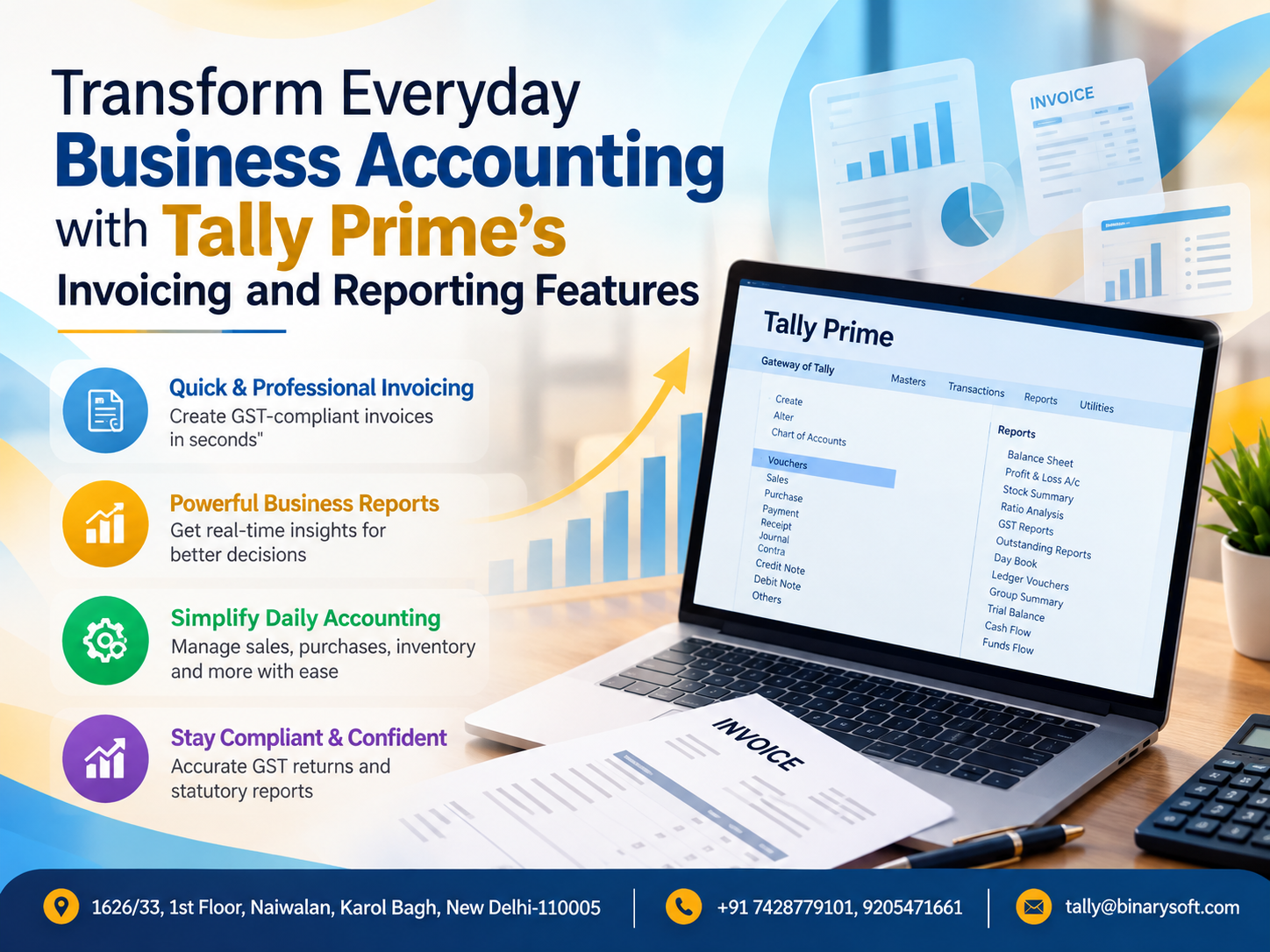
TallyPrime brings invoicing, accounting and reporting together, allowing businesses to maintain connected financial records and obtain useful information from everyday transactions.
With appropriate configuration and regular reconciliation, businesses can improve accuracy, reduce repetitive work and establish more dependable accounting processes.
A Business Owner's Story: When Delayed Accounting Almost Cost a Valuable Customer
Consider the example of Rajesh, a fictional wholesale electrical goods distributor operating in Delhi.
Rajesh had spent more than a decade building relationships with retailers, contractors and commercial customers. His business was growing steadily, but his accounting process had not kept pace.
His employees prepared invoices using spreadsheets, recorded customer payments separately and maintained stock information in another register.
Every evening, Rajesh spent additional hours checking sales figures and following up on outstanding balances.
One afternoon, a long-standing customer contacted him regarding an invoice that appeared unpaid.
Rajesh's records showed an outstanding balance of ₹85,000, but the customer insisted that the payment had already been transferred.
After searching through bank statements and payment records, Rajesh discovered that the amount had been received several days earlier but had not been updated in the customer ledger.
The customer was disappointed.
For Rajesh, the incident was more than an accounting mistake. It threatened a relationship he had worked years to establish.
He realised that inaccurate records could damage customer confidence even when the business itself was performing well.
Rajesh subsequently introduced a more structured accounting process using TallyPrime.
His team began recording sales invoices, receipts, purchases and inventory transactions in one accounting environment. Customer balances became easier to review, and outstanding reports helped identify pending payments.
Over time, Rajesh spent less time searching through disconnected records and more time planning business growth.
The biggest improvement was not simply faster billing. It was the confidence that came from having better-organised financial information.
This illustrative story highlights a common challenge faced by growing businesses: financial visibility becomes increasingly important as transaction volumes rise.
1. Professional Invoicing for Faster Business Transactions
Invoicing is one of the most important activities in daily business accounting.
An invoice communicates transaction details, establishes payment obligations and supports financial and tax records.
TallyPrime enables businesses to create sales invoices while recording the related accounting information.
GST-compliant sales invoicing
Businesses registered under GST can configure relevant tax information in TallyPrime and generate invoices containing applicable details.
Depending on the transaction and configuration, invoices can include:
-
Business name, address and GSTIN
-
Customer details and GSTIN, where applicable
-
Invoice number and date
-
Item descriptions, quantities and rates
-
HSN or SAC information
-
Applicable GST rates and tax amounts
-
Invoice totals and payment-related information
This integrated approach helps reduce repeated data entry.
However, businesses must ensure that GST rates, tax classifications, customer details and invoice settings are correctly maintained.
Different invoicing requirements
TallyPrime supports accounting workflows for businesses with different transaction structures, including cash sales, credit sales and item-based or service-based invoicing.
A retailer may need rapid counter billing, while a distributor may require detailed invoices showing multiple products, quantities and tax classifications.
A service provider may need to record professional fees and applicable taxes without maintaining physical inventory.
Using appropriate invoice configurations allows businesses to adapt their accounting processes to these different requirements.
Better invoice consistency
Standardised invoicing can help maintain consistent information across transactions.
It also makes invoices easier to review, share and reconcile with accounting records.
For businesses processing large numbers of transactions, this consistency can save considerable administrative effort.
2. Integrated Accounting That Reduces Duplicate Work
One of the major advantages of TallyPrime is the connection between business transactions and accounting records.
When a sales transaction is recorded correctly, the relevant ledger balances are updated through the accounting system.
Similarly, purchase, receipt, payment and journal vouchers affect the corresponding accounts.
This reduces the need to manually update several separate records for the same transaction.
Example of an integrated sales transaction
Suppose a distributor sells goods worth ₹50,000 before GST at 18%.
|
Particulars
|
Amount
|
|---|
|
Taxable sales value
|
₹50,000
|
|
GST at 18%
|
₹9,000
|
|
Total invoice value
|
₹59,000
|
Assuming an eligible intra-state sale with CGST and SGST at 9% each, the transaction would reflect ₹4,500 CGST and ₹4,500 SGST.
When the invoice is entered using correctly configured ledgers and tax details, TallyPrime records the accounting impact.
The customer balance also reflects the amount receivable when the sale is made on credit.
This connection between invoicing and accounting helps businesses avoid maintaining duplicate financial records.
3. GST Management and Better Tax Reporting
GST compliance requires accurate transaction recording, correct tax treatment and regular reconciliation.
Businesses must maintain reliable information about outward supplies, inward supplies, input tax credit and applicable tax liabilities.
TallyPrime provides GST-related accounting and reporting capabilities that help businesses organise the information needed for compliance.
GST-related capabilities
Depending on the product release, subscription, configuration and connected services available, businesses can use features supporting:
-
GST-compliant sales and purchase recording
-
Tax classification and calculation
-
GST-related transaction reports
-
Identification and correction of certain data exceptions
-
Review of outward and inward supply information
-
GST return preparation and supported filing workflows
-
Reconciliation activities
Connected GST functionality in supported TallyPrime releases can further assist with activities such as downloading information, reconciliation and return-related workflows.
Nevertheless, accounting software does not eliminate the responsibility to verify statutory requirements.
Businesses should review the applicable GST rules, filing deadlines, invoice requirements and portal records before submitting returns.
Why accurate GST reporting matters
Incorrect GST information can lead to reconciliation differences, delayed return preparation, customer disputes and additional compliance work.
Maintaining accurate records throughout the month is generally more efficient than correcting numerous transactions shortly before a filing deadline.
4. Real-Time Financial Reporting for Better Business Decisions
Financial reports help business owners understand performance, liquidity and financial obligations.
TallyPrime generates accounting reports from recorded transactions, allowing users to review information without manually preparing every statement.
These reports reflect the data entered into the system and should be reviewed for completeness and accuracy.
Profit and Loss Account
The Profit and Loss Account helps businesses understand income, expenses and profitability over a selected period.
Business owners can examine whether sales growth is translating into improved financial performance.
For example, increasing revenue may appear encouraging, but rising operating expenses could reduce overall profitability.
Regular review of the Profit and Loss Account helps identify such situations.
Balance Sheet
The Balance Sheet provides an overview of assets, liabilities and capital at a particular date.
It can help business owners assess their financial position and understand how resources are being financed.
Trial Balance
The Trial Balance summarises ledger balances and supports the review of accounting records.
It is useful during periodic closing, reconciliation and financial statement preparation.
Cash Flow Statement
Cash flow reporting helps businesses understand cash inflows and outflows.
This is particularly valuable for companies that generate substantial credit sales but experience delays in collecting payments.
Outstanding Receivables and Payables
Outstanding reports provide visibility into amounts due from customers and amounts payable to suppliers.
These reports can support payment follow-ups, credit control and cash planning.
5. Managing Customer Receivables and Supplier Payables
Profitable businesses can still experience cash shortages when customer collections are delayed.
For wholesalers and distributors, credit transactions often represent a significant portion of sales.
Without regular monitoring, outstanding balances can accumulate.
TallyPrime provides bill-wise accounting and outstanding reporting capabilities that help businesses track receivables and payables.
Customer receivables management
Businesses can review pending invoices, customer balances and ageing information where the relevant bill-wise details are maintained.
For example, a company may have the following outstanding amounts:
|
Customer
|
Outstanding
|
Overdue period
|
|---|
|
Customer A
|
₹45,000
|
15 days
|
|
Customer B
|
₹72,000
|
30 days
|
|
Customer C
|
₹1,20,000
|
60 days
|
|
Total
|
₹2,37,000
|
|
This information helps the accounts team prioritise collection efforts.
Instead of contacting every customer without a clear plan, the business can focus on older or higher-value overdue invoices.
Supplier payment planning
Payables reports can help businesses monitor upcoming obligations and avoid unnecessary payment delays.
A clear view of supplier balances also supports working capital planning.
However, businesses should remember that outstanding reports depend on accurate invoice allocation, payment entries and reconciliation.
6. Inventory and Accounting Integration
Inventory management is closely connected with business accounting.
When a business sells physical products, the transaction may affect sales revenue, inventory quantities, receivables and tax records.
Managing these elements independently can create inconsistencies.
TallyPrime supports integrated inventory and accounting functions that help businesses maintain better coordination between stock and financial transactions.
Stock item management
Businesses can create stock items with relevant descriptions, units of measurement and other applicable details.
Stock groups and categories
Products can be organised into groups and categories to simplify classification and reporting.
Godown and location management
Businesses maintaining stock at multiple locations can use godown-related functionality to track quantities by location.
Batch and expiry tracking
For suitable products and configurations, batch-related inventory features can help maintain additional stock information.
Stock valuation
Inventory valuation reports help businesses understand the value of recorded stock using the selected valuation method.
Accurate stock information supports purchasing decisions, financial reporting and inventory control.
For example, a distributor can review stock availability before committing to a large customer order.
This reduces the risk of promising products that are not available in sufficient quantities.
7. Banking and Reconciliation Features
Bank transactions form an important part of everyday accounting.
Businesses regularly receive customer payments, make supplier transfers, pay expenses and manage other banking activities.
When bank records and accounting entries are not reconciled, differences may remain unnoticed.
TallyPrime provides bank-related accounting and reconciliation capabilities.
Depending on the supported bank, release and configuration, additional connected banking or statement-related features may be available.
Benefits of regular bank reconciliation
Bank reconciliation helps businesses identify:
-
Receipts not yet recorded in the books
-
Payments requiring verification
-
Duplicate or incorrect entries
-
Bank charges and interest entries
-
Differences between bank statements and accounting records
Regular reconciliation improves the reliability of cash and bank balances.
It also reduces the pressure of identifying several months of discrepancies during year-end closing.
8. Business Reports That Support Smarter Planning
Accounting reports become more valuable when businesses use them for operational decisions rather than viewing them only during tax filing or annual closing.
TallyPrime provides multiple reports that can support business analysis.
Sales analysis
Sales reports can help identify transaction trends and compare performance across selected periods.
Businesses may use this information to evaluate demand patterns and sales activity.
Purchase analysis
Purchase reports support monitoring of procurement transactions and expenditure.
Expense monitoring
Ledger and financial reports help businesses review operating expenses such as rent, salaries, transportation, electricity and administrative costs.
Inventory analysis
Stock-related reports can help businesses review available quantities, movement and valuation.
Cash and bank position
Cash and bank reports help users understand recorded balances and plan near-term financial obligations.
When business owners review these reports regularly, they can identify problems earlier and make decisions using more dependable information.
9. Improving Accounting Efficiency for Small and Medium Businesses
Small and medium enterprises often operate with limited accounting resources.
A single employee may be responsible for sales billing, purchase entries, bank transactions and customer follow-ups.
As business activity increases, the workload can become difficult to manage.
TallyPrime helps centralise many accounting activities, reducing dependence on disconnected records.
A well-organised implementation can improve efficiency through consistent voucher entry, standardised ledger structures, reusable masters and integrated reporting.
Practical daily accounting routine
Businesses can establish a simple routine:
-
Record sales and purchase transactions promptly.
-
Enter customer receipts and supplier payments.
-
Review cash and bank transactions.
-
Check outstanding customer invoices.
-
Verify important inventory movements.
-
Review exceptions and unusual ledger balances.
-
Maintain regular backups and appropriate user access.
This routine supports better data quality and makes financial reports more useful.
10. Better Financial Control Through User Access and Data Management
As businesses grow, more employees may need access to accounting information.
Sales staff may create invoices, accountants may record financial transactions and managers may review reports.
Not every employee needs the same level of access.
TallyPrime provides security and user-access capabilities that can help businesses manage permissions according to responsibilities, subject to the applicable edition and configuration.
Businesses should also establish internal controls for reviewing important entries and protecting financial information.
Important data management practices
Accounting data should be protected through appropriate backups, controlled access and periodic verification.
Businesses should maintain backup copies in secure locations and test recovery procedures when practical.
A backup strategy is especially important because financial records support statutory compliance, customer relationships and business continuity.
11. How TallyPrime Supports Different Industries
TallyPrime can be configured for a wide range of business requirements.
|
Industry
|
Common accounting requirements
|
|---|
|
Retail businesses
|
Sales billing, GST, stock and daily collections
|
|
Wholesale traders
|
Bulk invoicing, receivables, purchases and inventory
|
|
Distributors
|
Customer balances, stock locations and supplier payments
|
|
Manufacturers
|
Inventory, material movements, production-related records and costing
|
|
Service providers
|
Service invoicing, expenses, GST and profitability
|
|
Professional firms
|
Client billing, receipts, expenses and financial reporting
|
|
Trading companies
|
Purchases, sales, stock valuation and outstanding management
|
The suitability of specific features depends on the organisation's workflow and the configuration selected.
Businesses should evaluate their requirements before implementing a new accounting system.
12. Practical Example: From Sales Invoice to Financial Report
Consider a trading company that sells 100 units of a product at ₹800 per unit.
Assume the applicable GST rate is 18%.
|
Transaction details
|
Value
|
|---|
|
Quantity sold
|
100 units
|
|
Selling price per unit
|
₹800
|
|
Taxable sales amount
|
₹80,000
|
|
GST at 18%
|
₹14,400
|
|
Total invoice amount
|
₹94,400
|
When the transaction is correctly recorded in TallyPrime, the relevant sales, tax and customer ledger information is reflected in the accounts.
If inventory is enabled and the stock item is properly configured, the transaction can also update the recorded stock quantity.
The information becomes available for relevant accounting and inventory reports.
Later, when the customer makes payment, the receipt can be recorded against the outstanding invoice.
This illustrates how a single business transaction can connect invoicing, accounting, inventory and reporting.
13. Common Accounting Problems TallyPrime Can Help Address
Many accounting difficulties arise from inconsistent processes rather than the absence of financial information.
Problem: Repeated data entry
When invoices and accounting records are maintained separately, employees may enter the same transaction multiple times.
Improvement: Integrated voucher-based accounting reduces unnecessary duplication.
Problem: Unclear customer balances
Businesses may struggle to determine which invoices remain unpaid.
Improvement: Bill-wise tracking and outstanding reports provide better visibility when maintained accurately.
Problem: Delayed financial reports
Manual consolidation can postpone management reviews.
Improvement: Reports generated from recorded transactions can be accessed more quickly.
Problem: Inventory differences
Separate stock and sales records may create inconsistencies.
Improvement: Integrated inventory accounting supports better coordination between transactions and quantities.
Problem: GST reconciliation pressure
Incomplete or incorrect transaction details can increase compliance workload.
Improvement: Consistent GST configuration, exception review and reconciliation help improve record quality.
14. How to Implement TallyPrime Effectively
Successful accounting software implementation requires more than installing the application.
Businesses should first understand their accounting structure and operational requirements.
Step 1: Review existing accounting processes
Identify how invoices, purchases, payments, inventory and reports are currently managed.
Step 2: Configure company and statutory details
Create the company and enter relevant financial and tax information.
Step 3: Organise accounting masters
Set up ledgers, groups, customer accounts, supplier accounts and other required masters.
Step 4: Configure inventory information
Create stock items, units, groups and locations where inventory management is required.
Step 5: Establish invoicing formats
Configure invoice details according to business requirements and applicable statutory rules.
Step 6: Train employees
Employees should understand correct voucher entry, ledger selection, GST classification and report review.
Step 7: Reconcile opening balances and migrated data
Before relying on the new system, verify opening balances, outstanding bills and inventory quantities.
Step 8: Review reports regularly
Use financial and operational reports to identify errors, monitor performance and support decisions.
A structured implementation can reduce transition difficulties and improve long-term results.
15. Why TallyPrime Can Be Valuable for Growing Businesses
Growing businesses face increasing pressure to maintain accurate financial information.
Higher sales volumes often bring more invoices, customers, suppliers, stock movements and payment obligations.
Without an organised accounting system, these activities can become difficult to coordinate.
TallyPrime offers a connected approach to accounting that can support businesses as their operational requirements expand.
Its value comes from combining routine transaction recording with financial visibility.
For a small retailer, the immediate benefit may be organised billing and stock records.
For a distributor, it may be better management of receivables and inventory.
For a service provider, it may be easier tracking of client invoices, expenses and profitability.
For management, it may be timely access to accounting reports.
The benefits ultimately depend on accurate data entry, suitable configuration, employee training and consistent financial controls.
16. The Future of Business Accounting: Automation, Accuracy and Visibility
Business accounting continues to evolve as organisations adopt digital transactions, connected compliance services and more structured financial processes.
In 2026, businesses increasingly need accounting information that is available when decisions must be made.
Waiting until the end of the month to understand customer dues, cash balances or operating expenses can limit management's ability to respond.
Integrated accounting systems can support faster access to information and reduce the effort required to prepare routine reports.
However, technology alone cannot guarantee accurate financial statements.
Businesses still need appropriate accounting policies, periodic reconciliations, internal controls and professional review where required.
The most effective approach combines accounting software with disciplined business processes.
TallyPrime can play an important role in this approach by helping organisations connect invoicing, transaction recording, inventory and reporting.
Conclusion: Transform Everyday Accounting into Better Business Control
Everyday accounting should help businesses understand their financial position, not simply satisfy recordkeeping requirements.
Accurate invoicing, organised customer balances, dependable inventory records and timely financial reports all contribute to stronger business management.
TallyPrime provides an integrated accounting environment that can help retailers, wholesalers, distributors, manufacturers and service providers manage these responsibilities more efficiently.
From GST billing and ledger management to outstanding reports, inventory accounting and financial statements, its features support better visibility across routine business activities.
For growing businesses, the real opportunity lies in using accounting information proactively.
When transactions are recorded correctly and reports are reviewed consistently, business owners can make better decisions about purchasing, collections, expenses and expansion.
Transforming business accounting is not only about working faster. It is about building reliable financial records, protecting customer relationships and creating a stronger foundation for sustainable business growth.
Powered by Binarysoft Technologies
Authorized Tally Partner
Binarysoft Technologies helps businesses explore TallyPrime accounting, invoicing, GST management, inventory and reporting solutions according to their operational requirements.
For TallyPrime licensing, implementation, training and related assistance, contact:
Location: 1626/33, 1st Floor, Naiwalan, Karol Bagh, New Delhi – 110005, INDIA
Contact us: +91 7428779101, 9205471661
Email us: tally@binarysoft.com
Business hours: 10:00 AM – 6:00 PM, Monday to Friday
Frequently Asked Questions
What are the main invoicing features available in TallyPrime?
TallyPrime supports sales invoicing, GST-related invoice information, cash and credit transactions, item-based billing and integration with accounting records. Specific capabilities depend on configuration and the product release.
Can TallyPrime generate financial reports automatically?
Yes. TallyPrime generates reports such as the Balance Sheet, Profit and Loss Account, Trial Balance, Cash Flow Statement and ledger reports using recorded accounting transactions. The reliability of these reports depends on the accuracy and completeness of the underlying data.
CA. Pankaj Bhadoria brings practical experience in GST, accounting, and business process consulting. He works closely with MSMEs to resolve compliance challenges and improve operational transparency. His articles aim to simplify complex regulations for everyday business use.