Call CA Tally HelpDesk
+91 9205471661,
7428779101
Introduction: Why Integrated Business Accounting Matters More in 2026
In 2026, Indian businesses are facing growing pressure to manage GST compliance, banking transactions, customer payments, inventory movements and financial reporting with greater accuracy and speed. Even a small mismatch between accounting records and GST returns can create reconciliation problems, while delayed bank entries and unpaid invoices can affect working capital. Businesses that continue using disconnected spreadsheets, manual banking records and separate billing systems may struggle to maintain reliable financial information.
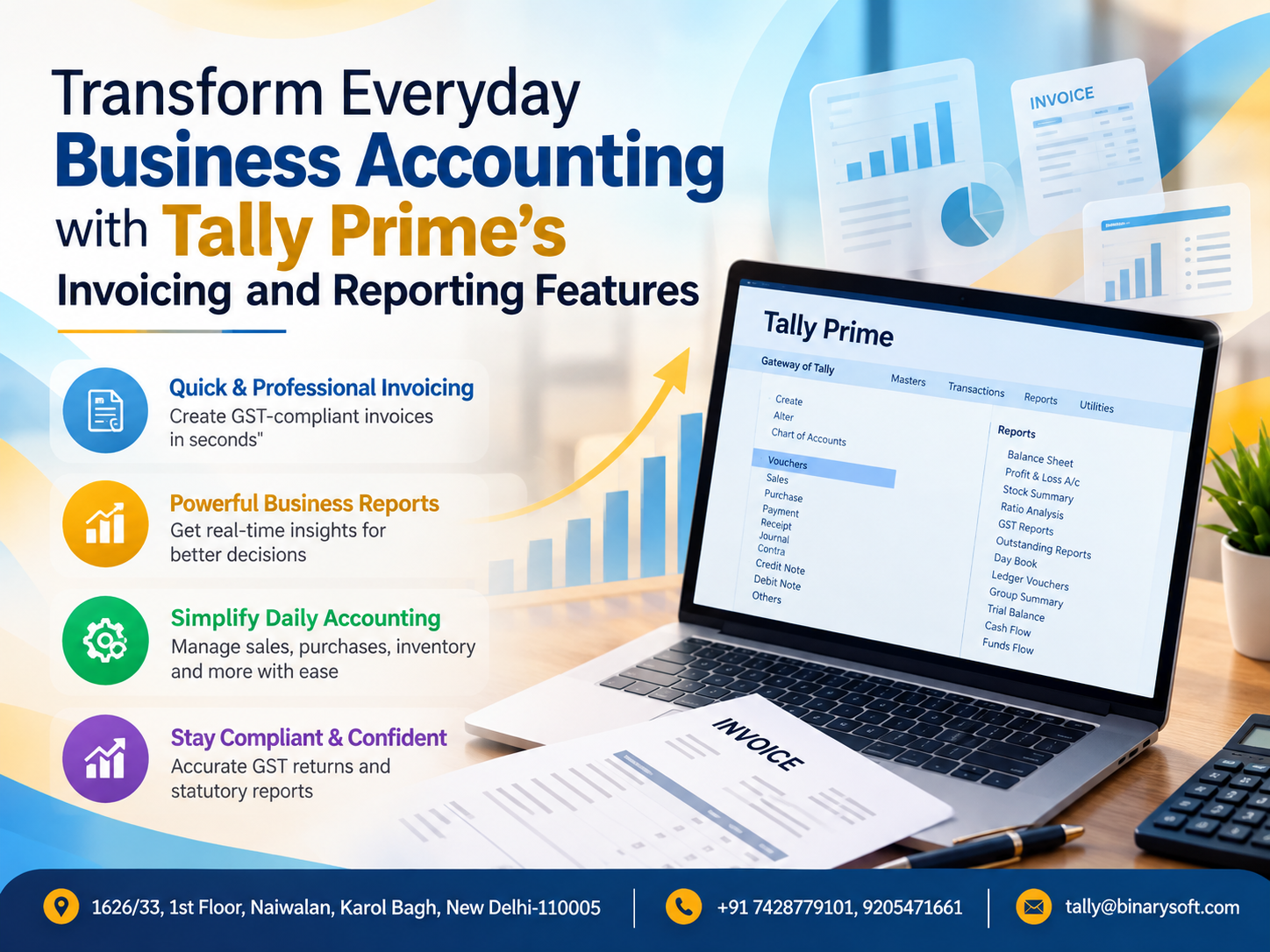
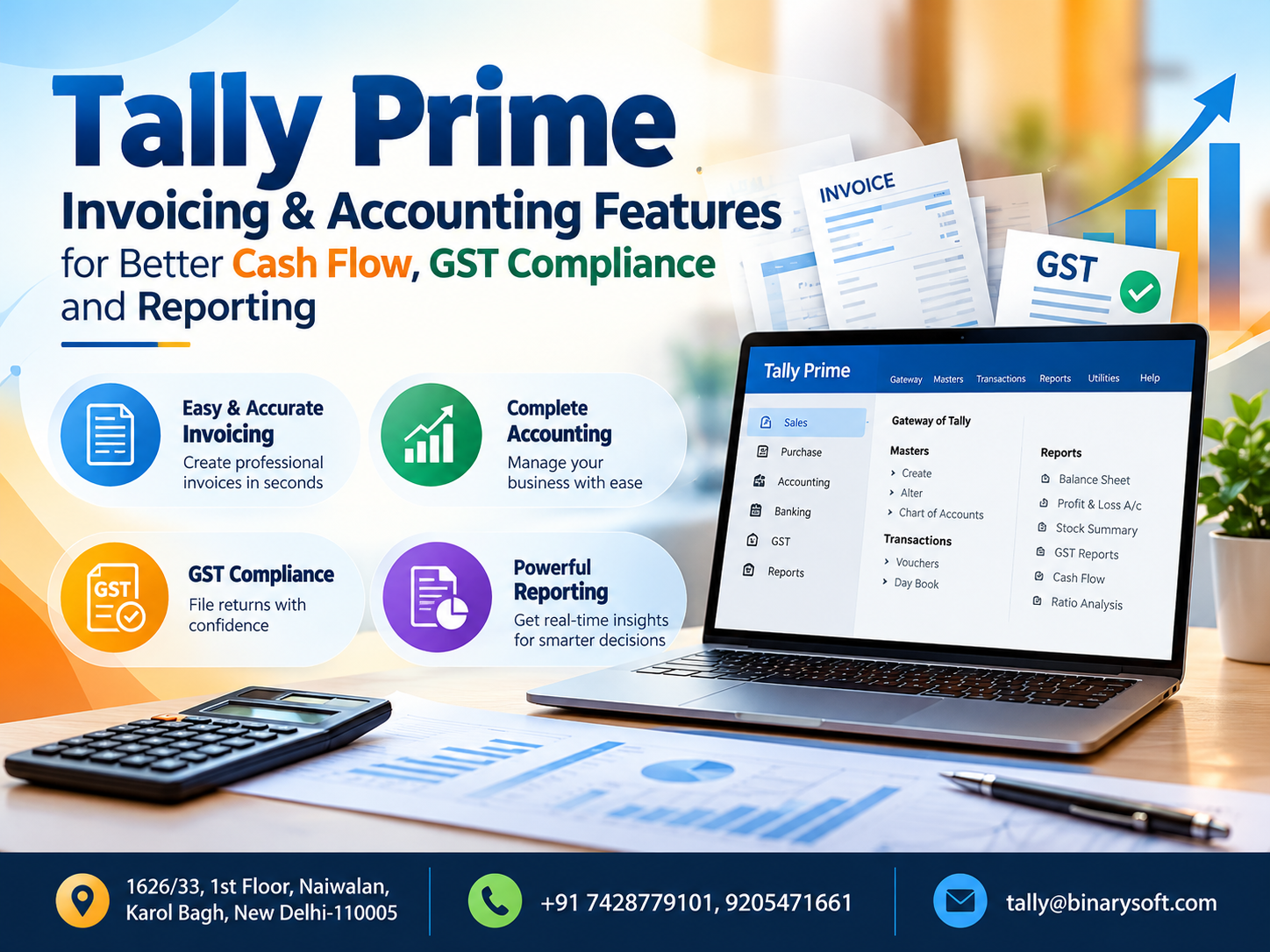
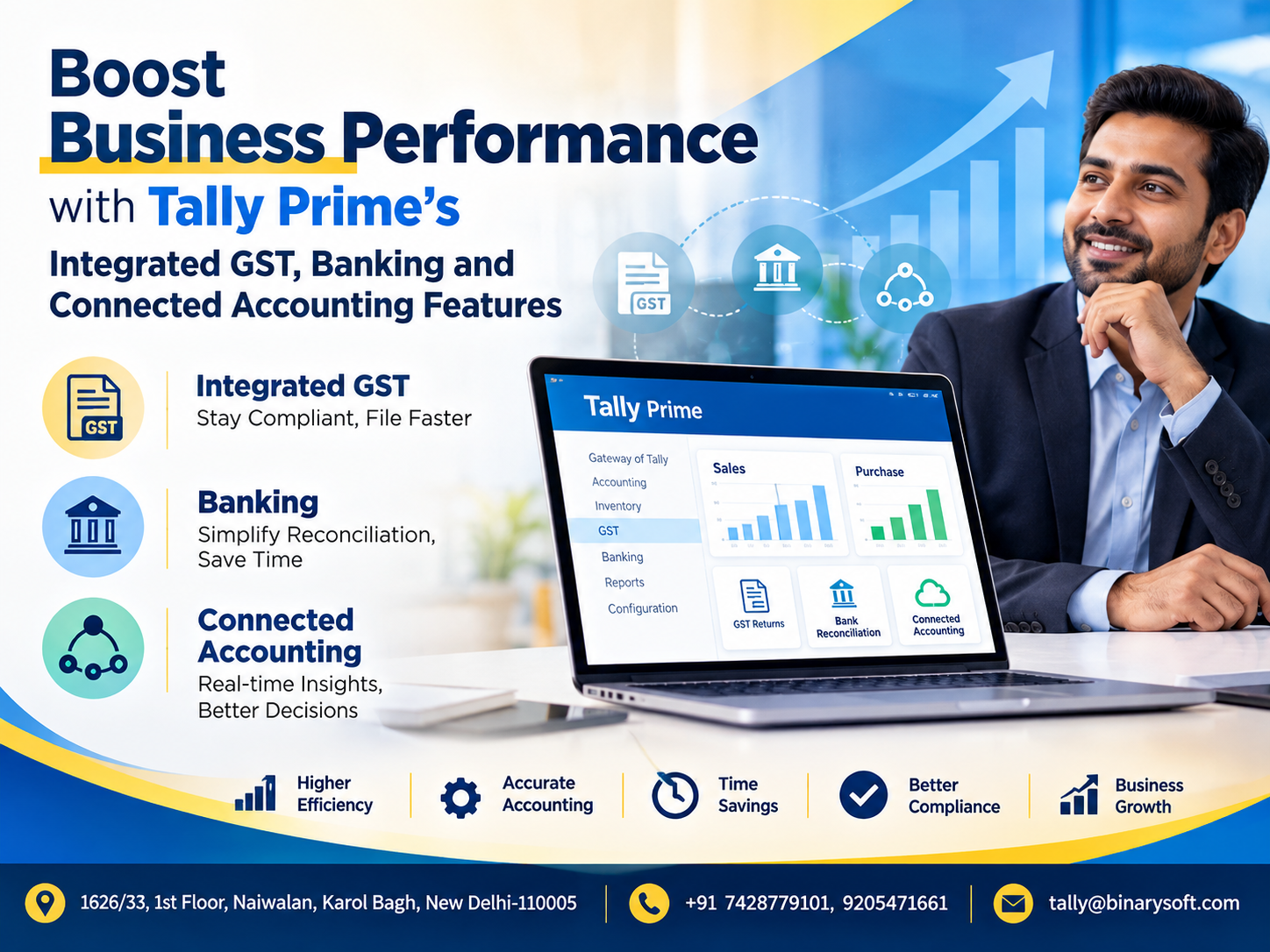
TallyPrime offers an integrated approach by bringing accounting, GST management, banking, inventory control and connected services into a unified business environment. With features such as GST reconciliation, e-invoicing, bank reconciliation, receivables tracking and financial reporting, businesses can reduce repetitive work and improve visibility over daily operations.
For retailers, wholesalers, distributors, manufacturers and service providers, adopting connected accounting processes is becoming an important step toward stronger compliance, better cash flow and sustainable business growth.
1. Understanding Integrated Accounting in TallyPrime
Modern accounting is no longer limited to recording sales, purchases, receipts and payments. Businesses need accurate information that connects financial transactions with statutory compliance, inventory movement, banking activities and management decisions.
TallyPrime is designed to help businesses manage these activities within one accounting system.
Instead of maintaining separate records for GST calculations, bank transactions, stock management and financial statements, businesses can use integrated workflows that connect different operational activities.
For example, when a business records a GST sales invoice in TallyPrime, the transaction can affect several accounting areas simultaneously:
-
Sales revenue and customer outstanding balances.
-
Applicable GST ledgers and tax reporting.
-
Inventory quantities and stock valuation, where inventory is maintained.
-
Financial statements and profitability reports.
-
Receivables and cash flow monitoring.
This integration reduces the need to enter the same information repeatedly.
It also helps business owners obtain a clearer picture of their financial position without depending entirely on manually prepared reports.
2. A Business Owner's Story: From Accounting Confusion to Financial Confidence
Consider the example of Rajesh, a fictional electronics distributor operating in Delhi.
His business was growing steadily, but managing its financial records had become increasingly stressful.
Every month, his accounting team spent several days comparing sales invoices with GST reports, checking bank deposits, following up on customer payments and identifying differences in stock records.
One evening, Rajesh discovered that a major customer's payment had already reached the bank, but the accounting records still showed the invoice as outstanding.
Meanwhile, a purchase invoice required additional verification before its input tax credit could be reconciled.
Rajesh felt frustrated. His business was generating sales, yet he could not confidently determine how much money was available for purchasing new inventory.
He decided to improve his accounting process by implementing TallyPrime with properly configured GST, banking and inventory features.
His team began recording transactions consistently, reconciling bank statements regularly and reviewing outstanding receivables through accounting reports.
Over time, the business experienced fewer manual reconciliation problems and better visibility over customer balances.
The biggest improvement was not simply faster accounting.
It was the confidence Rajesh gained from having more reliable information before making important business decisions.
His experience illustrates an important lesson: business growth becomes easier to manage when accounting information is accurate, connected and available when needed.
3. Integrated GST Management in TallyPrime
Goods and Services Tax compliance is an essential responsibility for registered businesses in India.
Companies must maintain appropriate transaction records, calculate GST accurately, classify supplies correctly and prepare returns according to applicable requirements.
TallyPrime provides GST-related accounting and reporting features that help businesses manage these responsibilities.
GST-compliant sales and purchase recording
Businesses can configure GST details for company records, ledgers, stock items and transactions.
Depending on the transaction and applicable tax rules, GST calculations may involve:
-
Central Goods and Services Tax (CGST).
-
State Goods and Services Tax (SGST).
-
Integrated Goods and Services Tax (IGST).
-
Applicable cess.
-
HSN and SAC classification.
-
Taxable and exempt supplies.
-
Business-to-business and business-to-consumer transactions.
Correct configuration helps reduce calculation errors and supports consistent tax treatment.
GST reports and return preparation
TallyPrime provides reports to review GST transactions and identify potential issues before filing returns.
Businesses can examine transaction classifications, taxable values, tax amounts and exceptions requiring correction.
Depending on the installed release and available connected services, TallyPrime may support GST return downloads, reconciliation and filing-related workflows.
These capabilities can reduce manual effort, although businesses must still review their records and comply with applicable GST rules.
4. GST Reconciliation for Better Compliance and Accuracy
One of the most important accounting challenges businesses face is matching their purchase records with GST information available through the GST portal.
Differences may arise because suppliers upload invoices late, enter incorrect GSTIN details, report different taxable amounts or make errors in invoice numbers.
Such differences can affect input tax credit verification.
How TallyPrime supports GST reconciliation
TallyPrime's GST reconciliation capabilities can help businesses compare relevant accounting information with downloaded GST data.
This allows accounting teams to identify:
-
Purchase invoices missing from available supplier-reported data.
-
Differences in invoice values or GST amounts.
-
Incorrect invoice numbers or dates.
-
Transactions requiring further verification.
-
Supplier-related mismatches that need follow-up.
For example, suppose a business records a purchase of ₹1,00,000 plus ₹18,000 GST.
If the supplier's corresponding invoice is not reflected correctly in the relevant GST data, the accounting team can investigate the discrepancy.
Early identification provides an opportunity to contact the supplier and correct reporting issues before they create further complications.
However, input tax credit eligibility must always be determined according to applicable GST provisions and conditions, not solely on the basis of software reconciliation results.
5. E-Invoicing Integration for Faster and More Reliable Billing
E-invoicing has become an important compliance requirement for businesses that meet the applicable eligibility criteria.
Under India's GST e-invoicing framework, specified invoices are reported to the Invoice Registration Portal, which generates an Invoice Reference Number (IRN) and related information.
TallyPrime supports e-invoicing workflows for eligible businesses, subject to the release, configuration and connected service availability.
Important benefits of e-invoicing integration
Reduced duplicate data entry: Invoice information recorded in the accounting system can be used in the e-invoicing workflow, reducing the need for separate manual preparation.
Improved invoice accuracy: Validations and exception handling can help users identify incomplete or incorrect information.
Faster processing: Businesses can streamline eligible invoice reporting and related documentation.
Better record management: Invoice references and related details can be maintained alongside accounting transactions.
Businesses should verify the applicable e-invoicing turnover threshold, reporting time limits and other requirements from current official GST notifications.
6. E-Way Bill Management for Goods Transportation
For wholesalers, manufacturers, distributors and businesses regularly transporting goods, e-Way Bill compliance can be an important operational requirement.
TallyPrime supports e-Way Bill-related processes that help businesses prepare and manage transportation information.
Depending on the transaction and available connected functionality, businesses may be able to generate or update relevant e-Way Bill information using accounting records.
Important information can include:
-
Supplier and recipient details.
-
Invoice number and date.
-
HSN classification.
-
Taxable value and GST amounts.
-
Transportation details.
-
Vehicle information where applicable.
-
Delivery destination.
Integrated accounting and transportation documentation can reduce repetitive entry and improve coordination between billing and dispatch teams.
7. Banking Integration in TallyPrime for Smarter Financial Management
Banking activities are closely connected with accounting accuracy and cash flow management.
Businesses regularly receive customer payments, pay suppliers, settle expenses, transfer funds and reconcile bank statements.
When these activities are managed manually, delays and recording mistakes can occur.
TallyPrime provides banking and reconciliation features designed to improve transaction visibility.
Bank reconciliation
Bank reconciliation helps compare transactions recorded in company books with transactions appearing in bank statements.
For example, a business may record a customer receipt of ₹75,000, but the bank statement may reflect the amount on a different date.
Similarly, bank charges may appear in the statement without having been recorded in the accounting books.
Reconciliation helps identify such differences.
Depending on the bank, statement format, TallyPrime release and connected banking services, users may have access to bank statement import, transaction matching and additional reconciliation functionality.
Why regular bank reconciliation matters
Regular reconciliation helps businesses identify unrecorded bank charges, missing entries, uncleared payments, duplicate transactions and timing differences.
It also helps accountants maintain more reliable bank balances for financial reporting.
For businesses handling numerous daily transactions, frequent reconciliation can significantly reduce month-end accounting pressure.
8. Connected Banking Services and Payment Management
Connected banking features can help businesses streamline selected banking activities directly from their accounting environment.
The precise services available depend on the supported bank, product release, service activation and eligibility.
Possible workflows include accessing supported banking information, preparing payment instructions and reconciling transactions.
Businesses should distinguish between preparing a payment instruction and successfully completing a bank transfer.
Payment execution, authorization and confirmation remain subject to the bank's applicable processes.
Example of improved payment management
Consider a wholesale distributor that makes regular payments to 30 suppliers.
Without an organized accounting process, the team may need to check separate spreadsheets, verify outstanding amounts and manually update payment records.
With TallyPrime, supplier outstanding reports can help the business identify payments due.
After payments are made and appropriately recorded, the accounting team can reconcile the corresponding bank transactions.
This improves visibility over supplier balances and reduces confusion about which invoices have been settled.
9. Connected Accounting Services: Bringing Business Processes Together
Connected accounting refers to accounting workflows that use integrations and online services to exchange information, validate records or support compliance-related processes.
TallyPrime provides various connected services, depending on product version, configuration and subscription eligibility.
These can include GST-related services, e-invoicing, e-Way Bill functions, supported banking integrations and business communication capabilities.
The major advantage is that users can perform more tasks without repeatedly transferring the same information between unrelated systems.
For example, an accountant may record an invoice, review its GST treatment, use supported connected services for statutory processing and monitor the customer's outstanding balance within the same accounting environment.
This helps establish consistency across accounting operations.
However, connected functionality does not eliminate the need for proper internal controls, authorized access, transaction verification or regular backups.
10. Improve Cash Flow with Receivables and Payables Tracking
A profitable business can still experience financial difficulties if customers delay payments or supplier obligations are not managed properly.
Cash flow management therefore requires more than monitoring sales.
Business owners need to understand when money is expected to arrive and when payments must be made.
TallyPrime provides receivables and payables reporting that helps businesses monitor outstanding amounts.
Receivables management
Businesses can review customer balances, bill-wise outstanding information and overdue invoices.
For example:
|
Customer
|
Invoice Amount
|
Credit Period
|
Payment Status
|
|---|
|
ABC Traders
|
₹85,000
|
30 days
|
Overdue
|
|
Delhi Electronics
|
₹1,25,000
|
45 days
|
Pending
|
|
Sunrise Distributors
|
₹62,000
|
15 days
|
Paid
|
|
Metro Retailers
|
₹1,48,000
|
30 days
|
Partially Paid
|
Illustrative data only.
Such reports help accounting teams prioritize follow-up activities.
Payables management
Payables reports help businesses review supplier obligations and plan payments.
When used effectively, these reports can help avoid unnecessary late-payment problems and improve relationships with suppliers.
Better working capital decisions
By reviewing receivables, payables, bank balances and inventory investment together, management can make more informed decisions about working capital.
For example, before purchasing additional stock, a business owner can examine expected collections and upcoming supplier payments.
This reduces the risk of committing funds without understanding short-term obligations.
11. Inventory Management Connected with Accounting
Inventory management plays an important role in the profitability of retail, wholesale and distribution businesses.
Stock inaccuracies can result in lost sales, unnecessary purchases, excess inventory and incorrect financial reporting.
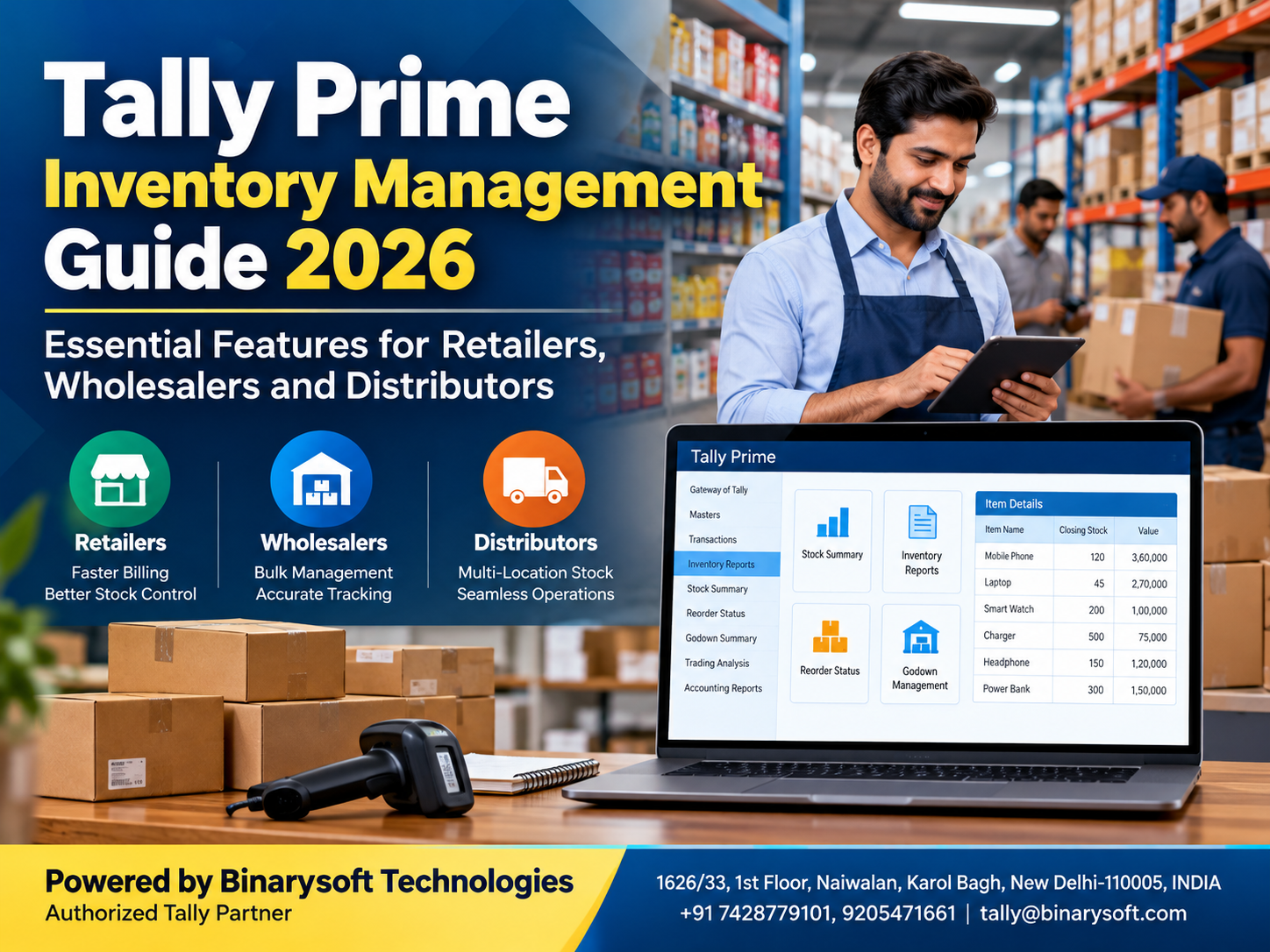
TallyPrime offers inventory accounting features that connect stock movements with business transactions.
These include stock items, stock groups, units of measurement, godowns or locations, and relevant inventory vouchers.
Additional features may support batch tracking, expiry information, reorder analysis and stock valuation according to configuration.
Example: Integrated sales and inventory
A distributor has 500 units of a product in stock.
A customer purchases 80 units.
When the sales transaction is recorded with the appropriate inventory details, TallyPrime can update the stock position.
Illustrative stock movement
This integration helps businesses understand stock availability while maintaining corresponding accounting records.
12. Financial Reporting for Better Business Decisions
Accurate financial reporting is essential for evaluating business performance.
TallyPrime provides accounting reports that help businesses review financial results and operational information.
Important reports include:
-
Balance Sheet.
-
Profit and Loss Account.
-
Trial Balance.
-
Cash and Bank Books.
-
Sales and Purchase Registers.
-
Receivables and Payables.
-
Stock Summary.
-
Cash Flow and Funds Flow reports.
These reports help business owners move beyond basic transaction recording.
For example, a business may experience increased sales but declining profitability.
By reviewing its Profit and Loss Account alongside purchase expenses, stock valuation and operating costs, management can investigate the reasons.
Similarly, a business with strong reported profits but limited available cash can examine receivables and cash flow information to understand possible collection problems.
The real value of integrated accounting is the ability to convert everyday transactions into useful management information.
13. How TallyPrime Helps Reduce Manual Accounting Errors
Manual accounting errors often arise from repeated data entry, inconsistent transaction classification and delayed reconciliation.
Integrated workflows can help reduce these risks.
Consider a business that maintains sales records in one spreadsheet, GST calculations in another and customer outstanding balances in a third.
A single invoice correction may require updates across multiple files.
If one spreadsheet is not updated, reports may become inconsistent.
TallyPrime reduces this fragmentation by maintaining related accounting information within the company data.
However, software cannot automatically correct every mistake.
Businesses should still follow good accounting practices, including appropriate ledger configuration, voucher verification, user access controls, periodic reconciliation and data backups.
Reliable financial information depends on both the accounting software and the discipline of the people using it.
14. Data Security, User Access and Business Continuity
Financial information is one of the most valuable assets of a business.
Accounting data may contain customer information, supplier details, transaction records, bank balances and tax-related information.
Protecting this data is essential.
TallyPrime provides security and user-management capabilities that can help businesses control access to accounting information.
Depending on the edition and configuration, businesses can establish appropriate user permissions and security settings.
Recommended accounting data practices
Businesses should implement strong access credentials, maintain reliable backups, review user permissions and protect computers against unauthorized access.
Backups should be stored securely, and restoration procedures should be tested periodically.
Companies using cloud-hosted TallyPrime environments should also evaluate the hosting provider's security, backup, access management and recovery arrangements.
Cloud hosting and connected services are separate considerations; using TallyPrime's connected features does not automatically mean that company data is stored in the cloud.
15. Benefits of Integrated GST, Banking and Connected Accounting
Businesses that implement TallyPrime effectively may achieve several operational benefits.
|
Business Area
|
Potential Improvement
|
|---|
|
GST Compliance
|
More consistent tax records and easier reconciliation
|
|
Banking
|
Faster identification of unmatched transactions
|
|
Sales Accounting
|
Better invoice and customer balance tracking
|
|
Purchases
|
Improved supplier liability visibility
|
|
Inventory
|
More accurate stock movement reporting
|
|
Cash Flow
|
Better understanding of collections and payments
|
|
Financial Reporting
|
Faster access to updated accounting reports
|
|
Management Decisions
|
Greater visibility over operational performance
|
The actual improvements depend on the quality of data, employee training, software configuration and business processes.
An integrated system works best when organizations use it consistently rather than treating it as a tool only for preparing statutory returns.
16. How Retailers, Wholesalers and Distributors Can Benefit
Different businesses have different accounting requirements.
Retail businesses
Retailers often handle frequent sales, customer returns, cash receipts, digital payments and inventory movements.
TallyPrime can help maintain sales records, track stock and review daily financial activity.
Wholesale businesses
Wholesalers typically manage larger invoices, multiple suppliers, customer credit periods and significant outstanding balances.
Integrated receivables, payables and inventory reporting can help improve control over these activities.
Distribution businesses
Distributors frequently manage stock movement across locations, supplier payments, customer collections and transportation documentation.
TallyPrime can support inventory tracking, financial accounting and applicable GST processes.
Manufacturing businesses
Manufacturers may require raw material tracking, consumption records, production-related inventory movements and cost analysis.
Properly configured accounting and inventory features can help maintain more consistent operational records.
Service businesses
Professional firms and service providers can use TallyPrime for service invoicing, expense management, GST accounting and financial reporting.
The suitability of particular features depends on the organization's actual workflow and reporting requirements.
17. Practical Steps to Improve Business Performance with TallyPrime
Implementing accounting software is only the beginning. Businesses must also establish processes that ensure the system is used effectively.
Step 1: Configure accounting and GST correctly
Create appropriate ledgers, stock masters, tax classifications, bank accounts and company settings. Verify applicable GST information before processing transactions.
Step 2: Record transactions consistently
Ensure sales, purchases, receipts, payments, debit notes and credit notes are recorded promptly and accurately.
Step 3: Reconcile bank transactions regularly
Compare accounting entries with bank statements and investigate differences without unnecessary delays.
Step 4: Review GST reports before filing
Identify incomplete transactions, incorrect tax treatment and reconciliation exceptions before completing applicable compliance processes.
Step 5: Monitor business performance
Review outstanding balances, stock levels, expenses, profitability and cash flow regularly.
Step 6: Train users and protect data
Establish appropriate approval processes, train accounting staff, maintain backups and review access permissions.
18. Why Businesses Should Modernize Their Accounting Processes in 2026
As businesses expand, accounting complexity generally increases.
More customers mean additional invoices and payment follow-ups.
More suppliers create greater purchase and payable management requirements.
Higher transaction volumes increase the importance of reconciliation, accurate reporting and internal controls.
Continuing with fragmented manual systems can make these activities more difficult to manage.
TallyPrime provides a foundation for improving accounting processes by connecting transaction recording, GST management, inventory and financial reporting.
For many organizations, the most meaningful improvement is not the number of software features available.
It is the ability to establish a consistent financial process that supports both day-to-day operations and long-term planning.
Businesses should evaluate their current software release, licensing, connected-service eligibility and operational requirements before activating new functionality.
19. The Role of an Authorized Tally Partner in Successful Implementation
Choosing the right accounting software is important, but implementation and ongoing support also influence the results.
An Authorized Tally Partner can assist businesses with understanding product capabilities, identifying suitable configurations and improving accounting workflows.
Professional assistance may include TallyPrime installation, company configuration, GST setup, inventory management, user training, data migration and troubleshooting.
For businesses planning to use connected GST and banking services, appropriate guidance can help identify prerequisites and reduce implementation difficulties.
Organizations should also review their existing accounting processes before migrating data or changing operational workflows.
A structured implementation can help employees adopt the system with fewer interruptions.
Conclusion
Business performance depends on accurate information, timely compliance, effective cash flow management and reliable financial controls.
TallyPrime brings together accounting, GST management, banking, inventory and connected services to help businesses manage these responsibilities through more integrated workflows.
From GST reconciliation and e-invoicing to bank reconciliation, receivables tracking and financial reporting, its capabilities can help reduce repetitive work and improve operational visibility.
For retailers, wholesalers, distributors, manufacturers and service providers, the objective should not simply be to digitize existing accounting records.
It should be to build a more reliable accounting process that supports better decisions.
With proper configuration, trained users and consistent financial controls, TallyPrime can become an important tool for improving business efficiency, compliance readiness and sustainable growth.
Powered by Binarysoft Technologies
Authorized Tally Partner
Location: 1626/33, 1st Floor, Naiwalan, Karol Bagh, New Delhi – 110005, INDIA
Contact us: +91 7428779101, 9205471661
Email us: tally@binarysoft.com
Business Hours: 10:00 AM – 6:00 PM, Monday to Friday
Binarysoft Technologies provides TallyPrime-related solutions, implementation assistance, accounting software guidance and business support services.
Frequently Asked Questions
What are the main benefits of integrated accounting in TallyPrime?
TallyPrime helps businesses manage accounting, GST, inventory, banking records and financial reporting within a unified environment. This can reduce duplicate data entry, improve accuracy and provide better visibility over business transactions.
Can TallyPrime help businesses manage GST compliance?
Yes. TallyPrime provides GST accounting, tax calculation, reporting and reconciliation capabilities. Supported releases also provide connected GST workflows. Businesses remain responsible for reviewing transactions and complying with applicable GST regulations.
CA. Anand Tirpathi is a Chartered Accountant with experience in statutory compliance, internal controls, and accounting process optimization. He has advised multiple businesses on improving operational efficiency through structured accounting and inventory systems. His writing focuses on clarity, compliance, and risk reduction for MSMEs.