Call CA Tally HelpDesk
+91 9205471661,
7428779101
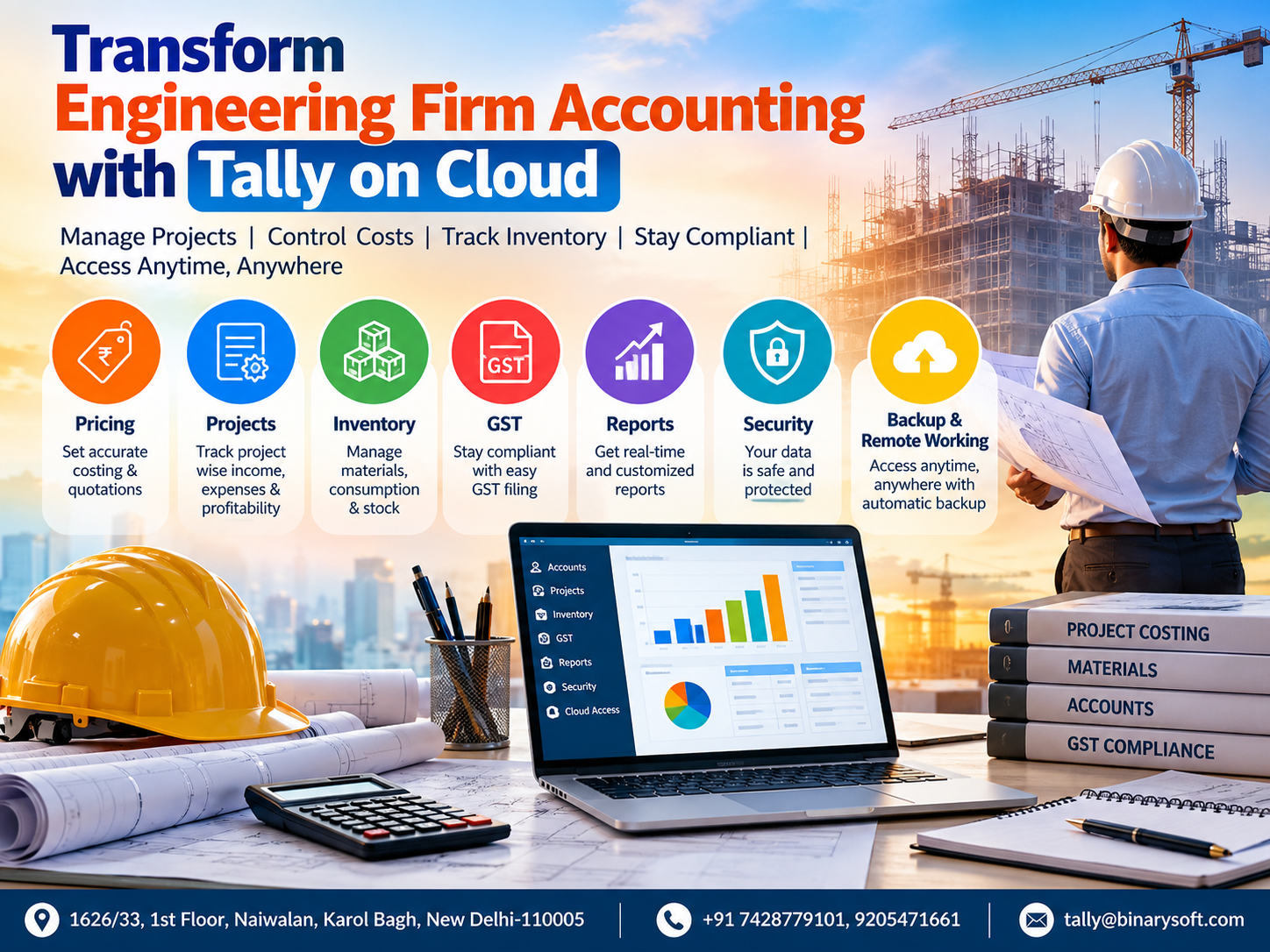
Engineering firms manage far more than routine purchases and sales. Projects, site expenses, raw materials, subcontractors, machinery, GST compliance, receivables and management reporting often need to be controlled simultaneously.
What Changed in 2026: Engineering Firms Need Accounting Beyond the Office
In 2026, engineering firms are operating with increasingly distributed teams, tighter project margins and a growing need for faster access to financial information. Accounts may be maintained at the head office while project managers work from factories, client locations and construction sites. When accounting data remains tied to one office computer or local network, approvals, GST reviews, stock checks and project reporting can become unnecessarily slow. Tally on Cloud addresses this pressure by making the firm's TallyPrime environment accessible remotely through a secure cloud setup. Authorized users can work with accounting, inventory, GST, outstanding receivables and management reports without depending on the physical office system. For engineering businesses handling multiple projects and locations, this can mean quicker decisions, improved coordination, better business continuity and significantly less dependence on manual data sharing.
Why Engineering Firms Need a Different Approach to Accounting
An engineering company rarely has a simple accounting structure.
A typical firm may simultaneously handle:
-
Turnkey engineering projects
-
Equipment manufacturing
-
Installation and commissioning
-
Annual maintenance contracts
-
Fabrication work
-
Electrical projects
-
Mechanical engineering
-
Civil and structural projects
-
Industrial automation
-
Repair and maintenance
-
Spare-parts supply
-
Government and private contracts
-
Subcontracted engineering work
Every activity can generate purchases, sales, inventory movements, expenses, GST transactions, payments and receivables.
The challenge becomes greater when different projects are running in different locations.
Management wants to know whether projects are profitable. The accounts team needs proper vouchers and GST records. Purchase teams need supplier balances. Project managers need cost information. Stores personnel need accurate material records.
This is where combining TallyPrime with a cloud environment can make accounting more accessible and manageable.
A Project Manager's Call That Changed the Way an Engineering Firm Worked
Consider the story of a medium-sized engineering firm handling industrial fabrication and installation projects.
Its accounts department worked from the company's main office. TallyPrime data was stored on the office system.
One Friday evening, the firm's director received a call from a project manager.
A customer wanted immediate confirmation of the outstanding amount before releasing the next project payment. At the same time, the project manager needed approval for an urgent material purchase.
The director was travelling.
The accountant had already left the office.
The latest figures were sitting on the office computer.
What should have been a five-minute decision became a chain of phone calls, spreadsheets, screenshots and uncertainty.
The bigger concern was not the inconvenience. The director realized that a project worth lakhs of rupees could be delayed simply because the right person could not access the latest accounting information at the right time.
The company later moved its Tally working environment to the cloud.
Now the authorized accounts team could access the company's Tally environment remotely. Management could obtain updated reports without waiting for somebody to return to the office.
For the director, the biggest benefit was not simply "working from anywhere."
It was confidence.
Important business information was no longer trapped inside one office computer.
What Is Tally on Cloud?
Tally on Cloud generally refers to using TallyPrime through a remotely accessible cloud-hosted environment rather than restricting its operation to a particular office desktop or local network.
The basic idea is simple.
Your accounting environment is hosted on cloud infrastructure, and authorized users connect to that environment through an internet connection.
Depending on the selected cloud solution and configuration, this can help businesses provide access to accountants, owners and other authorized users working from different locations.
For an engineering firm, this can be particularly useful because operations are frequently distributed among:
Head office
Project sites
Factories
Warehouses
Branch offices
Client locations
Remote employees
Management travelling for business
Instead of continuously transferring files or waiting for office access, teams can work with a centralized environment.
Tally on Cloud Pricing for Engineering Firms
One of the most common questions businesses ask is:
"How much does Tally on Cloud cost?"
There is no single cloud price suitable for every engineering business.
Pricing can depend on several factors, including:
-
Number of users
-
TallyPrime licensing requirements
-
Cloud server configuration
-
CPU and RAM requirements
-
Storage
-
Backup requirements
-
Security configuration
-
Number of companies or datasets
-
Expected workload
-
Remote-user requirements
-
Support requirements
-
Additional applications required on the server
A small engineering consultancy with one or two accounting users may need a very different configuration from a manufacturing and project engineering company with several concurrent users.
Therefore, businesses should compare cloud plans based on requirements rather than choosing solely on the lowest advertised price.
What Should You Check Before Comparing Tally Cloud Prices?
Before selecting a cloud package, determine:
How many people will use Tally?
How many need concurrent access?
How large is your Tally data?
Do you maintain inventory?
How many projects are active?
How many companies are maintained?
Do you require regular backups?
Are users connecting from multiple cities?
How important is technical support?
What server resources are being offered?
What security and access controls are available?
These questions make the pricing discussion much more meaningful.
Project Accounting with Tally on Cloud
Engineering firms must understand not only overall profit but also where money is being spent.
Suppose a company is simultaneously working on:
Project A – Factory electrical installation
Project B – Industrial automation
Project C – Mechanical fabrication
Project D – Plant maintenance contract
Looking only at the total company expenditure may not give management enough information.
Management may need to understand expenses and profitability associated with individual projects.
Depending on the firm's accounting design, TallyPrime features such as cost centres, cost categories, ledgers and reporting structures can help organize and analyse project-related financial information.
With cloud accessibility, authorized users can work with this information without being physically present at the main accounting office.
Track Project Costs More Effectively
Engineering projects can involve numerous costs:
Material purchases
Labour expenses
Transportation
Site accommodation
Subcontractor charges
Machinery rental
Professional fees
Installation expenses
Testing expenses
Travel
Fuel
Consumables
Electrical materials
Mechanical components
Fabrication
Site administration
When transactions are correctly classified, management can obtain a clearer picture of project expenditure.
This can help answer an important question:
"Are we actually making money on this project?"
Revenue alone does not tell the complete story.
A ₹50 lakh project can look impressive until management discovers that material, subcontracting, labour and site expenses have consumed most of the expected margin.
Inventory Management for Engineering Companies
Inventory is another critical area.
Engineering companies may handle hundreds or thousands of different materials, components and spare parts.
For example:
Steel
Cables
Bearings
Motors
Pumps
Electrical panels
Switchgear
Valves
Fasteners
Tools
Consumables
Fabricated components
Electronic components
Safety equipment
Replacement parts
Poor inventory visibility can create two expensive situations.
First, the business purchases materials it already has.
Second, the team assumes an item is available when it is actually out of stock.
Both can affect project schedules and working capital.
Better Visibility into Stock
With properly configured inventory records in TallyPrime, businesses can maintain information relating to stock items and transactions.
Depending on the accounting and inventory configuration, management can review information such as stock quantities, movement and valuations.
Cloud access adds another practical advantage: authorized users can reach the centrally maintained environment remotely.
For a company with a factory in one location and accounts office in another, this can improve coordination significantly.
Engineering Material Procurement and Supplier Management
Purchasing is often one of the largest cost areas for engineering firms.
Imagine a project requiring:
₹12 lakh of electrical material
₹8 lakh of mechanical equipment
₹5 lakh of fabrication
₹3 lakh of cables
₹2 lakh of installation consumables
Even a small procurement mistake can reduce project margins.
Proper accounting helps businesses maintain supplier ledgers, purchase transactions, outstanding amounts and other financial records.
Management can use these reports to understand obligations before approving additional purchases.
GST Compliance for Engineering Firms
GST can become complicated when an engineering company has a mixture of goods and services.
Depending on the business model and transaction, an engineering company may deal with:
Material supply
Installation
Repair services
Maintenance
Consultancy
Fabrication
Equipment sales
Works contracts
Interstate supplies
Local supplies
Input tax credit
Proper transaction classification and accurate accounting therefore become essential.
TallyPrime provides GST-related accounting and compliance capabilities, subject to the company's configuration and applicable statutory requirements.
Cloud access can make collaboration easier because authorized accounting personnel can work with the centralized data environment even when they are not sitting in the office where the original system was previously maintained.
Faster GST Review Before Filing
One common problem appears near a GST filing deadline.
The accountant identifies a transaction that requires clarification.
The project team has the supporting information.
Management must approve a correction.
The accountant may be working remotely.
When everyone depends on separately exchanged files, the process can become confusing.
A centralized cloud environment can reduce unnecessary movement of accounting data between users.
The objective should be simple:
One controlled environment and properly authorized access.
Financial Reports for Engineering Management
A growing engineering business needs more than bookkeeping.
Management needs information.
TallyPrime reports can help decision-makers review different areas of financial performance.
These may include reports relating to:
Profit and Loss
Balance Sheet
Cash Flow
Fund Flow
Receivables
Payables
Stock
Sales
Purchases
Cost centres
Ledgers
Outstanding balances
The exact reports and level of analysis available depend on how the company maintains and configures its accounting data.
Know Who Owes You Money
Receivables are particularly important for engineering businesses.
Project payments may be linked to milestones.
For example:
10% advance
20% after drawing approval
30% after material delivery
20% after installation
10% after commissioning
10% after final acceptance
A project may therefore be profitable on paper while the business still faces a cash shortage.
Outstanding reports can help management identify customers from whom payments remain due.
That information can support better collection follow-ups and cash-flow planning.
Payables and Vendor Planning
The opposite side is equally important.
Engineering firms frequently purchase materials on credit.
Management needs visibility into amounts payable to:
Material suppliers
Equipment manufacturers
Subcontractors
Transporters
Fabricators
Service providers
Understanding receivables and payables together can improve working-capital planning.
For example, if ₹30 lakh is receivable from customers during the next few weeks while ₹22 lakh is due to suppliers, management can plan cash requirements more intelligently than if these figures are maintained across separate spreadsheets.
Remote Working with Tally on Cloud
Remote access is one of the major reasons businesses consider cloud deployment.
An engineering firm's accountant might work from Delhi while the company operates projects in Noida, Gurugram, Jaipur or other locations.
Management may also travel frequently.
A cloud-based environment can allow authorized users to access the hosted setup from supported devices and locations with an appropriate internet connection.
This can reduce dependence on:
Office desktops
Physical data transfer
USB drives
Repeated file copying
Sending accounting files through email
Waiting for someone in the office
Work-from-Home Flexibility for Accounts Teams
Remote working is no longer limited to technology companies.
Accounts teams increasingly require flexibility too.
Situations such as travel, weather disruption, office maintenance, family requirements or temporary remote-working arrangements should not necessarily stop essential accounting operations.
Cloud deployment can support business continuity by allowing authorized users to connect remotely.
However, companies should establish appropriate user access, security policies and working procedures.
Security: A Critical Part of Tally on Cloud
Cloud accounting should never be evaluated only on price.
Security matters.
Engineering firms may store commercially sensitive information including:
Customer details
Supplier information
Project values
Purchase rates
Selling prices
Outstanding balances
Profit margins
Bank-related accounting records
Employee-related financial entries
Management reports
Businesses should therefore ask cloud providers detailed questions about their security practices.
Important areas to examine include:
Access controls
Authentication
Server security
Data protection
Backup policies
Administrative privileges
User management
Infrastructure monitoring
Disaster recovery arrangements
Support access
Control Who Can Access Accounting Data
Not every employee requires access to every financial report.
Management should define access according to job responsibilities.
For example:
Accounts staff may need voucher access.
A senior accountant may need broader financial reports.
Management may require complete reporting access.
Other personnel may need limited or no accounting access.
TallyPrime's security and user-control capabilities, combined with appropriate server and cloud security practices, can help businesses structure access according to their requirements.
Backup: Never Treat Accounting Data as Replaceable
Imagine losing several years of:
Sales invoices
Purchase records
Customer balances
Supplier balances
GST records
Inventory information
Project expenses
Financial statements
Such a loss can disrupt operations severely.
This is why backup planning should be part of the cloud decision from the beginning.
Businesses should understand:
How frequently backups are taken
Where backups are stored
How long backups are retained
Whether multiple backup versions are maintained
How restoration works
Who can initiate restoration
What happens during a server failure
A cloud service should not be selected simply because the word "backup" appears in the package description.
Ask exactly how the backup process works.
Centralized Accounting for Multiple Locations
Engineering businesses often expand geographically before their accounting systems evolve.
A company may have:
Head office in Delhi
Warehouse in Faridabad
Factory in Noida
Project site in Gurugram
Another project in Jaipur
Management travelling between locations
When accounting information is distributed across computers and spreadsheets, consolidation becomes difficult.
A centrally accessible cloud environment can reduce this fragmentation.
Authorized users work with the relevant centralized accounting setup rather than creating uncontrolled copies of the same data.
Reduce Spreadsheet Dependency
Excel remains valuable for analysis, calculations and many business activities.
The problem arises when spreadsheets become an unofficial parallel accounting system.
One employee maintains project expenses.
Another tracks receivables.
Someone else tracks material purchases.
Management maintains another sheet for cash flow.
Eventually, different files show different figures.
The solution is not necessarily to stop using Excel.
It is to define which system is the primary source of accounting information.
For businesses using TallyPrime, accounting transactions should be properly recorded and controlled in the accounting environment, while spreadsheets can be used where appropriate for supplementary analysis.
Faster Decision-Making for Business Owners
An engineering business owner should be able to ask:
What are our current receivables?
How much do we owe suppliers?
Which project is consuming the most money?
What is our current stock position?
What are our major expenses?
What is our profitability?
How much cash is available?
Which customers have overdue payments?
When information is maintained accurately, TallyPrime reports can support these decisions.
Cloud accessibility helps remove the geographical restriction around accessing that accounting environment.
Tally on Cloud for Engineering Manufacturing Companies
Manufacturing-oriented engineering companies can have additional requirements.
They may need to track:
Raw materials
Components
Finished goods
Semi-finished goods
Consumables
Production-related transactions
Purchase costs
Sales
Warehouses or locations
Depending on the organization's processes and TallyPrime configuration, inventory and manufacturing-related capabilities can support these requirements.
The key is correct implementation.
Moving poorly structured accounting data to the cloud does not automatically fix accounting problems.
First design the accounting and inventory structure correctly.
Then use cloud accessibility to make that system easier to reach and operate.
Tally on Cloud for Engineering Consultants
Not every engineering firm manages physical inventory.
Consulting engineering businesses may focus on:
Design
Architecture
Structural engineering
Electrical consulting
Mechanical consulting
Project management
Technical advisory
Inspection
Quality assurance
Engineering documentation
For these organizations, the main requirements may be project income, professional expenses, receivables, GST, banking and profitability.
Cloud accessibility can still be valuable because consultants and directors frequently work from client sites or travel between locations.
Tally on Cloud for EPC and Project-Based Companies
Engineering, Procurement and Construction businesses face particularly complex financial coordination.
They may simultaneously handle:
Customer billing
Vendor purchases
Site expenses
Subcontractors
Inventory
Project costing
Retention amounts
Advances
Outstanding payments
Taxes
Multiple locations
The greater the number of moving parts, the more important centralized financial information becomes.
Management needs an accounting system that provides visibility instead of another information silo.
Cloud vs Traditional Office-Based Tally Setup
A traditional local setup may be perfectly suitable for businesses where accounting is performed entirely from one location.
However, limitations can become noticeable when teams become distributed.
Traditional setup:
Accounting generally remains dependent on the office infrastructure.
Remote working may require additional arrangements.
Hardware maintenance is managed locally.
Access may be geographically restricted.
Cloud-based setup:
Remote accessibility can be easier.
Centralized working can support geographically distributed teams.
Infrastructure responsibilities depend on the cloud provider and selected service.
Backup and security arrangements can be structured as part of the hosted environment.
Neither model should be selected blindly.
The correct option depends on the business's operational requirements.
When Should an Engineering Firm Consider Tally on Cloud?
Cloud deployment may be worth evaluating if your business experiences situations such as:
Management frequently travels.
Accountants need work-from-home access.
Projects operate in multiple cities.
Branches require centralized accounting access.
The company wants to reduce dependency on a particular office computer.
Multiple authorized people need access.
Backup management has become difficult.
Accounting information is repeatedly shared through files.
Management wants easier access to financial reports.
If several of these problems are familiar, a cloud environment may offer practical benefits.
Mistakes to Avoid When Choosing Tally on Cloud
Do not choose solely because the monthly price is low.
Cheap infrastructure that performs poorly during critical accounting periods can cost more in lost productivity.
Do not ignore backup arrangements.
Do not provide unnecessary administrator access.
Do not share passwords among employees.
Do not assume every cloud plan offers identical performance.
Do not move to the cloud without understanding your Tally licensing requirements.
Do not ignore internet reliability at the locations from which users will connect.
Most importantly, do not assume that "cloud" automatically means secure.
Security depends on how the infrastructure, access, backup and operational procedures are designed and managed.
How to Choose the Right Tally Cloud Plan for an Engineering Firm
Start by evaluating your existing business environment.
Document:
Number of users
Concurrent users
Data size
Number of companies
Inventory complexity
Number of active projects
Branches and project locations
Remote-working requirements
Backup expectations
Security requirements
Current TallyPrime licensing
Future growth plans
Then discuss these requirements with an experienced Tally solution provider.
This approach is better than purchasing a generic package and trying to force your accounting operations into it later.
Scalability as Your Engineering Business Grows
Today's two-user accounting requirement can become tomorrow's five-user or ten-user requirement.
A business may win new contracts.
It may open another branch.
It may start manufacturing.
It may hire additional accountants.
It may create another company.
It may expand into another state.
Therefore, ask whether your cloud configuration can be scaled as requirements increase.
A good solution should support the current business without unnecessarily limiting future growth.
Why Implementation Matters as Much as Technology
The cloud server is only one part of the solution.
Successful accounting depends on:
Proper company configuration
Correct ledger creation
Appropriate inventory structure
GST configuration
User permissions
Voucher discipline
Cost-centre structure
Reporting requirements
Backup procedures
Staff training
Support
A powerful cloud server cannot compensate for poorly structured accounting.
For engineering businesses, implementation should begin with understanding how projects, purchases, inventory, expenses and billing actually flow through the organization.
Business Benefits of Tally on Cloud for Engineering Firms
When implemented appropriately, engineering businesses can potentially achieve several operational improvements.
Better remote accessibility
Centralized accounting
Improved coordination between teams
Faster access to reports
Reduced dependence on physical office systems
Improved business continuity
Better backup discipline
Easier support for distributed teams
Improved visibility into receivables and payables
Better project financial monitoring
More convenient management access
The real benefit is not simply putting TallyPrime on a remote server.
The objective is making financial information available to authorized decision-makers when they need it.
From Accounting Software to a Business Management Information System
Engineering firms often initially purchase accounting software because invoices and statutory records need to be maintained.
As the company grows, management expects more.
They want to understand:
Where money is going.
Where profit is coming from.
Which customers owe money.
Which suppliers need payment.
How much stock is available.
How projects are performing.
Whether cash flow is healthy.
Cloud accessibility can help turn the accounting environment into a more readily available source of management information.
But accurate reports still depend on accurate accounting.
The principle remains simple:
Better data creates better reports.
Better reports support better decisions.
Conclusion
Engineering firms operate in an environment where projects, procurement, inventory, subcontractors, GST, payments and deadlines are interconnected. When the accounts department is restricted to one physical office system, obtaining timely information can become increasingly difficult as the company grows.
Tally on Cloud can help remove this location dependency by providing authorized users with remote access to a centrally hosted TallyPrime environment.
For engineering businesses, the benefits can extend beyond remote accounting. Properly implemented, the solution can support project financial monitoring, inventory visibility, GST-related workflows, receivables and payables management, reporting, backup planning and business continuity.
However, the correct cloud solution should be selected based on actual requirements rather than price alone. Number of users, server resources, security, backup, support, Tally licensing and future scalability should all be considered.
The ultimate objective is straightforward: give the right people secure access to accurate business information so that important engineering and financial decisions are not delayed simply because the accounts are sitting on a computer somewhere else.
Frequently Asked Questions
What is Tally on Cloud for an engineering firm?
Tally on Cloud generally means operating TallyPrime in a cloud-hosted environment that authorized users can access remotely. This can be useful for engineering firms whose accountants, management, branches or project teams operate from different locations.
How much does Tally on Cloud cost?
Pricing varies according to factors such as number of users, server resources, storage, data size, backup requirements, security, support and the selected configuration. Engineering companies should obtain pricing based on their actual usage requirements.
CA. Pranav Baheti focuses on financial reporting, GST reconciliations, and accounting controls. He works with growing businesses to structure their accounting information for easier compliance, reporting, and management review.