Call CA Tally HelpDesk
+91 9205471661,
7428779101
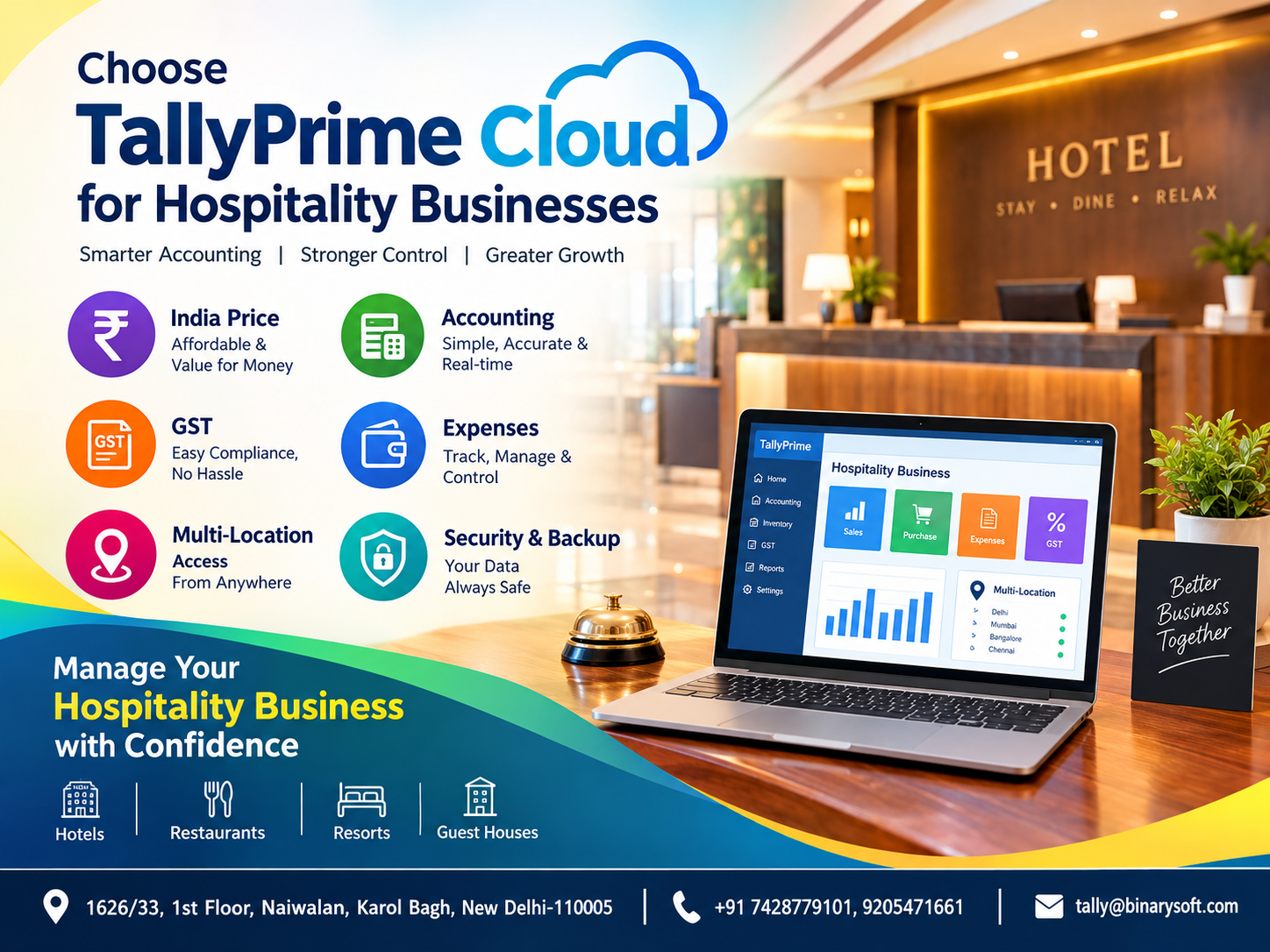
Introduction: Smarter Accounting for India's Growing Hospitality Industry
India's hospitality industry is evolving rapidly. From boutique hotels and luxury resorts to restaurants, cafés, banquet halls, guesthouses and hospitality chains, businesses are increasingly adopting digital technology to improve efficiency and customer satisfaction.
However, behind every memorable guest experience lies a complex financial operation involving room revenue, food and beverage sales, vendor payments, employee salaries, inventory purchases, GST compliance and daily expenses.
Managing these activities through disconnected software, spreadsheets or traditional accounting systems can create delays, errors and unnecessary financial pressure.
This is where TallyPrime Cloud for hospitality businesses becomes a practical solution.
By combining the accounting and reporting capabilities of Tally Prime with cloud-hosted accessibility, hospitality owners can manage financial operations securely from multiple locations without depending entirely on one office computer.
Whether you operate a small restaurant in Delhi, a hotel in Jaipur, a resort in Goa or a multi-location hospitality chain, TallyPrime Cloud can help improve financial visibility, accounting accuracy and operational control.
In this comprehensive guide, we explore TallyPrime Cloud pricing in India, hospitality accounting features, GST management, expense tracking, multi-location access, security, backup and real-world business applications.
1. What Is TallyPrime Cloud for Hospitality Businesses?
TallyPrime Cloud is a cloud-hosted arrangement that allows businesses to access their licensed Tally Prime accounting software through a remotely hosted computing environment.
Instead of installing and operating the software exclusively on a local office computer, businesses can use a suitable cloud server or hosted desktop infrastructure to access their accounting environment over the internet.
This approach is especially beneficial for hospitality businesses that operate across different locations or require continuous access to financial information.
For example, a hotel owner managing properties in Delhi, Agra and Jaipur may want to review financial reports without physically visiting each property.
With an appropriately configured TallyPrime Cloud environment, authorized users can access relevant accounting records and reports remotely.
Key benefits for hospitality businesses
-
Centralized access to accounting and financial information.
-
Remote working facilities for accountants and business owners.
-
GST accounting and tax reporting.
-
Expense and vendor payment tracking.
-
Inventory accounting for food, beverages and supplies.
-
Financial reporting for multiple properties.
-
Role-based access and better data control.
-
Scheduled backups and disaster recovery options.
-
Reduced dependency on a single physical office computer.
Cloud hosting does not automatically connect hotel booking systems, restaurant POS software or property management systems. Such integrations may require compatible connectors, custom development or approved data-import workflows.
2. Why Hospitality Businesses Need Cloud-Based Accounting in 2026
Hospitality businesses face accounting challenges that are different from those of many traditional trading businesses.
A restaurant may process hundreds of small transactions daily, while a hotel may receive payments through online travel agencies, corporate bookings, walk-in guests, advance deposits and digital payment platforms.
Each transaction must eventually be reflected accurately in financial records.
Multiple revenue streams
Hotels and resorts often earn revenue through accommodation, restaurants, room service, events, laundry, conference facilities and additional guest services.
Tally Prime helps businesses maintain appropriate ledgers, sales records and financial classifications for these revenue sources.
Daily operational expenses
Hospitality establishments regularly incur expenses for electricity, housekeeping, food ingredients, maintenance, staff salaries, equipment and vendor services.
Accurate expense classification helps management understand actual operating profitability.
Multiple business locations
When properties operate in different cities, collecting accounting information manually can become difficult.
Cloud-hosted access can reduce delays in financial review and make collaboration between locations easier.
Seasonal business fluctuations
Hotels and resorts often experience significant changes in occupancy and revenue between peak and off-peak seasons.
Reliable accounting reports can help owners prepare cash-flow forecasts, compare expenses and plan operational budgets.
3. TallyPrime Cloud Price in India for Hospitality Businesses
One of the most common questions hospitality owners ask is:
How much does TallyPrime Cloud cost in India?
The total cost depends on the hosting provider, server configuration, number of users, storage requirements, security features, backup arrangements and software licensing.
Unlike a fixed-price software package, cloud hosting is generally offered through monthly or annual subscription plans.
Illustrative cloud-hosting budget in India
The following figures are planning estimates, not verified quotations or official software prices.
|
Cloud hosting requirement
|
Indicative monthly budget
|
|---|
|
Basic hosting for a small establishment
|
₹800–₹1,500
|
|
Small hotel or restaurant team
|
₹1,500–₹3,000
|
|
Multi-user hospitality operation
|
₹3,000–₹6,000
|
|
Larger or customized cloud infrastructure
|
₹6,000+
|
Actual quotations may differ substantially. GST, Tally Prime licensing, user access, backup retention, setup and support may be charged separately.
What influences cloud hosting prices?
Number of users: A small café with one accountant may need fewer computing resources than a hotel chain with several accounting employees.
Server performance: Larger datasets and simultaneous users may require more memory, processing power and storage.
Backup facilities: Automated backups, offsite retention and disaster recovery arrangements can influence the subscription price.
Security: Enhanced authentication, access restrictions and managed security services may involve additional costs.
Technical support: Support hours, response commitments and server maintenance services vary by provider.
Businesses should compare the complete service package rather than selecting a plan solely on the lowest monthly price.
4. How Tally Prime Simplifies Hotel and Restaurant Accounting
Tally Prime provides accounting tools that help hospitality businesses maintain accurate records and prepare meaningful financial reports.
Room revenue and accommodation accounting
Hotels can create separate sales ledgers for room bookings, corporate accommodation, long-stay guests and other services.
Accounting teams can record invoices, advances, receipts, discounts, cancellations and adjustments according to the applicable accounting treatment.
Restaurant and food service accounting
Restaurants can maintain records for dine-in sales, takeaway orders, catering revenue and food delivery settlements.
Where a compatible POS system is available, sales summaries may be imported into Tally Prime through supported data-import methods or integration.
Accounts receivable and corporate customers
Hotels frequently offer credit facilities to corporate clients and travel agencies.
Tally Prime helps maintain party-wise outstanding balances, record receipts and review overdue invoices.
Accounts payable and vendor management
Hospitality establishments depend on suppliers of vegetables, groceries, beverages, cleaning materials, linen and maintenance equipment.
Purchase vouchers, supplier ledgers and outstanding reports help accounts teams monitor payments and manage vendor relationships.
Financial statements
Management can review:
-
Profit and Loss Account.
-
Balance Sheet.
-
Cash Flow and Funds Flow reports.
-
Day Book and Ledger reports.
-
Receivables and Payables.
-
Cost Centre reports.
-
Stock Summary and inventory valuation.
These reports support financial decisions without requiring management to manually combine information from multiple spreadsheets.
5. GST Compliance for Hotels, Restaurants and Resorts
GST compliance is an essential part of hospitality accounting in India.
Hotels, restaurants, banquet halls and catering businesses may be subject to different GST rates and input tax credit conditions depending on the nature of services and applicable classifications.
For example, under the revised accommodation structure effective from September 2025, qualifying hotel accommodation valued up to ₹7,500 per unit per day is generally subject to 5% GST without input tax credit, while accommodation above that threshold generally attracts 18% GST.
Restaurant services outside specified premises generally attract 5% GST without input tax credit, whereas services at specified premises may attract 18%, subject to applicable conditions.
The classification of specified premises also depends on relevant statutory criteria and declarations. Businesses must verify their treatment before configuring tax ledgers.
How Tally Prime helps with GST
GST-compliant invoices: Create invoices with appropriate GST details, tax rates, customer information and transaction classifications.
Purchase accounting: Record taxable purchases and identify input tax credit treatment according to applicable eligibility.
GST reporting: Review GST-related transaction summaries and identify potential errors before return preparation.
Reconciliation: Compare purchase records with available GST information through supported features and workflows.
Multiple GST registrations: Maintain appropriate accounting records for different GST registrations where required.
Audit preparation: Retrieve historical vouchers, invoice details and supporting accounting information for review.
Correct GST configuration is especially important when a hospitality business provides accommodation, restaurant services, banquet facilities and catering under different tax treatments.
6. Expense Management: Control Hospitality Operating Costs
Hospitality businesses operate with numerous recurring and variable expenses.
Even when bookings increase, profitability can decline if expenses are not monitored properly.
Consider a restaurant generating ₹12 lakh in monthly sales. If ingredient costs, staff overtime, food wastage and utility expenses are not controlled, its actual profit may remain significantly below expectations.
Tally Prime can help classify and monitor expenses such as:
-
Food and beverage purchases.
-
Staff salaries and wages.
-
Electricity, water and gas.
-
Housekeeping and laundry.
-
Repairs and maintenance.
-
Property rent and lease payments.
-
Marketing and booking commissions.
-
Kitchen equipment and consumables.
-
Administrative and professional expenses.
Department-wise expense analysis
Cost centres can be configured for departments such as Front Office, Kitchen, Housekeeping, Restaurant and Banquet Operations.
By allocating appropriate expenses to these cost centres, management can compare department-level spending.
This creates greater accountability and helps identify unusual increases in operational costs.
Budget planning
Hospitality businesses can use budgets and variance reports to compare planned expenditure with actual expenditure.
For example, if a hotel's monthly electricity budget is ₹1,20,000 but actual expenditure reaches ₹1,65,000, management can investigate the difference.
Such financial visibility supports better cost-control decisions.
7. Multi-Location Access for Hotel Chains and Restaurant Groups
A hospitality business operating across multiple locations needs timely access to financial information.
Traditional accounting arrangements may require each branch to email spreadsheets or send accounting backups to a central office.
This process can cause delays, duplication and reconciliation difficulties.
With TallyPrime Cloud, authorized users can access hosted accounting environments from different locations.
Example: Three-property hospitality group
Imagine a hospitality group operating three hotels in Delhi, Jaipur and Udaipur.
Each property has its own accounting staff, vendors, revenue streams and operating expenses.
A properly designed cloud setup can allow the accounts team to work on relevant company data while the owner reviews financial reports remotely.
Depending on the business structure, separate companies, branch accounting, cost centres or data synchronization arrangements may be appropriate.
Cloud hosting alone does not automatically consolidate independent company datasets. Consolidation and synchronization must be configured according to business requirements.
Benefits of multi-location accounting
Centralized oversight helps management compare financial performance, monitor outstanding payments, supervise expenses and coordinate with auditors.
It also supports business continuity when an owner or finance manager is travelling.
8. Inventory Management for Restaurants, Hotels and Catering Businesses
Food and beverage inventory directly affects hospitality profitability.
Poor stock management can result in over-purchasing, shortages, expired ingredients, wastage and unnecessary working capital requirements.
Tally Prime supports inventory accounting through stock items, stock groups, units of measurement, purchase entries, stock movements and inventory reports.
Practical applications
A restaurant can create inventory records for rice, flour, cooking oil, vegetables, packaged beverages and other materials.
Purchases can be recorded against the appropriate stock items, while stock consumption and adjustments can be maintained through suitable inventory vouchers.
Stock summaries help management understand available quantities and inventory values.
For detailed recipe costing, automatic ingredient consumption, expiry tracking or real-time kitchen operations, hospitality-specific software or additional integrations may be required.
Combining reliable inventory accounting with proper operational controls can reduce avoidable stock discrepancies.
9. Security and Data Backup: Protecting Hospitality Financial Records
Financial information is among the most important assets of a hospitality business.
Accounting records may include supplier details, customer billing information, payment transactions, salary records and commercially sensitive financial reports.
A damaged office computer, ransomware incident, unauthorized access or accidental deletion can interrupt business operations.
Cloud hosting can improve resilience when supported by suitable security controls and reliable backup policies.
Important security practices
User-based access: Provide individual credentials and appropriate permissions to accountants, managers and auditors.
Restricted financial permissions: Limit access to sensitive transactions and financial reports according to job responsibilities.
Secure remote connections: Use protected access methods and strong authentication wherever available.
Regular updates: Keep operating systems, accounting software and supporting applications updated.
Backup and recovery: Maintain scheduled backups, separate recovery copies and documented restoration procedures.
Activity review: Use available audit and change-tracking facilities to investigate accounting modifications.
Why backup testing matters
A backup is useful only when it can be restored successfully.
Hospitality businesses should periodically test restoration, confirm the completeness of accounting data and ensure that responsible personnel know the recovery procedure.
Some managed cloud arrangements provide automatic backup and restoration facilities, but retention periods, recovery speed and coverage vary by plan.
Before subscribing, confirm whether the provider backs up only accounting data or the entire hosted environment.
10. Case Study 1: A Boutique Hotel in Jaipur Improves Financial Control
Illustrative case study based on common hospitality accounting challenges; not a verified customer testimonial.
A 35-room boutique hotel in Jaipur was experiencing difficulties managing its financial records.
The hotel received bookings through online travel agencies, direct reservations and corporate customers. Its accountant maintained separate spreadsheets for expenses, vendor payments and revenue summaries.
At the end of each month, preparing a complete financial report required several days of reconciliation.
The challenge
The owner struggled to obtain timely information about outstanding corporate payments, housekeeping expenses and food service profitability.
Important accounting data was also stored on a single office computer.
The solution
The hotel adopted a cloud-hosted Tally Prime environment and reorganized its accounting records.
Separate revenue ledgers were created for accommodation, restaurant services and other income. Department-wise cost centres helped classify operating expenses.
The accounts team began reviewing supplier balances regularly, while management gained authorized remote access to financial reports.
Illustrative results
In this hypothetical scenario, monthly reconciliation time decreased from approximately four working days to two days after process improvements and staff training.
The owner could review expenses more frequently and identify unusual spending before month-end.
The main benefit was not simply remote software access. It was improved financial discipline and greater confidence in business decisions.
11. Case Study 2: A Multi-Location Restaurant Business Strengthens Expense Tracking
Illustrative business scenario; figures are examples rather than measured implementation results.
A restaurant group operating four outlets in Delhi NCR faced increasing challenges with vendor payments, ingredient purchases and branch-wise profitability.
Each outlet maintained separate financial records, and the central accounts team frequently received information late.
The challenge
Management could not easily compare food purchases and operational expenses between outlets.
Some suppliers delivered to multiple branches, creating reconciliation difficulties.
The solution
The group implemented a structured Tally Prime accounting process using a suitable cloud environment.
Branch-wise cost centres and expense classifications were introduced. Supplier records were standardized, and daily sales summaries were recorded consistently.
Management also established weekly financial review procedures.
Illustrative results
Suppose the business had monthly operating expenses of ₹20 lakh and identified avoidable costs equivalent to 3%.
That would represent potential savings of ₹60,000 per month, or ₹7.2 lakh annually, if those savings were consistently achieved.
This example demonstrates how better accounting visibility can support cost reduction, although actual savings depend on management action and business conditions.
12. An Emotional Story: The Hotel Owner Who Wanted His Evenings Back
For twelve years, Rajesh had managed a family-owned hotel in Rajasthan.
His father had started the business with just eight rooms, and Rajesh had gradually expanded it into a popular 40-room property.
Guests appreciated the warm hospitality, freshly prepared meals and personal attention.
But behind the welcoming reception desk, Rajesh was constantly worried.
Every evening, after the last guests had checked in, he sat in a small office reviewing bills, supplier payments and handwritten expense records.
His daughter often called from home asking, "Papa, will you come early today?"
Most nights, the answer was no.
The business was growing, but Rajesh felt increasingly disconnected from his family.
One evening, his accountant informed him that the office computer had stopped working. Important accounting records were temporarily inaccessible.
Although the data was eventually recovered, the experience made Rajesh realize how dependent his business had become on one machine.
He decided to reorganize the hotel's accounting operations and move to a properly managed cloud-hosted environment.
With Tally Prime, structured expense records and secure remote access, he could review financial information without remaining in the hotel office until late at night.
The transition required planning, staff training and new working procedures. It did not solve every operational challenge overnight.
But gradually, Rajesh became more confident about delegating routine accounting work.
One evening, he closed his laptop at seven and reached home before dinner.
His daughter smiled and said, "Papa, you're early!"
For Rajesh, that moment represented something more valuable than a financial report.
It represented the freedom to enjoy the life he had worked so hard to build.
This is a fictional story illustrating the human impact of better financial processes and responsible technology adoption.
13. How to Set Up TallyPrime Cloud for a Hospitality Business
Moving hospitality accounting to the cloud requires proper planning to ensure that existing financial records remain accurate and accessible.
Step 1: Evaluate business requirements
Identify the number of hotels, restaurants or outlets, the number of accounting users, existing software, data size and reporting requirements.
Step 2: Select a suitable hosting plan
Compare cloud performance, licensing requirements, storage, access controls, backup facilities and technical support.
Step 3: Prepare existing accounting data
Take a complete backup of the current Tally Prime company data. Review pending transactions and verify important financial balances before migration.
Step 4: Configure the cloud environment
Install or configure the licensed software in the selected hosting environment and restore the company data.
Ensure that the chosen hosting method complies with applicable software licensing conditions.
Step 5: Configure hospitality accounting
Create or review sales ledgers, GST classifications, expense groups, cost centres, supplier accounts and inventory records.
Step 6: Establish security and backup procedures
Assign individual user permissions, configure backup schedules and test the recovery process.
Step 7: Train employees
Provide practical training for accountants and relevant managers on voucher entry, reporting, remote access and data protection.
14. Why Choose Binarysoft Technologies for TallyPrime Cloud?
Choosing the right technology partner is important when implementing cloud accounting for hospitality operations.
Binarysoft Technologies, an Authorized Tally Partner, helps businesses evaluate Tally Prime requirements, understand available accounting features and identify suitable implementation and hosting arrangements.
Hospitality businesses can seek assistance with accounting setup, GST configuration, data migration planning, user access requirements and operational reporting.
The objective is to build an accounting environment that supports everyday business operations while remaining manageable as the organization grows.
15. Conclusion: Build a More Efficient Hospitality Business with TallyPrime Cloud
Hospitality success depends on much more than occupancy rates, restaurant sales or customer satisfaction.
Strong financial management is equally important.
From managing hotel revenue and restaurant expenses to maintaining GST records, monitoring supplier payments and reviewing financial reports, Tally Prime provides valuable accounting capabilities.
When combined with suitable cloud infrastructure, these capabilities can become more accessible to business owners, accountants and authorized teams across multiple locations.
TallyPrime Cloud for hospitality businesses can help reduce dependence on local hardware, improve financial visibility and support better coordination between properties.
However, businesses should carefully evaluate licensing, hosting prices, integration requirements, security arrangements and backup policies before implementation.
For hotels, resorts, restaurants and hospitality groups planning long-term growth, a properly configured cloud accounting environment can be an important step toward more organized and confident financial management.
Contact Binarysoft Technologies
Powered by Binarysoft Technologies
Authorized Tally Partner
Location: 1626/33, 1st Floor, Naiwalan, Karol Bagh, New Delhi – 110005, INDIA
Contact Us: +91 7428779101, 9205471661
Email: tally@binarysoft.com
Business Hours: 10:00 AM – 6:00 PM, Monday to Friday
Contact Binarysoft Technologies to discuss TallyPrime Cloud requirements, hospitality accounting needs and suitable hosting options for your business.
Frequently Asked Questions
What is TallyPrime Cloud for hospitality businesses?
TallyPrime Cloud allows hospitality businesses to use licensed Tally Prime software through a suitable hosted environment. It supports remote accounting access, financial reporting and collaboration between authorized users.
How much does TallyPrime Cloud cost in India?
Pricing depends on the hosting provider, user count, infrastructure, storage and support services. Some cloud-access offerings start at approximately ₹600 per user per month plus GST, while customized hosting packages can cost more. Software licensing may be additional.
CA. Pankaj Bhadoria brings practical experience in GST, accounting, and business process consulting. He works closely with MSMEs to resolve compliance challenges and improve operational transparency. His articles aim to simplify complex regulations for everyday business use.