Call CA Tally HelpDesk
+91 9205471661,
7428779101
Introduction: The Future of Retail Billing in the UAE Is Digital
The retail industry in the United Arab Emirates is undergoing a significant digital transformation. From supermarkets and fashion boutiques to electronics stores, grocery outlets and wholesale-retail businesses, companies increasingly depend on digital technology to manage daily transactions.
As the UAE introduces its national electronic invoicing framework, retailers need to understand how upcoming requirements may affect their billing, accounting and tax compliance processes.
For businesses already using Tally Prime, an important question is:
Can an existing Tally Prime license help a UAE retail business prepare for e-invoicing without purchasing an entirely new accounting system?
The answer depends on the installed software version, license eligibility, available UAE-specific functionality and compatibility with the required e-invoicing service providers.
Tally Prime 7.2 can serve as an important part of a retailer's accounting and digital billing environment. However, businesses should verify whether their specific installation supports the UAE's mandated electronic invoicing integration before assuming that an ordinary software upgrade completes compliance.
UAE e-invoicing is more than generating PDF invoices or emailing bills to customers. It involves structured electronic invoice information exchanged through an approved framework.
For retail businesses, the transition presents an opportunity to improve invoice accuracy, strengthen inventory controls, maintain organized VAT records and reduce repetitive administrative work.
This guide explains the UAE e-invoicing framework, how retailers can prepare Tally Prime 7.2, what an existing license may cover and how digital accounting can support long-term business growth.
What Is UAE e-Invoicing?
UAE e-invoicing is a regulated system for electronically exchanging prescribed invoice information between businesses through an approved digital infrastructure.
Unlike traditional paper invoices or PDF documents, compliant e-invoices use structured, machine-readable data.
The UAE framework is based on a decentralized exchange model involving accredited service providers and the Peppol-based exchange architecture.
Businesses covered by the mandate will need to meet applicable technical, onboarding, reporting and document exchange requirements.
How Is an E-Invoice Different from a PDF Invoice?
|
Traditional Digital Invoice
|
UAE-Compliant E-Invoice
|
|---|
|
May be a PDF or printed document
|
Uses prescribed structured electronic data
|
|
Often shared by email or messaging
|
Exchanged through the approved electronic framework
|
|
May require manual data extraction
|
Designed for automated processing
|
|
Formatting varies between businesses
|
Follows standardized data requirements
|
|
Does not automatically establish mandate compliance
|
Must satisfy applicable UAE e-invoicing specifications
|
A PDF generated through accounting software is useful for ordinary digital billing, but it should not automatically be considered a compliant UAE e-invoice.
UAE E-Invoicing Timeline and Retail Business Applicability
The UAE is implementing electronic invoicing through a phased approach.
The announced framework includes pilot and voluntary implementation beginning in July 2026, followed by mandatory phases based on business revenue and entity type.
Under the published implementation timetable, businesses with annual revenue of AED 50 million or more are scheduled to implement e-invoicing from 1 January 2027, while businesses below that threshold are scheduled for implementation from 1 July 2027. Related accredited service provider appointment deadlines precede implementation.
Retail businesses should verify their classification, exemptions and applicable deadlines against current UAE Ministry of Finance requirements.
An important distinction is that the framework's initial scope generally focuses on covered business-to-business and business-to-government transactions. Ordinary business-to-consumer transactions are excluded from the initial mandate under the announced scope.
Therefore, a retailer selling directly to individual consumers may have different obligations from a retailer supplying goods to VAT-registered companies.
Retailers should not assume that every cash counter receipt requires exchange through the UAE e-invoicing network.
Why UAE Retail Businesses Should Prepare Early
Retail businesses often handle substantial transaction volumes, multiple payment methods and frequent inventory movements.
A poorly organized billing process can lead to incorrect VAT calculations, missing customer details, inventory discrepancies and delayed financial reporting.
Early preparation offers several advantages.
1. Better Invoice Accuracy
Structured customer and product records reduce the possibility of incorrect billing information.
2. Improved VAT Record Management
Organized transaction records help businesses prepare and reconcile UAE VAT information.
3. Faster Accounting Processes
Integrated billing reduces the need to enter the same information into multiple systems.
4. Stronger Inventory Visibility
Retailers can track stock movement alongside sales and purchase transactions.
5. Easier Technology Integration
Preparing customer masters, product classifications and accounting workflows in advance can simplify future integration with accredited e-invoicing providers.
Can UAE Retailers Use Their Existing Tally Prime License?
Businesses already using a valid Tally Prime license may be able to continue using their existing licensed installation, subject to software upgrade eligibility and the functionality available for their UAE deployment.
This can reduce the need to replace a familiar accounting environment.
However, three separate requirements must be considered.
First: Software license eligibility. Confirm whether the existing license is eligible for Tally Prime 7.2 and whether an active Tally Software Services subscription or other entitlement is required.
Second: UAE accounting configuration. Verify that the software supports the retailer's required UAE VAT, invoicing, inventory and reporting workflows.
Third: Regulatory integration. Confirm whether the installed software, an authorized integration or an accredited service provider supports the required UAE structured e-invoicing exchange.
An existing license does not necessarily include third-party service provider charges, custom integrations, onboarding fees or future regulatory functionality.
Businesses should request confirmation of these capabilities before committing to an implementation.
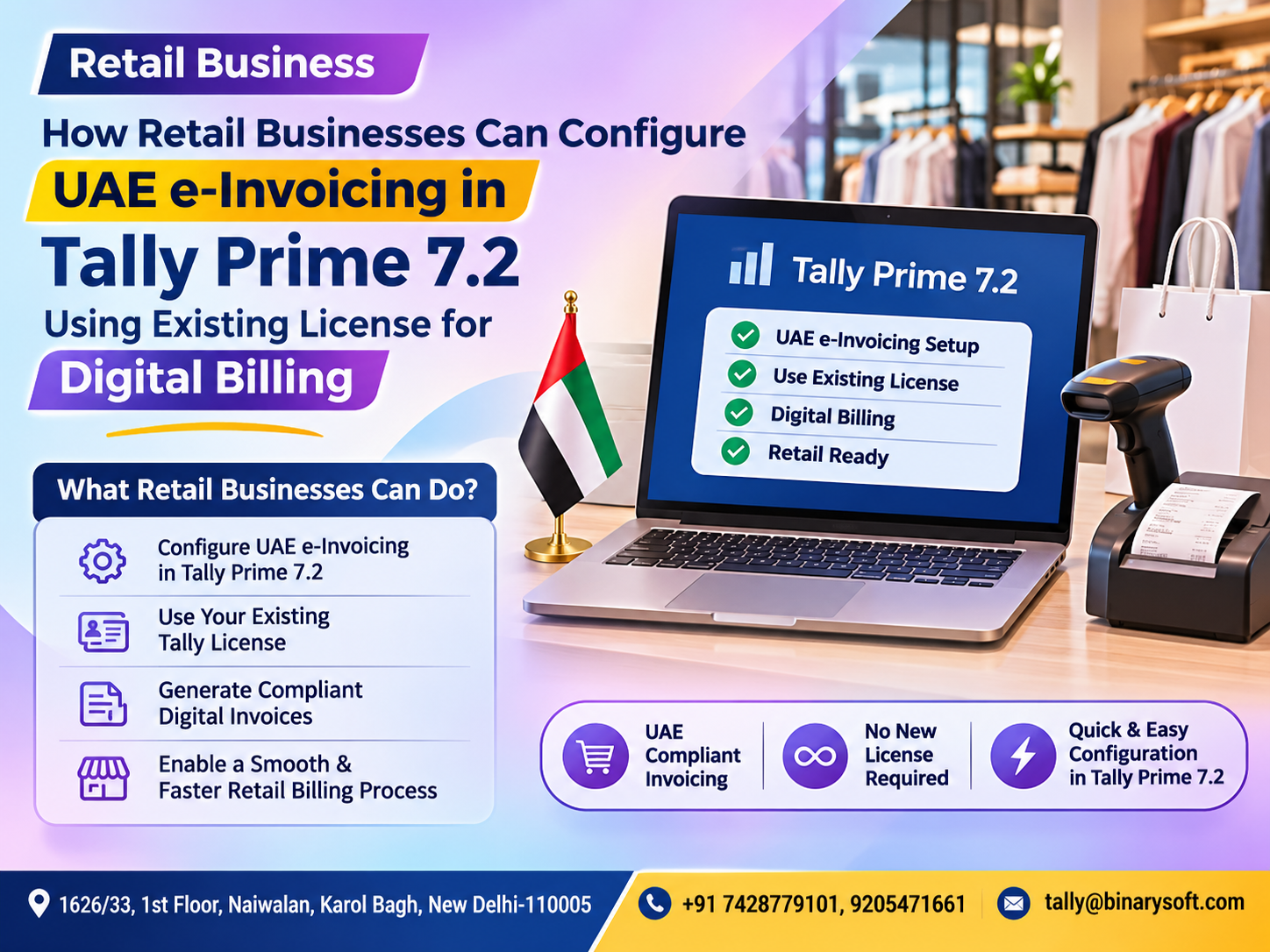
Step-by-Step Guide to Configure UAE e-Invoicing in Tally Prime 7.2
Tally Prime 7.2 provides UAE e-invoicing configuration, registration, invoice exchange and reporting capabilities. Retailers can prepare individual or bulk transactions through the supported workflow.
Step 1: Check Your Existing License
Before making changes, verify these requirements:
-
Valid Tally Prime serial number.
-
Active Tally.NET ID and login credentials.
-
Active TSS subscription.
-
Tally Prime 7.2 installed.
-
Company configured for UAE operations.
-
Relevant VAT TRN or Corporate Tax identification details.
-
Access to the authorized EmaraTax account.
-
Reliable internet connectivity.
An Indian Tally Prime license currently supports UAE e-invoicing registration, but an International license is expected to become necessary for continued registration access. Confirm current licensing conditions before implementation.
Step 2: Back Up Your Company Data
Take a complete backup before updating the software or changing statutory settings.
Confirm that the backup can be restored and retain a separate secure copy.
Step 3: Enable VAT and E-Invoicing
Open your UAE company in Tally Prime 7.2.
Press F11 (Company Features) and review the statutory settings.
Enable VAT and e-Invoicing, where applicable, and specify the appropriate starting date.
The e-invoicing applicable date can be configured from 1 July 2026 onward.
Save the company configuration.
Step 4: Update Company Information
Verify the legal business name, registered address, emirate, country, currency and tax identification information.
For UAE e-invoicing, ensure that the company is configured with AED as its base currency.
Check the Tax Identification Number and other identification details required for electronic exchange.
Step 5: Configure Customer and Supplier Ledgers
Open the relevant party ledgers and update:
-
Legal business name and address.
-
VAT Tax Registration Number, where applicable.
-
Tax Identification Number.
-
City and country.
-
Peppol-related identification details.
-
Digital location and identity information where required.
Correct party information helps prevent rejected electronic invoices.
Step 6: Configure Products, VAT Rates and Units
Review stock items, services and relevant accounting ledgers.
Tally Prime 7.2 includes reports that help users update VAT rates across multiple records and map Units of Measurement to standardized Unit Quantity Codes.
This mapping is important for structured invoice exchange.
For example, a retailer selling electronic accessories may maintain units such as pieces, boxes and cartons. These must be mapped correctly wherever required.
Step 7: Complete E-Invoicing Registration
Use Alt+Z (Exchange) to access the relevant VAT and e-invoicing functions.
Open the e-invoicing login and registration workflow.
Complete the required steps in Tally Prime and through EmaraTax using the authorized business account.
Ensure the business is onboarded with an appropriate Accredited Service Provider.
Step 8: Generate a Retail B2B E-Invoice
Open a Sales voucher and select the business customer.
Enter the product details, quantity, rate, applicable VAT, discounts and additional charges.
Review the party information required for e-invoicing.
Save the voucher and use the supported e-invoicing exchange workflow.
The software can submit eligible transactions to the e-invoicing system and display their processing status.
For ordinary B2C sales, continue following the applicable VAT invoice requirements without assuming that the transaction must enter the mandated B2B exchange process.
Step 9: Generate E-Invoices in Bulk
Retailers supplying multiple corporate customers may process numerous invoices daily.
Tally Prime 7.2 supports individual and bulk e-invoice exchange.
Use the Send for e-Invoicing report to review pending transactions, identify errors and select eligible invoices for processing.
Step 10: Review E-Invoice Status
Use the e-Invoice report to monitor transaction status.
Relevant categories include invoices being processed, successfully generated invoices, rejected transactions and vouchers modified after exchange.
Investigate rejected invoices and confirm successful processing before treating a transaction as completed.
Case Study 1: A Dubai Electronics Retailer Improves B2B Billing
Illustrative case study.
A Dubai electronics retailer operated two outlets selling smartphones, laptops and accessories.
Although most customers were individuals, the business also supplied equipment to offices and corporate buyers.
The accounts team maintained customer information across multiple spreadsheets, making B2B invoice preparation time-consuming.
The Challenge
Employees regularly needed to verify customer tax details, review VAT calculations and coordinate stock information between outlets.
The Tally Prime Approach
The retailer organized its customer masters, configured product categories and reviewed VAT classifications in Tally Prime 7.2.
It also prepared its B2B invoicing process for the UAE electronic exchange framework.
The Outcome
The improved accounting structure helped staff prepare invoices more consistently and monitor stock movement.
Corporate customer records became easier to maintain, while management gained clearer information about sales and outstanding balances.
The example shows how e-invoicing preparation can encourage broader improvements in retail accounting.
Case Study 2: An Abu Dhabi Supermarket Strengthens Inventory and Financial Control
Illustrative case study.
A supermarket in Abu Dhabi managed thousands of products, frequent supplier deliveries and a growing corporate catering supply business.
The owner found it difficult to reconcile inventory movements with daily sales and purchase records.
The Challenge
Different departments maintained separate records, resulting in additional administrative work.
The business also needed to distinguish ordinary consumer sales from transactions potentially covered by the UAE e-invoicing mandate.
The Tally Prime Approach
The supermarket organized stock groups, supplier ledgers, customer records and VAT settings.
Its accounts team began reviewing sales, purchase and inventory reports regularly.
Corporate transactions were assessed separately for e-invoicing applicability.
The Outcome
The supermarket gained more structured accounting records and improved visibility into inventory and supplier balances.
The approach also helped management prepare for future electronic invoice exchange requirements.
A Retailer's Story: How Digital Billing Helped Protect a Family Business
This fictional story reflects the everyday challenges of small retail entrepreneurs.
When Farhan opened his first clothing shop in Dubai, he had one dream: to build a stable business that would provide security for his family.
He worked long hours, carefully selected merchandise and remembered the preferences of his regular customers.
As the business grew, however, managing sales and accounting became increasingly difficult.
Every evening, Farhan stayed behind after closing the shop to review receipts, purchase bills and supplier payments.
His young son often called and asked, "Baba, when are you coming home?"
Farhan always replied, "Soon."
But soon frequently meant another two hours.
One day, a corporate customer requested a detailed invoice for a large clothing order.
The accounts were incomplete, some customer information was missing and the team struggled to prepare the documents quickly.
Farhan realized that his business needed a better system.
He introduced structured billing and inventory management using Tally Prime.
His employees learned to maintain accurate customer records, record sales consistently and review inventory reports.
As UAE e-invoicing requirements developed, Farhan also began preparing his business records for the new digital framework.
Over time, the accounting process became more organized.
One evening, he completed his work earlier than usual.
When he reached home, his son ran toward him.
"Baba, you're early!"
Farhan smiled.
He understood that better business technology was not only about reducing paperwork. It was also about creating time for his family.
For retailers, the real value of digital accounting often lies in these everyday improvements.
Additional Benefits of Tally Prime for UAE Retail Businesses
Beyond e-invoicing, Tally Prime can support important retail management activities.
Inventory management: Track product quantities, stock groups, purchase movements and closing inventory.
VAT accounting: Maintain relevant tax records and review VAT-related reports.
Customer management: Monitor outstanding balances and maintain organized customer ledgers.
Supplier accounting: Track purchases, payments and pending supplier obligations.
Financial reporting: Review Profit and Loss Accounts, Balance Sheets, cash records and other business reports.
Multi-location inventory: Maintain location-wise stock information where configured.
These capabilities help retailers develop better operational discipline while preparing for digital compliance.
Common UAE E-Invoicing Setup Problems
Businesses may encounter issues during implementation.
Incorrect tax identification details, missing party information, invalid VAT classifications or unmapped units can prevent successful invoice exchange.
Authentication and connectivity problems may also interrupt processing.
Retailers should review the relevant error messages, correct the underlying records and verify the transaction status before resubmitting.
Invoices already exchanged should not be casually modified without understanding the required correction process.
UAE E-Invoicing Compliance: Important Considerations
Retailers should distinguish between ordinary VAT billing and mandated structured electronic invoicing.
The current phased framework generally covers relevant B2B and B2G transactions, while B2C transactions remain excluded until a further ministerial decision.
For businesses within scope, the implementation timetable includes:
|
Business category
|
E-invoicing implementation
|
|---|
|
Annual revenue AED 50 million or more
|
1 January 2027
|
|
Annual revenue below AED 50 million
|
1 July 2027
|
|
In-scope government entities
|
1 October 2027
|
The amended deadline for appointing an Accredited Service Provider for the first business category was 30 October 2026. Businesses in the second category must appoint a provider by 31 March 2027.
Businesses should also follow applicable invoice transmission, retention and correction requirements.
The UAE's 2026 amendments provide for electronic invoices and credit notes to be issued and transmitted within 14 business days of the relevant business transaction, subject to the applicable provisions.
Compliance obligations should be reviewed with a qualified UAE tax professional.
Why Choose Binarysoft Technologies for Tally Prime Support?
A successful digital invoicing implementation requires more than installing software.
Businesses need accurate company settings, correctly configured ledgers, employee training and reliable accounting procedures.
Binarysoft Technologies, an Authorized Tally Partner, can assist businesses with Tally Prime licensing discussions, installation, configuration, inventory setup and accounting support.
Retailers can also seek guidance on preparing their existing Tally Prime environment for UAE e-invoicing requirements and identifying additional integration or service-provider needs.
Conclusion: Prepare Your UAE Retail Business for Digital Invoicing with Tally Prime 7.2
UAE e-invoicing represents an important development in the country's digital business environment.
Retailers that prepare early can improve customer information, VAT records, inventory management and accounting processes while reducing the difficulties associated with future compliance changes.
Tally Prime 7.2 provides UAE e-invoicing functionality alongside established accounting and inventory capabilities.
Businesses using an existing license should verify their software eligibility, active subscription, regional licensing requirements and Accredited Service Provider arrangements.
For retailers, the objective should be to create an integrated and dependable billing process rather than simply replacing paper invoices with electronic documents.
With suitable configuration, training and compliance planning, Tally Prime can help UAE retail businesses become more organized and better prepared for digital growth.
Contact Binarysoft Technologies for Tally Prime licensing, UAE accounting configuration and digital invoicing assistance.
Powered by Binarysoft Technologies
Authorized Tally Partner
Location: 1626/33, 1st Floor, Naiwalan, Karol Bagh, New Delhi – 110005, INDIA
Contact Us: +91 7428779101, 9205471661
Email Us: tally@binarysoft.com
Business Hours: 10:00 AM – 6:00 PM, Monday to Friday
Frequently Asked Questions
Can UAE retailers use Tally Prime 7.2 for e-invoicing?
Yes. Tally Prime 7.2 includes UAE e-invoicing configuration, registration, invoice exchange and reporting features. Businesses must complete the required setup and onboarding.
Can I use my existing Tally Prime license?
An eligible existing license may currently support UAE e-invoicing registration. However, International license requirements and active TSS eligibility should be verified before long-term implementation.
Is UAE e-invoicing mandatory for all retail sales?
No. Ordinary B2C transactions are excluded from the initial UAE e-invoicing mandate. Covered B2B and B2G transactions follow the applicable phased requirements.
Does Tally Prime 7.2 support bulk e-invoicing?
Yes. The software supports individual and bulk e-invoice exchange for eligible transactions.
CA. Priya Tanvi specializes in accounting compliance, GST advisory, and business reporting for small and growing enterprises. She works with business owners to improve record-keeping and financial clarity. Her articles focus on practical compliance solutions and operational discipline.