Call CA Tally HelpDesk
+91 9205471661,
7428779101
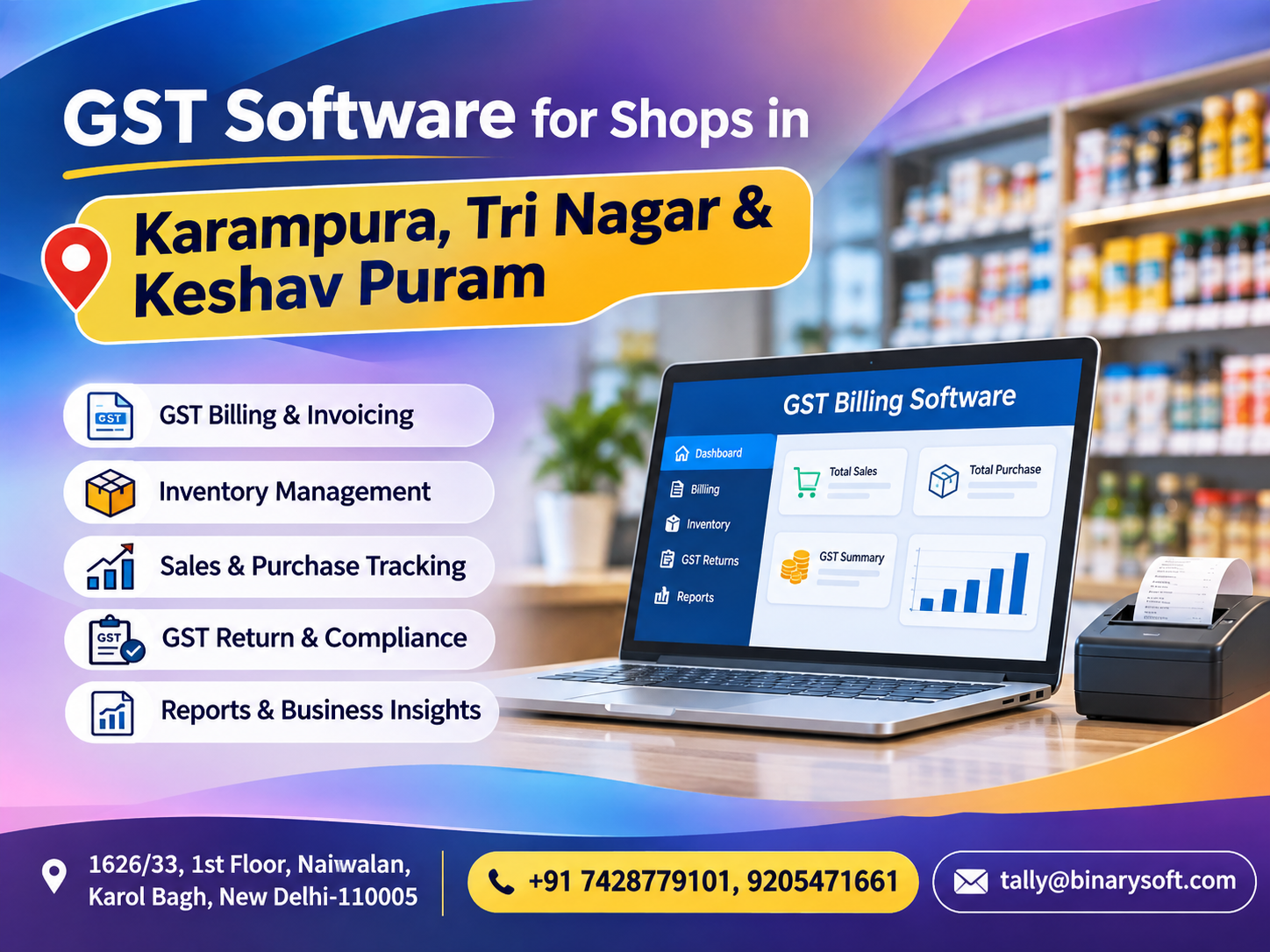
Introduction: Helping Local Shops Grow with Smarter GST Billing and Accounting
Running a successful shop in Delhi requires much more than selling quality products and maintaining good customer relationships. Every shopkeeper must also manage daily sales, purchase bills, stock availability, customer payments, supplier balances and applicable Goods and Services Tax (GST) requirements.
For shop owners in Karampura, Tri Nagar and Keshav Puram, managing these responsibilities manually can become difficult as business transactions increase.
A small billing mistake can affect customer confidence. An incorrect stock record can result in lost sales. Delayed accounting can make GST return preparation stressful and time-consuming.
This is where Tally Prime GST software for shops can make a meaningful difference.
Tally Prime combines accounting, GST billing, inventory management, financial reporting and business controls within a single integrated system. It helps retailers, wholesalers, traders and small businesses organize their financial operations without depending on multiple disconnected applications.
Whether you operate a grocery shop in Karampura, a garment business in Tri Nagar or an electrical goods store in Keshav Puram, Tally Prime can help simplify your everyday business activities.
With professional implementation and support from Binarysoft Technologies, local shopkeepers can adopt digital accounting practices, improve billing accuracy and gain greater visibility into their business performance.
Why Shops in Karampura, Tri Nagar and Keshav Puram Need GST Software
Delhi's local markets support a wide variety of businesses, including general stores, garment retailers, hardware suppliers, electronics shops, stationery dealers, wholesalers and distributors.
Although their products and customers may differ, these businesses face many similar accounting challenges.
1. Managing Daily Sales Transactions
Busy retail shops may generate dozens or hundreds of transactions during working hours.
Recording these transactions manually increases the possibility of calculation mistakes, missing entries and incorrect tax amounts.
GST billing software helps shopkeepers create invoices quickly while maintaining organized sales records.
2. Maintaining Accurate Inventory
Stock management is essential for retailers dealing with multiple product categories.
Without proper inventory records, shopkeepers may face overstocking, product shortages, incorrect stock valuation and unnecessary purchasing expenses.
Integrated inventory software helps businesses track stock movements and identify products requiring attention.
3. Preparing GST Records
GST-registered businesses must maintain appropriate transaction records and meet their applicable compliance obligations.
Manual accounting can make it difficult to reconcile purchases, verify input tax credit and prepare accurate return data.
Tally Prime helps organize GST-related transactions and supports the preparation and reconciliation of applicable GST information.
4. Tracking Customer and Supplier Payments
Retailers often purchase goods on credit and may also extend credit to regular customers.
Without proper tracking, unpaid invoices and overdue supplier balances can create cash flow problems.
Accounting software helps businesses monitor outstanding receivables and payables.
5. Understanding Actual Profitability
A shop may generate substantial sales without earning the expected profit.
Rent, salaries, transportation, discounts, damaged goods and operating expenses affect profitability.
Tally Prime provides financial reports that help shopkeepers understand income, expenses and business performance.
What Is Tally Prime GST Software?
Tally Prime is an integrated business management and accounting application designed to help businesses manage financial transactions, billing, taxation, inventory and reporting.
Instead of maintaining separate registers for sales, purchases, inventory and customer balances, businesses can record transactions in a connected accounting environment.
For GST-registered shops, Tally Prime supports GST-compliant invoicing, tax classification, GST-related reports and reconciliation activities, subject to the business's applicable tax requirements and configured features.
It also provides accounting capabilities for businesses that are not required to register under GST.
The major advantage is that everyday transactions contribute to updated business records.
For example, when a shopkeeper records a sales invoice, the relevant accounting entries and inventory movements can be reflected according to the voucher configuration.
This reduces repetitive data entry and helps maintain more consistent records.
Important Features of Tally Prime for Local Shops
1. Fast and Professional GST Billing
Billing speed is important when customers are waiting at the counter.
Tally Prime allows shopkeepers to create invoices containing relevant customer information, product descriptions, quantities, rates, discounts and applicable taxes.
Businesses can configure invoice formats according to their operational needs.
Important billing capabilities include:
-
GST tax invoices and applicable bill-of-supply formats.
-
Automatic tax calculations based on configured classifications.
-
Item-wise billing with quantity and rate details.
-
Discounts and additional charges.
-
Invoice printing and sharing through supported methods.
-
Sales returns and credit note accounting.
These capabilities help retailers maintain professional billing records and reduce avoidable manual calculations.
2. Inventory Management for Retail and Wholesale Shops
Inventory represents a major investment for many local businesses.
Tally Prime helps shopkeepers organize stock items, stock groups, units of measurement and godown or location-wise inventory.
Businesses can monitor opening stock, purchases, sales, stock transfers and closing quantities.
A garment retailer can organize products by category and maintain stock items for different sizes or designs.
A hardware shop can track electrical fittings, tools, plumbing materials and accessories separately.
Useful inventory reports include Stock Summary, Stock Item Analysis and other relevant inventory views.
With appropriate configuration, businesses can also use batch-wise tracking, reorder levels and additional inventory controls.
3. GST Accounting and Tax Reporting
GST compliance requires accurate transaction classification and organized records.
Tally Prime supports GST accounting for applicable sales and purchase transactions, including relevant CGST, SGST, IGST and cess calculations where required.
Businesses can use GST reports to review transaction details, identify potential exceptions and prepare information needed for filing.
Supported connected GST capabilities may also assist with return-related workflows and reconciliation, depending on the installed version, subscription, configuration and availability of services.
Important: GST returns must still be reviewed and submitted in accordance with current GST portal procedures and applicable statutory requirements.
4. Purchase and Supplier Management
Shops regularly purchase products from manufacturers, distributors and wholesalers.
Tally Prime allows businesses to record purchase invoices, supplier balances, purchase returns and payment transactions.
Supplier-wise outstanding reports help identify pending payments and support better payment planning.
This is particularly useful for businesses working with multiple distributors or purchasing stock on credit.
5. Customer Outstanding and Credit Control
Credit sales are common in many wholesale and business-to-business transactions.
Tally Prime helps businesses maintain customer ledgers, record receipts and monitor outstanding invoices.
Bill-wise tracking can help identify unpaid amounts and overdue balances.
Shopkeepers can use this information to follow up with customers and reduce the risk of delayed collections.
6. Banking and Cash Management
Daily cash and banking activities are essential parts of shop accounting.
Tally Prime supports cash receipts, payments, bank transactions, transfers and bank reconciliation.
Depending on the banking features and integrations available, businesses may also benefit from bank statement import and additional banking automation.
Maintaining accurate cash and bank records helps shopkeepers understand available funds and identify discrepancies.
7. Financial Reports for Better Decisions
Tally Prime provides business reports such as:
-
Profit and Loss Account.
-
Balance Sheet.
-
Cash and Bank Books.
-
Sales and Purchase Registers.
-
Receivables and Payables.
-
Stock Summary.
-
Day Book and Ledger Reports.
These reports help shopkeepers evaluate business performance, control expenses and make informed purchasing decisions.
How Tally Prime Helps Different Types of Shops in Delhi
Every retail business has different operational requirements. Tally Prime can be configured to support a wide range of business activities.
GST Software for Grocery and General Stores in Karampura
Grocery shops often handle numerous products with different selling prices and applicable tax treatments.
Tally Prime helps maintain item-wise sales, purchase records, inventory balances and accounting information.
Shopkeepers can organize products into categories and review stock movement to identify frequently purchased items.
Accurate stock records also help reduce unnecessary purchasing and improve working capital management.
GST Billing Software for Garment Shops in Tri Nagar
Garment retailers frequently manage different sizes, colors, designs and seasonal collections.
Tally Prime allows businesses to organize inventory items and maintain appropriate stock classifications.
Retailers can record sales, purchases, discounts, customer balances and stock movement.
With suitable inventory configuration, garment businesses can improve visibility into product availability and seasonal stock.
Accounting Software for Electrical and Hardware Shops in Keshav Puram
Electrical and hardware businesses may deal with hundreds of products, multiple suppliers and frequent credit transactions.
Tally Prime helps maintain item-wise inventory, supplier ledgers, customer outstanding balances and purchase records.
Business owners can review product sales and inventory reports before placing new purchase orders.
This supports better stock planning and reduces dependence on handwritten registers.
Case Study 1: A Garment Shop in Tri Nagar Improves Inventory and Billing Accuracy
Illustrative case study based on common retail business challenges.
A family-owned garment shop in Tri Nagar was experiencing difficulties managing seasonal inventory and daily sales records.
The business maintained handwritten sales registers and used spreadsheets to track purchases.
During busy shopping periods, employees sometimes struggled to locate available sizes and confirm product quantities.
The owner also found it difficult to calculate accurate monthly profitability.
The Challenge
The shop faced several operational problems:
-
Differences between physical stock and recorded inventory.
-
Delays in preparing customer invoices.
-
Difficulty identifying slow-moving garments.
-
Incomplete customer payment records.
-
Time-consuming monthly accounting work.
The Tally Prime Approach
The business adopted a structured accounting and inventory workflow using Tally Prime.
Garments were organized into stock groups, with separate stock items for relevant product variations.
Sales and purchase vouchers were recorded regularly, and customer balances were maintained through accounting ledgers.
The owner began reviewing stock summaries and financial reports to understand business activity.
The Business Benefits
The improved process made it easier to locate stock information, review customer dues and understand purchasing requirements.
The owner could identify products requiring replenishment and avoid ordering items without first checking available stock.
More organized records also simplified communication with the accountant during GST return preparation.
The important lesson is that digital accounting can improve business control even for a traditional neighborhood shop.
Case Study 2: A Hardware Store in Keshav Puram Strengthens Credit Management
Illustrative case study showing how integrated accounting can support a growing trading business.
A hardware store in Keshav Puram supplied electrical accessories, plumbing materials and construction-related products to local customers and contractors.
A significant portion of its sales involved credit transactions.
The owner maintained customer dues in separate notebooks, while supplier payments were tracked through bank statements and handwritten notes.
As transaction volumes increased, identifying overdue payments became increasingly difficult.
The Challenge
The store struggled with delayed customer collections, inconsistent payment tracking, inventory shortages and uncertainty about available cash.
The owner needed a system that connected sales, purchases, inventory and outstanding balances.
The Tally Prime Approach
The store introduced Tally Prime for sales billing, purchase accounting, inventory records and customer ledger management.
Bill-wise accounting helped identify unpaid invoices, while supplier outstanding reports supported payment planning.
The owner also began reviewing cash, bank and stock reports regularly.
The Business Benefits
The new workflow provided clearer information about receivables and supplier obligations.
Staff could check inventory availability more easily, while the owner could prioritize collection follow-ups.
Instead of relying entirely on memory and handwritten records, the business could use updated accounting reports to make decisions.
This example demonstrates how proper credit control can support financial stability without requiring a business to become significantly larger.
A Shopkeeper's Story: From Late-Night Accounting Stress to Peace of Mind
The following fictional story illustrates a situation familiar to many small-business owners.
For more than fifteen years, Rajesh had operated a small general store in Karampura.
His shop was more than a business. It represented years of hard work, family sacrifices and the hope of providing a better future for his children.
Every morning, Rajesh opened his shutters before the market became busy. He greeted regular customers, negotiated with suppliers and carefully managed household expenses.
But after closing the shop, another responsibility awaited him.
He had to calculate daily sales, review purchase bills, update customer dues and prepare records for his accountant.
Some evenings, the work continued late into the night.
His daughter often asked him to spend time with the family, but Rajesh would reply, "Just a little more work. I need to finish the accounts."
One month, while preparing his GST records, he discovered that several purchase invoices were missing from his register.
He spent hours checking old papers and calling suppliers.
The experience made him realize that his business had grown beyond the accounting methods he had used for years.
Rajesh decided to introduce digital billing and accounting.
After learning how to record sales, purchases and inventory in Tally Prime, he gradually developed a more organized daily routine.
Invoices were easier to locate. Customer balances were clearer. Stock information became more accessible.
Most importantly, he no longer needed to reconstruct an entire month's transactions from scattered papers.
One evening, after reviewing his accounts, Rajesh closed his computer and joined his family for dinner.
His daughter smiled and said, "Papa, you finished early today?"
Rajesh smiled back.
For him, technology was no longer just about billing or accounting. It was about creating more time for the people who mattered most.
The lesson: Good accounting software cannot eliminate every business challenge, but it can reduce unnecessary administrative work and help shopkeepers focus on customers, growth and family.
How to Start Using Tally Prime GST Software for Your Shop
Adopting Tally Prime does not require a shopkeeper to change every business process immediately.
A planned implementation can make the transition easier.
Step 1: Understand Your Business Requirements
Identify the activities that need improvement, such as GST billing, inventory, customer dues, purchase accounting or financial reporting.
Step 2: Create Your Company
Set up the company in Tally Prime using the appropriate business name, financial year, accounting details and statutory information.
Step 3: Configure GST Details
Where applicable, enter the correct GST registration information and configure relevant tax settings.
GST rates, HSN or SAC classifications and tax treatments should be verified before billing begins.
Step 4: Create Stock Items and Ledgers
Organize products into suitable stock groups and create ledgers for customers, suppliers, expenses, cash and bank accounts.
Step 5: Enter Opening Balances
Record verified opening inventory, customer dues, supplier balances and other relevant financial information.
Step 6: Start Daily Billing
Begin recording sales, purchases, receipts and payments through the appropriate vouchers.
Step 7: Review Reports Regularly
Monitor stock, receivables, payables and financial performance.
Step 8: Maintain Backups and Security
Configure suitable user permissions, maintain reliable backups and periodically verify data integrity.
GST Compliance Considerations for Local Shopkeepers
GST software is most useful when businesses maintain accurate records and apply the correct tax rules.
Shopkeepers should ensure that invoice details, tax classifications, customer GSTINs where applicable, and purchase records are properly maintained.
Regular taxpayers may need to prepare GSTR-1 for outward supplies and GSTR-3B for tax liabilities and eligible input tax credit, according to their applicable filing requirements. Composition taxpayers follow different requirements.
Businesses should also reconcile purchase information with relevant GST portal records before claiming input tax credit.
GST registration requirements, return frequency, e-invoicing applicability and tax treatment depend on the business's circumstances and current law.
Properly configured accounting software supports compliance, but it does not replace professional tax review.
Why Choose Binarysoft Technologies for Tally Prime in Delhi?
Choosing the right accounting software is only one part of improving business operations.
Correct implementation, data organization, user training and ongoing technical assistance are equally important.
Binarysoft Technologies, an Authorized Tally Partner, provides Tally Prime-related assistance for businesses seeking more organized billing and accounting processes.
Shops in Karampura, Tri Nagar, Keshav Puram and surrounding Delhi areas can contact Binarysoft Technologies to discuss their business requirements.
Support requirements may include Tally Prime licensing, software installation, GST configuration, inventory setup, data migration, employee training and troubleshooting.
Businesses interested in remote accounting access can also discuss suitable cloud deployment options, along with internet connectivity, security, backup and access-control requirements.
A properly planned implementation helps shopkeepers adopt software with greater confidence.
Benefits of Choosing Tally Prime for Small and Growing Shops
Tally Prime can help businesses build more disciplined financial processes.
Some of the most valuable benefits include faster invoice preparation, organized purchase and sales records, improved inventory visibility, clearer customer outstanding information and easier access to financial reports.
Integrated accounting can also reduce duplicate data entry when transactions are recorded correctly.
For a small shop, these improvements can free up valuable administrative time.
For a growing wholesale or retail business, they can provide the information needed to manage additional products, customers and suppliers.
The objective is not simply to replace handwritten registers with a computer.
It is to create a dependable accounting system that supports better everyday business decisions.
Conclusion: Make Your Shop More Efficient with Tally Prime GST Software
Running a successful shop in Karampura, Tri Nagar or Keshav Puram requires accurate billing, disciplined inventory management, organized accounting and reliable financial information.
Manual processes may work when transaction volumes are limited, but they often become difficult to maintain as a business grows.
Tally Prime brings GST billing, accounting, inventory and financial reporting together in one business management environment.
Whether you own a garment store, grocery shop, electrical business, hardware outlet or wholesale trading firm, the software can be configured around your operational requirements.
With the right implementation and consistent daily accounting practices, shopkeepers can reduce administrative difficulties, improve financial visibility and make more informed decisions.
If you are looking for GST software for shops in Karampura, Tri Nagar or Keshav Puram, contact Binarysoft Technologies to discuss a suitable Tally Prime solution for your business.
Powered by Binarysoft Technologies
Authorized Tally Partner
Location: 1626/33, 1st Floor, Naiwalan, Karol Bagh, New Delhi – 110005, INDIA
Contact Us: +91 7428779101, 9205471661
Email: tally@binarysoft.com
Business Hours: 10:00 AM – 6:00 PM, Monday to Friday
Frequently Asked Questions
Which is the best GST software for shops in Karampura, Delhi?
Tally Prime is an established option for shops requiring integrated GST billing, accounting, inventory tracking and financial reports. The best choice depends on the shop's transaction volume, budget and operational needs.
Can I use Tally Prime for my garment shop in Tri Nagar?
Yes. Tally Prime can manage garment sales, purchases, inventory categories, customer balances and accounting records. Suitable stock-item configuration can help organize different product variations.
Is Tally Prime suitable for hardware shops in Keshav Puram?
Yes. Hardware and electrical shops can use Tally Prime for item-wise inventory, supplier accounts, customer outstanding balances, purchase management and financial reporting.
Can Tally Prime generate GST invoices automatically?
Tally Prime can calculate applicable GST amounts during invoice preparation when tax settings, product classifications and transaction details are configured correctly.
CA. Devansh Rathi works closely with wholesalers, distributors, and growing enterprises on taxation, reconciliations, and financial controls. His approach emphasizes accurate records, timely compliance, and efficient accounting systems.