Call CA Tally HelpDesk
+91 9205471661,
7428779101
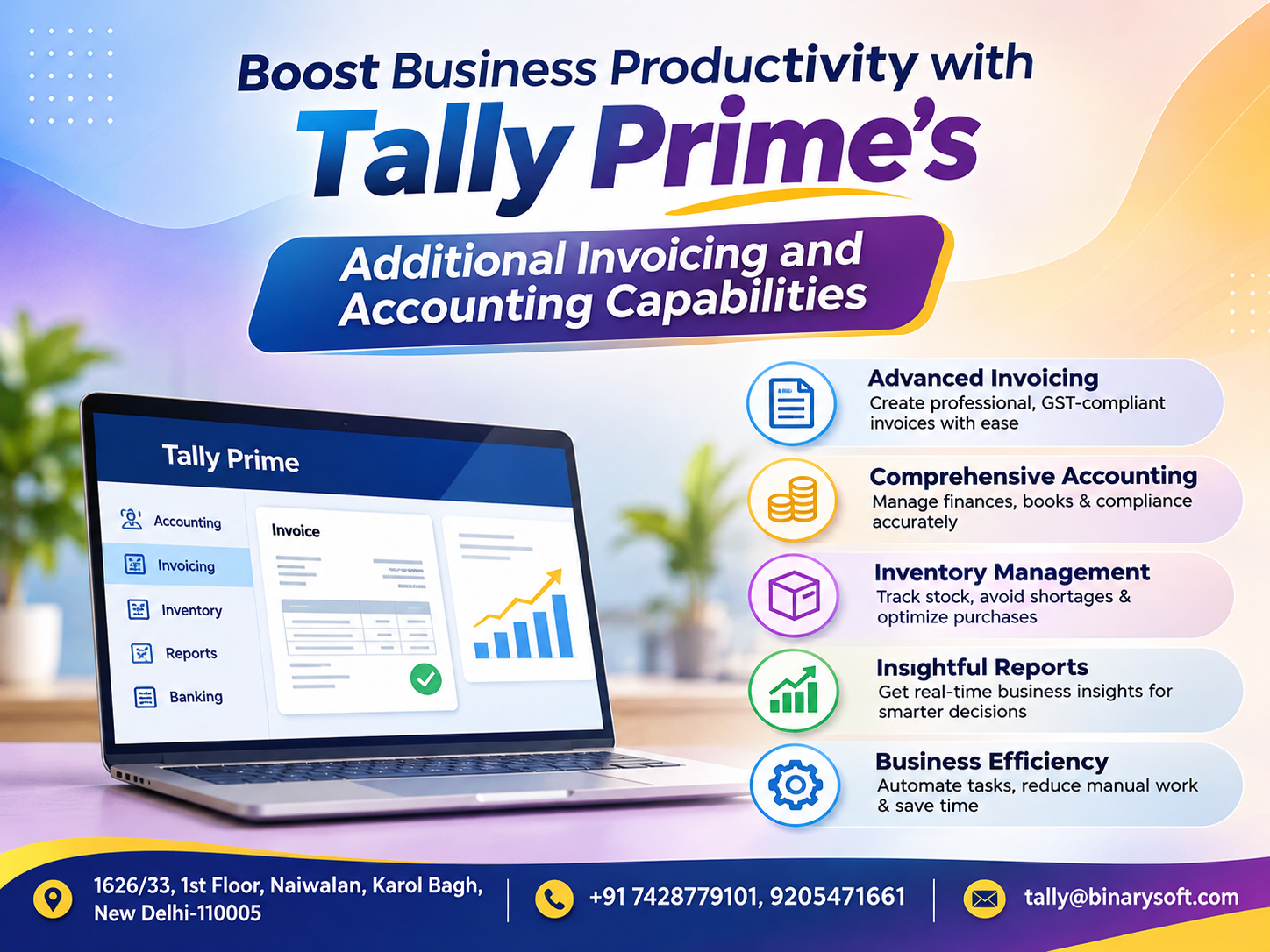
Why Modern Businesses Need Smarter Invoicing and Accounting
Running a successful business requires much more than selling products or providing services. Every transaction, invoice, customer payment, purchase, expense and financial report contributes to the overall health of an organisation.
Yet many Indian businesses continue to spend valuable hours managing repetitive accounting activities, correcting billing mistakes, following up on outstanding payments and preparing financial reports manually.
Imagine a business owner who completes a successful sales day but spends the entire evening checking invoices, reconciling payments and calculating outstanding balances. Instead of planning expansion, building customer relationships or exploring new opportunities, valuable time disappears into administrative work.
This is where Tally Prime's additional invoicing and accounting capabilities can make a meaningful difference.
Tally Prime helps businesses bring billing, accounting, inventory, taxation, banking and reporting activities into a connected environment. Its flexible invoicing options, bill-wise accounting, cost-centre tracking, banking tools and business reports can reduce repetitive work and improve financial visibility.
For wholesalers, retailers, manufacturers, service providers and growing MSMEs, these capabilities support faster everyday operations and more informed decision-making.
This article explores how Tally Prime can improve business productivity, simplify accounting workflows and help entrepreneurs focus on growth rather than paperwork.
1. Understanding Tally Prime's Additional Invoicing Capabilities
Invoicing is one of the most important activities in any business.
An invoice records a commercial transaction, communicates payment expectations and supports accurate accounting.
However, different businesses require different billing formats and processes.
A retail store may need quick invoices, while a distributor may require detailed product descriptions, discounts, delivery information and customer-specific terms.
Tally Prime offers flexible invoicing features that help businesses accommodate these requirements.
Customisable invoice formats
Businesses can configure invoice details according to their operational needs.
Depending on the invoice type and configuration, invoices can include business information, customer details, item descriptions, quantities, rates, discounts, tax information and payment terms.
A properly designed invoice improves readability and reduces confusion between buyers and sellers.
Multiple invoice modes
Tally Prime supports different approaches to recording sales transactions, including item-based invoicing and accounting-oriented invoicing.
This flexibility is particularly useful for businesses dealing with both goods and services.
For example, a computer dealer may sell hardware products while also charging customers for installation or maintenance services.
The appropriate invoice mode helps maintain clear transaction records.
Faster invoice preparation
Businesses can maintain customer ledgers, stock items, units of measurement and applicable tax details in advance.
During billing, users can select existing records rather than repeatedly entering the same information.
This reduces unnecessary typing and helps standardise invoice preparation.
2. Simplify GST Billing and Tax Compliance
GST invoicing is an essential requirement for many Indian businesses.
Incorrect tax classification, incomplete customer information or calculation mistakes can create additional work during return preparation and reconciliation.
Tally Prime supports GST-related accounting and invoicing through appropriately configured tax features.
Businesses can maintain GST registration information, item classifications, tax rates and relevant transaction details.
How Tally Prime helps
When a GST sales invoice is recorded, the software can calculate applicable taxes based on the configured transaction details.
Businesses can review GST-related reports, identify certain inconsistencies and prepare information needed for compliance activities.
Where supported by the applicable release, subscription and service configuration, connected GST capabilities can further assist with return-related workflows.
Practical example
A Delhi-based wholesaler sells goods worth ₹50,000 before tax, with an applicable GST rate of 18%.
The invoice calculation would be:
|
Particulars
|
Amount
|
|---|
|
Taxable value
|
₹50,000
|
|
GST at 18%
|
₹9,000
|
|
Invoice total
|
₹59,000
|
For an eligible intra-state transaction, the tax may be split into CGST and SGST according to applicable rules.
Tally Prime can help calculate and record these amounts when the transaction is configured correctly.
Businesses must still verify GST classifications, eligibility, rates and current statutory requirements.
3. Manage Sales Orders, Delivery Notes and Purchase Transactions
For many businesses, invoicing is only one stage of a larger commercial process.
A customer may first place an order, followed by product dispatch, invoice generation and payment collection.
Tally Prime supports order-processing and inventory-related workflows that help businesses maintain clearer records across these stages.
Sales order management
Sales orders help businesses record customer requirements before invoicing.
A wholesaler can maintain information about ordered products, quantities, delivery expectations and customer details.
This supports better coordination between sales and warehouse teams.
Delivery notes
Delivery notes can record the movement of goods associated with customer deliveries.
Where the workflow is configured appropriately, businesses can link relevant order, delivery and invoice transactions.
Purchase order management
Purchase orders help businesses communicate procurement requirements to suppliers and monitor purchasing activities.
These capabilities are especially useful for distributors and manufacturers handling frequent transactions.
By maintaining connected transaction records, businesses can reduce repeated data entry and improve order visibility.
4. Improve Payment Tracking with Bill-Wise Accounting
Outstanding payments are among the most common challenges faced by Indian MSMEs.
A business may generate strong sales but still experience cash-flow pressure because customers delay payments.
Tally Prime's bill-wise accounting capabilities help businesses monitor receivables and payables more systematically.
Customer outstanding management
Businesses can maintain invoice-wise payment information and review outstanding balances.
For example:
|
Customer
|
Outstanding amount
|
Payment status
|
|---|
|
Customer A
|
₹45,000
|
Within credit period
|
|
Customer B
|
₹78,000
|
Overdue
|
|
Customer C
|
₹32,000
|
Partially paid
|
This information helps accounting teams identify which customers require payment follow-up.
Supplier payment management
The same approach can help businesses review amounts payable to suppliers.
By monitoring payment obligations, managers can plan cash requirements and avoid unnecessary delays.
Benefits of bill-wise tracking
Bill-wise accounting supports clearer customer statements, improved collection planning, accurate payment allocation and better cash-flow visibility.
Instead of relying on separate registers, accounting teams can review relevant balances within Tally Prime.
5. Banking and Bank Reconciliation Made Easier
Banking transactions form a major part of everyday accounting.
Businesses receive customer payments, transfer funds to suppliers, pay expenses and manage multiple bank accounts.
Manually comparing bank statements with accounting records can be time-consuming.
Tally Prime provides banking and reconciliation capabilities that help businesses review bank transactions and identify unmatched entries.
Bank reconciliation
Bank reconciliation compares transactions recorded in accounting books with transactions appearing in bank records.
For example, a payment may have been recorded in the books but may not yet appear as cleared in the bank statement.
Reconciliation helps identify such differences.
Bank statement processing
Depending on the supported bank, file format, software release and enabled services, businesses may be able to import bank statements and use assisted transaction-matching or accounting workflows.
These capabilities can reduce manual entry and improve reconciliation efficiency.
However, imported transactions should be reviewed before they are accepted into financial records.
Business impact
More efficient bank reconciliation can help accountants identify missing transactions, detect duplicate entries and maintain more reliable bank balances.
For businesses handling hundreds of monthly payments, even small improvements in reconciliation time can make a substantial difference.
6. Cost Centres and Cost Categories for Better Expense Control
Understanding total business expenses is important, but understanding where those expenses originate is even more valuable.
Tally Prime supports cost-centre accounting to help businesses allocate relevant income and expenses to departments, projects or business activities.
For example, a company may create cost centres for Sales, Marketing, Administration and Operations.
Management can then analyse expenses associated with these functions.
Project-wise accounting
Service businesses can use cost centres to track expenses associated with individual projects.
A consultancy firm handling several assignments may allocate employee travel, professional expenses and other relevant costs to the appropriate projects.
This helps management evaluate project-level financial performance.
Better budgeting decisions
When business owners understand departmental or project expenses, they can identify areas requiring cost control.
Cost-centre reports support financial analysis, although their accuracy depends on correct allocation during transaction entry.
7. Additional Invoicing Features That Save Time
Beyond standard billing, Tally Prime provides several useful capabilities for businesses handling complex transactions.
Actual and billed quantities
Businesses sometimes deliver additional quantities without charging customers for every unit.
For example, a promotional offer may provide 11 products while charging for only 10.
Tally Prime supports separate actual and billed quantities, helping businesses maintain accurate stock movement and invoice values.
Zero-valued transactions
Businesses can record eligible transactions involving free samples or promotional goods without assigning a selling value to those items.
Correct accounting and GST treatment must be determined according to the transaction.
Multiple billing templates
Different customers or transaction types may require different invoice layouts and information.
Configurable invoice formats and voucher settings help reduce repetitive work.
Post-dated transactions
Tally Prime supports recording and monitoring post-dated transactions where appropriate.
This is useful for businesses managing future-dated payment arrangements and planned financial activities.
Multi-currency accounting
Businesses dealing with international customers or suppliers can maintain transactions in foreign currencies, configure exchange rates and account for exchange differences.
These capabilities make Tally Prime useful for importers, exporters and internationally operating service businesses.
8. Financial Reporting for Smarter Business Decisions
Business owners need accurate financial information to understand profitability, liquidity and overall performance.
Tally Prime provides accounting reports that reflect recorded business transactions.
Profit and Loss Account
The Profit and Loss Account helps management review income, expenses and profitability during a selected period.
Balance Sheet
The Balance Sheet presents the company's assets, liabilities and capital at a particular date.
Cash Flow Statement
Cash-flow reports help businesses understand money received and paid during a period.
Ratio Analysis
Financial ratios support evaluation of liquidity, profitability and financial structure.
Outstanding Reports
Receivables and payables reports help managers identify unpaid invoices and upcoming payment obligations.
Instead of preparing every report manually, businesses can review financial information generated from their accounting records.
This enables faster monthly reviews and better-informed business decisions.
9. How to Configure Tally Prime for Better Productivity
A structured setup helps businesses use Tally Prime more effectively.
Step 1: Create company information. Enter accurate business details, financial year information and applicable statutory registrations.
Step 2: Configure accounting features. Review F11 company features and enable relevant options, including bill-wise accounting, cost centres and GST where applicable.
Step 3: Create accounting masters. Maintain customer, supplier, bank, income, expense and tax ledgers.
Step 4: Configure invoicing. Select appropriate invoice modes, numbering methods, discounts, quantity options and printing preferences.
Step 5: Establish payment tracking. Enable bill-wise balances for relevant customer and supplier ledgers and use invoice references consistently.
Step 6: Set up banking workflows. Configure bank ledgers and review available reconciliation and statement-import capabilities.
Step 7: Define access permissions. Assign appropriate rights to employees according to their responsibilities.
Step 8: Review reports regularly. Examine sales, outstanding balances, expenses, profitability and bank reconciliation reports.
The available features and exact configuration steps may vary according to the installed release, licensing and enabled services.
10. Case Study 1: Wholesale Distributor Reduces Billing Delays
Illustrative case study based on a typical Indian wholesale business.
A Delhi-based electrical goods distributor supplied products to retailers across several markets.
The company processed numerous sales invoices daily but maintained payment follow-ups and customer outstanding information in separate spreadsheets.
This created repeated data entry and made it difficult to identify overdue invoices.
The business reorganised its accounting workflow using Tally Prime.
Customer ledgers were standardised, bill-wise tracking was enabled, and invoice formats were configured according to business requirements.
The accounting team also introduced a weekly review of receivables and bank reconciliation.
Business improvements
The company established a more consistent invoicing process and reduced dependence on manually maintained outstanding registers.
Sales employees could access relevant invoice information, while the accounts team could review customer dues systematically.
Management gained clearer visibility into credit sales and collections.
The most important improvement was better coordination between billing, accounting and payment follow-up activities.
11. Case Study 2: Consultancy Firm Improves Project Accounting
Illustrative case study based on a professional services business.
A growing consultancy firm handled assignments for several corporate clients.
Its accounting team maintained client invoices, employee expenses and project budgets using multiple spreadsheets.
Although the company generated sufficient revenue, management struggled to determine which assignments were genuinely profitable.
The firm introduced project-wise cost centres in Tally Prime.
Relevant expenses were allocated to projects, while customer invoices and receipts were recorded systematically.
Managers began reviewing project-related financial information alongside overall Profit and Loss reports.
Business improvements
The company gained better visibility into project expenses and outstanding customer payments.
Management could compare project income with allocated costs and identify assignments requiring attention.
Accounting employees also benefited from a more consistent transaction-recording process.
The experience demonstrated that effective accounting is not limited to recording transactions; it also supports business planning and profitability analysis.
12. An Emotional Story: The Business Owner Who Finally Had Time for His Family
Every evening, Amit closed his small trading business in Delhi and returned home carrying a laptop and a notebook filled with pending accounting work.
His daughter often waited for him to help with her school assignments.
But Amit was usually busy checking customer payments, correcting invoices and calculating the next day's supplier obligations.
One evening, his daughter asked, "Papa, why are you always working even after coming home?"
The question stayed with him.
Amit had started his business to create a better future for his family, yet the daily workload was taking away the time he wanted to spend with them.
He realised that his business had expanded, but his accounting processes were still dependent on manual records.
He decided to organise his invoicing and accounting activities using Tally Prime.
Over the following weeks, his accountant created structured customer ledgers, introduced bill-wise payment tracking and configured standard invoice formats.
Bank reconciliation became part of the regular accounting routine, and financial reports were reviewed weekly.
The transition required training and discipline, but the accounting process gradually became more organised.
Amit could now obtain important business information without repeatedly searching through different spreadsheets.
One evening, he finished his review earlier than usual.
When he reached home, his daughter was waiting with her school project.
This time, he sat beside her.
For Amit, business productivity had acquired a new meaning.
It was not simply about completing more invoices in less time. It was about creating space for the people and moments that mattered most.
This fictional story illustrates the human value of improving business processes.
13. Tally Prime on Cloud: Support Business Operations from Different Locations
Businesses with multiple offices, travelling owners or remote accounting teams may benefit from an appropriately configured Tally Prime cloud-hosting environment.
Cloud hosting can provide authorised users with access to a centrally hosted Tally Prime installation through a suitable internet connection.
For example, a business owner visiting a supplier in Mumbai may need to review financial reports maintained by the accounting team in Delhi.
A properly configured hosted environment can support such access.
Potential advantages
Cloud hosting may provide greater location flexibility, centralised access to company data and easier coordination between authorised employees.
It can also reduce reliance on a single office computer.
However, performance, simultaneous-user capacity, data protection and availability depend on the hosting infrastructure, software licensing, internet connectivity and security configuration.
Businesses should assess access controls, backup procedures, recovery arrangements and hosting support before implementation.
14. Best Practices to Maximise Accounting Productivity
Businesses can improve the value of Tally Prime by adopting disciplined accounting procedures.
Record transactions promptly rather than allowing invoices and expenses to accumulate.
Maintain accurate customer and supplier ledgers, and avoid unnecessary duplicate records.
Review overdue receivables regularly and reconcile bank accounts at defined intervals.
Use cost centres where departmental or project-wise financial analysis is important.
Configure invoice templates carefully and verify GST-related information before issuing documents.
Restrict sensitive accounting functions to authorised employees and maintain reliable backup arrangements.
Finally, review financial reports consistently. A weekly review of sales, collections, expenses and cash flow can help management identify issues before they become serious.
15. Why Choose Binarysoft Technologies for Tally Prime?
Selecting accounting software is only the beginning. Businesses also need appropriate configuration, practical workflows and reliable guidance.
Binarysoft Technologies, an Authorized Tally Partner, helps businesses explore Tally Prime solutions according to their invoicing, accounting and operational requirements.
Whether you manage a retail store, wholesale distribution company, manufacturing unit or professional services firm, Tally Prime can support more organised financial operations.
Businesses can also explore suitable Tally Prime cloud-hosting arrangements when access from multiple locations is required.
The objective is to help organisations make better use of their accounting information while reducing avoidable administrative effort.
Conclusion
Improving business productivity requires more than working faster. It requires better systems, accurate information and consistent processes.
Tally Prime's additional invoicing and accounting capabilities help businesses simplify billing, track outstanding payments, manage expenses, reconcile banking transactions and review financial performance.
Features such as configurable invoices, bill-wise accounting, cost centres, multi-currency transactions and financial reporting can support a more efficient business environment.
When implemented correctly, these capabilities reduce dependence on disconnected records and give business owners greater confidence in their financial information.
For Indian MSMEs seeking sustainable growth, Tally Prime can serve as an integrated platform for smarter invoicing, organised accounting and informed business decisions.
Powered by Binarysoft Technologies
Authorized Tally Partner
Location: 1626/33, 1st Floor, Naiwalan, Karol Bagh, New Delhi – 110005, INDIA
Contact us: +91 7428779101, 9205471661
Email us: tally@binarysoft.com
Business Hours: 10:00 AM – 6:00 PM, Monday to Friday
Frequently Asked Questions
What are the additional invoicing features available in Tally Prime?
Tally Prime supports configurable invoice formats, discounts, actual and billed quantities, zero-valued transactions, multiple addresses and various voucher configurations. Available options depend on the software release and settings.
. How does Tally Prime improve accounting productivity?
Tally Prime integrates transaction recording, invoice management, outstanding tracking, banking and financial reporting. This reduces the need to maintain disconnected accounting records.
CA. Atharv Nambiar provides advisory services in accounting, audit, and taxation. He shares practical guidance on financial reporting, business controls, and technology adoption for modern organizations.