Call CA Tally HelpDesk
+91 9205471661,
7428779101
Introduction: Why Modern Businesses Need More Than Basic Stock Tracking
Imagine running a successful wholesale business with hundreds of products, multiple suppliers, and customers placing orders throughout the day. Sales are increasing, your warehouse is expanding, and business appears to be growing. Yet, at the end of every month, you discover unexpected stock shortages, excess inventory, delayed deliveries, and money blocked in products that customers rarely purchase.
This situation is familiar to many Indian business owners.
Traditional inventory management focuses primarily on recording stock received, stock sold, and the remaining quantity. Although these activities are essential, they are no longer sufficient for businesses operating in competitive markets.
Modern businesses require deeper inventory visibility, accurate stock valuation, efficient warehouse management, timely purchasing decisions, and better coordination between inventory and accounting.
This is where Tally Prime's additional inventory management features become valuable.
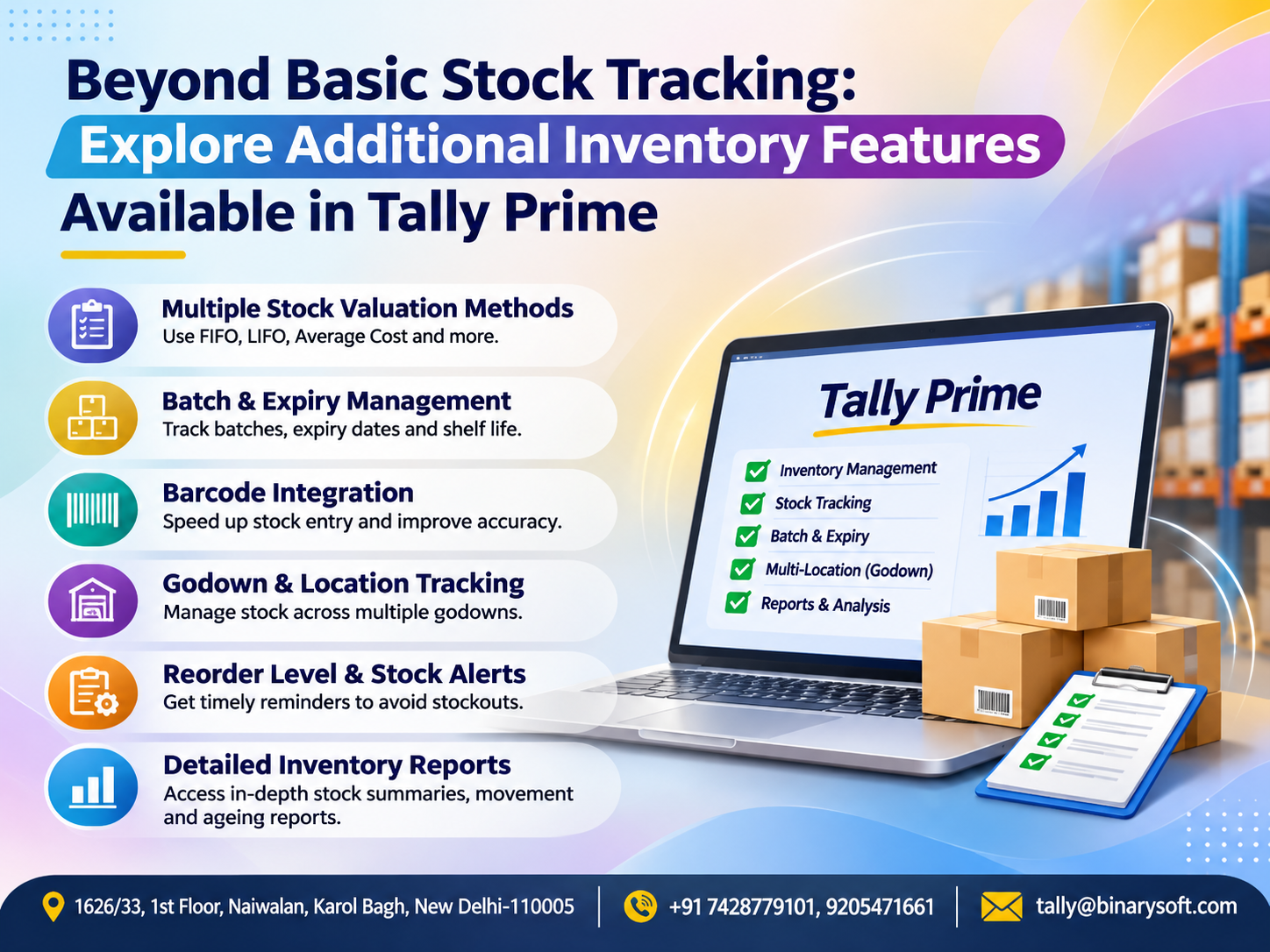
Tally Prime helps businesses move beyond basic stock tracking by offering capabilities such as batch-wise inventory management, multiple godown tracking, reorder levels, stock ageing analysis, inventory valuation, manufacturing records, stock movement analysis, and integrated accounting.
These features enable business owners to make informed decisions, reduce operational inefficiencies, and improve profitability.
Whether you operate a retail shop, wholesale distribution company, manufacturing unit, pharmaceutical business, electronics store, or trading enterprise, understanding these capabilities can transform the way you manage inventory.
1. Understanding Advanced Inventory Management in Tally Prime
Inventory management is not simply about knowing how many products are available in a warehouse. It involves understanding where products are stored, how quickly they are selling, how much they cost, and when additional stock should be purchased.
Tally Prime combines inventory transactions with financial accounting, allowing businesses to monitor stock movement alongside sales, purchases, receivables, and profitability.
Its inventory management capabilities help businesses:
-
Maintain accurate records of stock items and quantities.
-
Organize products into stock groups and categories.
-
Track inventory across multiple storage locations.
-
Monitor batch numbers and expiry dates.
-
Establish minimum and maximum stock planning levels.
-
Analyze slow-moving and ageing inventory.
-
Manage purchase and sales orders.
-
Record manufacturing and material consumption.
-
Evaluate inventory using different valuation methods.
-
Generate detailed stock reports for better decision-making.
Instead of maintaining separate spreadsheets for stock, purchases, and financial reporting, businesses can manage connected information through a centralized accounting environment.
2. Multiple Godown Management for Better Warehouse Control
Businesses operating from multiple warehouses, branches, shops, or storage facilities often struggle to identify where their inventory is physically located.
For example, a distributor may maintain stock at a central warehouse in Delhi, a secondary warehouse in Gurugram, and a retail outlet in Noida.
Without location-wise inventory records, employees may promise deliveries without confirming stock availability at the correct location.
How Tally Prime helps
Tally Prime supports multiple godowns, allowing businesses to create separate inventory locations and track stock quantities at each location.
Businesses can record inventory receipts, issues, and transfers between godowns through appropriate inventory vouchers.
Practical example: A distributor has 500 units of a product, with 300 in Delhi and 200 in Gurugram. Location-wise inventory reports help the sales team determine which warehouse should fulfill a customer order.
This improves stock visibility, reduces unnecessary transportation, and supports better coordination between sales and warehouse teams.
3. Batch-Wise Inventory Tracking and Expiry Date Management
Batch-wise inventory management is particularly important for pharmaceutical distributors, food manufacturers, cosmetic businesses, chemical suppliers, and companies handling products with limited shelf lives.
Products purchased at different times may have different manufacturing dates, expiry dates, and purchase costs.
Managing these products as one combined stock quantity can create serious operational problems.
How Tally Prime helps
Tally Prime allows businesses to maintain batch-wise inventory details, including batch identification and expiry information where applicable.
Businesses can use batch details during purchases, sales, and inventory reporting.
For example, a pharmaceutical distributor purchases 1,000 units of medicine under two batches. One batch expires in March, while the other expires in September.
Batch-wise tracking helps employees identify the appropriate stock before dispatching products.
Business benefits: Improved traceability, better expiry monitoring, reduced wastage, and more reliable stock selection.
However, businesses must establish suitable operating procedures for physically checking expiry dates and following applicable industry regulations.
4. Reorder Levels for Smarter Purchasing Decisions
Running out of fast-selling products can result in lost customers, while purchasing excessive stock can block working capital.
Reorder level management helps businesses maintain an appropriate balance between stock availability and purchasing costs.
How Tally Prime helps
Businesses can define reorder levels and minimum order quantities for relevant stock items.
Tally Prime provides reorder-related reporting to support purchasing decisions.
Consider an electrical goods distributor selling approximately 20 units of a product daily. If suppliers typically require five days for delivery, the business must plan purchases before inventory becomes insufficient.
A basic planning calculation is:
Reorder Point = Average Daily Demand × Supplier Lead Time + Safety Stock
If daily demand is 20 units, supplier lead time is five days, and safety stock is 40 units:
Reorder Point = (20 × 5) + 40 = 140 units.
The business can use this calculation to establish an appropriate reorder level.
Tally Prime supports monitoring against configured levels, while management determines the correct thresholds based on demand, lead time, and business requirements.
5. Stock Ageing Analysis to Identify Slow-Moving Inventory
One of the biggest hidden problems in inventory management is money blocked in products that remain unsold for long periods.
Businesses may report strong overall inventory values while a significant portion consists of outdated, damaged, or slow-moving goods.
Stock ageing analysis helps identify inventory that has remained in stock for extended periods.
How Tally Prime helps
Tally Prime provides stock ageing analysis that helps businesses evaluate inventory based on its age.
Business owners can use this information to identify products requiring special attention.
For example, an electronics retailer discovers that several laptop accessories have remained unsold for more than six months.
Instead of continuing to purchase similar products, the retailer can introduce promotional offers, negotiate supplier returns where permitted, or reduce future purchase quantities.
Regular stock ageing reviews help improve cash flow, reduce storage costs, and minimize the risk of inventory becoming obsolete.
6. Inventory Valuation Methods for Accurate Financial Reporting
Inventory valuation directly influences the value of closing stock, cost of goods sold, and reported business profitability.
Incorrect inventory valuation can lead to misleading financial statements and poor pricing decisions.
Tally Prime supports different inventory costing and valuation methods, depending on the stock item and configuration.
Common methods include FIFO (First In, First Out), average cost, and other supported costing approaches.
Under FIFO, earlier inventory costs are generally assigned to goods sold first for valuation purposes. Under average cost, inventory costs are averaged according to the selected method.
For example, a business purchases 100 units at ₹200 and another 100 units at ₹240.
The total purchase cost is ₹44,000, and the simple weighted average cost is ₹220 per unit.
Businesses can use appropriate valuation reports to understand stock values and compare inventory costs.
The selected accounting method should remain consistent with applicable accounting standards and business policies.
7. Manufacturing Inventory Management with Bills of Materials
Manufacturing businesses face more complicated inventory requirements than ordinary trading companies.
They must track raw materials, work-in-progress, finished goods, production expenses, and material wastage.
Tally Prime supports manufacturing inventory management through Bills of Materials (BoM), Stock Journals, and Manufacturing Journals.
A Bill of Materials defines the components and quantities required to manufacture a finished product.
For example, a furniture manufacturer producing one wooden table may require wooden boards, screws, adhesive, and finishing materials.
By defining these components in a BoM, the business can standardize material requirements.
Manufacturing Journal entries help record raw material consumption, finished goods production, and applicable by-products or scrap.
This enables manufacturers to monitor material usage, estimate production costs, and evaluate profitability more accurately.
8. Stock Groups, Categories, and Flexible Units of Measurement
Businesses dealing with hundreds or thousands of products need an organized inventory structure.
Tally Prime allows products to be classified into stock groups and stock categories.
A clothing retailer may organize products under Men's Wear, Women's Wear, and Children's Wear while using stock categories to analyze characteristics across groups.
This makes reporting and product identification more manageable.
Tally Prime also supports flexible units of measurement.
For example, a wholesaler may purchase products in cartons but sell them individually.
With suitable unit configurations, the business can maintain consistent quantities and reduce manual conversion errors.
This is particularly helpful for FMCG distributors, hardware suppliers, grocery wholesalers, and packaging businesses.
9. Purchase Order and Sales Order Management
Inventory planning becomes more effective when businesses monitor outstanding customer orders and supplier commitments.
Tally Prime supports purchase order and sales order processing.
Purchase orders help businesses record products ordered from suppliers, while sales orders help track customer requirements before delivery.
Businesses can monitor pending quantities, partially fulfilled orders, and outstanding commitments.
For example, a distributor receives an order for 500 units but has only 300 available.
Order-related reporting helps management identify the pending requirement and coordinate replenishment.
This reduces communication gaps between purchasing, warehouse, and sales departments.
10. Physical Stock Verification and Inventory Adjustments
Even well-managed businesses experience differences between recorded inventory and physical stock.
These differences may arise from damaged products, counting mistakes, misplaced goods, or incorrect transaction entries.
Tally Prime provides Physical Stock vouchers to record verified quantities and account for differences.
Businesses should conduct periodic physical stock verification and investigate significant discrepancies before making adjustments.
Maintaining a proper approval process is important because inventory corrections can affect stock values and financial reporting.
Regular verification improves record reliability and strengthens internal controls.
11. Inventory Movement Analysis and Business Intelligence
Inventory movement analysis helps businesses understand which products generate demand and which products remain underutilized.
Tally Prime provides reports that help evaluate stock inflows, outflows, quantities, rates, and values.
Business owners can identify fast-moving products, slow-moving inventory, seasonal demand patterns, and purchasing trends.
For example, a hardware supplier may discover that plumbing accessories sell consistently while certain decorative fittings remain unsold.
This information can guide purchasing priorities, promotional planning, and supplier negotiations.
Inventory movement analysis is especially valuable when combined with stock ageing and profitability reporting.
12. Job Work and Third-Party Inventory Management
Many manufacturers outsource production activities such as polishing, packaging, assembling, printing, and finishing.
Tracking materials sent to outside job workers can become difficult without proper records.
Tally Prime supports job work management for businesses acting as principal manufacturers or job workers.
Businesses can record materials sent for processing, materials received, finished goods, and related job work transactions.
This helps maintain visibility over inventory that is temporarily outside company premises.
It also supports better coordination with production partners and reduces the possibility of unaccounted materials.
13. Integrating Inventory with GST Billing and Accounting
One of the most valuable aspects of Tally Prime is the connection between inventory transactions and accounting records.
When configured correctly, purchase and sales transactions can update inventory information alongside the relevant accounting entries.
For GST-registered Indian businesses, Tally Prime also supports GST-related invoice and accounting workflows.
This integration helps reduce duplicate data entry and supports consistency between stock movement and financial transactions.
Businesses can monitor sales, purchases, inventory values, outstanding receivables, and supplier payments from connected records.
However, GST accuracy still depends on correct tax configurations, product classifications, transaction details, and regular reconciliation.
14. Emotional Business Story: The Warehouse That Almost Broke a Family Dream
Illustrative story based on common small-business inventory challenges.
For nearly twenty years, Rajesh had managed a small electrical wholesale business in Delhi.
His father had started the company with a rented shop, a few shelves, and a determination to build something meaningful for the family.
Over time, Rajesh expanded the business into a warehouse supplying electrical accessories to contractors and retailers.
But success brought unexpected difficulties.
Every month, employees reported missing products. Customers complained about delayed deliveries. Expensive inventory remained untouched in storage while popular items repeatedly went out of stock.
One evening, Rajesh sat in his office reviewing unpaid supplier bills.
His daughter had recently asked whether the family could afford her postgraduate education.
Although the business generated substantial sales, Rajesh could not confidently answer.
Too much money was trapped in inventory, and he lacked accurate information about what was actually available.
He realized that the problem was not simply declining profitability. It was the absence of inventory visibility.
Rajesh decided to reorganize his stock records using Tally Prime.
His team classified products, created warehouse locations, configured reorder levels, and began reviewing stock movement reports.
Over the following months, the business gradually identified unnecessary purchases, improved stock verification, and established more disciplined replenishment practices.
The transformation did not happen overnight.
Employees required training, old records needed correction, and management had to develop consistent processes.
But Rajesh finally began understanding where his working capital was going.
One evening, when his daughter again discussed her education plans, Rajesh opened the company's financial reports with greater confidence.
For him, inventory management was no longer merely about counting products.
It was about protecting the business his father had built and creating opportunities for the next generation.
15. Case Study One: Wholesale Distribution Company Improves Inventory Visibility
Illustrative case study; figures demonstrate a possible business outcome rather than verified customer results.
Business Profile: Electrical accessories distributor operating from Delhi with two storage locations.
Challenges: The company handled approximately 1,200 stock items. Employees relied on spreadsheets and manual warehouse communication.
Frequent problems included duplicate purchases, inconsistent location records, and delayed order fulfillment.
Tally Prime Implementation: The business introduced structured stock groups, multiple godowns, reorder levels, and regular stock movement analysis.
The team also established weekly physical verification for selected high-value products.
Illustrative Results: After six months, the company reduced avoidable excess inventory from ₹12 lakh to ₹9 lakh, releasing ₹3 lakh in working capital.
Order processing became more organized because employees could review location-wise stock before confirming dispatches.
Key Learning: Inventory visibility becomes valuable when accurate software records are supported by disciplined warehouse procedures.
16. Case Study Two: Food Manufacturer Reduces Inventory Wastage
Illustrative case study using hypothetical operational figures.
Business Profile: Packaged food manufacturer supplying regional retailers.
Challenges: The company managed raw materials with different expiry dates and experienced inconsistent production consumption records.
Products approaching expiry were sometimes overlooked, resulting in avoidable losses.
Tally Prime Implementation: The manufacturer introduced batch-wise inventory tracking, expiry date recording, Bills of Materials, and Manufacturing Journal entries.
Management also reviewed batch balances and ageing information before planning production.
Illustrative Results: Over a six-month period, estimated inventory wastage decreased from ₹1.8 lakh to ₹1.1 lakh.
The company also improved visibility into raw material consumption and finished goods quantities.
Key Learning: Batch tracking and production records can support better decisions, particularly when combined with physical expiry checks and appropriate stock rotation practices.
17. How to Start Using Advanced Inventory Features in Tally Prime
Businesses can implement additional inventory features gradually instead of changing every process simultaneously.
A practical implementation approach includes:
-
Review existing inventory records: Identify missing stock items, duplicate product names, and incorrect opening balances.
-
Organize stock masters: Create appropriate stock groups, categories, and units of measurement.
-
Configure storage locations: Establish godowns for warehouses, branches, or internal storage areas.
-
Enable relevant features: Use F11 and applicable stock-item configurations for features such as batch tracking and expiry dates.
-
Define purchasing controls: Configure reorder levels and introduce purchase order procedures.
-
Improve manufacturing records: Create Bills of Materials and use manufacturing vouchers where required.
-
Verify inventory regularly: Compare physical stock with recorded quantities and investigate differences.
-
Review management reports: Monitor Stock Summary, Movement Analysis, Stock Ageing, and Godown Summary reports.
Businesses should test configurations using representative transactions before adopting them across daily operations.
18. Benefits of Advanced Inventory Management for Indian MSMEs
For Indian micro, small, and medium enterprises, inventory often represents a substantial portion of working capital.
Poor stock management can affect liquidity, customer satisfaction, and long-term business stability.
Using Tally Prime's additional inventory capabilities can help businesses achieve several operational improvements.
Better cash flow: Identifying excess and slow-moving inventory supports more disciplined purchasing.
Improved customer service: Accurate stock records help sales teams provide more reliable delivery commitments.
Reduced wastage: Batch and expiry tracking support timely decisions about products approaching the end of their usable life.
Greater financial accuracy: Inventory valuation and accounting integration improve visibility into stock-related financial information.
Stronger business planning: Reorder reports and movement analysis provide useful information for purchasing and demand planning.
Scalable operations: Structured inventory masters and multiple locations help growing businesses manage increasingly complex stock requirements.
The actual benefits depend on data quality, employee training, business processes, and management involvement.
19. Tally Prime on Cloud for Inventory Management
Businesses with multiple offices or employees working from different locations may also consider hosting Tally Prime in a suitable cloud environment.
Tally Prime on Cloud can provide remote access to the accounting and inventory environment, depending on the hosting arrangement, licensing, permissions, and network connectivity.
For example, a business owner travelling outside Delhi may need to review inventory reports while warehouse employees continue recording daily transactions.
A properly configured hosted environment can make this workflow more convenient.
Cloud hosting may also support centralized infrastructure management, controlled user access, and backup arrangements.
However, businesses should evaluate hosting security, performance, data protection, backup recovery, and concurrent-user requirements before selecting a solution.
Cloud hosting does not automatically eliminate inventory errors. Accurate transaction recording and regular verification remain essential.
20. Why Choose Binarysoft Technologies for Tally Prime Inventory Solutions?
Implementing inventory software successfully requires more than installing an application.
Businesses need suitable configuration, accurate opening stock records, employee training, and reporting structures aligned with their operations.
Binarysoft Technologies, an Authorized Tally Partner, assists businesses with Tally Prime-related requirements, including inventory configuration, accounting workflows, implementation guidance, and cloud hosting solutions.
Businesses can seek assistance with organizing stock masters, managing godowns, configuring batches, setting reorder levels, understanding inventory reports, and improving stock-related accounting processes.
The objective is to help businesses use Tally Prime more effectively according to their operational requirements.
Conclusion: Transform Inventory from a Business Challenge into a Competitive Advantage
Inventory management is one of the most important factors influencing business profitability, operational efficiency, and customer satisfaction.
Basic stock tracking provides essential quantity information, but growing businesses require deeper visibility into inventory movement, storage locations, purchasing requirements, product costs, and manufacturing activities.
Tally Prime offers additional inventory features that help businesses address these requirements through batch management, multiple godowns, reorder levels, stock ageing analysis, inventory valuation, manufacturing records, and integrated accounting.
For wholesalers, retailers, distributors, and manufacturers, these capabilities can support more informed decisions and better working capital management.
The most successful inventory systems combine reliable software with accurate data, trained employees, and consistent business processes.
By adopting suitable advanced inventory features, businesses can move beyond simply counting stock and begin managing inventory as a strategic asset.
Powered by Binarysoft Technologies
Authorized Tally Partner
Location: 1626/33, 1st Floor, Naiwalan, Karol Bagh, New Delhi – 110005, INDIA
Contact Us: +91 7428779101, 9205471661
Email: tally@binarysoft.com
Business Hours: 10:00 AM – 6:00 PM, Monday to Friday
Frequently Asked Questions
What are the additional inventory features available in Tally Prime?
Tally Prime provides batch-wise tracking, multiple godown management, reorder levels, stock ageing analysis, stock valuation, manufacturing journals, Bills of Materials, purchase and sales order processing, and inventory reporting.
Can Tally Prime manage inventory across multiple warehouses?
Yes. Businesses can create multiple godowns or storage locations, allocate stock to each location, record transfers, and view location-wise inventory reports.
Does Tally Prime support batch numbers and expiry dates?
Yes. Tally Prime supports batch-wise inventory records, including manufacturing and expiry dates where configured. This is useful for pharmaceutical, food, cosmetic, and other expiry-sensitive businesses.
CA. Rishaan Lodha focuses on accounting controls, taxation, and financial reporting for trading and service organizations. He helps businesses improve transaction recording, reconciliations, and documentation for efficient financial management.