Call CA Tally HelpDesk
+91 9205471661,
7428779101
Why Financial Accuracy Matters More Than Ever in 2026
Every successful business depends on accurate financial information. Whether a company manages hundreds of daily invoices, processes supplier payments, maintains inventory records or prepares GST returns, even a small accounting mistake can create serious financial consequences.
An incorrectly recorded purchase invoice may affect Input Tax Credit (ITC). A missed bank transaction can distort the cash balance. An unreconciled GST entry can create unnecessary compliance complications. When these errors accumulate, business owners may lose confidence in their financial reports.
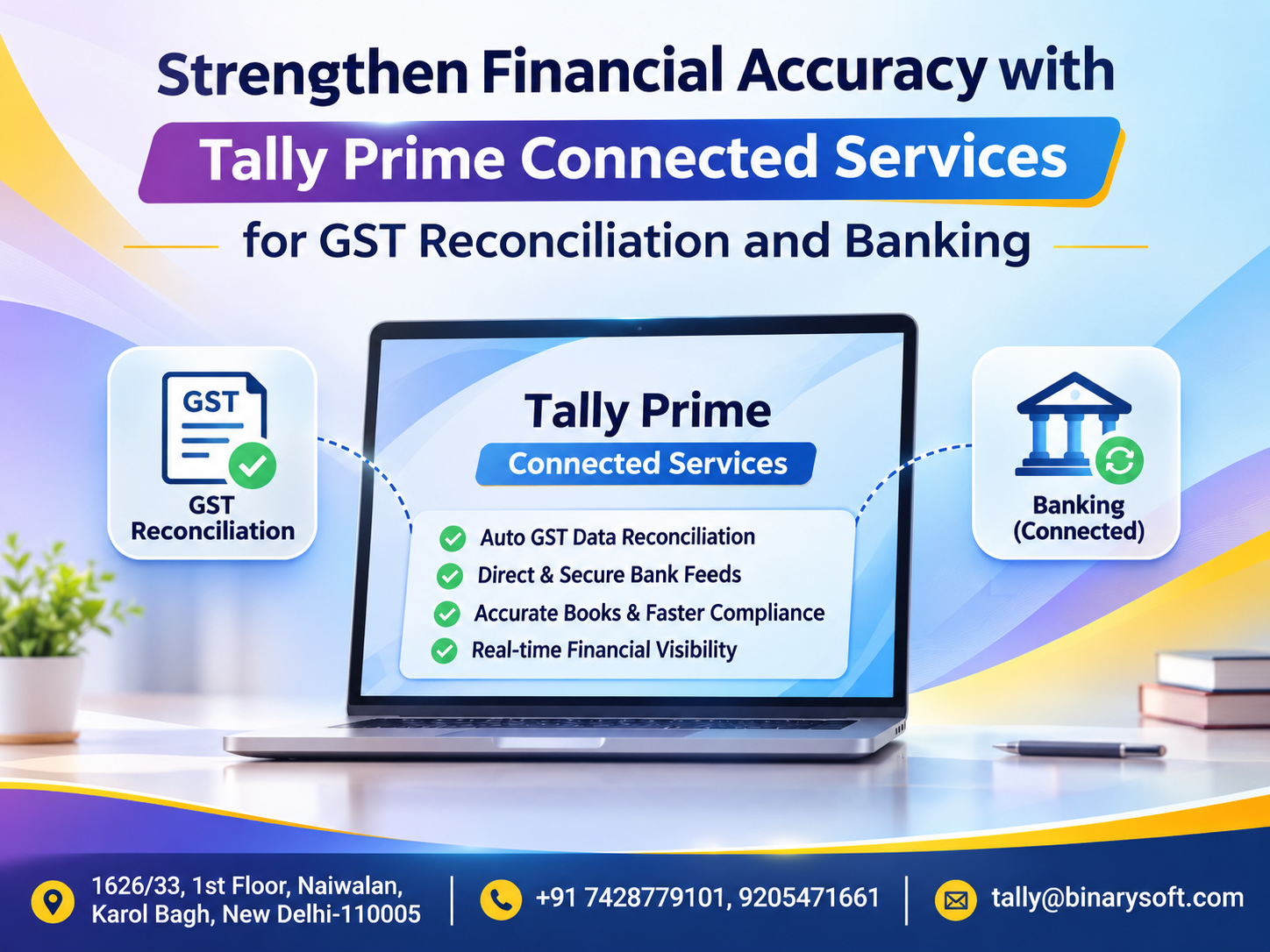
This is where Tally Prime Connected Services for GST reconciliation and banking can make a meaningful difference.
Tally Prime combines accounting, GST management, banking workflows, inventory tracking and financial reporting within a connected business environment. By reducing repetitive manual activities and improving visibility into financial transactions, businesses can strengthen accuracy and make better decisions.
For Indian businesses operating in a competitive and compliance-driven market, connected accounting is becoming an essential part of efficient financial management.
This article explains how Tally Prime helps businesses improve GST reconciliation, simplify banking, reduce accounting errors, strengthen cash flow management and establish more reliable financial controls.
A Business Owner's Story: When One Accounting Mistake Threatened Years of Hard Work
Rajesh owned a growing electrical equipment distribution business in Delhi. Over twelve years, he had built strong relationships with suppliers and customers.
His business was growing, but his accounting processes were struggling to keep up.
Every month, his accountant manually compared purchase invoices with GST records. Bank statements were downloaded separately, and payment entries were checked using spreadsheets.
During one particularly busy month, several supplier invoices were not properly matched with the available GST records. At the same time, a customer payment remained unidentified in the books.
Rajesh believed his company had sufficient funds to make a major inventory purchase. However, the bank balance and accounting records were not fully reconciled.
When his accountant identified the discrepancies, Rajesh became worried.
He had spent years building his business, and now he feared that inaccurate financial information could damage supplier relationships and disrupt operations.
His accountant recommended introducing a more structured accounting workflow using Tally Prime.
The team began reviewing GST reconciliation regularly, importing supported banking transactions, matching outstanding payments and monitoring financial reports.
Over time, Rajesh gained clearer visibility into his business finances.
Instead of waiting until month-end to discover problems, his team could investigate discrepancies earlier.
The biggest improvement was not simply faster accounting. It was peace of mind.
Rajesh could focus on customers and business expansion, knowing that his financial records were being reviewed through a more reliable process.
This illustrative story reflects common challenges experienced by growing Indian businesses.
1. Understanding Tally Prime Connected Services
Tally Prime Connected Services help businesses perform supported digital accounting, statutory compliance and banking activities through integrated workflows.
Traditional accounting often involves moving information between separate applications, spreadsheets, government portals and bank statements.
This creates opportunities for duplicate entries, missing information and reconciliation delays.
Tally Prime helps bring important financial activities into a more organized environment.
Important Connected Capabilities
-
GST data retrieval and reconciliation through supported connected GST features.
-
GST return preparation and applicable filing workflows.
-
E-invoice and e-way bill generation for eligible businesses.
-
Banking transaction import and reconciliation.
-
Connected banking facilities with supported banks.
-
Digital invoice sharing and document management workflows.
-
Financial reporting and outstanding payment monitoring.
-
User access controls and accounting data management.
The availability of individual capabilities depends on the installed Tally Prime version, subscription eligibility, bank support and applicable configuration.
By using these capabilities together, businesses can reduce unnecessary manual work and improve financial transparency.
2. GST Reconciliation: Building Confidence in Tax Records
GST reconciliation is the process of comparing transactions recorded in a business's accounting system with relevant GST information.
For example, purchase invoices entered in Tally Prime should be reviewed against supplier-reported details appearing in GSTR-2B.
Differences may occur because of incorrect GSTIN details, missing invoices, reporting delays, duplicate entries or inaccurate taxable values.
Without regular reconciliation, these issues can remain unnoticed until the return preparation stage.
How Tally Prime Helps with GST Reconciliation
Purchase Invoice Matching
Businesses can compare purchase transactions recorded in their books against GST information available through supported reconciliation features.
This helps identify missing or mismatched invoices.
Input Tax Credit Verification
Eligible ITC is important for controlling tax costs. Reconciliation helps accountants review supplier-reported transactions and investigate discrepancies before claiming credit.
However, appearance in GSTR-2B alone does not establish ITC eligibility. Businesses must also satisfy applicable GST conditions.
Mismatch Identification
Tally Prime can help highlight differences requiring investigation, such as invoice number discrepancies, taxable value differences and tax amount mismatches.
Regular GST Reviews
Instead of postponing reconciliation until the filing deadline, businesses can conduct periodic reviews.
Improved Audit Preparation
Organized GST records, supporting invoices and reconciliation reports help finance teams respond more efficiently during internal reviews and statutory examinations.
Practical Example
A trading company records 450 purchase invoices during a month.
During reconciliation, the accountant identifies 18 invoices requiring review because the corresponding GST details are missing or different.
The team contacts suppliers, verifies documents and determines the appropriate accounting or compliance action.
This process reduces the risk of overlooking discrepancies and helps the company prepare more reliable GST records.
3. Simplifying Banking Through Tally Prime
Banking transactions form an essential part of everyday business operations.
Companies receive customer payments, transfer money to suppliers, pay salaries, deposit funds and settle operating expenses.
When these activities are recorded manually, mistakes can occur.
A payment may be entered twice. A bank charge may be missed. A customer receipt may remain unallocated.
Tally Prime banking features help businesses manage these activities more systematically.
Bank Statement Import
Businesses can import statements from supported banks and formats into Tally Prime.
This reduces repetitive data entry and makes transaction review easier.
Bank Reconciliation
Bank reconciliation compares transactions recorded in the books with transactions appearing in the bank statement.
Tally Prime helps accountants identify matched and unmatched entries so discrepancies can be investigated.
Payment Management
Businesses can record supplier payments, track outstanding liabilities and prepare supported banking instruments or payment instructions.
Connected Banking
Where supported and configured, connected banking capabilities can provide additional access to banking information or workflows within Tally Prime.
Specific functionality varies by bank and service availability.
Better Cash Visibility
When banking records are updated and reconciled regularly, financial reports become more dependable.
Business owners can make decisions based on clearer information about available funds, outstanding payments and financial obligations.
4. Step-by-Step Guide to GST Reconciliation in Tally Prime
A structured reconciliation process helps businesses maintain dependable GST records.
Step 1: Configure GST Details
Open the company in Tally Prime and ensure GST is enabled.
Verify the GSTIN, registration details, tax classifications and relevant company settings.
Correct configuration is essential because inaccurate master data can affect subsequent GST reports.
Step 2: Record Purchase Transactions
Enter purchase invoices with the correct supplier details, invoice numbers, taxable values and applicable GST amounts.
Ensure that the appropriate tax ledgers and classifications are used.
Step 3: Download GSTR-2B
In supported versions, use:
Alt+Z (Exchange) → All GST Options → Download GST Returns
Select GSTR-2B and the required return period.
Complete the applicable GST portal authentication process.
Alternatively, import a supported GSTR-2B file downloaded from the GST portal.
Step 4: Review the Reconciliation Report
Open the GSTR-2B Reconciliation report.
Examine matched invoices, mismatches, transactions available only in books and transactions appearing only on the portal.
Step 5: Resolve Differences
Investigate discrepancies by checking original invoices, supplier information and GST reporting periods.
Contact suppliers where necessary.
Avoid changing genuine accounting records merely to force a reconciliation match.
Step 6: Verify ITC and Prepare Returns
Review eligible ITC, applicable reversals and adjustments.
Reconcile the relevant outward and inward supply information before preparing GST returns.
Final return figures should be reviewed by the responsible accountant or tax professional.
5. How to Perform Bank Reconciliation in Tally Prime
Regular bank reconciliation helps businesses identify differences between accounting records and actual banking transactions.
Step 1: Maintain Bank Ledgers
Create or verify the bank ledger under the Bank Accounts group.
Ensure that opening balances and relevant bank details are correct.
Step 2: Record Banking Transactions
Enter receipts, payments, contra entries and other applicable vouchers.
Use correct dates, amounts, party ledgers and references.
Step 3: Import Bank Statements
Use the bank statement import facility available in the installed version.
Select the supported statement file and relevant accounting period.
Step 4: Review Transaction Matches
Open the Bank Reconciliation report.
The system can identify exact matches and suggest potential matches based on available transaction information.
Step 5: Investigate Unmatched Transactions
Review missing entries, duplicate postings, bank charges, interest, uncleared cheques and unidentified receipts.
Create or correct vouchers where appropriate.
Step 6: Verify the Reconciled Balance
Compare the reconciled book balance with the bank statement.
Investigate outstanding differences before completing the period-end review.
This procedure helps establish a more dependable financial position.
6. Case Study One: GST Reconciliation for a Wholesale Trading Business
The following is an illustrative case study with hypothetical figures.
Business Background
A wholesale electrical goods distributor in Delhi handled approximately 1,200 purchase invoices every month.
Its accounting team used spreadsheets to compare purchase records with GST information.
The process was time-consuming, and discrepancies were frequently identified close to filing deadlines.
Challenges
The company experienced several recurring problems:
-
Missing supplier-reported invoices.
-
Incorrect GSTIN and invoice references.
-
Delayed identification of ITC discrepancies.
-
Excessive manual reconciliation work.
-
Difficulty tracking unresolved supplier issues.
Tally Prime Implementation
The business introduced a structured GST reconciliation process using Tally Prime.
Purchase invoices were entered consistently, supplier masters were reviewed and GSTR-2B information was reconciled periodically.
The accountant maintained a register of unresolved discrepancies and followed up with suppliers.
Illustrative Results
|
Performance Indicator
|
Before
|
After
|
|---|
|
Monthly reconciliation effort
|
24 hours
|
10 hours
|
|
Unresolved invoice differences at month-end
|
45
|
12
|
|
Reconciliation frequency
|
Monthly
|
Weekly
|
|
Supplier follow-up
|
Reactive
|
Structured
|
These figures illustrate possible operational improvements, not guaranteed software outcomes.
Business Impact
The company gained better visibility into supplier reporting discrepancies and reduced the amount of last-minute reconciliation work.
Its finance team could focus more attention on reviewing exceptions rather than repeatedly comparing spreadsheets.
Most importantly, management developed greater confidence in the reliability of its GST records.
7. Case Study Two: Improving Banking Accuracy for a Manufacturing Company
This case study is also illustrative.
Business Background
A medium-sized manufacturing company in Faridabad maintained multiple bank accounts for customer collections, supplier payments and operating expenses.
The company processed hundreds of banking transactions each month.
Manual reconciliation frequently resulted in delays.
Challenges
The finance team struggled with unidentified customer receipts, unrecorded bank charges and differences between bank statements and accounting ledgers.
Management also found it difficult to determine the actual availability of funds.
Tally Prime Implementation
The company introduced regular statement imports, bank reconciliation reviews and improved payment reference tracking.
Accountants used matching suggestions to identify corresponding entries and investigated unmatched transactions separately.
Illustrative Results
|
Performance Indicator
|
Before
|
After
|
|---|
|
Monthly reconciliation effort
|
18 hours
|
7 hours
|
|
Unidentified receipts at month-end
|
22
|
5
|
|
Reconciliation frequency
|
Monthly
|
Twice weekly
|
|
Cash reporting
|
Delayed
|
More regularly updated
|
Business Impact
The improved process helped the company identify transaction discrepancies earlier and prepare more reliable cash reports.
Management could review supplier payments and working capital requirements with greater confidence.
The case demonstrates how better banking workflows can support operational stability and financial planning.
8. How Connected GST and Banking Work Together
GST reconciliation and banking reconciliation are closely related to financial accuracy.
A purchase invoice affects supplier balances, tax records and business expenses.
The corresponding payment affects bank balances and outstanding liabilities.
If these activities are managed independently without regular review, financial discrepancies can remain hidden.
Tally Prime helps businesses connect these accounting activities through consistent transaction records and reporting.
Consider a company purchasing goods worth ₹1,00,000 plus applicable GST.
The accountant records the purchase invoice and relevant tax amounts.
Later, the business makes payment to the supplier through its bank account.
The GST reconciliation process helps verify the supplier-reported tax information, while bank reconciliation confirms the payment transaction.
The supplier ledger reflects the outstanding or settled amount.
Together, these activities provide a clearer picture of the transaction.
However, bank reconciliation does not itself establish GST compliance, and GST reconciliation does not confirm that a payment has cleared. Each requires its own verification.
9. Strengthening Cash Flow and Financial Decision-Making
Accurate accounting information is essential for cash flow planning.
Businesses need to understand how much money is available, which customers owe payments and which supplier obligations are approaching their due dates.
Tally Prime provides financial reports that help management monitor these areas.
Accounts Receivable Management
Outstanding receivables reports help businesses identify customers with unpaid invoices.
Regular monitoring supports timely collection follow-ups.
Accounts Payable Management
Supplier outstanding reports help finance teams understand upcoming payment commitments.
This supports better payment scheduling and working capital planning.
Cash and Bank Reports
Cash and bank summaries provide visibility into recorded balances and transactions.
Their reliability improves when entries are updated and reconciled regularly.
Profitability Analysis
Profit and Loss reports help businesses evaluate income, expenses and profitability.
Accurate transaction classification is important for meaningful analysis.
Balance Sheet Review
The Balance Sheet presents the financial position of the business, including assets, liabilities and capital.
Regular review can reveal unusual balances or accounting inconsistencies requiring investigation.
10. Reducing Human Errors Through Structured Accounting
Manual accounting errors can arise from repetitive data entry, inconsistent processes and inadequate verification.
Connected workflows can reduce certain risks, but they do not eliminate the need for human review.
Tally Prime supports improved accounting discipline through voucher management, reconciliation reports, user permissions and transaction tracking.
Businesses can strengthen these controls by introducing approval procedures and clearly assigning responsibilities.
For example, one employee may record purchase invoices while another reviews GST reconciliation differences.
Similarly, payment preparation and payment authorization can be assigned to different responsible individuals.
This separation reduces the risk of unauthorized or incorrect transactions.
Regular backups, appropriate access permissions and periodic financial reviews further support data reliability.
11. Supporting E-Invoicing and E-Way Bill Management
For eligible businesses, e-invoicing and e-way bill compliance are important components of transaction management.
Tally Prime supports connected e-invoicing and e-way bill workflows in applicable configurations.
Businesses can generate relevant documents using information recorded in their accounting transactions.
This helps reduce repeated entry of invoice details.
Correct GSTIN, HSN or SAC, taxable value, tax rate and transaction information remain essential.
Businesses should also verify whether e-invoicing and e-way bill requirements apply to their turnover, transaction type and current legal obligations.
Connected functionality can simplify compliance procedures, but it does not replace statutory verification.
12. Why Growing Businesses Need Connected Accounting in 2026
As businesses expand, their transaction volumes increase.
More customers, suppliers, employees and bank accounts create additional accounting responsibilities.
A process that works for a small organization may become inefficient when transaction volumes multiply.
Connected accounting helps businesses establish more scalable financial workflows.
For retailers, it supports daily sales recording and payment monitoring.
For wholesalers, it improves purchase management, supplier reconciliation and outstanding tracking.
For manufacturers, it helps coordinate inventory, purchasing, expenses and financial reporting.
For service businesses, it supports invoice management, customer collections and expense accounting.
The objective is not merely to process transactions faster.
It is to create a dependable financial information system that supports business growth.
13. Best Practices for Maximum Financial Accuracy
Businesses can obtain greater value from Tally Prime by following consistent accounting procedures.
Maintain accurate master data: Review customer, supplier, GSTIN, bank and ledger information regularly.
Reconcile frequently: Perform banking and GST reconciliation at intervals appropriate to transaction volumes.
Review exceptions: Investigate unmatched invoices and bank transactions instead of ignoring them.
Maintain supporting documents: Preserve invoices, payment references, credit notes and other necessary records.
Restrict user permissions: Give employees access according to their responsibilities.
Back up accounting data: Maintain secure, tested backups and suitable recovery procedures.
Review reports regularly: Examine outstanding balances, cash positions, GST summaries and financial statements.
Stay updated: Review relevant statutory changes and use supported software versions.
These practices help businesses develop a stronger accounting control environment.
14. How Binarysoft Technologies Can Help Your Business
Implementing accounting software successfully requires more than installing an application.
Businesses must configure ledgers, GST settings, banking workflows and reporting structures according to their operational requirements.
Binarysoft Technologies, an Authorized Tally Partner, can assist businesses with Tally Prime implementation, configuration, training and technical support.
Support requirements may include GST reconciliation setup, bank statement import guidance, financial reporting configuration, user management and accounting workflow improvements.
Businesses considering cloud-based accounting access can also discuss suitable deployment and security requirements.
The objective is to help organizations use Tally Prime more effectively while maintaining accurate and organized financial records.
Conclusion
Financial accuracy is essential for maintaining business stability, regulatory compliance and long-term growth.
When GST records, banking transactions and accounting reports are managed through disconnected manual processes, businesses face greater risks of delays, inconsistencies and avoidable errors.
Tally Prime Connected Services help address these challenges by supporting GST reconciliation, banking workflows, financial reporting and more organized transaction management.
Businesses can identify discrepancies earlier, reduce repetitive work and strengthen visibility into their financial position.
However, technology delivers the greatest benefits when combined with correct accounting practices, regular reconciliation and responsible financial oversight.
For growing Indian businesses, investing in connected accounting is not simply about saving time. It is about building confidence in every financial decision.
Powered by Binarysoft Technologies
Authorized Tally Partner
Location: 1626/33, 1st Floor, Naiwalan, Karol Bagh, New Delhi – 110005, INDIA
Contact Us: +91 7428779101, 9205471661
Email: tally@binarysoft.com
Business Hours: 10:00 AM – 6:00 PM, Monday to Friday
Frequently Asked Questions
What are Tally Prime Connected Services?
Tally Prime Connected Services provide supported digital workflows for activities such as GST reconciliation, GST return management, connected banking, e-invoicing and e-way bill generation.
How does Tally Prime help with GST reconciliation?
Tally Prime allows businesses to compare recorded purchase transactions with relevant GST data, including GSTR-2B, and identify discrepancies that require review.
Can Tally Prime automatically reconcile bank transactions?
Yes. Supported versions provide automated matching of eligible bank transactions and suggestions for potential matches. Unmatched transactions still require investigation.
Does Tally Prime support GSTR-2B reconciliation?
Yes. Businesses can download or import GSTR-2B data and compare it with purchase records through the reconciliation report.
CA. Priya Tanvi specializes in accounting compliance, GST advisory, and business reporting for small and growing enterprises. She works with business owners to improve record-keeping and financial clarity. Her articles focus on practical compliance solutions and operational discipline.