Call CA Tally HelpDesk
+91 9205471661,
7428779101
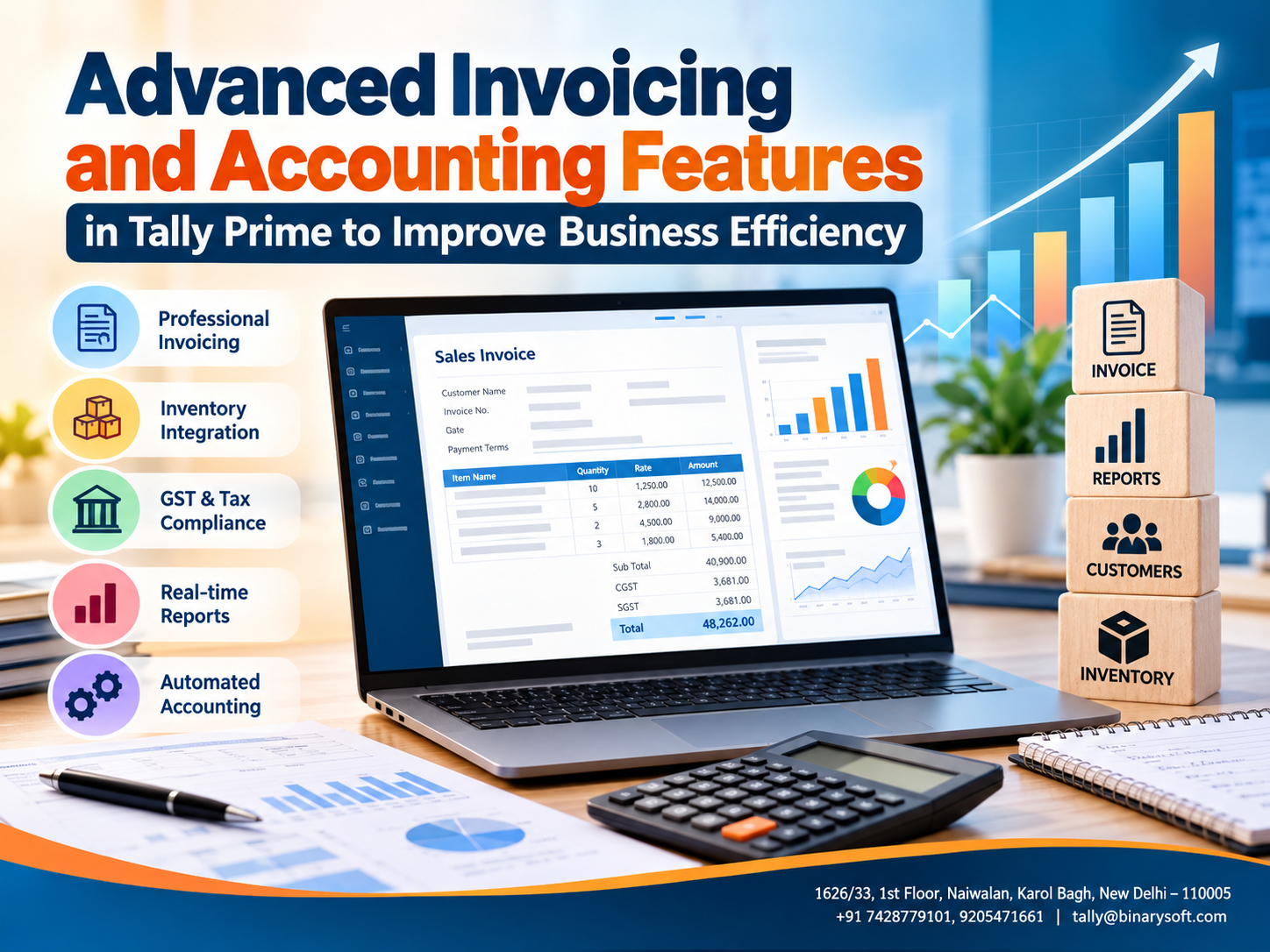
Introduction: Why Advanced Invoicing and Accounting Matter in 2026
Running a successful business requires more than generating sales and recording expenses. Every invoice, payment, purchase and financial transaction contributes to the overall efficiency and profitability of an organization.
In 2026, Indian businesses face growing expectations for faster billing, accurate GST documentation, timely payment collection and reliable financial reporting. Whether operating a retail shop, wholesale distribution company, manufacturing unit or professional service business, inefficient accounting processes can create serious operational challenges.
Manual billing, disconnected spreadsheets, duplicate entries and delayed financial updates consume valuable time. Small mistakes can lead to incorrect invoices, customer disputes, inventory mismatches and unnecessary compliance difficulties.
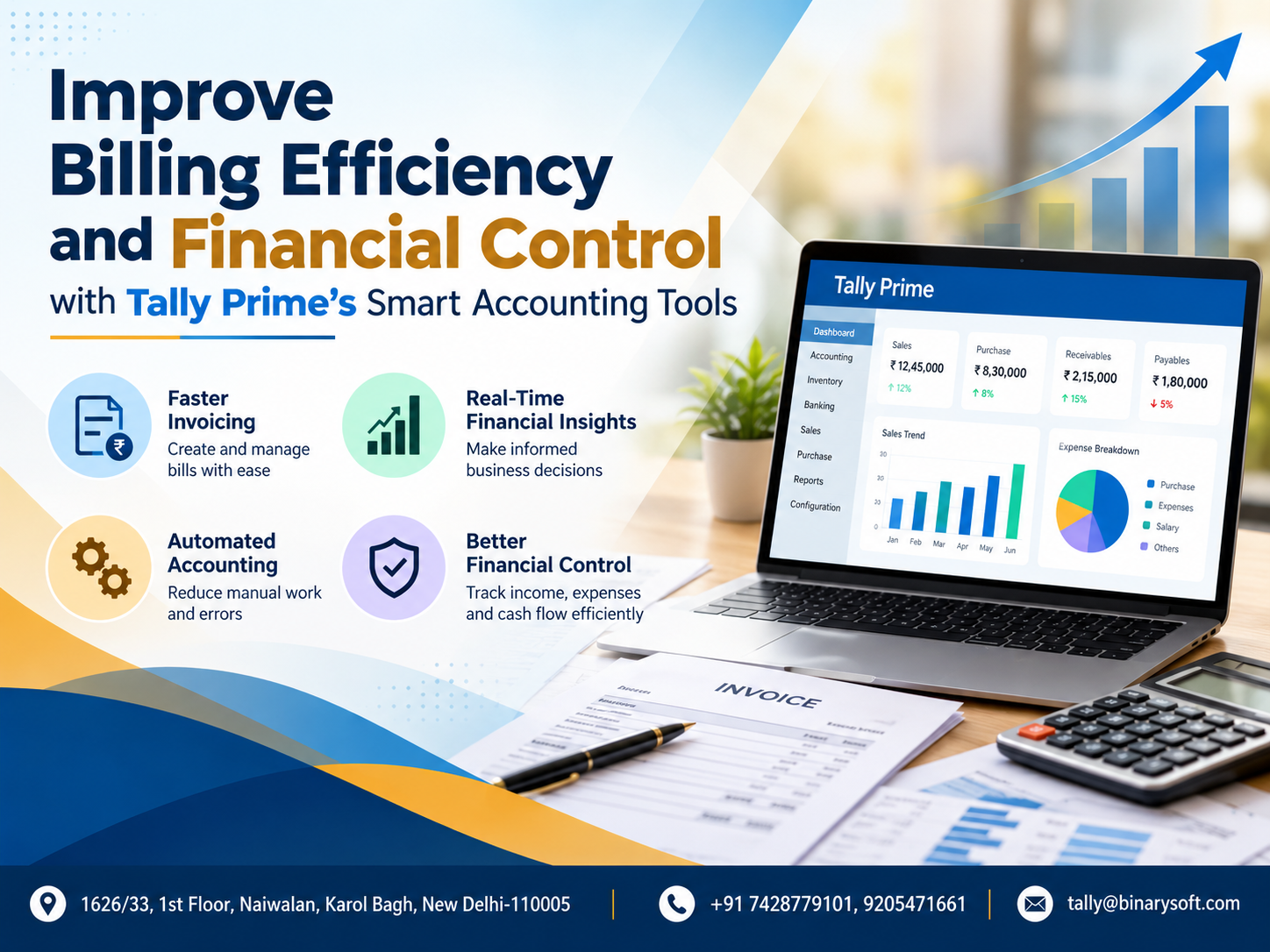
Tally Prime provides integrated invoicing and accounting capabilities that help businesses manage these activities within a connected system.
From customized invoices and automated ledger postings to GST calculations, inventory-linked billing and outstanding payment tracking, Tally Prime helps business owners improve transaction accuracy and operational visibility.
Understanding these features allows businesses to reduce repetitive work, strengthen internal controls and make better financial decisions.
A Business Owner's Story: The Invoice Error That Nearly Cost a Valuable Customer
Amit operated a growing electronics distribution business in Delhi. His company supplied products to retailers, offices and small commercial establishments.
As customer orders increased, his team struggled to prepare invoices quickly.
Employees maintained product information in spreadsheets, calculated taxes separately and manually entered sales transactions into accounting records.
One afternoon, Amit received an angry call from a long-standing customer.
The customer had received an invoice containing an incorrect product quantity and a tax calculation that did not match the agreed transaction.
The customer refused to process the payment until the invoice was corrected.
Amit immediately contacted his accounts department, but the employee responsible for preparing the invoice was unavailable.
The team spent several hours reviewing spreadsheets, purchase records and billing documents.
The delay affected customer confidence and created additional pressure because supplier payments were approaching.
That evening, Amit realized the real problem was not employee carelessness. His business had outgrown its manual billing process.
He decided to reorganize invoicing and accounting using Tally Prime.
Product masters, customer ledgers, tax details and invoice configurations were brought into a structured system.
Sales transactions began updating the relevant accounting and inventory records through the same workflow.
Within the following months, invoice preparation became more consistent, and the accounts team spent less time correcting repetitive errors.
Most importantly, Amit regained confidence that his business could handle increasing transaction volumes.
The lesson was simple: efficient invoicing protects customer relationships as well as business profitability.
This is an illustrative story reflecting common challenges faced by growing businesses.
1. Understanding Advanced Invoicing and Accounting
Advanced invoicing refers to using structured billing tools to prepare, calculate, record and manage sales transactions efficiently.
Advanced accounting involves maintaining accurate financial records through integrated transaction processing, ledger management and reporting.
Traditional manual systems often require separate activities for invoice preparation, tax calculation, stock adjustment and accounting entries.
An integrated accounting system reduces the need to repeat the same transaction across multiple records.
For example, when a business records a sales invoice in Tally Prime, the transaction can update customer balances, sales ledgers, tax ledgers and inventory quantities according to its configuration.
This creates a more reliable accounting workflow.
The objective is not merely to generate invoices faster but to ensure that each transaction contributes to accurate business records.
2. Professional and Customizable Invoice Formats
An invoice represents a business's professionalism and financial accuracy.
Customers expect clear product descriptions, quantities, rates, taxes, payment terms and business information.
Poorly formatted invoices can create confusion and delay payment approvals.
Invoice Customization in Tally Prime
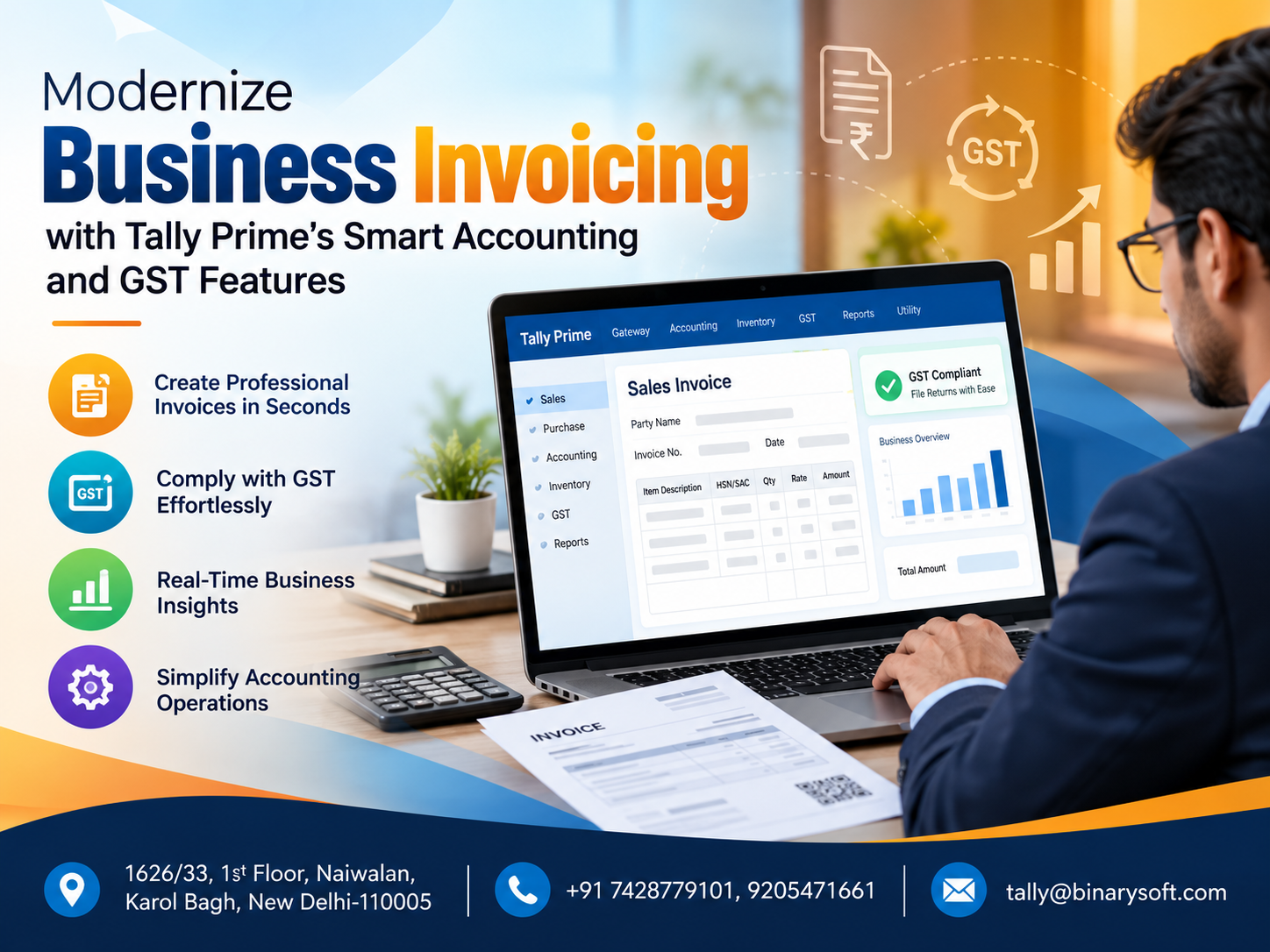
Tally Prime supports invoice configuration options that allow businesses to adjust the information displayed on printed or shared invoices.
Depending on the transaction type and configuration, invoices may include business details, GST information, product descriptions, quantities, rates, discounts, payment terms and additional details.
Businesses can configure invoice numbering and print settings to suit operational requirements.
Advanced layout customization may require additional configuration or suitable customization tools.
Professional invoices improve communication and make transactions easier for customers to verify.
3. Automated Accounting Entries from Sales Invoices
One of the most valuable benefits of integrated invoicing is the reduction of duplicate accounting work.
In a disconnected system, employees may generate invoices in one application and record accounting entries in another.
This creates additional workload and increases the possibility of errors.
How Tally Prime Helps
When a sales invoice is recorded correctly, Tally Prime posts the corresponding accounting information to the relevant ledgers.
For example, a credit sale of ₹50,000 plus 18% GST may generate the following accounting effect, assuming a local taxable sale with CGST and SGST:
|
Accounting ledger
|
Debit
|
Credit
|
|---|
|
Customer Account
|
₹59,000
|
—
|
|
Sales Account
|
—
|
₹50,000
|
|
Output CGST
|
—
|
₹4,500
|
|
Output SGST
|
—
|
₹4,500
|
|
Total
|
₹59,000
|
₹59,000
|
The applicable tax treatment depends on the nature of the supply and relevant GST rules.
This integrated posting helps maintain consistency between invoices and accounting records.
It also reduces repetitive entry and makes financial information available sooner.
4. GST-Compliant Invoicing and Tax Calculation
GST compliance is an essential part of invoicing for registered Indian businesses.
Invoices must contain applicable information such as supplier GSTIN, invoice number, date, taxable value, tax rates and relevant HSN or SAC details.
Incorrect GST calculations can create reconciliation differences and compliance difficulties.
Tally Prime allows businesses to configure GST registration information, tax rates, stock item classifications and transaction details.
Depending on the place of supply and nature of the transaction, the system can calculate applicable CGST, SGST or IGST.
Businesses should verify tax classifications and configurations because automated calculations depend on the accuracy of the underlying information.
5. E-Invoicing and E-Way Bill Management
Eligible businesses must comply with applicable electronic invoicing requirements.
Preparing e-invoices separately from accounting records can increase administrative work.
Tally Prime supports e-invoicing workflows, including the generation of Invoice Reference Numbers and applicable QR codes through supported connected services.
It also provides e-way bill capabilities for eligible goods movement transactions.
These features help reduce repeated data entry and improve consistency between accounting records and statutory documents.
E-invoicing applicability, reporting deadlines and e-way bill requirements depend on current government rules and the circumstances of each transaction.
6. Inventory-Linked Billing for Better Stock Control
Businesses dealing in physical products need accurate inventory information during invoicing.
When billing and inventory systems operate independently, stock balances may become unreliable.
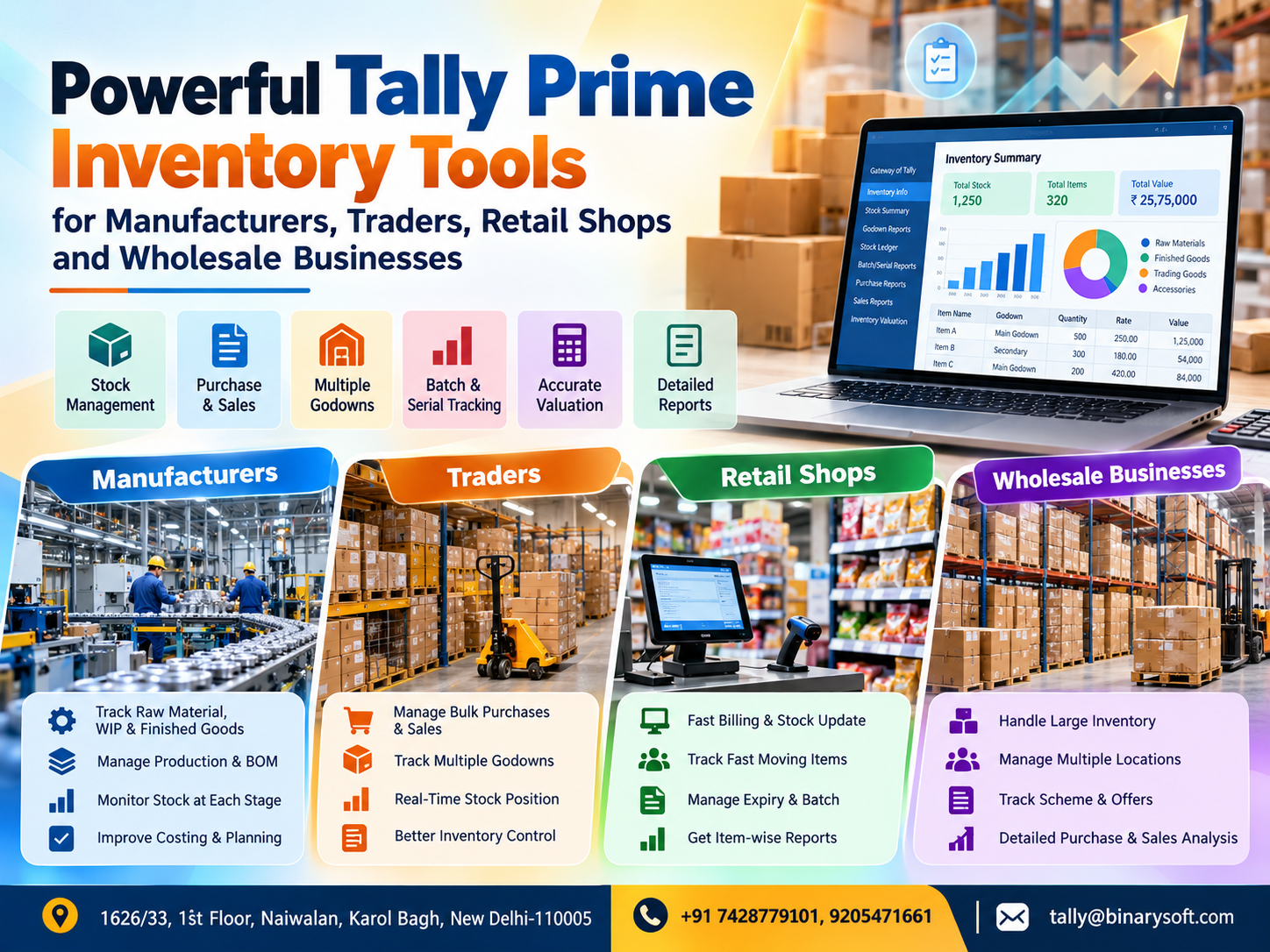
Tally Prime supports integrated accounting and inventory management.
When properly configured, sales invoices can update inventory quantities while recording the corresponding financial transactions.
Businesses can maintain stock groups, stock categories, units of measurement, godowns and batch-related information.
For example, an electronics distributor selling 15 printers can record the sale and reduce the corresponding inventory quantity within the same transaction.
This helps management monitor stock availability and identify purchasing requirements.
7. Multiple Price Levels and Discount Management
Retailers, wholesalers and distributors often offer different prices to different customer categories.
A distributor may maintain separate rates for retail customers, wholesale buyers and institutional clients.
Manually remembering these prices can create billing errors.
Tally Prime supports price lists, price levels and discount-related configurations.
Businesses can maintain structured pricing information and apply appropriate rates during invoicing.
This helps improve pricing consistency and reduces repetitive calculations.
8. Credit Notes, Debit Notes and Sales Adjustments
Sales transactions sometimes require adjustments after an invoice has been issued.
Customers may return damaged products, receive additional discounts or report billing differences.
Tally Prime supports credit notes and debit notes for recording relevant adjustments.
These vouchers help maintain accounting accuracy and update the appropriate customer or supplier balances.
Where GST applies, businesses should ensure that adjustments satisfy the relevant documentation and reporting requirements.
9. Customer Outstanding and Payment Tracking
An invoice does not complete the financial cycle until the payment is collected.
Businesses frequently experience cash flow difficulties because customer payments remain pending.
Tally Prime provides bill-wise receivables tracking, customer outstanding reports and ageing analysis.
These features help accounts teams identify unpaid invoices, review due dates and follow up on overdue balances.
For example, a business can review which customers have unpaid invoices older than 30, 60 or 90 days.
Timely collection monitoring helps improve working capital management.
10. Banking and Reconciliation Features
Accurate banking records are necessary for reliable accounting.
Tally Prime supports bank reconciliation, payment recording and bank-related reporting.
Depending on the release and supported banking services, additional connected banking capabilities may be available.
These tools help businesses identify unreconciled transactions and maintain more reliable cash and bank balances.
Regular reconciliation also supports the detection of duplicate entries, missing receipts and unrecorded charges.
11. Advanced Financial Reporting and Analysis
Business owners need timely financial information to understand performance.
Tally Prime provides reports including the Balance Sheet, Profit and Loss Account, Trial Balance, Sales Register, Purchase Register, Cash Flow and outstanding statements.
These reports are generated from recorded accounting transactions.
Managers can use them to evaluate profitability, expenses, customer balances and financial commitments.
Cost centres can also help businesses analyze expenses or income across departments, projects or business activities.
Regular reporting enables management to identify problems earlier and take corrective action.
12. Multi-User Access and Accounting Security
Growing businesses often require multiple employees to work with accounting information.
However, unrestricted access can increase the risk of unauthorized changes.
Tally Prime supports user access controls and security configurations.
Businesses can assign permissions according to employee responsibilities.
For example, a billing employee may require sales invoice access, while a finance manager may need broader reporting and accounting permissions.
Where applicable, edit log capabilities can help organizations review changes to accounting information.
Regular backups and secure access policies remain important even when accounting software includes built-in protection features.
13. Practical Steps to Improve Invoicing Efficiency
Businesses can improve invoicing and accounting through a structured implementation process.
Step 1: Configure company information. Enter accurate business details, financial year settings and applicable GST registration information.
Step 2: Create accounting ledgers. Organize customer, supplier, sales, purchase, expense and tax ledgers.
Step 3: Configure inventory masters. Create stock items, units, groups and relevant pricing information.
Step 4: Customize invoice settings. Configure invoice numbering, required details, printing preferences and relevant voucher options.
Step 5: Enable bill-wise accounting. Track customer and supplier transactions against individual invoices.
Step 6: Record sales and purchases. Use the appropriate voucher types and verify transaction details before saving.
Step 7: Reconcile banking records. Compare recorded transactions with bank statements regularly.
Step 8: Review reports. Monitor sales, expenses, inventory, receivables and profitability.
Step 9: Maintain data security. Configure user permissions, backups and appropriate access controls.
Step 10: Train employees. Establish consistent procedures for invoicing, corrections, payment allocation and reporting.
A well-configured system delivers the greatest benefit when employees follow accurate and consistent processes.
14. Case Study One: Electronics Distributor Reduces Billing Delays
Illustrative case study based on common distribution business challenges.
Business Background
A wholesale electronics distributor in Nehru Place, Delhi, handled approximately 120 sales invoices daily.
The company maintained customer information, inventory balances and billing calculations across different spreadsheets.
Challenges
Employees frequently repeated the same information across multiple records.
Billing delays increased during busy periods, and management struggled to identify stock discrepancies.
Solution
The business introduced Tally Prime for integrated invoicing, customer ledgers, inventory tracking and GST calculations.
It configured stock masters, standardized invoice formats and enabled bill-wise customer tracking.
Illustrative Results
In this hypothetical scenario, average invoice preparation time decreased from six minutes to three minutes.
For 120 invoices, this represented a reduction from 12 hours to six hours of combined daily processing time.
The company also gained better visibility into customer balances and stock movements.
The example demonstrates how integrated invoicing can reduce repetitive administrative work.
15. Case Study Two: Manufacturing Company Strengthens Accounting Accuracy
Illustrative case study showing a manufacturing accounting improvement.
Business Background
A packaging manufacturer in Bawana, Delhi, supplied products to wholesalers and industrial customers.
Its accounting team handled purchases, sales, customer payments and inventory transactions.
Challenges
The company experienced delays in monthly reporting because transaction records required repeated checking.
Customer payments were not consistently allocated against invoices, and stock adjustments were sometimes recorded late.
Solution
The company implemented structured accounting procedures using Tally Prime.
It configured customer and supplier ledgers, bill-wise tracking, inventory masters and financial reporting.
Employees received training on recording vouchers and reconciling transactions.
Illustrative Results
Over three months, the example company reduced its monthly accounting review process from five working days to two.
Management also gained clearer visibility into outstanding receivables and inventory-related transactions.
The case highlights the importance of combining accounting software with employee training and disciplined recordkeeping.
16. How Advanced Accounting Supports Business Growth
As businesses expand, transaction volumes and reporting requirements become more complex.
Manual accounting processes may work during the early stages but become difficult to manage as operations grow.
Integrated invoicing and accounting help businesses establish repeatable procedures.
Accurate records support better purchasing decisions, customer credit management and expense monitoring.
Financial reports provide management with information needed to evaluate profitability and plan investments.
Businesses can also improve coordination between billing, inventory and finance departments.
The long-term objective is to build a reliable financial system that supports sustainable expansion.
Conclusion
Advanced invoicing and accounting features play an important role in improving business efficiency, financial accuracy and operational control.
Businesses that rely on disconnected spreadsheets and repetitive manual processes often experience unnecessary delays, accounting errors and limited financial visibility.
Tally Prime provides integrated capabilities for professional invoicing, GST accounting, inventory-linked billing, customer outstanding tracking, banking and financial reporting.
When configured correctly, these features help businesses reduce repetitive work, maintain organized records and make informed decisions.
Retailers, wholesalers, distributors, manufacturers and service providers can all benefit from structured accounting practices.
Efficient invoicing is not simply about preparing bills faster. It is about creating accurate financial information that supports stronger customer relationships, reliable compliance processes and sustainable business growth.
Powered by Binarysoft Technologies
Authorized Tally Partner
Location: 1626/33, 1st Floor, Naiwalan, Karol Bagh, New Delhi – 110005, INDIA
Contact Us: +91 7428779101, 9205471661
Email: tally@binarysoft.com
Business Hours: 10:00 AM – 6:00 PM, Monday to Friday
Binarysoft Technologies assists businesses with Tally Prime implementation, GST billing configuration, accounting automation, inventory management, financial reporting and cloud-based accounting solutions.
Frequently Asked Questions
What are the advanced invoicing features available in Tally Prime?
Tally Prime supports customizable invoice configurations, GST billing, multiple pricing options, discounts, inventory-linked invoicing, credit and debit notes, bill-wise tracking and applicable e-invoicing features.
How does Tally Prime improve accounting efficiency?
Tally Prime integrates transaction recording with accounting ledgers and financial reports. This reduces duplicate data entry and helps businesses maintain more consistent records.
CA. Harshit Gaurwaadi is a practicing Chartered Accountant with hands-on experience in accounting systems, GST compliance, and MSME advisory. He regularly works with small and mid-sized businesses to streamline inventory, billing, and statutory processes using modern accounting software. His articles focus on practical, ground-level challenges faced by Indian traders and professionals.