Call CA Tally HelpDesk
+91 9205471661,
7428779101
Introduction: Why Accurate Inventory Management Is Becoming Essential for Businesses in 2026
In 2026, businesses are facing increasing pressure to maintain accurate inventory records while managing fluctuating purchase costs, faster customer deliveries, multiple warehouses, and growing product varieties. A small stock mismatch can now create serious operational problems, including delayed orders, unnecessary purchases, blocked working capital, and inaccurate financial reporting. For wholesalers, manufacturers, retailers, and distributors, relying on manual stock registers or disconnected spreadsheets can make inventory control increasingly difficult. Businesses need reliable information about stock quantities, inventory value, product batches, and warehouse-wise availability to make timely decisions. TallyPrime provides integrated inventory management capabilities, including stock valuation methods, batch-wise tracking, godown management, stock ageing analysis, and inventory reports. By using these features correctly, businesses can reduce stock discrepancies, improve inventory visibility, control storage costs, and make more informed purchasing and sales decisions while maintaining better coordination between inventory and accounting operations.
Understanding Inventory Accuracy and Its Importance for Business Growth
Inventory accuracy refers to the consistency between the stock quantities recorded in a business's accounting or inventory system and the actual physical stock available.
For example, if a business's inventory records show 500 units of a product but only 470 units are physically available, the difference can affect purchasing, sales commitments, financial reporting, and customer satisfaction.
Inventory accuracy becomes particularly important when businesses handle hundreds or thousands of products across different locations.
TallyPrime helps businesses maintain organized inventory records by connecting stock transactions with accounting information.
Why Inventory Accuracy Matters
-
Reduces stock shortages and unexpected product unavailability.
-
Helps prevent unnecessary inventory purchases.
-
Improves financial reporting through appropriate stock valuation.
-
Supports better warehouse and storage management.
-
Makes it easier to track products by batch and expiry date.
-
Helps identify slow-moving and ageing inventory.
-
Improves customer order fulfilment.
-
Supports better purchasing and replenishment decisions.
-
Reduces dependence on manual inventory calculations.
-
Provides greater visibility into working capital invested in stock.
For businesses operating in competitive markets, accurate inventory information can directly influence profitability, customer relationships, and operational efficiency.
A Business Story: How One Inventory Mistake Almost Cost a Distributor His Biggest Customer
Consider the fictional story of Amit, who manages a growing FMCG distribution business in Delhi.
His company supplies packaged food products, household goods, and personal care items to retailers across the city.
Over several years, Amit expanded his operations from a small storage room to three warehouses.
Sales increased, customer demand grew, and his business began handling hundreds of different products.
However, inventory management became increasingly difficult.
His employees maintained separate spreadsheets for each warehouse. Some stock transfers were recorded immediately, while others were entered several days later.
One Monday morning, Amit received an urgent order from one of his largest retail customers.
The customer needed 800 units of a popular packaged product for an upcoming promotional campaign.
Amit checked his inventory spreadsheet.
It showed 1,100 units available.
Confident that the stock was sufficient, he confirmed the order and promised delivery the following morning.
The Unexpected Inventory Crisis
When warehouse employees started preparing the shipment, they discovered a serious problem.
Only 620 units were physically available in the designated warehouse.
Another 250 units had been transferred to a different location, but the transfer had not been properly recorded.
The remaining stock difference resulted from damaged products and outdated entries.
Amit immediately contacted his warehouse supervisors.
After several hours of checking records and making telephone calls, the team located some additional stock.
Unfortunately, they could not fulfil the entire order on time.
The customer expressed disappointment and warned that future orders might be placed with another distributor.
For Amit, the situation was emotionally exhausting.
He had spent years building customer trust, yet a preventable inventory mistake had placed an important business relationship at risk.
The Turning Point: Introducing Structured Inventory Management
Amit decided to reorganize his inventory operations using TallyPrime.
He created separate godowns for his storage locations, maintained stock items consistently, enabled batch tracking for relevant products, and reviewed stock valuation reports.
He also introduced regular physical stock verification and required employees to record stock transfers promptly.
Gradually, his team gained better visibility into available stock.
Warehouse managers could review location-wise quantities, while the accounts team could monitor inventory values using consistent accounting methods.
The business also started identifying products approaching expiry and stock that had remained unsold for extended periods.
Over time, these practices helped reduce avoidable stock discrepancies.
Amit learned an important lesson:
Inventory accuracy is not simply about counting products. It is about protecting customer trust, preserving working capital, and making reliable business decisions.
This illustrative story demonstrates how structured inventory processes, supported by TallyPrime, can help growing businesses avoid costly operational mistakes.
1. Stock Valuation in TallyPrime: Understanding the Financial Value of Inventory
Stock valuation is the process of determining the monetary value of inventory held by a business.
It plays an important role in calculating the cost of goods sold, gross profit, and closing stock value.
Incorrect inventory valuation can lead to misleading profitability figures and inaccurate financial statements.
TallyPrime supports different stock valuation methods that businesses can use according to their inventory characteristics and accounting requirements.
Common Stock Valuation Methods in TallyPrime
FIFO (First In, First Out)
Under FIFO, earlier inventory purchases are assumed to be issued or sold before later purchases for valuation purposes.
This method can be useful for businesses that handle products purchased at different prices.
Example:
A trader purchases:
|
Purchase
|
Quantity
|
Rate
|
Total
|
|---|
|
First purchase
|
100 units
|
₹200
|
₹20,000
|
|
Second purchase
|
100 units
|
₹220
|
₹22,000
|
|
Total
|
200 units
|
|
₹42,000
|
If 120 units are sold, FIFO assumes that the first 100 units are issued at ₹200 and the next 20 units at ₹220.
Cost of goods sold:
(100 × ₹200) + (20 × ₹220) = ₹24,400
Closing inventory:
80 × ₹220 = ₹17,600
FIFO can help businesses maintain a systematic valuation approach when purchase prices change.
However, using FIFO for valuation does not automatically ensure that warehouse employees physically dispatch the oldest stock first.
Average Cost Method
The average cost method calculates inventory value using an average purchase cost.
Using the previous example:
Total inventory cost = ₹42,000
Total quantity = 200 units
Average cost per unit = ₹210
If 120 units are issued:
Cost of goods sold = ₹25,200
Closing stock value = ₹16,800
Average costing can be useful for businesses that purchase similar products at different prices throughout the accounting period.
Other Valuation Methods
Depending on the stock item and applicable TallyPrime configuration, additional methods may include:
-
Last Purchase Cost
-
Standard Cost
-
FIFO
-
Average Cost
-
LIFO
-
Standard Price
-
Market Value
-
At Zero Cost
The precise methods available for inward and outward valuation can differ.
Businesses should select appropriate valuation methods in consultation with their accounting professionals. A method being available in software does not necessarily mean it is permitted for statutory financial reporting or income-tax purposes.
Benefits of Accurate Stock Valuation
Accurate valuation helps businesses:
-
Calculate inventory values consistently.
-
Improve the reliability of financial statements.
-
Understand the impact of purchase price changes.
-
Review gross profit more effectively.
-
Identify differences between stock quantities and inventory values.
-
Support financial audits and management reviews.
-
Make better purchasing and pricing decisions.
2. Batch-Wise Inventory Tracking in TallyPrime
Batch tracking is particularly important for businesses handling products that must be identified by manufacturing batch, lot, or expiry date.
Examples include pharmaceutical products, packaged foods, cosmetics, chemicals, and selected manufacturing materials.
TallyPrime supports batch-wise inventory tracking for applicable stock items.
What Is Batch Tracking?
Batch tracking allows businesses to maintain stock records for different batches of the same product.
For example, a distributor may purchase the same product in three batches.
|
Batch number
|
Quantity
|
Manufacturing date
|
Expiry date
|
|---|
|
BATCH-101
|
500 units
|
01-Jan-2026
|
31-Dec-2026
|
|
BATCH-102
|
700 units
|
01-Mar-2026
|
28-Feb-2027
|
|
BATCH-103
|
600 units
|
01-May-2026
|
30-Apr-2027
|
Illustrative batch data.
Instead of maintaining only a total stock quantity of 1,800 units, the business can track the quantities associated with each batch.
This supports more precise stock identification and inventory control.
Important Benefits of Batch Tracking
Product traceability: Businesses can identify inventory associated with specific batches.
Expiry-date visibility: Relevant expiry information can be maintained and reviewed.
Improved stock selection: Employees can identify appropriate batches for dispatch.
Reduced inventory confusion: Different batches of the same product can be managed separately.
Better return handling: Batch information can help identify products involved in returns or quality complaints.
Improved stock control: Businesses can review available quantities at a more detailed level.
How Batch Tracking Helps Prevent Losses
Consider a food distributor that maintains 2,000 units of a packaged product.
Of these, 300 units will expire within the next month.
Without batch-level information, warehouse staff may dispatch newer stock while older stock remains in storage.
This can increase the risk of expiry-related losses.
With batch tracking, the business can identify older batches and plan dispatches accordingly.
The software provides batch information, but employees must still follow appropriate stock selection and warehouse procedures.
3. Expiry-Date Management for Perishable and Time-Sensitive Products
Expiry-date management is essential for businesses dealing with products that have limited shelf lives.
These may include:
TallyPrime's batch-related features can help businesses maintain expiry information and review stock associated with particular batches.
Benefits of Expiry-Date Tracking
Businesses can use expiry information to identify stock requiring attention, plan dispatches, reduce avoidable wastage, and improve purchasing decisions.
For example, a distributor may review batches nearing expiry and prioritize eligible stock for sale.
However, expiry tracking should be supported by regular warehouse checks, product handling procedures, and appropriate reporting.
Not every business will have the same expiry-alert or notification functionality available by default.
4. Warehouse Management with TallyPrime Godown Features
Businesses often maintain inventory across multiple locations.
A retailer may operate several stores, while a distributor may use central and regional warehouses.
Manufacturing businesses may maintain separate storage locations for raw materials, finished goods, and damaged products.
TallyPrime provides godown management features that allow businesses to maintain inventory records by storage location.
What Is a Godown in TallyPrime?
A godown represents a defined inventory storage location.
It may refer to a physical warehouse, retail outlet, storage room, or another inventory location used for stock reporting.
Businesses can create multiple godowns and record inventory movements against them.
Example of Multi-Warehouse Inventory
|
Warehouse
|
Product quantity
|
|---|
|
Delhi Central Warehouse
|
1,500 units
|
|
Noida Warehouse
|
850 units
|
|
Gurugram Warehouse
|
650 units
|
|
Total stock
|
3,000 units
|
This location-wise information helps businesses identify where products are available.
Advantages of Godown Management
-
Maintain separate inventory records for different locations.
-
Review warehouse-wise stock quantities.
-
Record inventory transfers between godowns.
-
Improve coordination between warehouses.
-
Identify stock concentration at specific locations.
-
Support physical stock verification.
-
Reduce confusion when fulfilling orders from multiple locations.
-
Improve visibility into inventory distribution.
Godown management in TallyPrime provides inventory-location accounting. It should not be confused with a full warehouse management system that automatically performs barcode scanning, bin-level routing, picking optimization, or warehouse robotics.
5. Stock Transfers Between Warehouses
When businesses operate multiple warehouses, inventory frequently moves between locations.
Without proper recording, these transfers can create stock mismatches.
TallyPrime supports stock transfer recording through appropriate inventory vouchers, including Stock Journal transactions.
Practical Example
A company maintains:
Delhi Warehouse: 1,000 units
Noida Warehouse: 500 units
The business transfers 200 units from Delhi to Noida.
After recording the transfer correctly:
|
Warehouse
|
Before transfer
|
After transfer
|
|---|
|
Delhi
|
1,000
|
800
|
|
Noida
|
500
|
700
|
|
Total
|
1,500
|
1,500
|
The total quantity remains unchanged because the transaction represents an internal stock movement.
Accurate transfer recording helps ensure that the receiving warehouse and dispatching warehouse maintain consistent inventory records.
Where applicable, businesses must also review GST documentation and e-way bill requirements for stock movements.
6. Stock Summary Reports for Real-Time Inventory Visibility
The Stock Summary report is one of TallyPrime's most useful inventory reporting features.
It provides an overview of stock quantities and values based on recorded transactions.
Businesses can use it to understand opening stock, inward movement, outward movement, and closing balances.
Why Stock Summary Reports Matter
Stock Summary reports help businesses:
-
Review available stock quantities.
-
Understand closing stock values.
-
Identify unusual inventory movements.
-
Compare stock across product categories.
-
Analyze inventory changes over a period.
-
Support purchasing decisions.
-
Investigate negative or unexpected stock balances.
For businesses handling large product catalogues, regular Stock Summary reviews can reduce the time required to locate inventory information.
The accuracy of these reports depends on timely and correct transaction entry.
7. Stock Ageing Analysis to Identify Slow-Moving Inventory
Inventory ageing analysis helps businesses understand how long stock has remained in inventory.
Products that remain unsold for extended periods can create financial pressure because they occupy storage space and tie up working capital.
TallyPrime provides stock ageing analysis capabilities that help businesses examine inventory by age.
Example of Inventory Ageing
|
Inventory age
|
Stock value
|
Management priority
|
|---|
|
0–30 days
|
₹5,00,000
|
Normal monitoring
|
|
31–60 days
|
₹3,00,000
|
Review movement
|
|
61–90 days
|
₹2,00,000
|
Identify slow movers
|
|
Above 90 days
|
₹1,50,000
|
Evaluate corrective action
|
|
Total
|
₹11,50,000
|
|
Illustrative figures.
In this example, ₹1,50,000 worth of inventory has remained in stock for more than 90 days.
Management may need to review demand, pricing, storage costs, and product condition.
Benefits of Inventory Ageing Reports
-
Identify slow-moving products.
-
Reduce excessive stock accumulation.
-
Support inventory clearance planning.
-
Improve purchasing decisions.
-
Reduce working capital tied up in stock.
-
Highlight products requiring closer inspection.
-
Support more effective inventory turnover analysis.
8. Physical Stock Verification and Inventory Adjustment
Even well-managed businesses can experience differences between recorded inventory and physical stock.
Common reasons include:
-
Incorrect data entry.
-
Damaged products.
-
Unrecorded stock transfers.
-
Product theft or shrinkage.
-
Incorrect units of measurement.
-
Missing purchase or sales entries.
-
Counting errors.
-
Unrecorded returns.
TallyPrime provides a Physical Stock voucher for recording physical stock quantities and adjusting inventory records where appropriate.
Example
Recorded stock: 750 units
Physical stock: 735 units
Difference: 15 units
After verifying the reason for the difference, the business can record an appropriate adjustment.
Best Practices for Physical Stock Verification
Businesses should conduct regular stock counts, investigate significant discrepancies, maintain supporting records, and ensure that adjustments are approved.
Physical stock adjustments should not be used merely to conceal unexplained shortages.
A documented verification process is essential for reliable inventory accounting.
9. Inventory Management with Stock Groups and Stock Categories
Businesses handling many products need a structured inventory classification system.
TallyPrime allows businesses to organize stock items using stock groups and, where useful, stock categories.
Stock Groups
Stock groups organize products according to a common hierarchy.
For example:
Electrical Products
-
Wires and Cables
-
Switches
-
Lighting Products
-
Electrical Accessories
Stock Categories
Stock categories provide another way to classify products across stock groups.
For example, a business may classify products according to brand, size, or another relevant characteristic.
Benefits
Organized inventory masters make it easier to locate products, analyze stock, prepare reports, and maintain consistent product records.
A well-designed inventory structure becomes increasingly valuable as the business grows.
10. Units of Measurement for Accurate Inventory Records
Inventory discrepancies frequently occur when products are purchased and sold using different units.
For example, a wholesale business may purchase products in cartons but sell them in individual pieces.
TallyPrime supports units of measurement, including compound units for applicable scenarios.
Example
1 carton = 24 pieces
A distributor purchases 50 cartons.
Total quantity = 1,200 pieces.
If 300 pieces are sold, the remaining quantity is 900 pieces, equivalent to 37.5 cartons.
Correct unit configuration helps prevent errors when converting quantities between purchasing and sales units.
This is especially important for wholesalers, FMCG distributors, hardware traders, and businesses handling packaged products.
11. Reorder Levels and Inventory Replenishment Planning
Maintaining too much inventory increases storage costs and blocks working capital.
Maintaining too little inventory can lead to lost sales and dissatisfied customers.
Reorder levels help businesses identify when additional stock may be required.
TallyPrime provides reorder-related reporting and configuration capabilities that can support purchasing decisions.
Example
A retailer sells approximately 20 units of a product daily.
Supplier lead time: 5 days
Expected demand during lead time: 100 units
Safety stock: 40 units
Reorder level:
100 + 40 = 140 units
When available stock approaches the reorder level, the business can consider placing a new purchase order.
The calculation is illustrative; actual reorder planning should account for demand variability, supplier reliability, existing purchase orders, and seasonal requirements.
Benefits of Reorder Planning
-
Reduce stockout risk.
-
Improve purchase timing.
-
Avoid excessive inventory.
-
Support better working capital management.
-
Improve customer order fulfilment.
-
Reduce emergency procurement.
12. Manufacturing Inventory Management in TallyPrime
Manufacturing businesses must track raw materials, work-in-progress, and finished goods.
Inventory inaccuracies can affect production schedules, material consumption, and product costing.
TallyPrime provides inventory features that support manufacturing-related stock movements, including Bills of Materials and Stock Journal transactions.
Example
A furniture manufacturer produces wooden tables.
For each table, the business requires:
-
Wooden boards.
-
Screws and fittings.
-
Adhesives.
-
Finishing materials.
A Bill of Materials can define the required components and quantities.
Appropriate manufacturing transactions can then record material consumption and finished goods production.
Benefits for Manufacturers
-
Better raw material tracking.
-
Improved visibility into material consumption.
-
More organized finished goods records.
-
Support for production-related stock accounting.
-
Improved inventory costing information.
-
Reduced manual stock calculations.
Complex production scheduling, shop-floor automation, and advanced manufacturing execution requirements may require additional systems or integrations.
13. Managing Damaged, Returned and Non-Saleable Stock
Damaged or returned inventory should not always be treated as normal saleable stock.
Businesses need to identify products that cannot be sold or require inspection.
TallyPrime's inventory locations, stock transactions, and appropriate accounting entries can support these processes.
For example, a business may maintain a separate godown for damaged goods.
When damaged products are identified, relevant quantities can be transferred to that location.
This helps distinguish saleable inventory from stock requiring further action.
Business Benefits
-
Improved visibility into damaged stock.
-
More accurate saleable stock assessment.
-
Better return processing.
-
Reduced risk of dispatching unsuitable products.
-
Improved stock verification.
-
More reliable inventory reporting.
The accounting treatment of damaged, obsolete, or written-down inventory should follow applicable accounting and tax requirements.
14. Integrating Inventory and Accounting for Better Financial Control
One of TallyPrime's major advantages is its ability to connect inventory transactions with accounting records.
When properly configured, purchase and sales transactions can affect both inventory quantities and relevant accounting information.
This reduces the need to maintain separate systems for routine stock and financial records.
Benefits of Integrated Inventory Accounting
Improved consistency: Inventory and accounting information can be maintained within the same system.
Better reporting: Businesses can review inventory values alongside financial statements.
Reduced duplication: Common transactions do not need to be repeatedly entered into disconnected records.
Improved profitability analysis: Inventory costs can be considered when evaluating sales performance.
Better working capital visibility: Management can understand how much money is invested in inventory.
Integrated accounting is particularly useful for businesses seeking more reliable financial information.
15. Inventory Turnover Analysis for Smarter Purchasing Decisions
Inventory turnover measures how frequently inventory is sold or consumed during a period.
It helps businesses evaluate whether stock is moving efficiently.
A common formula is:
Inventory Turnover Ratio = Cost of Goods Sold ÷ Average Inventory
Example
Annual cost of goods sold: ₹60,00,000
Average inventory: ₹10,00,000
Inventory turnover ratio = 6 times.
This means inventory turned over approximately six times during the year.
A lower turnover ratio may indicate slow-moving stock, excessive purchases, or changing demand.
However, the appropriate turnover level varies by industry and product category.
Businesses can use TallyPrime inventory and accounting reports to calculate and monitor this indicator.
16. How TallyPrime Helps Reduce Inventory-Related Business Losses
Inventory losses can arise from several sources, including stock shortages, damaged products, inaccurate valuation, and inefficient purchasing.
TallyPrime helps businesses maintain better visibility into these risks.
|
Inventory challenge
|
Relevant TallyPrime capability
|
Potential benefit
|
|---|
|
Incorrect stock values
|
Stock valuation methods
|
More consistent inventory valuation
|
|
Expired products
|
Batch and expiry tracking
|
Better expiry visibility
|
|
Warehouse stock confusion
|
Godown management
|
Location-wise stock records
|
|
Slow-moving inventory
|
Stock ageing analysis
|
Improved stock review
|
|
Stock shortages
|
Reorder information
|
Better replenishment planning
|
|
Physical stock mismatch
|
Physical Stock voucher
|
Recorded stock adjustments
|
|
Manufacturing material errors
|
BOM and Stock Journal
|
Better material accounting
|
|
Excessive stock purchases
|
Stock reports and analysis
|
Improved purchasing decisions
|
|
Incorrect product quantities
|
Units of measurement
|
More consistent quantity recording
|
These capabilities are most effective when supported by accurate master data and disciplined operational procedures.
17. Practical Steps to Improve Inventory Accuracy in TallyPrime
Businesses can improve inventory control by following a structured implementation process.
Step 1: Organize Stock Masters
Create stock groups, stock items, and units of measurement consistently.
Avoid duplicate product masters and unclear item descriptions.
Step 2: Select Appropriate Valuation Methods
Choose inventory valuation methods based on business requirements and applicable accounting standards.
Step 3: Enable Batch Tracking Where Required
Maintain batch details for products that require lot-level identification or expiry tracking.
Step 4: Create Separate Godowns
Configure inventory locations for warehouses, retail stores, storage rooms, and other relevant facilities.
Step 5: Record Transactions Promptly
Enter purchases, sales, returns, manufacturing transactions, and stock transfers without unnecessary delay.
Step 6: Review Stock Summary Reports
Check stock quantities and values regularly to identify unusual balances.
Step 7: Monitor Ageing and Reorder Information
Identify slow-moving products and items approaching replenishment levels.
Step 8: Conduct Physical Stock Verification
Compare recorded quantities with actual stock and investigate differences.
Step 9: Review Inventory Valuation
Check whether closing stock values are consistent with selected valuation policies.
Step 10: Establish Management Controls
Assign responsibilities for stock entry, transfers, verification, and approval of adjustments.
These practices can significantly improve the reliability of inventory information.
18. Industry-Wise Benefits of TallyPrime Inventory Management
Retail Shops
Retail businesses can monitor stock quantities, organize product categories, review inventory values, and identify products requiring replenishment.
Wholesale Traders
Wholesalers can manage large product catalogues, maintain warehouse-wise records, and track stock movements across locations.
FMCG Distributors
FMCG businesses can use batch tracking, expiry information, and godown reports to manage high-volume inventory.
Pharmaceutical Businesses
Batch and expiry tracking can support medicine inventory identification and stock monitoring, alongside other required regulatory and quality-control processes.
Manufacturing Units
Manufacturers can manage raw materials, finished goods, Bills of Materials, and production-related inventory transactions.
Hardware Traders
Hardware businesses can organize stock by product group, size, brand, and unit of measurement.
Apparel and Garment Businesses
Garment traders can use stock classification and inventory reports to manage product varieties, sizes, and seasonal inventory.
Electronics Distributors
Electronics businesses can maintain stock records by product and location, while using suitable supplementary processes for serial-number tracking or warranty requirements where needed.
19. Common Inventory Management Mistakes to Avoid
Even with accounting software, businesses can experience inventory problems if operational procedures are weak.
Common mistakes include:
-
Creating duplicate stock items.
-
Using incorrect units of measurement.
-
Failing to record warehouse transfers.
-
Ignoring batch and expiry information.
-
Selecting unsuitable stock valuation methods.
-
Delaying purchase and sales entries.
-
Failing to conduct physical stock counts.
-
Ignoring slow-moving inventory.
-
Recording stock adjustments without investigation.
-
Maintaining inaccurate opening stock balances.
-
Failing to review damaged inventory.
-
Making purchases without checking existing stock.
-
Not maintaining clear responsibilities for inventory transactions.
-
Ignoring differences between stock records and physical quantities.
-
Reviewing inventory reports only at year-end.
Avoiding these mistakes helps businesses maintain more reliable inventory records and reduce operational disruption.
20. Why Inventory Accuracy Supports Better Cash Flow Management
Inventory is not only an operational resource.
It also represents money invested in goods.
When businesses purchase excessive inventory, a significant portion of their working capital becomes tied up in stock.
This can reduce the funds available for supplier payments, salaries, rent, taxes, and other obligations.
Example
A wholesale business maintains inventory worth ₹25 lakh.
After reviewing stock ageing and sales patterns, management identifies ₹5 lakh worth of slow-moving products.
The business may decide to reduce future purchases of those items and explore appropriate clearance strategies.
Over time, better inventory planning can release working capital and improve liquidity.
TallyPrime's inventory reports can provide information needed to support such decisions.
Accurate inventory management therefore contributes not only to stock control but also to stronger financial management.
21. The Role of Inventory Reporting in Business Decision-Making
Inventory reports are most valuable when businesses use them regularly.
A business owner should be able to answer important questions such as:
-
Which products are selling quickly?
-
Which products have remained unsold for several months?
-
How much stock is available in each warehouse?
-
What is the value of closing inventory?
-
Which batches are approaching expiry?
-
Which products need replenishment?
-
Are recorded quantities consistent with physical stock?
-
How much working capital is tied up in inventory?
TallyPrime provides inventory information that can help answer these questions.
However, reports alone do not improve business performance.
Management must review the information, investigate exceptions, and take appropriate action.
22. The Future of Inventory Management for Growing Businesses
As business operations become more complex in 2026, inventory accuracy is becoming an increasingly important part of digital transformation.
Growing companies need reliable information about product availability, stock valuation, batch movement, and warehouse operations.
Manual registers and disconnected spreadsheets can become difficult to maintain as transaction volumes increase.
TallyPrime provides a connected accounting and inventory environment that supports structured stock management.
For businesses requiring additional capabilities such as barcode-based warehouse workflows, advanced demand forecasting, e-commerce synchronization, or automated warehouse operations, suitable integrations or specialized systems may also be necessary.
The objective should be to build an inventory management process that remains reliable as the business expands.
By combining accurate stock records, regular verification, appropriate valuation methods, and disciplined warehouse procedures, businesses can improve operational efficiency and make more confident decisions.
Conclusion
Accurate inventory management is essential for businesses that want to reduce operational losses, improve customer satisfaction, and maintain financial stability.
In 2026, rising operational complexity, multiple storage locations, changing purchase costs, and increasing customer expectations make reliable inventory information more important than ever.
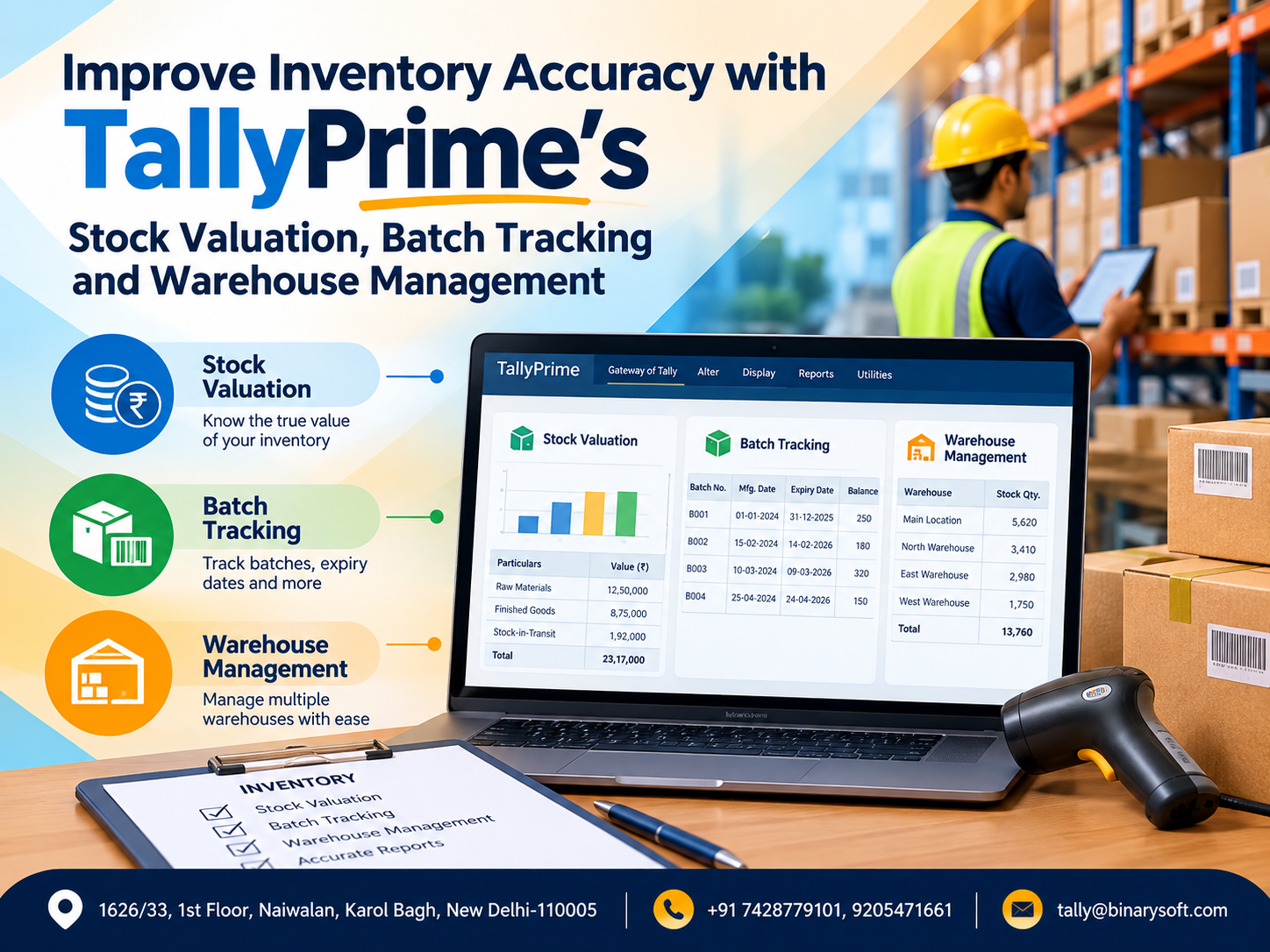
TallyPrime offers practical inventory management features, including stock valuation, batch-wise tracking, expiry information, godown management, stock transfers, inventory ageing analysis, physical stock adjustments, and reorder-related reporting.
These capabilities help businesses maintain more organized stock records and gain better visibility into inventory quantities and values.
Retailers, wholesalers, manufacturers, distributors, and other inventory-intensive businesses can benefit from implementing these features alongside consistent inventory procedures.
The real value of TallyPrime inventory management lies in helping businesses transform stock information into better purchasing decisions, stronger warehouse control, more reliable financial reporting, and sustainable business growth.
Powered by Binarysoft Technologies
Authorized Tally Partner
Binarysoft Technologies provides TallyPrime-related solutions and assistance for businesses seeking better accounting, inventory management, GST compliance, stock valuation, batch tracking, and warehouse-wise inventory control.
Whether your business operates a retail shop, wholesale distribution network, manufacturing unit, or multiple warehouses, properly configured TallyPrime inventory features can support more accurate stock records and efficient business operations.
Location: 1626/33, 1st Floor, Naiwalan, Karol Bagh, New Delhi – 110005, INDIA
Contact Us: +91 7428779101, 9205471661
Email Us: tally@binarysoft.com
Business Hours: 10:00 AM – 6:00 PM, Monday to Friday
Frequently Asked Questions
What is inventory management in TallyPrime?
Inventory management in TallyPrime involves recording and monitoring stock items, purchases, sales, warehouse movements, batch details, and inventory values. It helps businesses maintain organized stock records and review inventory information.
How does TallyPrime improve inventory accuracy?
TallyPrime supports inventory accuracy through structured stock masters, stock transactions, godown management, batch tracking, stock reports, and physical stock adjustments. Accurate results depend on correct data entry and regular stock verification.
CA. Arinav Chakraborty advises businesses on taxation, accounting systems, and financial planning. His professional interests include digital transformation, compliance management, and improving business efficiency through technology.