Call CA Tally HelpDesk
+91 9205471661,
7428779101
Introduction: Why Profitable Businesses Sometimes Struggle to Pay Their Bills
A business may have strong sales, regular customers and increasing profits, yet still struggle to pay suppliers, salaries and everyday operating expenses.
This situation is more common than many entrepreneurs realize.
The reason is often insufficient working capital.
Imagine a manufacturing company receiving a large customer order. The company must purchase raw materials, pay employees, cover electricity expenses and complete production before receiving payment.
Even though the order is profitable, the business needs money to finance operations until the customer pays.
Similarly, a wholesaler may have substantial inventory and outstanding customer invoices but insufficient cash to purchase additional stock.
These situations demonstrate why working capital assessment is essential for financial stability.
Working capital assessment helps businesses estimate the funds required to maintain daily operations. Banks also use various assessment methods to evaluate financing requests and determine suitable credit limits.
For Indian businesses seeking cash credit, overdraft or other working capital facilities, understanding these methods can improve financial planning and loan preparation.
Accounting software such as TallyPrime helps businesses maintain financial records, monitor receivables and payables, review inventory and analyze cash flow information.
This guide explains the meaning, importance, formulas and major working capital assessment methods, along with practical examples, two case studies and how TallyPrime supports financial management.
1. What Is Working Capital?
Working capital represents the difference between a business's current assets and current liabilities.
It indicates the financial resources available to support short-term operations.
Working Capital Formula
Net Working Capital = Current Assets − Current Liabilities
Current assets generally include cash, bank balances, inventory, trade receivables and other assets expected to be realized within the operating cycle or applicable short-term period.
Current liabilities include trade payables, short-term borrowings, accrued expenses and other obligations due within the relevant period.
Practical Example
Consider a trading business with the following financial position:
| Particulars | Amount |
|---|
| Inventory |
₹12,00,000 |
| Trade Receivables |
₹8,00,000 |
| Cash and Bank |
₹3,00,000 |
| Other Current Assets |
₹2,00,000 |
| Total Current Assets |
₹25,00,000 |
| Trade Payables |
₹9,00,000 |
| Short-Term Borrowings |
₹5,00,000 |
| Other Current Liabilities |
₹2,00,000 |
| Total Current Liabilities |
₹16,00,000 |
Net Working Capital = ₹25,00,000 − ₹16,00,000
Net Working Capital = ₹9,00,000
A positive working capital balance generally indicates that current assets exceed current liabilities.
However, positive working capital does not automatically guarantee sufficient cash.
A business may have substantial receivables or slow-moving inventory that cannot immediately be converted into cash.
2. What Is Working Capital Assessment?
Working capital assessment is the process of estimating how much financing a business requires to support its operating activities.
It considers the timing of cash payments and collections, inventory requirements, operating expenses and available funding.
The objective is to determine the appropriate level of working capital rather than simply borrowing the maximum possible amount.
Businesses use working capital assessment for internal financial planning.
Banks use it to evaluate credit requirements, repayment capacity and financial risk.
Main Objectives
-
Estimate funds required for daily operations.
-
Identify shortages in operational cash.
-
Evaluate inventory and receivable financing needs.
-
Determine appropriate borrowing requirements.
-
Maintain sufficient liquidity.
-
Reduce unnecessary financing costs.
-
Support uninterrupted business operations.
Effective assessment helps businesses balance liquidity and profitability.
3. An Emotional Story: The Business Owner Who Had Orders but No Money
For eighteen years, Amit had operated a packaging manufacturing business in Delhi.
He started with a small workshop and gradually built relationships with retailers and manufacturing companies.
His business supported several employees whose families depended on regular salaries.
One year, Amit received the largest order in his company's history.
The customer wanted packaging materials worth ₹40 lakh.
For Amit, the order represented an opportunity to expand production and improve his family's financial future.
He immediately purchased raw materials and arranged additional production shifts.
However, the customer had negotiated a 60-day payment period.
Meanwhile, raw material suppliers required payment within 20 days.
Employee salaries, transportation charges and electricity bills also had to be paid.
Within weeks, Amit faced an unexpected financial crisis.
His factory was busy, but the bank account was nearly empty.
He struggled to understand how a profitable order could create such pressure.
One evening, while reviewing pending payments, he worried about whether he could pay his employees on time.
His accountant explained the problem.
The company had not properly estimated its working capital requirement.
Cash was being paid to suppliers and employees long before customer collections arrived.
Together, they reviewed inventory levels, outstanding receivables, supplier credit periods and monthly expenses.
They prepared a working capital forecast and identified the funding gap.
The business also organized its accounting information using TallyPrime to monitor customer balances, inventory and payment obligations.
With better financial planning, Amit approached his bank with a clearer assessment of the company's requirements.
The experience changed how he viewed business growth.
He realized that receiving a large order was only the beginning.
The business also needed sufficient financial resources to complete the order successfully.
For Amit, working capital management became more than an accounting exercise. It became a way to protect employee salaries, customer relationships and the business he had spent years building.
This is an illustrative story created to explain the importance of working capital assessment.
4. Why Is Working Capital Assessment Important?
Maintaining Business Continuity
Adequate working capital helps businesses pay suppliers, employees and operating expenses on time.
Avoiding Cash Shortages
Regular assessment identifies potential funding gaps before they disrupt operations.
Supporting Business Expansion
Growing sales often require additional investment in inventory and receivables.
Improving Borrowing Decisions
Businesses can estimate how much bank finance they genuinely require.
Reducing Financing Costs
Accurate assessment helps avoid unnecessary borrowing and associated interest expenses.
Strengthening Supplier Relationships
Timely payments support better relationships with suppliers.
Improving Financial Stability
Working capital planning helps businesses prepare for seasonal demand and unexpected expenses.
5. Major Working Capital Assessment Methods Used by Businesses and Banks
Different assessment methods are suitable for different business models.
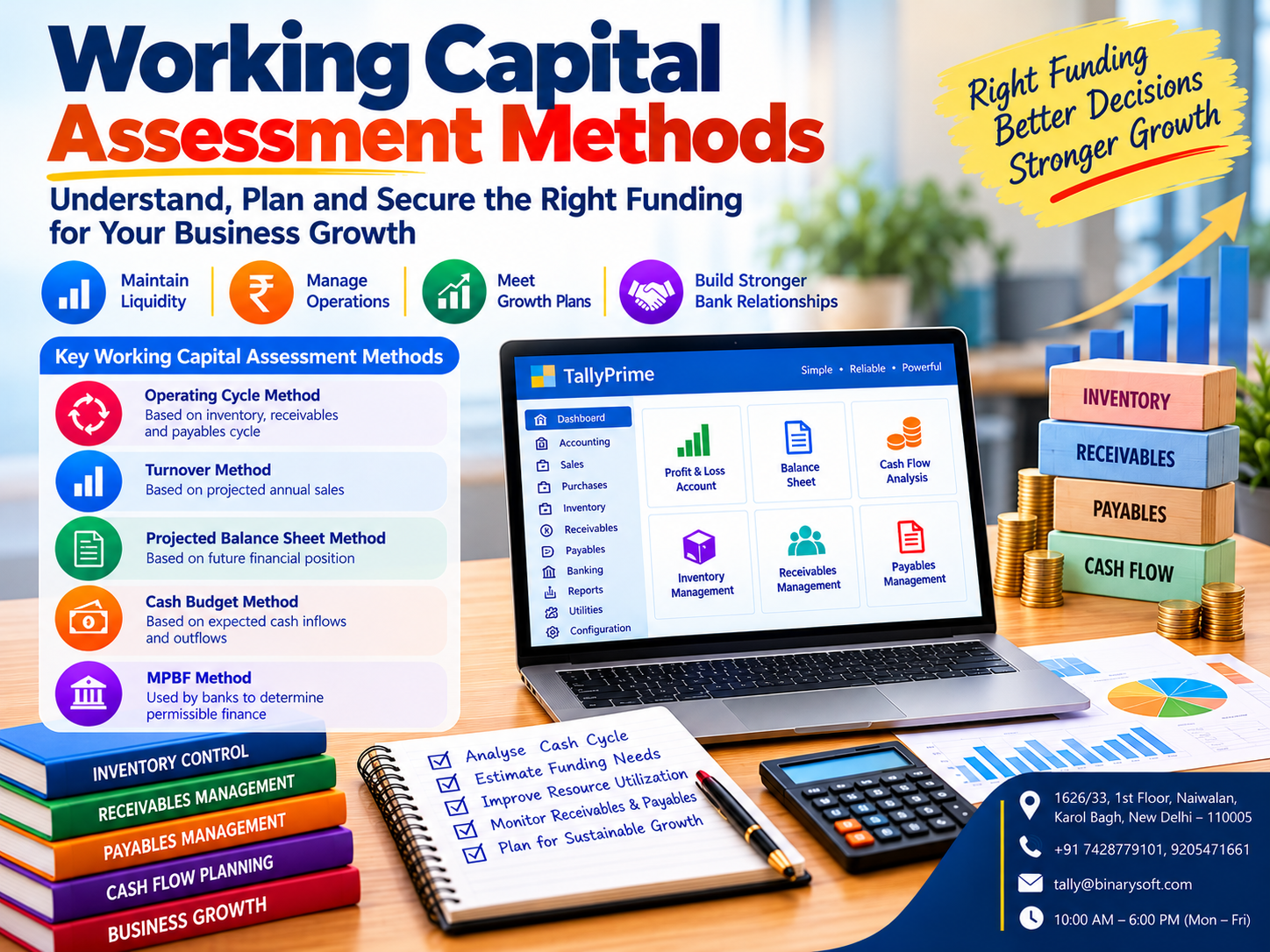
Common approaches include the operating cycle method, turnover method, projected balance sheet method, cash budget method and Maximum Permissible Bank Finance framework.
Banks may also apply internal credit policies, drawing-power calculations and borrower-specific assessments.
No single method is mandatory for every borrower or lending facility.
5.1 Operating Cycle Method
The operating cycle method estimates working capital based on the time required to convert operating expenditure into customer collections.
It considers inventory holding periods, production time, customer credit and supplier credit.
Cash Conversion Cycle = Inventory Days + Receivable Days − Payable Days
For manufacturing businesses, inventory days may include raw materials, work-in-progress and finished goods.
Example
Suppose a company has:
Inventory holding period: 45 days
Customer collection period: 60 days
Supplier credit period: 30 days
Cash conversion cycle:
45 + 60 − 30 = 75 days
The business must finance its operating costs for approximately 75 days.
A longer cash conversion cycle generally increases working capital requirements.
5.2 Turnover Method
The turnover method estimates working capital requirements using projected annual sales.
A commonly referenced illustrative approach assumes working capital requirements equal 25% of projected annual turnover, with borrower contribution and bank finance considered separately.
Historically, this approach has been associated with simplified bank assessment practices for eligible borrowers.
However, banks may use different policies and assessment criteria.
Example
Projected annual turnover = ₹2 crore
Illustrative working capital requirement at 25%:
₹2 crore × 25% = ₹50 lakh
If the borrower contributes 5% of projected turnover:
Borrower contribution = ₹10 lakh
Indicative bank finance:
₹50 lakh − ₹10 lakh = ₹40 lakh
This calculation is illustrative and does not establish loan eligibility or an approved credit limit.
5.3 Projected Balance Sheet Method
Under this method, businesses prepare projected financial statements to estimate future current assets and current liabilities.
The projected balance sheet helps identify the expected working capital gap.
Example
| Particulars | Projected Amount |
|---|
| Current Assets |
₹80 lakh |
| Current Liabilities Excluding Proposed Bank Borrowing |
₹35 lakh |
| Working Capital Gap |
₹45 lakh |
The business must determine how the gap will be financed through owner funds, bank facilities or other suitable sources.
Banks may assess the projected figures alongside historical performance, repayment capacity and internal lending policies.
5.4 Cash Budget Method
The cash budget method estimates working capital needs by forecasting cash receipts and payments.
It is particularly useful for businesses with seasonal operations, irregular collections or project-based cash flows.
Example
| Particulars | Amount |
|---|
| Opening Cash Balance |
₹3,00,000 |
| Expected Cash Receipts |
₹12,00,000 |
| Supplier Payments |
₹8,00,000 |
| Salary Payments |
₹4,00,000 |
| Other Operating Payments |
₹5,00,000 |
| Closing Cash Before Financing |
−₹2,00,000 |
The business faces an estimated cash shortfall of ₹2 lakh.
A cash budget helps management identify when financing is needed.
5.5 Maximum Permissible Bank Finance (MPBF) Method
MPBF is a traditional bank assessment framework associated with the Tandon Committee approach.
It evaluates working capital requirements using current assets, eligible current liabilities and borrower contribution.
Different historical MPBF methods used different margin calculations.
For example, under the traditional second method, the borrower was expected to provide a minimum contribution equivalent to 25% of total current assets.
The resulting permissible bank finance was calculated after considering other current liabilities.
Modern banks may use different assessment frameworks according to their policies and applicable regulatory requirements.
Therefore, MPBF should be understood as a traditional assessment approach rather than a universal rule for every current working capital loan.
6. Working Capital Assessment Methods: Comparison
| Method | Main Basis | Suitable Application |
|---|
| Operating Cycle |
Inventory and collection periods |
Manufacturing and trading |
| Turnover Method |
Projected annual sales |
Simplified turnover-based assessment |
| Projected Balance Sheet |
Forecast current assets and liabilities |
Businesses with detailed financial projections |
| Cash Budget |
Expected receipts and payments |
Seasonal and project-based businesses |
| MPBF Framework |
Current assets and financing margins |
Traditional bank finance assessment |
The most suitable method depends on the business model, financing requirement and lender's assessment policies.
7. How Banks Evaluate Working Capital Funding Requirements
Banks generally consider several financial and operational factors before approving working capital facilities.
Business Financial Performance
Banks review financial statements, profitability and operating performance.
Sales and Turnover
Historical and projected sales help lenders understand business activity.
Inventory Requirements
Banks evaluate inventory levels, stock movement and relevant valuation information.
Receivables Quality
Customer outstanding amounts, collection periods and overdue balances influence financing assessment.
Supplier Credit
Available supplier credit can reduce the need for external working capital.
Cash Flow
Banks evaluate whether the business can generate sufficient cash to meet obligations.
Existing Borrowings
Current loan commitments and repayment obligations are also considered.
Credit History and Security
Lenders may assess credit behavior, collateral and other risk factors.
Approval depends on the bank's credit policies and applicable requirements.
8. Understanding Cash Credit, Overdraft and Working Capital Loans
Businesses can use different financing facilities to meet short-term requirements.
Cash Credit
Cash credit is commonly used to finance business operations against eligible current assets or other approved security.
Interest is generally charged according to the facility terms and utilization.
Overdraft
An overdraft allows eligible borrowers to withdraw funds beyond their available account balance within an approved limit.
Working Capital Term Loan
A working capital term loan provides financing under an agreed repayment schedule.
Bill Discounting
Eligible trade receivables may be financed through bill discounting or similar arrangements.
Other Receivables Financing
Businesses may explore suitable invoice financing arrangements depending on eligibility and lender terms.
Each facility has different documentation, security, interest and repayment conditions.
9. How TallyPrime Helps with Working Capital Assessment
TallyPrime provides accounting and financial reporting features that support working capital analysis.
9.1 Receivables Management
Businesses can monitor customer outstanding balances and overdue invoices.
This helps identify collection delays and evaluate cash expected from customers.
9.2 Payables Management
Supplier outstanding reports help businesses understand upcoming payment obligations.
9.3 Inventory Management
TallyPrime provides inventory records and stock reports that support stock monitoring.
Businesses can review stock quantities, valuations and relevant movement information.
9.4 Cash Flow Reporting
Cash flow reports help management review historical cash movements and understand liquidity.
9.5 Balance Sheet Analysis
The Balance Sheet provides information about current assets and liabilities.
9.6 Sales Reporting
Sales reports help businesses analyze turnover and historical business performance.
9.7 Ratio Analysis
Relevant financial reports can support liquidity and performance analysis.
9.8 Financial Record Preparation
Organized accounting records help businesses prepare information required for discussions with lenders.
TallyPrime supports data collection and reporting, while financing projections and bank-specific assessment calculations may require separate worksheets.
10. Step-by-Step: Assessing Working Capital Using TallyPrime
Step 1: Review the Balance Sheet. Identify current assets and current liabilities.
Step 2: Examine receivables. Review customer outstanding balances and overdue amounts.
Step 3: Analyze payables. Identify supplier obligations and expected payment dates.
Step 4: Review inventory. Examine stock levels and valuation reports.
Step 5: Analyze sales. Use historical turnover to develop realistic sales forecasts.
Step 6: Review cash flow. Understand cash receipts, payments and liquidity patterns.
Step 7: Estimate the operating cycle. Calculate inventory, receivable and payable periods using appropriate data.
Step 8: Prepare financial projections. Estimate future inventory, receivables, payables and operating expenses.
Step 9: Calculate funding requirements. Apply the assessment method appropriate to the business and financing arrangement.
Step 10: Monitor performance. Compare actual results with forecasts and update the working capital plan.
This process helps businesses make financing decisions using more reliable accounting information.
11. Case Study 1: Manufacturing Company Manages a Working Capital Shortage
Business Background
A manufacturing company supplied components to industrial customers.
Its sales were increasing, but customer payments were frequently received after 60 days.
Challenges
The company needed to purchase raw materials and pay employees before receiving customer collections.
This created recurring cash shortages.
Solution Using TallyPrime
Management reviewed inventory records, receivables and supplier outstanding reports.
The finance team calculated the operating cycle and prepared a working capital forecast.
The company also improved customer follow-up procedures and reviewed inventory purchasing practices.
Illustrative Results
Suppose the company's cash conversion cycle was initially 90 days.
After improving inventory movement and customer collections, the cycle declined to 65 days.
This reduced the period for which operating costs required financing.
Key Learning
Improving inventory turnover and customer collections can reduce working capital pressure.
This is an illustrative case study, not a documented customer implementation.
12. Case Study 2: Wholesale Distributor Prepares for Bank Financing
Business Background
A wholesale distributor supplied electrical products to retailers.
The company wanted to expand its product range and increase inventory.
Challenges
Management needed additional funds but was uncertain about the appropriate borrowing amount.
Solution Using TallyPrime
The finance team reviewed historical turnover, inventory levels, customer outstanding amounts and supplier obligations.
Projected sales and working capital requirements were prepared using a separate financial model.
The company organized supporting accounting information for discussion with its bank.
Illustrative Results
The assessment helped management estimate its financing gap and distinguish necessary borrowing from avoidable inventory accumulation.
The company could evaluate different financing options using more realistic assumptions.
Key Learning
Reliable financial records improve the quality of working capital planning and bank financing discussions.
This is an illustrative case study intended to demonstrate potential business benefits.
13. Common Working Capital Management Mistakes
Excessive Inventory
Holding unnecessary stock ties up cash and increases storage costs.
Delayed Customer Collections
Long collection periods increase financing requirements.
Poor Cash Forecasting
Businesses may face shortages when expected payments are delayed.
Ignoring Supplier Payment Dates
Unplanned payments can create liquidity pressure.
Overestimating Sales
Unrealistic projections may lead to excessive inventory purchases or borrowing.
Using Short-Term Funds for Long-Term Investments
Financing fixed assets through short-term operating facilities can create repayment mismatches.
Inaccurate Accounting Records
Incorrect receivable, payable or inventory information can distort funding estimates.
Regular financial review helps businesses identify these problems early.
14. Important Working Capital Ratios
Current Ratio
Current Ratio = Current Assets ÷ Current Liabilities
This ratio measures short-term liquidity.
Quick Ratio
Quick Ratio = Quick Assets ÷ Current Liabilities
Quick assets generally exclude inventory and certain other less-liquid current assets.
Inventory Turnover Ratio
Inventory Turnover = Cost of Goods Sold ÷ Average Inventory
This ratio indicates how efficiently inventory is converted into sales.
Receivables Turnover Ratio
Receivables Turnover = Net Credit Sales ÷ Average Trade Receivables
This ratio helps evaluate customer collection efficiency.
Working Capital Turnover Ratio
Working Capital Turnover = Net Sales ÷ Average Net Working Capital
This ratio measures sales relative to working capital employed.
Ratios should be interpreted according to the industry, business model and financial circumstances.
15. Best Practices for Effective Working Capital Management
Prepare regular cash forecasts. Estimate expected receipts and payments.
Monitor receivables. Follow up on overdue customer invoices.
Review inventory. Identify slow-moving and excess stock.
Manage supplier payments. Plan payments according to agreed terms.
Maintain accurate accounting records. Reconcile relevant balances regularly.
Review financial ratios. Monitor liquidity and operating efficiency.
Use realistic sales projections. Avoid unnecessary inventory accumulation.
Maintain financial reserves. Prepare for unexpected operating expenses.
Evaluate financing costs. Compare borrowing options carefully.
Review working capital requirements periodically. Update forecasts when business conditions change.
These practices help businesses maintain liquidity while controlling financing requirements.
16. How Working Capital Assessment Supports Business Growth
Business expansion often increases working capital requirements.
Higher sales may require additional inventory, more employees and greater customer credit.
Without proper planning, rapid growth can create serious cash flow pressure.
Working capital assessment helps businesses identify these requirements before committing to expansion.
It also encourages management to distinguish between profitable sales and available cash.
A company may report strong profits while substantial funds remain tied up in inventory and receivables.
Regular assessment helps management identify financing gaps, improve operational efficiency and maintain financial stability.
17. How Binarysoft Technologies Helps Businesses Use TallyPrime
Binarysoft Technologies, an Authorized Tally Partner, helps businesses explore TallyPrime solutions for accounting, inventory and financial management.
Accounting Setup
Assistance with company configuration, ledgers and voucher recording.
Receivables Management
Guidance on monitoring customer outstanding balances.
Payables Management
Understanding supplier outstanding reports and payment obligations.
Inventory Accounting
Exploring stock management, valuation and inventory reporting features.
Financial Reporting
Using Balance Sheet, Profit & Loss and cash flow information.
Sales and Purchase Analysis
Reviewing transaction information relevant to business planning.
TallyPrime Cloud
Exploring suitable hosted arrangements for authorized remote accounting access.
Financial Data Management
Understanding backup procedures and organized accounting records.
A well-maintained accounting system provides useful information for working capital planning and financial decision-making.
18. Conclusion: Better Working Capital Assessment Creates Stronger Financial Stability
Working capital assessment is an essential part of responsible business financial management.
It helps organizations determine how much funding is required to maintain daily operations and support growth.
Methods such as the operating cycle approach, turnover method, projected balance sheet method, cash budget method and traditional MPBF framework provide different ways to evaluate financing needs.
The appropriate approach depends on the business model, operating cycle, financial projections and lender requirements.
For businesses seeking bank finance, accurate accounting information and realistic forecasts are particularly important.
TallyPrime supports working capital management through receivables, payables, inventory accounting, cash flow information and financial reporting.
These features help businesses understand their financial position and prepare information for working capital assessment.
However, accounting software does not replace bank credit appraisal or professional financial judgment.
Ultimately, successful working capital management is about ensuring that money is available when the business needs it.
A business that manages working capital effectively can serve customers consistently, pay employees on time, maintain supplier relationships and pursue growth with greater financial confidence.
Powered by Binarysoft Technologies
Authorized Tally Partner
Location: 1626/33, 1st Floor, Naiwalan, Karol Bagh, New Delhi – 110005, INDIA
Contact Us: +91 7428779101, 9205471661
Email Us: tally@binarysoft.com
Business Hours: 10:00 AM – 6:00 PM, Monday to Friday
Frequently Asked Questions
How can businesses reduce working capital requirements?
Businesses can improve collections, optimize inventory, manage supplier payments and prepare accurate cash forecasts.
Is working capital assessment necessary for small businesses?
Yes. Small businesses benefit from understanding their operating cash requirements and financing gaps.
How can businesses improve working capital management with TallyPrime?
Businesses can use TallyPrime to maintain accurate accounting records, monitor outstanding balances, review inventory and analyze financial reports.
Can profitable businesses face working capital shortages?
Yes. Profitable businesses may experience cash shortages when customer collections are delayed or funds remain tied up in inventory.
CA. Aarav Bhandari specializes in GST compliance, accounting systems, and business advisory services. He regularly writes about tax updates, accounting automation, and financial best practices to help businesses improve efficiency and maintain statutory compliance.