Call CA Tally HelpDesk
+91 9205471661,
7428779101
Introduction: Why Construction Contractors Need Better Project-Wise Accounting
Running a construction business involves much more than completing projects on time.
Contractors must manage construction materials, labour expenses, subcontractor payments, machinery costs, transportation charges, customer billing and project profitability.
A contractor may handle several projects simultaneously, each with different budgets, timelines and financial requirements.
Without proper accounting, identifying the actual profit earned from individual projects becomes difficult.
For example, a contractor managing three construction sites may purchase cement, steel and electrical materials for different locations.
If all expenses are recorded together, management may know the company's total expenditure but struggle to determine which project is profitable.
This is where project-wise costing and construction accounting software become important.
A structured accounting system helps contractors allocate expenses, monitor project budgets, control material purchases and understand financial performance.
TallyPrime provides accounting, inventory, cost-centre and financial reporting features that can support construction contractors in managing their operations.
This article explains how construction accounting works, why project-wise costing matters, and how contractors can use TallyPrime to improve financial visibility and business profitability.
1. What Is Construction Accounting Software?
Construction accounting software helps contractors maintain financial records related to construction projects.
Unlike businesses that primarily sell finished products, construction contractors often incur expenses over extended periods before receiving full payment.
These expenses may include:
-
Cement, steel, bricks and other construction materials.
-
Skilled and unskilled labour.
-
Subcontractor payments.
-
Machinery rental and maintenance.
-
Site transportation expenses.
-
Electricity and water charges.
-
Administrative and project overheads.
Construction accounting software helps organize these transactions and supports financial analysis.
An effective accounting system should enable contractors to understand the financial position of their business and individual projects.
For project-wise costing, the ability to classify income and expenses by project is particularly valuable.
2. An Emotional Story: The Contractor Who Worked Hard but Could Not Find His Profit
Rajesh had been a construction contractor in Delhi for nearly fifteen years.
He began his career supervising small renovation projects.
Over time, his dedication helped him secure contracts for residential buildings and commercial properties.
His business grew from a handful of workers to several construction teams.
Rajesh believed that completing more projects would automatically improve his financial position.
One year, he accepted three major construction contracts.
His employees worked long hours, materials arrived regularly, and construction activity continued across multiple sites.
Yet something unexpected happened.
Despite receiving substantial payments from customers, Rajesh struggled to pay suppliers.
His accountant informed him that the business had very little available cash.
Rajesh was confused.
He had completed several projects successfully, so where had the money gone?
After reviewing the records, he discovered the problem.
Expenses from different construction sites had been recorded together.
Additional material purchases, repeated transportation charges and unexpected labour expenses were not being properly monitored against individual project budgets.
One project had generated a reasonable profit.
Another had barely broken even.
The third had exceeded its estimated cost.
Rajesh remembered promising his family that the business would provide greater financial security.
Instead, he was borrowing money to pay workers.
He decided to change his accounting practices.
With professional guidance, his team began maintaining project-wise financial records using TallyPrime.
They allocated expenses to individual projects, monitored supplier balances and compared project costs with estimated budgets.
Over time, Rajesh gained a clearer understanding of his construction business.
He could identify cost overruns earlier and make better decisions before accepting new contracts.
One evening, while reviewing a completed project's financial performance, he finally understood how much profit the project had earned.
For Rajesh, the greatest achievement was not simply completing another building.
It was gaining financial clarity over the business he had spent years building.
This is an illustrative story created to explain the importance of project-wise construction accounting.
3. What Is Project-Wise Costing in Construction?
Project-wise costing is the process of identifying and allocating income and expenses to individual construction projects.
It helps contractors determine how much money has been spent on each project and compare expenditure with the project's revenue and budget.
Example of Project-Wise Costing
Consider a contractor managing a residential construction project.
| Expense Category | Amount |
|---|
| Cement and Steel |
₹12,00,000 |
| Bricks and Other Materials |
₹5,00,000 |
| Labour Expenses |
₹8,00,000 |
| Subcontractor Charges |
₹4,00,000 |
| Machinery and Equipment |
₹2,00,000 |
| Transportation |
₹1,50,000 |
| Other Project Expenses |
₹1,50,000 |
| Total Project Cost |
₹34,00,000 |
Suppose the contractor earns ₹42,00,000 from the project.
Project Profit = Project Revenue − Project Cost
₹42,00,000 − ₹34,00,000 = ₹8,00,000
Project Profit Margin = (Project Profit ÷ Project Revenue) × 100
(₹8,00,000 ÷ ₹42,00,000) × 100 = 19.05%
This simplified calculation excludes any additional unallocated costs, financing expenses, taxes or adjustments that may be relevant.
Project-wise costing helps contractors understand whether their actual financial performance matches expectations.
4. Why Is Project-Wise Costing Important for Contractors?
Accurate Project Profitability
Contractors can identify the income and expenditure associated with each project.
Better Budget Control
Project-wise reports help management compare estimated and actual costs.
Improved Material Management
Contractors can monitor material purchases and consumption.
Labour Expense Visibility
Project-wise labour allocations help identify differences in workforce costs.
Better Subcontractor Management
Separate records make it easier to monitor subcontractor bills and payments.
Improved Financial Planning
Management can estimate future project requirements using historical cost information.
Reduced Risk of Cost Overruns
Regular financial reviews help identify unexpected expenses before they become difficult to control.
5. Major Challenges in Construction Accounting
Construction contractors face several accounting challenges.
Multiple Construction Sites
Managing expenses across different locations requires consistent transaction classification.
Fluctuating Material Prices
Changes in cement, steel and other material prices can affect project profitability.
Labour Cost Management
Labour requirements vary according to construction stages and project schedules.
Subcontractor Payments
Contractors must track subcontractor invoices, advances and outstanding amounts.
Delayed Customer Payments
Construction contracts may involve milestone-based billing and delayed collections.
Budget Overruns
Unexpected site conditions and design changes may increase project costs.
GST and Tax Compliance
Construction-related transactions may require careful treatment of GST, TDS and other applicable obligations.
An organized accounting system helps businesses manage these challenges more effectively.
6. How TallyPrime Helps Construction Contractors
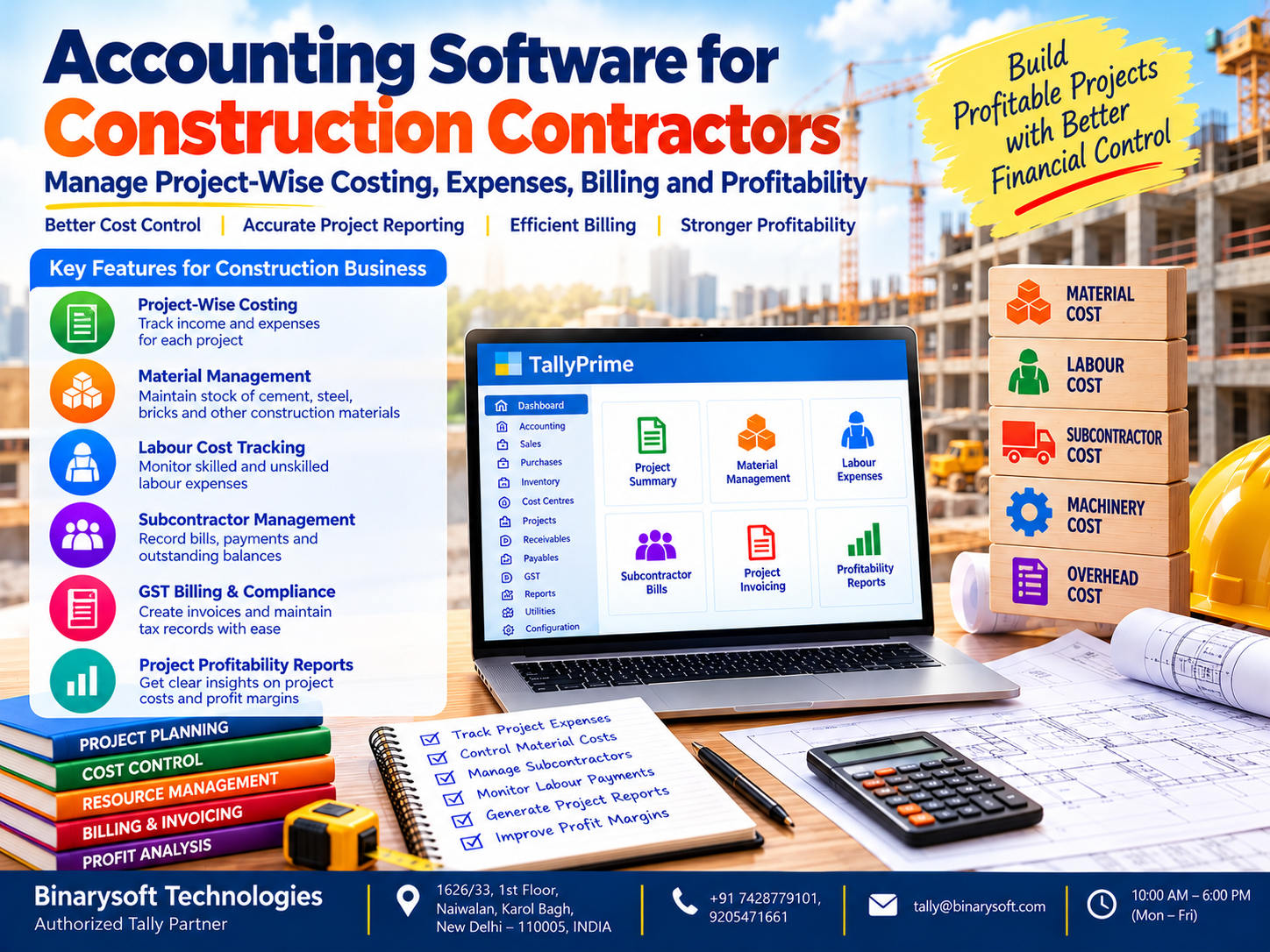
TallyPrime provides several features that can support construction accounting.
6.1 Project-Wise Cost Allocation
Contractors can use cost centres to classify relevant income and expenses according to construction projects.
For example, a contractor may create cost centres for:
Project A – Residential Building
Project B – Commercial Complex
Project C – Warehouse Construction
Relevant transactions can then be allocated to the appropriate project.
This helps management analyze project-level financial performance.
6.2 Construction Material Accounting
TallyPrime supports inventory management through stock items, stock groups and inventory transactions.
Contractors can maintain records for materials such as cement, steel, bricks, electrical supplies and plumbing materials.
Additional controls and suitable transaction practices are required to accurately track site-wise consumption.
6.3 Labour Expense Tracking
Labour expenses can be recorded through appropriate accounting ledgers and allocated to cost centres.
This supports project-wise analysis of recorded labour expenditure.
6.4 Subcontractor Accounting
Contractors can maintain separate supplier ledgers for subcontractors.
Bills, payments and outstanding balances can be monitored through accounting reports.
6.5 Purchase Management
Material purchase transactions can be recorded and reviewed.
This helps contractors monitor supplier costs and purchasing activity.
6.6 Customer Billing
TallyPrime supports sales invoicing and applicable tax configuration.
Construction billing requirements may involve contract-specific documentation and additional calculations.
6.7 Financial Reporting
Profit & Loss, Balance Sheet, cash flow and other reports help contractors understand overall business performance.
Cost-centre reports can support project-level financial analysis.
7. How to Set Up Project-Wise Costing in TallyPrime
Contractors can establish a structured accounting process using the following steps.
Step 1: Create the Company
Set up the construction business in TallyPrime with the relevant financial year and statutory details.
Step 2: Configure Cost Centres
Enable cost-centre functionality where applicable.
Create separate cost centres for individual construction projects.
Step 3: Create Expense Ledgers
Maintain suitable ledgers for construction materials, labour, transportation, machinery rental and other expenses.
Step 4: Configure Inventory
Create stock items for relevant construction materials.
Use appropriate units of measurement, such as bags, kilograms, tonnes or pieces.
Step 5: Record Purchases
Enter material purchase transactions and preserve supporting invoices.
Step 6: Allocate Expenses
Allocate applicable project expenses to the corresponding cost centres.
Step 7: Record Customer Billing
Record invoices according to contract terms and applicable accounting requirements.
Step 8: Monitor Outstanding Amounts
Review customer receivables and supplier payables regularly.
Step 9: Analyze Cost-Centre Reports
Examine project-wise income and expenditure allocations.
Step 10: Compare Actual Costs with Budgets
Use recorded project expenses and separately maintained project estimates to identify variances.
Where suitable, TallyPrime's budgeting capabilities can also support financial monitoring.
Important: Accurate project profitability depends on consistent cost allocation, correct inventory treatment and suitable recognition of contract revenue and expenses.
8. Construction Material Management with TallyPrime
Materials often represent a significant portion of construction expenditure.
Poor material management can increase costs through wastage, theft, damage or unnecessary purchases.
Contractors can use TallyPrime inventory features to organize material records.
Common Construction Materials
| Material | Common Unit |
|---|
| Cement |
Bags |
| Steel |
Kilograms or Tonnes |
| Bricks |
Pieces |
| Sand |
Cubic Metres |
| Electrical Cable |
Metres |
| Tiles |
Boxes or Square Metres |
Maintaining suitable stock items helps contractors review quantities and valuations.
Godowns or locations can be configured where appropriate to support location-wise inventory records.
However, accurate site inventory requires timely recording of stock transfers, issues and consumption.
9. Managing Labour Costs in Construction Projects
Labour expenditure can vary significantly between construction stages.
Foundation work, structural construction, electrical installation and finishing activities require different skills.
Contractors should maintain reliable labour records and allocate relevant expenses to projects.
For example:
Project A Labour Expenses: ₹4,50,000
Project B Labour Expenses: ₹6,20,000
Project C Labour Expenses: ₹3,80,000
Project-wise accounting helps management compare labour expenditure with estimates.
Attendance, wage calculations and statutory payroll obligations may require appropriate payroll configuration or additional systems.
TallyPrime accounting entries can then support financial reporting.
10. Managing Subcontractors and Supplier Payments
Construction projects frequently involve specialized subcontractors.
Examples include electrical contractors, plumbing contractors, painting teams and fabrication providers.
Managing subcontractor payments requires proper documentation.
Contractors should record invoices, advances, payments and outstanding amounts.
TallyPrime supplier ledgers and bill-wise accounting can support this process.
Regular reconciliation helps reduce duplicate payments and identify unsettled balances.
Retention money, contract deductions and other specialized arrangements may require carefully designed ledgers and accounting procedures.
11. Construction Project Budgeting and Cost Control
Project budgeting establishes expected expenditure before construction begins.
A basic construction budget may include material, labour, subcontractor, machinery and overhead costs.
Budget vs Actual Example
| Expense | Budget | Actual |
|---|
| Materials |
₹15,00,000 |
₹16,50,000 |
| Labour |
₹8,00,000 |
₹8,50,000 |
| Subcontractors |
₹5,00,000 |
₹4,50,000 |
| Machinery |
₹2,00,000 |
₹2,20,000 |
| Other Expenses |
₹2,00,000 |
₹2,30,000 |
| Total |
₹32,00,000 |
₹34,00,000 |
Cost Overrun = ₹34,00,000 − ₹32,00,000 = ₹2,00,000
Cost Overrun Percentage = 6.25%
Regular variance analysis helps management investigate unexpected expenditure.
Contractors can then review purchasing practices, labour productivity and project execution.
12. Case Study 1: Residential Contractor Improves Project Cost Visibility
Business Background
A residential construction contractor managed four projects simultaneously.
The company maintained accounting records but did not consistently allocate expenses to individual projects.
Challenges
Management struggled to determine which projects were generating profits.
Material purchases and labour expenses were frequently recorded without project classification.
Solution Using TallyPrime
The contractor introduced separate cost centres for each project.
Relevant material purchases, labour expenses and subcontractor charges were classified systematically.
Project estimates were maintained for comparison with actual expenditure.
Illustrative Results
Suppose one project's estimated cost was ₹50 lakh.
Without regular monitoring, actual expenditure was projected to reach ₹55 lakh.
After introducing stronger purchasing controls and periodic cost reviews, the contractor identified avoidable expenditure and limited the final cost to ₹52 lakh.
The difference between the original projection and final cost was ₹3 lakh.
These figures are hypothetical and demonstrate how better information can support cost-control decisions.
Key Learning
Project-wise financial visibility helps contractors identify cost overruns and take corrective action earlier.
This is an illustrative case study, not a documented customer implementation.
13. Case Study 2: Commercial Contractor Improves Payment Management
Business Background
A commercial construction contractor worked with multiple suppliers and subcontractors.
Projects involved substantial material purchases and milestone-based customer billing.
Challenges
The business experienced delayed customer collections and difficulty tracking supplier obligations.
Solution Using TallyPrime
Management organized customer and supplier ledgers.
Bill-wise accounting helped track outstanding invoices.
Cost-centre reporting supported project-wise expense reviews.
The finance team also introduced regular cash flow forecasting outside the accounting system.
Illustrative Results
Suppose average customer collection time was initially 75 days.
Through improved billing procedures and follow-up, the contractor reduced the collection period to 55 days.
This improvement shortened the time between invoicing and receiving cash.
It also helped management plan supplier payments more effectively.
Key Learning
Accurate receivables information and timely customer follow-up can improve construction business liquidity.
This is an illustrative case study intended to demonstrate potential business benefits.
14. GST and Tax Accounting for Construction Contractors
Construction businesses may encounter different GST and direct-tax requirements depending on their activities and contracts.
These may include:
-
GST on applicable construction services.
-
GST treatment of material purchases.
-
Input tax credit eligibility.
-
Reverse charge provisions where applicable.
-
TDS on eligible contractor payments.
-
Contract-specific tax deductions.
TallyPrime provides GST accounting and reporting capabilities that can support compliant recordkeeping when properly configured.
However, tax treatment varies according to transaction type, contract terms and applicable law.
Businesses should obtain professional guidance for complex construction contracts and statutory compliance.
15. Project-Wise Profitability Analysis
Construction contractors should regularly compare project revenue with associated costs.
Project Profit Formula
Project Profit = Recognized Project Revenue − Associated Project Costs
For example:
Recognized Project Revenue: ₹80 lakh
Associated Project Costs: ₹65 lakh
Project Profit: ₹15 lakh
Profit Margin = (₹15 lakh ÷ ₹80 lakh) × 100 = 18.75%
This example is simplified.
Actual financial reporting may require adjustments for work-in-progress, contract assets, retention amounts, revenue recognition and other relevant accounting treatments.
A project may appear profitable based on invoices issued while still facing cash flow shortages.
Therefore, contractors should monitor both profitability and liquidity.
16. How TallyPrime Cloud Can Help Construction Businesses
Construction contractors often work from multiple locations.
Business owners may need access to accounting information while visiting project sites.
A suitable TallyPrime Cloud hosting arrangement can support authorized remote access to accounting data.
Potential benefits include:
-
Access to accounting information from different locations.
-
Centralized financial recordkeeping.
-
Easier coordination between authorized users.
-
Reduced dependence on a single office computer.
-
Support for suitable backup and access-control arrangements.
Actual availability, performance, security and multi-user capabilities depend on the hosting provider, license and configuration.
Cloud hosting does not automatically replace site-management software or construction project scheduling systems.
17. Features to Look for in Construction Accounting Software
Before selecting accounting software, contractors should evaluate their operational requirements.
Project-Wise Cost Allocation
The system should support appropriate classification of project expenses.
Inventory Management
Construction materials should be recorded and monitored systematically.
Supplier and Subcontractor Accounting
The software should support purchase transactions, payments and outstanding balances.
Customer Billing
Contractors need reliable invoicing and receivables records.
Budget Monitoring
Management should be able to compare estimated and actual expenditure.
Financial Reporting
Profitability, cash flow and financial position reports are essential.
Tax Compliance Support
Relevant statutory accounting and reporting capabilities should be available.
Data Security
Appropriate access controls, backups and recovery procedures are important.
Scalability
The system should support increasing transaction volumes and business growth.
18. Common Construction Accounting Mistakes to Avoid
Mixing Project Expenses
Recording expenses without project classification makes profitability analysis difficult.
Ignoring Material Wastage
Unrecorded wastage can distort inventory and project cost information.
Delayed Transaction Recording
Late entries reduce the usefulness of financial reports.
Poor Subcontractor Reconciliation
Unreconciled accounts can lead to disputes and payment errors.
Inaccurate Project Estimates
Unrealistic budgets make cost control difficult.
Ignoring Cash Flow
Profitable projects can still create liquidity problems.
Inadequate Documentation
Missing invoices and supporting records complicate financial review.
Incorrect Revenue Recognition
Construction contracts may require accounting treatment that differs from simply recognizing revenue when cash is received.
Contractors should establish clear accounting procedures and review project records regularly.
19. Best Practices for Construction Project Cost Management
Create separate project cost centres. Classify relevant expenses consistently.
Prepare realistic project budgets. Include materials, labour, subcontractors and contingencies.
Monitor material consumption. Compare actual usage with estimated requirements.
Review labour expenditure. Identify unusual cost increases.
Track subcontractor payments. Maintain accurate outstanding records.
Reconcile customer accounts. Follow up on overdue invoices.
Review project profitability. Compare revenue and associated costs regularly.
Monitor cash flow. Forecast upcoming receipts and payments.
Maintain supporting documentation. Preserve invoices, agreements and payment records.
Use accounting reports for decisions. Review financial information before accepting new contracts.
Consistent financial monitoring can improve project control and reduce avoidable expenditure.
20. How Binarysoft Technologies Helps Construction Contractors with TallyPrime
Binarysoft Technologies, an Authorized Tally Partner, helps businesses explore TallyPrime solutions for accounting, inventory and financial management.
TallyPrime Setup
Assistance with company creation and accounting configuration.
Cost-Centre Configuration
Guidance on setting up cost centres for project-wise expense allocation.
Inventory Management
Exploring stock items, stock groups and inventory reporting.
Supplier Accounting
Maintaining subcontractor and material supplier ledgers.
Customer Outstanding Management
Understanding receivables and bill-wise accounting.
GST Accounting
Guidance on relevant TallyPrime GST configuration and reporting features.
Financial Reports
Using accounting reports to analyze overall business performance.
TallyPrime Cloud
Exploring suitable remote accounting access arrangements.
Backup and Data Management
Understanding appropriate accounting data protection procedures.
These services can help contractors maintain more organized accounting records and improve financial visibility.
21. Conclusion: Better Construction Accounting Creates More Profitable Projects
Construction businesses operate in an environment where costs, timelines and financial requirements can change rapidly.
A contractor may successfully complete several projects but still struggle financially if project costs are not monitored properly.
Project-wise costing provides the financial visibility needed to understand individual project performance.
It helps contractors identify material expenditure, labour costs, subcontractor payments and other operating expenses.
TallyPrime supports construction accounting through cost centres, inventory management, purchase accounting, customer billing, supplier outstanding reports and financial reporting.
When configured and used consistently, these features can help contractors organize financial records and analyze project-level costs.
However, specialized construction requirements such as detailed project scheduling, engineering progress measurement and complex contract accounting may require additional processes or systems.
Ultimately, successful construction accounting is not only about recording expenses.
It is about understanding where money is being spent, identifying financial risks and making better decisions.
With accurate project-wise accounting, contractors can improve cost control, protect profitability and build stronger businesses for the future.
Powered by Binarysoft Technologies
Authorized Tally Partner
Location: 1626/33, 1st Floor, Naiwalan, Karol Bagh, New Delhi – 110005, INDIA
Contact Us: +91 7428779101, 9205471661
Email Us: tally@binarysoft.com
Business Hours: 10:00 AM – 6:00 PM, Monday to Friday
Frequently Asked Questions
How can contractors reduce construction cost overruns?
Contractors can prepare realistic budgets, monitor material consumption, review labour costs and compare actual expenditure with estimates.
What are common construction accounting challenges?
Common challenges include cost overruns, delayed payments, material wastage, subcontractor management and inaccurate project expense allocation.
What is the difference between project costing and general accounting?
General accounting records overall business transactions, while project costing focuses on income and expenses associated with individual projects.
How is construction project profit calculated?
Project profit is generally calculated by deducting appropriately recognized project costs from recognized project revenue.
CA. Ankit Vardiya works closely with traders, wholesalers, and service businesses on accounting automation, GST reporting, and audit readiness. His professional exposure to day-to-day business operations allows him to translate complex accounting concepts into practical guidance for Indian business owners.