Call CA Tally HelpDesk
+91 9205471661,
7428779101
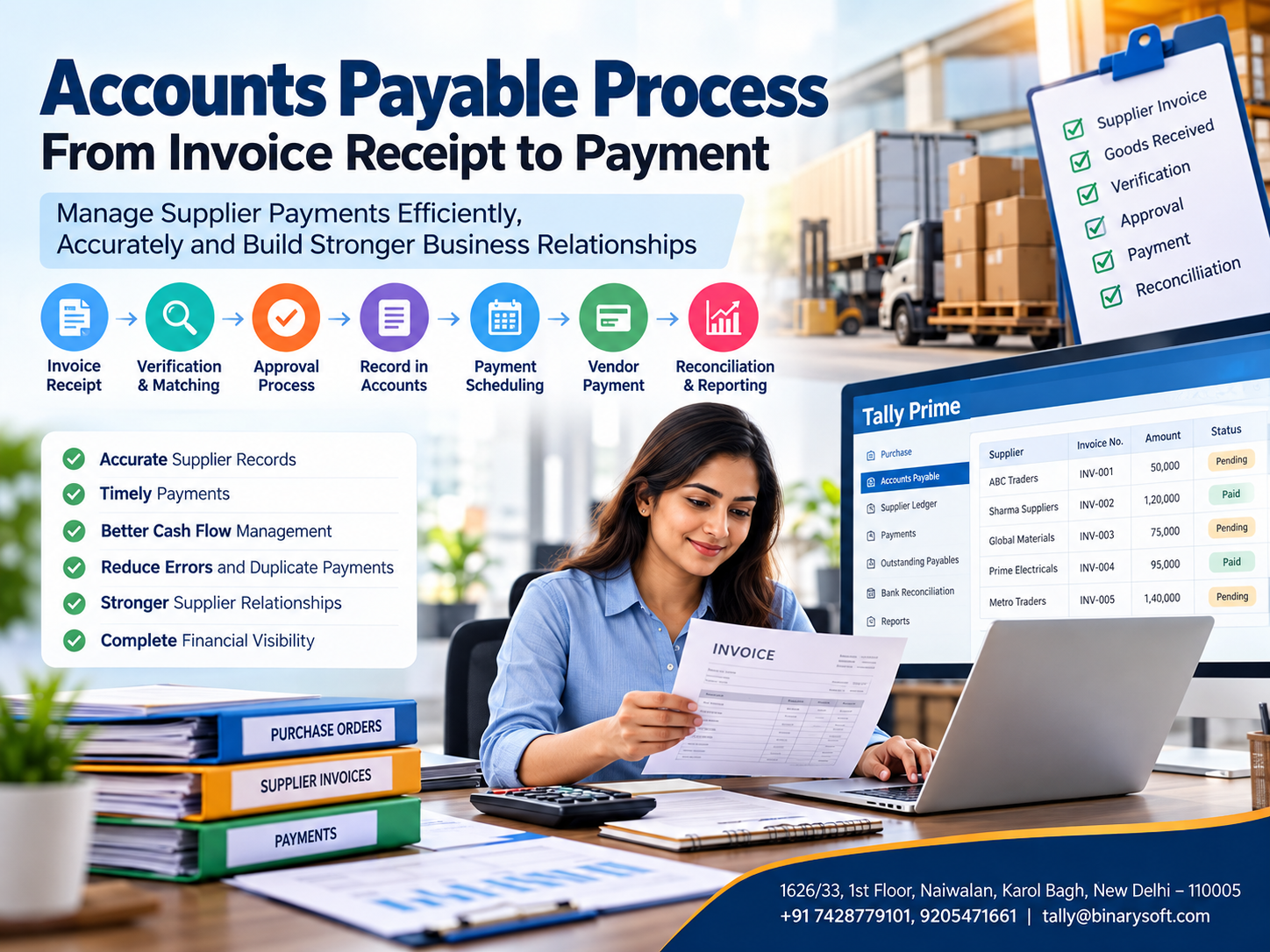
Introduction: Why Every Business Needs an Efficient Accounts Payable Process
Every successful business depends on maintaining healthy relationships with suppliers, managing expenses accurately and ensuring that payments are completed on time. Behind these important activities lies a financial function known as the accounts payable process.
Accounts payable represents the money a business owes to suppliers, vendors and service providers for goods or services purchased on credit.
Whether a company operates in manufacturing, retail, construction, distribution or professional services, managing accounts payable effectively is essential for financial stability.
An inefficient accounts payable system can create several problems, including delayed supplier payments, duplicate invoices, inaccurate financial records, missed discounts and unnecessary pressure on working capital.
Conversely, a structured accounts payable process helps businesses improve financial control, maintain supplier confidence and make better cash flow decisions.
Modern accounting solutions such as Tally Prime simplify accounts payable management by bringing supplier transactions, purchase invoices, outstanding balances and payment records into an integrated accounting environment.
This guide explains the complete accounts payable cycle, from receiving supplier invoices to making payments and reconciling accounts.
It also explores practical business examples and demonstrates how Tally Prime can help organizations manage their financial obligations more efficiently.
A Business Story: When One Delayed Payment Almost Destroyed Years of Trust
For nearly fifteen years, Rajesh had operated a small electrical equipment distribution business in Delhi.
His company supplied electrical components to contractors, retailers and local construction companies.
Over time, Rajesh built strong relationships with suppliers who trusted him enough to provide goods on credit.
However, as his business expanded, managing supplier invoices became increasingly difficult.
Purchase invoices arrived through emails, printed documents and messaging applications. Some were recorded in spreadsheets, while others remained in office files.
One afternoon, Rajesh received an unexpected call from one of his oldest suppliers.
The supplier informed him that several invoices had remained unpaid for more than sixty days.
Rajesh was shocked.
He believed those invoices had already been processed.
After searching through multiple files, his accountant discovered that the invoices had been received but never entered into the payment schedule.
The supplier temporarily stopped further credit deliveries.
Within days, Rajesh faced stock shortages and struggled to fulfil important customer orders.
What hurt him most was not the temporary financial loss. It was the possibility of losing a business relationship built over many years.
He realized that his business had grown, but his accounting process had not grown with it.
Rajesh introduced a structured invoice verification process, maintained supplier-wise outstanding reports and started reviewing payment obligations regularly using Tally Prime.
Gradually, payment visibility improved, overdue invoices became easier to identify and communication with suppliers became more reliable.
The lesson was simple: a business does not lose supplier trust only because it lacks money. Sometimes, it loses trust because it lacks financial visibility.
This is an illustrative story created to explain a common business challenge.
What Is the Accounts Payable Process?
The accounts payable process is a series of financial and administrative activities used to manage payments owed to suppliers and vendors.
It begins when a business receives an invoice for goods or services purchased on credit and ends when the payment is completed, recorded and reconciled.
The process typically involves several departments, including purchasing, inventory management, accounts and finance.
A well-organized accounts payable process ensures that:
-
Supplier invoices are genuine and accurate.
-
Goods or services have been received.
-
Invoice amounts match agreed purchase terms.
-
Payments receive the necessary authorization.
-
Supplier payments are made according to agreed deadlines.
-
Accounting records remain accurate and updated.
-
Financial obligations are visible to management.
For example, a manufacturing company purchasing raw materials worth ₹2,00,000 on thirty-day credit creates an accounts payable obligation.
Until the supplier receives payment, the amount remains outstanding in the company's accounting records.
Efficient management of this obligation is important for maintaining liquidity and avoiding unnecessary supplier disputes.
Why Is Accounts Payable Management Important?
Accounts payable is more than a routine accounting activity. It directly influences business profitability, cash flow and operational efficiency.
1. Maintains Healthy Supplier Relationships
Suppliers prefer working with businesses that consistently honour payment commitments.
Timely payments can help businesses negotiate favourable credit periods, competitive prices and priority deliveries.
2. Improves Cash Flow Management
Businesses must balance incoming customer payments with outgoing supplier obligations.
Accurate accounts payable records help management understand upcoming payment requirements and plan available funds accordingly.
3. Prevents Duplicate Payments
Without proper invoice tracking, the same supplier invoice may accidentally be processed more than once.
A structured verification system reduces this risk.
4. Strengthens Financial Accuracy
Correctly recording supplier invoices ensures that liabilities, expenses and inventory purchases are reflected accurately in financial statements.
5. Supports Tax Compliance
Proper documentation of purchase invoices, GST details and applicable tax deductions supports compliance and simplifies financial reviews.
6. Improves Business Decision-Making
Management can use outstanding payable reports to evaluate supplier exposure, working capital requirements and payment priorities.
Complete Accounts Payable Process: Step-by-Step Explanation
Step 1: Receive the Supplier Invoice
The accounts payable process begins when a supplier submits an invoice for goods delivered or services provided.
Invoices may arrive through email, printed documents or digital billing systems.
Each invoice should contain essential information, including:
-
Supplier name and contact details
-
Invoice number and date
-
Description of goods or services
-
Quantity and unit price
-
Applicable taxes
-
Total invoice value
-
Payment terms and due date
For example, a furniture manufacturer receives an invoice for timber worth ₹75,000 plus applicable GST.
The accounts team must ensure that the invoice is received and recorded correctly.
How Tally Prime Helps
Tally Prime allows businesses to record supplier purchase invoices and maintain vendor-wise accounting records.
Supplier ledgers can be created to track transactions and outstanding balances.
Businesses can also maintain bill-wise references to identify individual invoices and their payment status.
Step 2: Verify Invoice Accuracy
After receiving an invoice, the accounts team must verify its details.
Verification helps identify errors before an incorrect liability or payment is recorded.
Important checks include supplier information, invoice number, purchase quantity, agreed rates, taxes and total amount.
For example, if a supplier invoices 120 units but the business receives only 100 units, the difference must be investigated.
Recording the full invoice without verification may result in an incorrect payable amount.
How Tally Prime Helps
Businesses can compare purchase invoices with recorded purchase orders and receipt information where these features are configured and used.
Tally Prime supports purchase order management, receipt notes and purchase accounting, helping users review transaction details.
However, businesses should maintain appropriate internal approval procedures because accounting software does not independently confirm that every physical delivery is correct.
Step 3: Match the Invoice with Purchase Documents
One of the most important controls in accounts payable management is invoice matching.
A common approach is three-way matching.
This compares three documents:
Purchase Order: Confirms the items, quantities, prices and terms agreed with the supplier.
Goods Receipt Note: Confirms the quantity of goods actually received.
Supplier Invoice: Confirms the amount requested by the supplier.
For example:
| Particulars | Purchase Order | Goods Receipt | Supplier Invoice |
|---|
| Product Quantity |
100 Units |
100 Units |
100 Units |
| Rate per Unit |
₹500 |
— |
₹500 |
| Taxable Value |
₹50,000 |
— |
₹50,000 |
When these documents agree, the invoice can proceed to the next stage.
If discrepancies appear, the accounts team should contact the purchasing department or supplier before approving payment.
Tally Prime Advantage
Tally Prime supports purchase orders, receipt notes and purchase vouchers, enabling businesses to maintain related transaction records.
Authorized users can review these records as part of an established invoice-matching procedure.
Step 4: Obtain Invoice Approval
After verification, the invoice should receive approval from the responsible person or department.
Approval ensures that the purchase is legitimate, properly documented and consistent with company policies.
Different businesses may use different authorization limits.
For example:
-
Purchases below ₹25,000 may require department-level approval.
-
Purchases between ₹25,000 and ₹1,00,000 may require finance manager approval.
-
Larger purchases may require senior management authorization.
These are illustrative approval limits; actual policies depend on the organization.
A clear approval structure reduces unauthorized payments and improves accountability.
Tally Prime Advantage
Tally Prime provides user access controls and security features that can help businesses restrict accounting activities according to assigned permissions.
Formal invoice approval workflows may require additional procedures, customization or integrated applications.
Step 5: Record the Invoice in Accounts Payable
Once verified and approved, the supplier invoice must be recorded in the accounting system.
This creates the payable liability in the company's books.
Consider a purchase of office equipment worth ₹50,000 plus 18% GST.
The total invoice value becomes ₹59,000.
An illustrative accounting entry, assuming eligible input tax credit and an intra-state purchase, would be:
| Account | Debit | Credit |
|---|
| Office Equipment Account |
₹50,000 |
— |
| Input CGST |
₹4,500 |
— |
| Input SGST |
₹4,500 |
— |
| Supplier Account |
— |
₹59,000 |
The actual ledger classification and GST treatment depend on the nature of the purchase and applicable tax rules.
How Tally Prime Helps
Tally Prime supports purchase voucher entry, supplier ledger accounting and GST-related transaction recording.
When bill-wise tracking is enabled, users can associate the transaction with an invoice reference and monitor the unpaid amount.
Step 6: Schedule the Supplier Payment
Recording an invoice does not necessarily mean that payment should be made immediately.
Businesses must consider supplier credit terms, available cash and payment priorities.
For example, a supplier offering thirty-day credit expects payment within the agreed period.
The accounts team should identify the due date and include the invoice in the payment schedule.
A payment schedule helps businesses:
-
Avoid overdue invoices.
-
Manage short-term cash requirements.
-
Prioritize critical suppliers.
-
Plan bank balances.
-
Take advantage of available early-payment discounts.
Tally Prime Advantage
Tally Prime provides outstanding payable reports and bill-wise information that help users identify unpaid supplier invoices.
Where due dates are correctly maintained, businesses can review upcoming and overdue obligations.
Step 7: Process the Vendor Payment
Once an invoice becomes due and receives payment authorization, the finance team initiates payment.
Common payment methods include NEFT, RTGS, IMPS, UPI and cheques, depending on business requirements.
Before releasing payment, the team should confirm the supplier's bank details, payable amount and approval status.
For example, if a supplier invoice totals ₹1,18,000 and the company has already paid an advance of ₹18,000, the remaining payable amount is ₹1,00,000.
The accounts team must ensure that the advance is adjusted correctly.
How Tally Prime Helps
Tally Prime supports payment voucher recording and bill-wise settlement against supplier invoices.
Depending on the edition, release, banking setup and supported bank services, businesses may also use available banking features to assist with payment preparation and processing.
Actual payment authorization and execution should follow the company's banking controls.
Step 8: Reconcile Payments and Close the Invoice
The final stage involves confirming that the payment has been recorded correctly and the supplier's outstanding balance has been updated.
The accounts team should compare:
Any difference must be investigated.
For example, a payment may appear in the company's accounting records but remain unmatched with the bank statement.
Bank reconciliation helps identify such differences.
Tally Prime Advantage
Tally Prime provides ledger reports, bill-wise outstanding details and bank reconciliation capabilities.
These features help businesses review completed payments and identify pending or unmatched transactions.
Common Challenges in the Accounts Payable Process
Despite having accounting systems, businesses may face operational difficulties.
Duplicate Invoices: Suppliers may resend invoices, increasing the risk of duplicate entries or payments.
Incorrect GST Details: Errors in supplier GSTIN, tax rates or invoice information can create reconciliation and compliance difficulties.
Delayed Approvals: Invoices may remain pending because responsible employees are unavailable.
Missing Documentation: Purchase orders, delivery records or invoices may be difficult to locate.
Poor Cash Flow Planning: Businesses may fail to anticipate large payment obligations.
Manual Data Entry Errors: Incorrect amounts, supplier names or invoice references can create accounting discrepancies.
Unreconciled Supplier Balances: Differences between supplier statements and internal records may remain unnoticed.
A combination of reliable accounting software, clear internal controls and regular financial reviews can significantly reduce these problems.
How Tally Prime Simplifies Accounts Payable Management
Tally Prime helps businesses manage supplier transactions through integrated accounting and reporting capabilities.
Supplier Ledger Management
Businesses can maintain separate ledgers for suppliers and track their purchase transactions, payments and outstanding balances.
Bill-Wise Outstanding Tracking
Individual invoices can be tracked through bill references, helping accountants identify unpaid amounts and adjust payments against the correct bills.
Purchase Invoice Management
Purchase vouchers allow businesses to record supplier invoices and maintain accounting information in an organized format.
GST Accounting
Tally Prime supports GST-related purchase accounting, tax ledgers and reports that assist businesses in reviewing tax transactions.
Payment Voucher Recording
Supplier payments can be recorded through payment vouchers and adjusted against outstanding bills.
Outstanding Payables Reports
Businesses can review supplier-wise payable balances and ageing information to identify overdue invoices and plan payments.
Bank Reconciliation
Bank reconciliation features help compare accounting records with bank transactions and investigate differences.
Inventory Integration
For businesses maintaining inventory, purchase transactions can be connected with stock records, improving visibility into goods received and purchased.
Financial Reporting
Balance sheets, cash flow information and other financial reports help management understand liabilities and financial commitments.
Tally Prime on Cloud
Businesses using an appropriately configured Tally Prime cloud-hosting environment can access their accounting system remotely through authorized connections.
This can support coordination between accountants, business owners and finance teams working from different locations.
Cloud access should be supported by appropriate security controls, reliable connectivity, access permissions and backup arrangements.
Case Study 1: Manufacturing Company Improves Supplier Payment Visibility
Business: Illustrative medium-sized packaging manufacturer
Location: Faridabad, Haryana
Challenge: Delayed supplier payments and inaccurate outstanding records
A packaging manufacturer purchased paper, ink, adhesives and other materials from approximately forty suppliers.
Its accounts team maintained invoice details across spreadsheets and physical files.
As purchase volumes increased, the company struggled to identify which invoices were due.
Some suppliers repeatedly contacted the finance department for payment updates.
Management also lacked a clear picture of upcoming cash requirements.
Solution
The company adopted a more structured accounts payable process using Tally Prime.
Supplier ledgers were reviewed, bill-wise tracking was introduced and purchase invoices were recorded with appropriate references.
The accounts team began reviewing outstanding payable reports every week.
Payment vouchers were adjusted against individual invoices, and supplier statements were reconciled regularly.
Illustrative Results
After three months, the company estimated that:
-
Overdue supplier invoices decreased by approximately 35%.
-
Invoice status review became faster.
-
Duplicate-payment risk was reduced through additional checks.
-
Cash requirements became easier to forecast.
-
Supplier communication improved.
These figures are hypothetical and demonstrate potential outcomes rather than verified customer results.
Key Lesson: Accurate supplier records and consistent payment monitoring can strengthen working capital management and vendor relationships.
Case Study 2: Retail Distributor Gains Better Control Over Vendor Payments
Business: Illustrative electronics distribution company
Location: Jaipur, Rajasthan
Challenge: Multiple supplier invoices and inconsistent payment reconciliation
An electronics distributor purchased products from several wholesalers.
During busy sales periods, the business received numerous purchase invoices.
Its accounting staff frequently struggled to match payments with the correct supplier bills.
As a result, some invoices appeared unpaid even after the business had transferred money.
Solution
The company standardized its invoice recording and payment procedures.
Using Tally Prime, the accounting team maintained supplier-wise ledgers, recorded bill references and allocated payments against outstanding invoices.
The finance manager introduced monthly supplier reconciliation and weekly payable reviews.
Illustrative Results
Within four months:
-
Supplier balance discrepancies became easier to identify.
-
Payment allocation errors decreased.
-
Outstanding invoice reports became more reliable.
-
Management gained clearer visibility into upcoming payment obligations.
-
Accountants spent less time searching for transaction information.
The business also improved coordination between its purchasing and finance teams.
Key Lesson: Effective accounts payable management requires both reliable accounting records and disciplined reconciliation procedures.
Best Practices for Improving Accounts Payable Efficiency
Businesses can strengthen their accounts payable process by following several practical practices.
Maintain a Centralized Invoice Register: Record every received invoice promptly and assign responsibility for verification.
Use Consistent Invoice References: Maintain supplier invoice numbers and bill references to reduce confusion.
Verify Purchases Before Approval: Compare invoices with purchase orders and delivery records wherever applicable.
Define Authorization Limits: Establish clear approval responsibilities for different transaction values.
Review Outstanding Payables Weekly: Identify upcoming payments, overdue invoices and potential cash shortages.
Reconcile Supplier Accounts Regularly: Compare supplier statements with internal accounting records.
Protect Supplier Banking Information: Independently verify changes to bank account details before releasing payments.
Maintain Proper Documentation: Retain invoices, purchase orders, payment records and other supporting documents according to applicable requirements.
Use Accounting Reports for Planning: Review payables alongside receivables, bank balances and expected operating expenses.
Train Accounting Employees: Ensure that staff understand invoice verification, GST treatment, bill allocation and reconciliation procedures.
These practices help businesses establish stronger financial controls without making routine accounting unnecessarily complicated.
Accounts Payable vs Accounts Receivable
Accounts payable and accounts receivable are both essential components of working capital management, but they represent opposite sides of business transactions.
| Particulars | Accounts Payable | Accounts Receivable |
|---|
| Meaning |
Money owed to suppliers |
Money owed by customers |
| Accounting Nature |
Liability |
Asset |
| Transaction |
Credit purchases |
Credit sales |
| Cash Flow Impact |
Future cash outflow |
Expected cash inflow |
| Main Objective |
Manage supplier payments |
Collect customer payments |
| Example |
₹50,000 payable to vendor |
₹75,000 receivable from customer |
Businesses must monitor both accounts payable and accounts receivable to maintain healthy cash flow.
A company may report strong sales but still experience financial pressure if customer collections are delayed while supplier payments become due.
Conclusion: Build a Stronger Business Through Better Accounts Payable Management
An efficient accounts payable process is essential for maintaining financial accuracy, supplier trust and business stability.
From receiving supplier invoices and verifying purchase details to approving payments and reconciling accounts, every stage contributes to better financial control.
Businesses that rely on scattered spreadsheets, incomplete documentation and irregular payment reviews may face unnecessary financial risks.
By introducing clear procedures and using accounting solutions such as Tally Prime, organizations can improve visibility into supplier obligations and manage payment responsibilities more confidently.
Tally Prime supports purchase accounting, supplier ledgers, bill-wise outstanding tracking, payment recording and financial reporting.
When combined with effective internal controls, these capabilities can help businesses reduce errors, improve cash flow planning and strengthen vendor relationships.
The ultimate goal of accounts payable management is not simply to pay suppliers. It is to protect business relationships, maintain financial discipline and support sustainable growth.
Get Professional Tally Prime Support for Your Business
Improve your supplier payment management, purchase accounting and financial reporting with professional Tally Prime assistance.
Binarysoft Technologies helps businesses understand and implement accounting solutions suited to their operational requirements.
Powered by Binarysoft Technologies
Authorized Tally Partner
Location: 1626/33, 1st Floor, Naiwalan, Karol Bagh, New Delhi – 110005, INDIA
Contact Us: +91 7428779101, 9205471661
Email: tally@binarysoft.com
Business Hours: 10:00 AM – 6:00 PM, Monday to Friday
Frequently Asked Questions
What is the accounts payable process?
The accounts payable process is the procedure businesses follow to receive, verify, approve, record and pay supplier invoices. It also includes payment reconciliation and outstanding liability management.
What are the main steps in the accounts payable cycle?
The main steps include invoice receipt, invoice verification, purchase document matching, approval, accounting entry, payment scheduling, payment processing and reconciliation.
Why is accounts payable management important?
Effective accounts payable management helps businesses maintain supplier relationships, improve cash flow planning, prevent duplicate payments and maintain accurate financial records.
How does Tally Prime help manage accounts payable?
Tally Prime supports supplier ledger management, purchase voucher recording, bill-wise outstanding tracking, payment entries, GST accounting and bank reconciliation.
CA. Kairav Dalmia focuses on GST reporting, bookkeeping controls, and accounting automation for trading and service businesses. He translates technical accounting requirements into practical processes that businesses can follow in their daily operations.