Call CA Tally HelpDesk
+91 9205471661,
7428779101
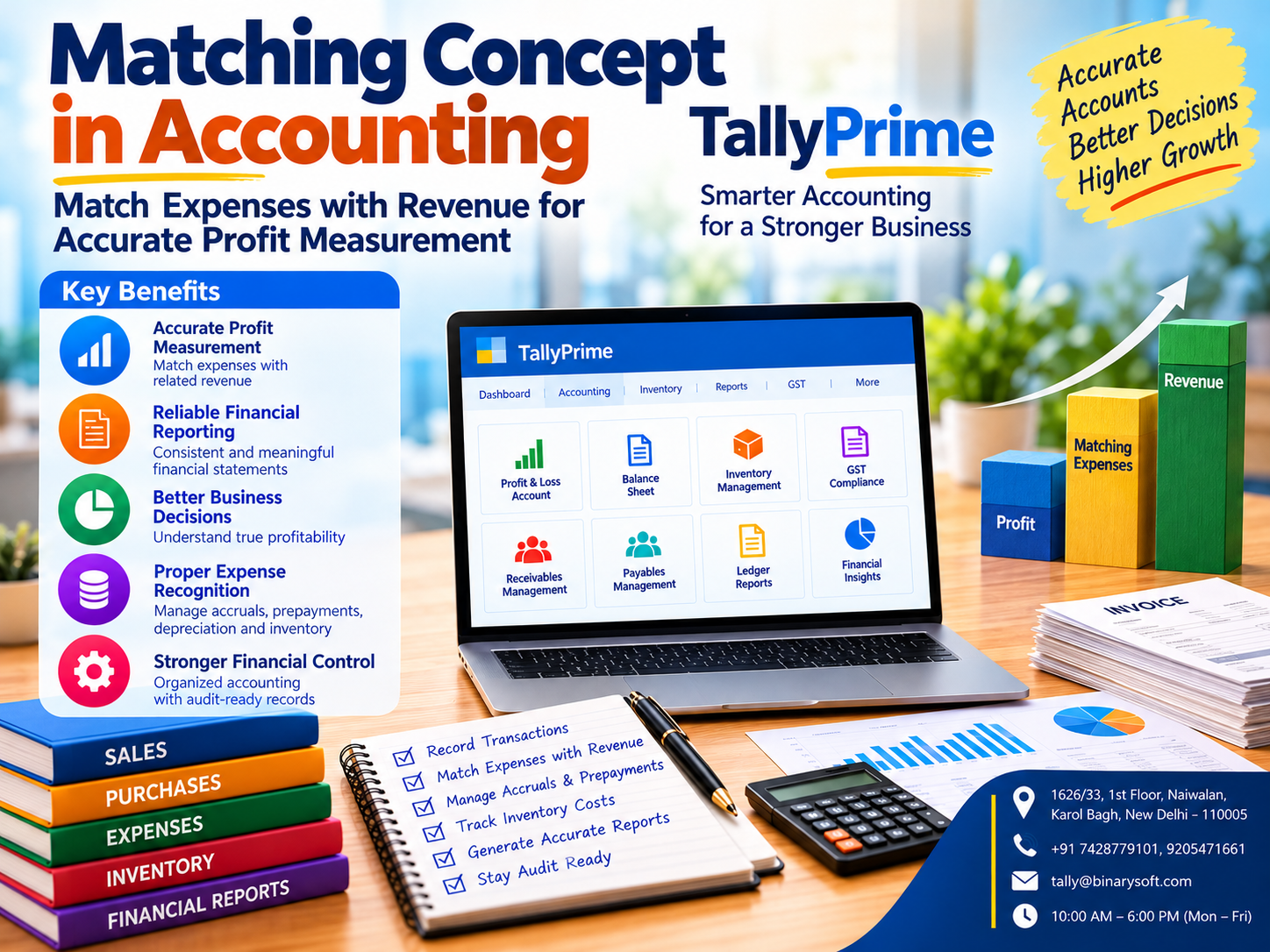
Introduction: Why High Sales Do Not Always Mean High Profits
Imagine running a business where sales are increasing every month, customers are placing new orders and employees are working harder than ever.
Everything appears successful.
But when the accountant prepares the financial statements, the profit figures tell a completely different story.
One month shows unusually high profits, while the following month reports unexpected losses.
The business owner becomes confused.
How can a growing business experience such unpredictable financial results?
Often, the problem is not declining sales or excessive spending. It is the way revenue and expenses are recorded.
Businesses frequently incur expenses before receiving the related revenue. Sometimes, they earn revenue in one month but pay the associated costs in another.
If these transactions are recorded in the wrong accounting periods, financial statements may not reflect actual business performance.
This is where the matching concept in accounting becomes essential.
The matching concept helps businesses recognize expenses in the periods to which the related revenue belongs, subject to applicable accounting standards.
It is an important part of accrual-based accounting and contributes to more reliable profit measurement.
For Indian businesses managing purchases, sales, inventory, employee salaries, rent and operating expenses, understanding this concept is particularly useful.
Modern accounting software such as TallyPrime helps businesses maintain organized financial records, record necessary adjustments and generate financial reports that support accurate profit measurement.
This guide explains the matching concept, its importance, practical examples, journal entries, common mistakes and how TallyPrime supports its application.
1. What Is the Matching Concept in Accounting?
The matching concept is an accounting principle that emphasizes recognizing expenses in the same accounting period as the related revenue when a direct relationship exists.
It helps businesses determine the appropriate expenses to include when calculating profit for a particular period.
The concept is closely connected with accrual accounting.
Under accrual accounting, revenue and expenses are generally recognized according to when they are earned or incurred, rather than simply when cash changes hands.
However, modern accounting standards apply specific recognition requirements. Not every expense can be deferred merely because management expects future revenue.
Simple Example
Suppose a furniture dealer purchases a table for ₹8,000 in January and sells it for ₹12,000 in February.
The purchase creates inventory in January.
When the table is sold in February, its ₹8,000 cost is recognized as the cost of goods sold.
The February profit is:
| Particulars | Amount |
|---|
| Sales Revenue |
₹12,000 |
| Cost of Goods Sold |
₹8,000 |
| Gross Profit |
₹4,000 |
The cost is recognized alongside the revenue generated by selling the table.
This provides a more meaningful measurement of profitability.
2. Why Is the Matching Concept Important?
Accurate profit measurement is essential for business planning.
When expenses are recognized in inappropriate periods, management may receive misleading financial information.
Accurate Profit Calculation
The matching concept helps businesses associate relevant expenses with revenue.
This improves the usefulness of profit calculations.
Reliable Financial Statements
Proper expense recognition supports meaningful Profit & Loss statements and Balance Sheets.
Better Financial Planning
Business owners can evaluate operational performance using more consistent financial information.
Improved Cost Analysis
Businesses can understand the relationship between revenue and the costs required to generate it.
Consistent Performance Evaluation
Recognizing expenses in appropriate periods reduces misleading fluctuations caused by payment timing.
Greater Financial Transparency
Reliable accounting information helps owners, managers, lenders and other stakeholders understand business performance.
The matching concept is therefore important for maintaining financial discipline.
3. The Emotional Story of a Business Owner Who Mistook Cash for Profit
Rajesh operated a growing garment manufacturing business in Delhi.
For fifteen years, he had worked tirelessly to transform a small tailoring unit into a successful manufacturing operation.
His factory supplied garments to retailers across several cities.
Every order represented more than revenue.
It represented salaries for employees, security for their families and the future of the business Rajesh had built.
During the festive season, the factory received several large orders.
Sales increased significantly.
Rajesh believed the business was enjoying its most profitable quarter.
He began planning a factory expansion and considered purchasing additional machinery.
However, his accountant noticed something unusual.
The monthly profit figures were inconsistent.
Several production expenses had been paid in advance, while other expenses related to completed orders were recorded only when suppliers received payment.
Some raw materials remained in inventory, but their entire purchase cost had been treated as an immediate expense.
The accounting records did not consistently distinguish between cash movements, inventory costs and expenses belonging to specific reporting periods.
When the accountant prepared corrected financial statements, the results surprised Rajesh.
The business was profitable, but not nearly as profitable as he had believed.
His expansion plans required more careful financial planning.
Rajesh felt disappointed.
He had worked for years to create opportunities for his employees, and inaccurate financial information could have led him into unnecessary financial pressure.
Instead of rushing into expansion, he decided to strengthen the company's accounting procedures.
His team began reviewing inventory valuation, outstanding expenses, prepaid costs and period-end adjustments.
They also used TallyPrime more systematically to maintain accounting records and review financial reports.
Gradually, Rajesh gained a clearer understanding of actual profitability.
He learned that cash availability and accounting profit were different measurements.
Most importantly, he realized that accurate financial information protects the people and businesses depending on every major decision.
This is an illustrative story created to explain the importance of proper expense recognition.
4. How Does the Matching Principle Work?
The matching concept works through appropriate recognition of revenue and related expenses.
Step 1: Identify Revenue
Determine the revenue recognized during the accounting period according to applicable accounting policies.
Step 2: Identify Related Expenses
Identify costs directly associated with generating that revenue.
Examples include inventory costs and certain sales-related commissions.
Step 3: Determine the Appropriate Period
Recognize expenses in the period required by the applicable accounting framework.
Directly attributable inventory costs are generally recognized when the related goods are sold.
Other expenses may be recognized over time or when incurred.
Step 4: Record Adjustments
Prepare necessary accounting entries for accrued expenses, prepaid expenses, depreciation and other period-end adjustments.
Step 5: Review Financial Reports
Examine the Profit & Loss account and supporting ledgers.
Step 6: Verify Accounting Accuracy
Reconcile relevant balances and investigate unusual transactions.
This process helps businesses maintain more reliable financial statements.
5. Matching Concept vs Cash Basis Accounting
Understanding the difference between accrual-based matching and cash accounting is important.
| Basis | Accrual-Based Accounting | Cash Basis Accounting |
|---|
| Revenue Recognition |
When recognition criteria are met |
Generally when cash is received |
| Expense Recognition |
When incurred or otherwise required by applicable standards |
Generally when cash is paid |
| Profit Measurement |
Reflects recognized revenue and related expenses |
Reflects cash receipts and payments |
| Outstanding Expenses |
Recognized where applicable |
Generally not recognized until payment |
| Prepaid Expenses |
May be recognized as assets and expensed over time |
Generally recorded when paid |
| Inventory Costs |
Recognized according to inventory accounting requirements |
Treatment depends on the applicable framework |
Example
A business earns ₹1,00,000 in March and incurs ₹60,000 in related expenses.
The expenses are paid in April.
Under accrual accounting, assuming both amounts meet the recognition criteria for March:
March profit = ₹1,00,000 − ₹60,000
March Profit = ₹40,000
Under a simple cash-basis approach, the March cash result may look different because the payment occurs in April.
This illustrates why payment timing should not be confused with profitability.
6. Practical Examples of the Matching Concept
Example 1: Cost of Goods Sold
A retailer purchases 100 products at ₹500 each.
Total purchase cost = ₹50,000.
During the month, the retailer sells 60 products for ₹800 each.
Sales revenue = ₹48,000.
Cost of goods sold = 60 × ₹500 = ₹30,000.
Gross profit = ₹18,000.
The remaining inventory cost of ₹20,000 continues to be recognized as inventory, assuming no write-down is required.
Example 2: Sales Commission
A company recognizes ₹5,00,000 in sales during June.
A commission of ₹25,000 becomes payable for those sales.
Where the commission qualifies as a June expense under the applicable accounting framework, it should be recognized in June even if payment occurs in July.
Example 3: Outstanding Electricity Expense
A manufacturing company consumes electricity worth ₹18,000 in September.
The bill is received and paid in October.
The company recognizes the expense in September if the obligation relates to that month and can be reliably estimated.
Example 4: Prepaid Insurance
A business pays ₹24,000 for a 12-month insurance policy beginning on 1 April.
Assuming the coverage is consumed evenly, the monthly expense is ₹2,000.
The unexpired portion remains a prepaid asset until the related coverage period passes.
Example 5: Depreciation
A company purchases machinery for production.
The machinery provides economic benefits over several years.
Depreciation allocates the depreciable amount over its estimated useful life according to the applicable depreciation method.
It is not simply matched against individual sales invoices.
7. Journal Entries Under the Matching Concept
Correct journal entries help businesses apply accrual accounting principles.
Outstanding Expense Entry
Suppose March salary expense is ₹75,000, payable in April.
On 31 March:
Salary Expense A/c Dr. ₹75,000
To Salary Payable A/c ₹75,000
When paid in April:
Salary Payable A/c Dr. ₹75,000
To Bank A/c ₹75,000
The expense is recognized in March, while the April payment settles the liability.
Prepaid Expense Entry
Suppose a business pays ₹36,000 for 12 months of insurance.
At the time of payment:
Prepaid Insurance A/c Dr. ₹36,000
To Bank A/c ₹36,000
Monthly adjustment:
Insurance Expense A/c Dr. ₹3,000
To Prepaid Insurance A/c ₹3,000
This recognizes the insurance expense as the coverage is consumed.
Depreciation Entry
Suppose monthly depreciation is ₹10,000.
Depreciation Expense A/c Dr. ₹10,000
To Accumulated Depreciation A/c ₹10,000
The entries are illustrative. Actual accounting treatment depends on the applicable reporting framework and business circumstances.
8. How TallyPrime Helps Apply the Matching Concept
TallyPrime provides accounting features that support appropriate expense recognition and period-end adjustments.
Voucher-Based Accounting
Businesses can record transactions using sales, purchase, payment, receipt and journal vouchers.
These records help maintain organized accounting information.
Journal Adjustments
Journal vouchers can be used to record accruals, prepaid expense adjustments, depreciation and other applicable entries.
Ledger Management
Businesses can maintain separate ledgers for expenses, liabilities, prepaid amounts and accumulated depreciation.
Proper ledger classification improves financial reporting.
Inventory Accounting
TallyPrime supports inventory records, stock valuation methods and related reports.
Appropriate inventory configuration helps businesses recognize inventory costs in financial statements.
Cost Centres
Businesses can allocate relevant expenses and income to cost centres for internal analysis.
This helps management review department-wise or project-wise performance.
Financial Reporting
TallyPrime provides Profit & Loss, Balance Sheet, Trial Balance and ledger reports.
These reports help accountants review whether transactions have been recorded in appropriate periods.
Period-End Review
Accountants can examine ledger balances, outstanding amounts and relevant adjustments before finalizing financial statements.
TallyPrime supports the accounting workflow, but the business must determine the correct recognition period and adjustment amounts.
9. Step-by-Step: Recording Matching Adjustments in TallyPrime
Step 1: Create Appropriate Ledgers
Create ledgers for relevant expenses, prepaid assets, accrued liabilities and depreciation.
Choose suitable accounting groups.
Step 2: Record Regular Transactions
Enter sales, purchases, receipts and payments through appropriate vouchers.
Step 3: Identify Period-End Adjustments
Review expenses incurred but not yet paid, prepaid costs and applicable depreciation.
Step 4: Record Journal Vouchers
Open the journal voucher screen and record the necessary debit and credit entries.
Step 5: Review Inventory Valuation
Examine stock records and valuation methods to ensure inventory information is appropriate.
Step 6: Generate Financial Reports
Review the Profit & Loss account, Balance Sheet and Trial Balance.
Step 7: Verify Supporting Records
Compare relevant ledger entries with invoices, contracts, calculations and other supporting documents.
Step 8: Finalize the Reporting Period
Investigate unusual balances and make necessary corrections before finalizing accounts.
Businesses should consult their accountant when recognition or classification requires professional judgment.
10. Case Study 1: How a Wholesale Business Improved Profit Accuracy
Business Background
A wholesale electronics distributor supplied products to retailers across North India.
The business maintained purchase, sales and inventory records.
Challenges
The company recorded some inventory purchases as immediate expenses.
As a result, months with large purchases showed unusually low profits, even when much of the inventory remained unsold.
Management struggled to understand actual trading performance.
Solution Using TallyPrime
The company reorganized inventory and accounting records.
Stock items and valuation settings were reviewed.
Purchases and sales were recorded systematically.
The accountant examined inventory balances and cost of goods sold before preparing monthly reports.
Business Results
Profit calculations became more meaningful because the cost of unsold inventory was not treated as an immediate expense.
Management could compare sales and related inventory costs more effectively.
Key Learning
Correct inventory accounting is essential for applying the matching concept in trading businesses.
This is an illustrative case study, not a documented customer implementation.
11. Case Study 2: How a Service Company Improved Monthly Profit Reporting
Business Background
A growing digital marketing agency provided monthly services to corporate clients.
The company incurred employee salaries, software subscriptions and other operating expenses.
Challenges
Some expenses were recorded only when payments were made.
Annual software subscriptions were sometimes charged entirely to the month of purchase.
Monthly profit figures fluctuated significantly.
Solution Using TallyPrime
The agency introduced structured expense ledgers.
Prepaid expenses were identified and allocated over the relevant service periods.
Outstanding expenses were reviewed monthly.
The accountant recorded appropriate adjustment entries using journal vouchers.
Business Results
Monthly financial statements became more consistent and informative.
Management could evaluate operating performance without confusing payment timing with expense recognition.
Key Learning
Proper accrual accounting helps service businesses measure profitability more accurately.
This is an illustrative case study intended to demonstrate potential business benefits.
12. Common Mistakes When Applying the Matching Concept
Recording All Purchases as Expenses
Unsold inventory should generally remain an asset, subject to applicable inventory valuation requirements.
Ignoring Outstanding Expenses
Expenses incurred but not paid may need to be recognized along with a corresponding liability.
Expensing Prepaid Services Immediately
Payments for future benefits may need to be recognized as prepaid assets and expensed over the relevant periods.
Confusing Cash Flow with Profit
Cash receipts and payments do not always occur in the same periods as related income and expenses.
Missing Depreciation Adjustments
Failure to recognize depreciation may overstate profit and asset values.
Incorrect Expense Classification
Improper ledger grouping can distort financial statements.
Deferring Expenses Without Justification
Businesses should not capitalize or postpone expenses merely to increase reported profit.
All adjustments must follow applicable accounting standards.
13. Benefits of Applying the Matching Concept Correctly
More Reliable Profit Measurement
Appropriate recognition helps businesses measure profitability without excessive distortion from payment timing.
Better Cost Control
Management can evaluate costs associated with business activities.
Improved Budgeting
Accurate financial reports support realistic budgeting and forecasting.
Better Performance Comparisons
Consistent accounting policies improve comparisons between reporting periods.
Stronger Financial Planning
Businesses can evaluate expansion and investment decisions using more reliable financial information.
Improved Audit Readiness
Proper supporting schedules and adjustments make accounting records easier to review.
Greater Stakeholder Confidence
Reliable financial reporting supports trust among owners, lenders and other stakeholders.
14. Matching Concept and Revenue Recognition
The matching concept is closely related to revenue recognition, but the two are not identical.
Revenue recognition determines when revenue should be recorded.
Expense recognition determines when costs should be charged to profit or loss.
For inventory, the cost of goods sold is generally recognized when the related inventory is sold.
For expenses such as rent, utilities and depreciation, recognition follows the applicable accounting requirements.
Businesses should not assume that every cost can be directly matched with a particular sales transaction.
Modern financial reporting frameworks contain specific rules for recognizing assets, liabilities, income and expenses.
The matching concept should therefore be applied consistently with those requirements.
15. Matching Concept and GST Accounting
GST accounting and financial expense recognition serve different purposes.
GST treatment depends on applicable tax provisions, transaction details and eligibility requirements.
For example, the accounting cost of inventory may exclude recoverable input tax credit, while non-recoverable taxes may form part of the relevant cost where required.
Businesses should maintain appropriate tax ledgers and verify the treatment of input tax credit.
TallyPrime provides GST-related accounting features that support transaction recording and reporting.
However, applying the matching concept does not automatically determine GST liability or input tax credit eligibility.
Both financial reporting and GST compliance require separate consideration of applicable rules.
16. Best Practices for Accurate Profit Measurement
Businesses should establish a structured month-end accounting process.
Review sales and revenue recognition. Ensure revenue belongs to the correct reporting period.
Verify inventory records. Check closing stock and relevant valuation methods.
Identify outstanding expenses. Recognize liabilities for expenses incurred but not yet paid.
Review prepaid expenses. Allocate costs over the periods receiving the related benefits.
Record depreciation. Apply appropriate depreciation policies.
Reconcile accounts. Review bank, customer and supplier balances.
Check ledger classifications. Ensure expenses and assets are grouped correctly.
Maintain supporting documents. Preserve invoices, contracts and adjustment calculations.
Review financial statements. Investigate unusual changes in profitability.
Use consistent accounting policies. Apply methods consistently unless a justified change is required.
These practices help businesses maintain more reliable financial information.
17. Why Growing Businesses Need TallyPrime for Accurate Accounting
As businesses expand, the volume and complexity of financial transactions increase.
Managing expenses, inventory, customer balances and reporting adjustments through disconnected spreadsheets can become difficult.
TallyPrime provides an integrated environment for maintaining accounting records.
Its features support voucher recording, ledger management, inventory accounting, cost-centre analysis and financial reporting.
Accountants can use journal vouchers to record appropriate adjustments and review the effect on financial statements.
For businesses requiring remote access, suitable hosted TallyPrime arrangements may also be considered.
However, accurate profit measurement still depends on proper accounting policies, reliable data and professional review.
Accounting software helps implement financial procedures; it does not replace accounting judgment.
18. How Binarysoft Technologies Helps Businesses Use TallyPrime
Binarysoft Technologies, an Authorized Tally Partner, helps businesses explore TallyPrime solutions according to their accounting requirements.
Accounting Setup
Assistance with company creation, ledger configuration and voucher setup.
Expense and Income Management
Guidance on maintaining organized income and expense records.
Journal Adjustments
Understanding how appropriate adjustment entries can be recorded.
Inventory Accounting
Configuring relevant stock items, inventory features and valuation settings.
Financial Reporting
Using Profit & Loss, Balance Sheet and other reports to review business performance.
Cost-Centre Accounting
Exploring cost allocation for departments, projects and other business activities.
GST Accounting
Configuring applicable GST-related accounting features.
TallyPrime Cloud
Exploring suitable hosted accounting arrangements for authorized remote access.
A properly configured accounting system can help businesses maintain organized records and make more informed financial decisions.
19. Conclusion: Accurate Profit Measurement Begins with Proper Expense Recognition
The matching concept in accounting plays an important role in understanding business profitability.
It emphasizes recognizing relevant expenses in the appropriate reporting periods rather than relying only on payment dates.
For trading businesses, proper inventory accounting helps associate the cost of goods sold with related revenue.
For service businesses, accruals and prepaid expense adjustments help improve monthly financial reporting.
For manufacturing companies, accurate inventory valuation, depreciation and expense recognition support more meaningful financial analysis.
However, the matching concept must be applied within the requirements of the applicable accounting framework.
Businesses should avoid both premature expense recognition and unjustified deferral of costs.
TallyPrime supports accurate accounting through organized ledgers, journal vouchers, inventory management and financial reporting.
These capabilities help accountants maintain records, process adjustments and review profitability.
Ultimately, understanding profit requires more than examining sales or bank balances.
It requires recognizing revenue and expenses correctly.
When businesses measure profit accurately, they can plan confidently, control costs responsibly and build a stronger financial future.
Powered by Binarysoft Technologies
Authorized Tally Partner
Location: 1626/33, 1st Floor, Naiwalan, Karol Bagh, New Delhi – 110005, INDIA
Contact Us: +91 7428779101, 9205471661
Email Us: tally@binarysoft.com
Business Hours: 10:00 AM – 6:00 PM, Monday to Friday
Frequently Asked Questions
Can TallyPrime record prepaid expense adjustments?
Yes. Accountants can use appropriate ledgers and journal vouchers to record prepaid expense adjustments.
How can businesses improve profit measurement?
Businesses should maintain accurate records, review inventory valuation, identify accruals and prepayments, record depreciation and verify financial statements regularly.
How does the matching concept affect profit?
It helps ensure expenses are recognized in appropriate periods, making reported profit more meaningful.
Can TallyPrime support the matching concept?
Yes. TallyPrime supports accounting entries, journal adjustments, inventory accounting and financial reporting that help businesses apply appropriate recognition policies.
CA. Dhruv Bhandekar works with businesses on bookkeeping controls, GST reporting, and month-end accounting processes. His focus is on creating structured financial workflows that improve accuracy and reduce reconciliation issues.