Call CA Tally HelpDesk
+91 9205471661,
7428779101
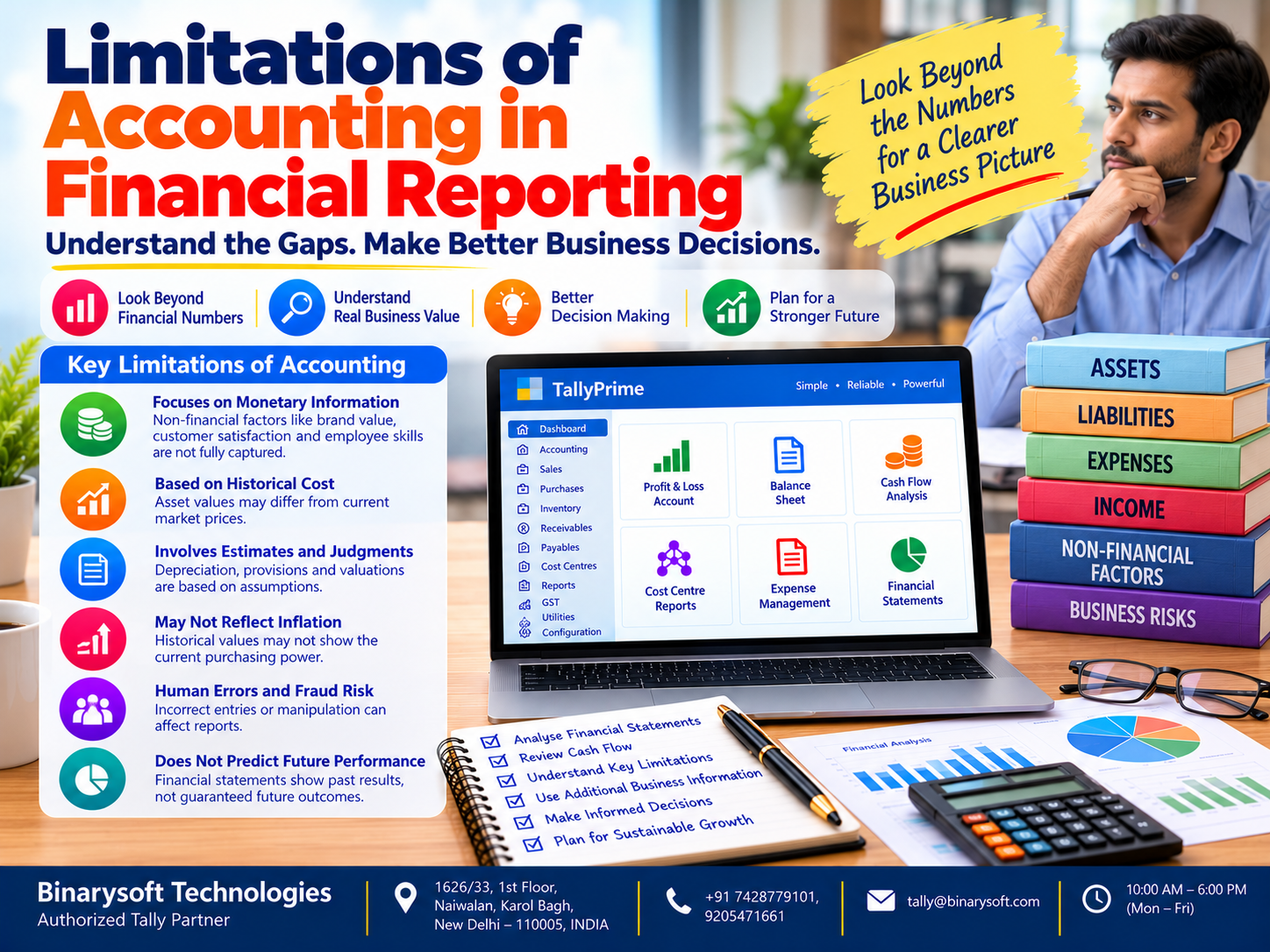
Introduction: Why Financial Statements Do Not Always Tell the Complete Business Story
Every business owner wants to know whether their company is financially healthy.
They examine sales reports, profit statements, balance sheets and cash flow information to understand business performance.
Accounting plays an essential role in providing this information.
However, financial statements do not always reveal the complete reality of a business.
A company may report substantial profits while struggling to collect customer payments.
Another business may own valuable property that appears in its accounting records at a much lower historical value.
Similarly, employee satisfaction, customer loyalty, management quality and brand reputation may significantly influence business success without being fully reflected in financial statements.
These situations highlight the limitations of accounting in financial reporting.
Accounting provides structured financial information, but it relies on established principles, estimates, classifications and available records.
Understanding its limitations helps business owners interpret financial statements more carefully.
Modern accounting software such as TallyPrime can reduce manual errors, improve transaction organization and provide timely financial reports.
However, software cannot eliminate every limitation of accounting.
This article explains the major limitations of accounting, their impact on business decisions and how TallyPrime can help organizations strengthen financial management.
1. What Are the Limitations of Accounting?
The limitations of accounting are the restrictions and weaknesses that prevent accounting information from representing every aspect of a business with complete precision.
Accounting primarily records and reports financial transactions according to applicable accounting principles.
However, business performance depends on both financial and non-financial factors.
Financial statements also involve assumptions, estimates and professional judgments.
Consequently, accounting information should be interpreted alongside operational information, market conditions and management analysis.
Simple Example
Suppose a business reports an annual profit of ₹20 lakh.
At first glance, the company appears successful.
However, its customers owe ₹35 lakh, including several overdue invoices.
The company may face a cash shortage despite reporting a profit.
The financial statements are not necessarily incorrect.
They simply need to be interpreted together with receivables, liquidity and cash flow information.
2. An Emotional Story: The Business Owner Who Trusted His Profit Report
For twelve years, Manoj operated a wholesale electrical goods business in Delhi.
He started with a small shop and gradually expanded into supplying electrical products to contractors and retailers.
His business supported his family and several employees.
Every year, Manoj eagerly reviewed his financial statements.
One year, his accountant informed him that the business had earned a profit of ₹18 lakh.
Manoj felt proud.
He believed the company was financially stronger than ever.
Encouraged by the results, he purchased additional inventory and planned to expand his warehouse.
However, within three months, problems began.
Several customers delayed their payments.
Some inventory remained unsold.
Supplier bills became due, but the business had insufficient cash.
Manoj was shocked.
“How can my business be profitable when I cannot pay my suppliers?” he asked.
His accountant explained that accounting profit and available cash are different.
The profit statement included credit sales for which payment had not yet been received.
Some stock was also moving more slowly than expected.
The accountant helped Manoj examine customer outstanding reports, inventory records and cash flow information.
Using TallyPrime, the business began reviewing overdue invoices and stock movement more regularly.
Manoj also introduced stricter customer credit policies and improved payment follow-up procedures.
Over time, he learned to evaluate his business using several financial indicators instead of relying only on reported profit.
One evening, after reviewing the company's financial position, Manoj realized something important.
His financial statements had provided useful information, but he had misunderstood what that information meant.
He had treated accounting profit as proof that the business had sufficient cash.
The experience taught him that financial success is not measured by profit alone. It also depends on liquidity, financial discipline and informed decisions.
This is an illustrative story created to explain the practical limitations of financial reporting.
3. Why Is Understanding Accounting Limitations Important?
Recognizing accounting limitations helps businesses avoid incorrect financial conclusions.
Better Financial Decisions
Management can interpret accounting reports alongside other business information.
Improved Risk Identification
Businesses can identify liquidity problems, inventory risks and financial uncertainty.
More Realistic Business Valuation
Owners can distinguish accounting values from current market values.
Better Financial Planning
Understanding estimates and assumptions helps businesses prepare realistic forecasts.
Stronger Internal Controls
Recognizing possible errors encourages regular verification and reconciliation.
Improved Transparency
Businesses can explain accounting policies, estimates and uncertainties more clearly.
4. Major Limitations of Accounting in Financial Reporting
4.1 Accounting Primarily Records Monetary Information
Traditional financial accounting focuses on transactions and events that can be measured reliably in monetary terms.
However, several important business factors are difficult to quantify.
Examples include employee motivation, customer satisfaction, management capability and brand reputation.
These factors can influence future profitability but may not be fully recognized as accounting assets.
Practical Impact: A business with highly skilled employees may possess substantial competitive advantages that are not directly reflected in its balance sheet.
4.2 Historical Cost May Differ from Current Market Value
Many assets are initially recorded at their acquisition cost.
Depending on applicable accounting standards, subsequent measurement may involve depreciation, impairment, revaluation or fair value.
Therefore, carrying amounts may differ from current market prices.
Example
A company purchased land for ₹20 lakh several years ago.
Its current estimated market value is ₹90 lakh.
If the applicable accounting treatment retains the land at historical cost, the balance sheet may not reflect its current market value.
Practical Impact: Accounting carrying amounts should not automatically be treated as current realizable values.
4.3 Accounting Involves Estimates and Judgments
Financial reporting frequently requires estimates.
Examples include depreciation, impairment, expected credit losses, provisions and asset useful lives.
Different reasonable assumptions can produce different reported results.
Example
Two companies purchase similar machinery.
One estimates a useful life of eight years, while another estimates ten years.
Their annual depreciation expenses may differ.
The estimates should be based on relevant evidence and applicable accounting requirements.
4.4 Financial Statements May Not Fully Reflect Inflation
Historical monetary values may not reflect changes in purchasing power.
Inflation can make comparisons between amounts recorded in different periods more difficult.
For example, an asset purchased many years ago may have a recorded cost significantly below the amount required to replace it today.
Practical Impact: Management may need additional replacement-cost or inflation-adjusted analysis when making investment decisions.
4.5 Accounting Does Not Guarantee Complete Accuracy
Accounting systems depend on the quality of recorded information.
Incorrect entries, omissions, duplicate transactions and inappropriate classifications can affect reports.
Even computerized systems cannot guarantee accuracy when incorrect information is entered.
Regular reconciliation and internal controls remain essential.
4.6 Accounting Information Can Be Misinterpreted
Financial statements require careful analysis.
A high profit margin may appear attractive, but it does not automatically indicate strong liquidity.
Similarly, increasing revenue does not guarantee improved cash flow.
Users should consider multiple financial reports and relevant operational information.
4.7 Accounting May Not Fully Reflect Future Business Conditions
Financial statements primarily report past transactions and conditions as of a reporting date.
Although some accounting measurements incorporate forward-looking estimates, financial statements do not predict future performance with certainty.
Changes in competition, technology, customer demand and economic conditions can affect future results.
4.8 Different Accounting Policies Can Affect Comparability
Companies may apply different permitted accounting policies or estimates.
These differences can influence reported profits, asset values and financial ratios.
Financial statement users should review relevant accounting policies and disclosures before comparing businesses.
4.9 Accounting Cannot Eliminate Fraud
Accounting records may be manipulated through unauthorized transactions, false invoices or intentional misstatements.
Software controls can reduce certain risks but cannot eliminate deliberate fraud.
Effective internal controls, management oversight and independent reviews remain important.
4.10 Financial Statements May Be Affected by Reporting Delays
Annual or periodic financial statements describe performance for a completed reporting period.
Business conditions may change before the reports are reviewed.
Management therefore benefits from more frequent financial monitoring.
4.11 Intangible Business Strengths May Not Be Fully Recognized
Internally generated goodwill, customer relationships and certain other intangible resources may not qualify for recognition as assets under applicable accounting standards.
This means a company's economic value can differ significantly from its reported net assets.
4.12 Accounting Profit Is Different from Cash Flow
Accrual accounting recognizes income and expenses according to applicable recognition principles rather than simply when cash changes hands.
As a result, profitable businesses can experience cash shortages.
This limitation is especially important for businesses offering customer credit.
4.13 Financial Reports Depend on Materiality
Accounting standards apply the concept of materiality.
Information that could reasonably influence users' decisions requires appropriate consideration.
Not every small transaction receives the same level of separate presentation.
As a result, financial statements provide summarized information rather than every operational detail.
4.14 Accounting Cannot Measure Every Business Risk
Financial reports provide information about recognized obligations, relevant estimates and required disclosures.
However, they may not fully capture risks involving customer relationships, employee turnover, technological disruption or market competition.
Management needs additional risk assessments.
4.15 Financial Statements Require Professional Interpretation
Accounting reports are most useful when users understand their purpose, assumptions and limitations.
Incorrect interpretation can lead to poor investment, borrowing or operational decisions.
Professional financial analysis can help management understand the implications of reported information.
5. Summary of Accounting Limitations
| Limitation | Business Impact |
|---|
| Monetary Measurement |
Important non-financial factors may be excluded |
| Historical Cost |
Asset values may differ from market prices |
| Estimates |
Reported amounts involve judgment |
| Inflation |
Historical values may lose comparability |
| Recording Errors |
Reports may contain inaccuracies |
| Interpretation |
Profit may be confused with cash |
| Historical Focus |
Future performance remains uncertain |
| Accounting Policies |
Company comparisons may be difficult |
| Fraud Risk |
Financial information may be manipulated |
| Reporting Delays |
Information may become outdated |
Understanding these limitations improves the usefulness of financial statements.
6. How Accounting Limitations Affect Business Decisions
Accounting limitations can influence several important decisions.
Investment Decisions
Asset carrying amounts may not reflect current replacement or market values.
Credit Decisions
Reported profits should be evaluated alongside customer collections and liquidity.
Business Expansion
Historical performance alone may not accurately predict future demand.
Inventory Planning
Inventory valuations should be considered alongside stock movement and market conditions.
Financial Forecasting
Past accounting information provides a starting point, but forecasts require additional assumptions.
Business Valuation
A company's market value may differ from the net assets shown in its financial statements.
7. How TallyPrime Helps Reduce Practical Accounting Challenges
TallyPrime provides features that support organized accounting and financial reporting.
Accurate Transaction Recording
Structured voucher entry helps businesses maintain consistent accounting records.
Ledger Management
Separate ledgers support appropriate classification of income, expenses, assets and liabilities.
Receivables Monitoring
Customer outstanding reports help businesses identify overdue payments.
Payables Monitoring
Supplier reports provide visibility into outstanding obligations.
Inventory Management
Stock records help businesses review inventory quantities and valuations.
Financial Reporting
Profit & Loss, Balance Sheet and cash flow reports provide different perspectives on financial performance.
Bank Reconciliation
Reconciliation features support verification of bank-related transactions.
Cost-Centre Accounting
Cost centres can help businesses analyze expenses across departments or activities.
Audit and Control Support
Relevant security, user-access and audit-related features can support internal controls, depending on configuration and product capabilities.
TallyPrime improves accounting recordkeeping and reporting efficiency, but it does not remove the need for sound accounting policies, professional judgment and management review.
8. Step-by-Step: Improving Financial Reporting with TallyPrime
Step 1: Configure accounting ledgers correctly. Create appropriate groups for assets, liabilities, income and expenses.
Step 2: Record transactions regularly. Avoid unnecessary delays in accounting entries.
Step 3: Review customer outstanding balances. Identify overdue invoices and potential collection problems.
Step 4: Monitor supplier payments. Understand upcoming financial obligations.
Step 5: Reconcile bank accounts. Investigate differences between accounting records and bank statements.
Step 6: Review inventory reports. Identify slow-moving stock and valuation concerns.
Step 7: Examine financial statements. Analyze Profit & Loss and Balance Sheet reports.
Step 8: Review cash flow information. Understand cash movements separately from accounting profit.
Step 9: Verify significant estimates. Review depreciation, provisions and other relevant accounting judgments.
Step 10: Combine financial and operational analysis. Use accounting reports alongside budgets, forecasts and market information.
These practices help businesses make more informed financial decisions.
9. Case Study 1: Trading Business Discovers the Difference Between Profit and Cash
Business Background
A trading company supplied products to retailers on credit.
Sales increased significantly during the financial year.
Challenge
Management believed that higher accounting profits indicated strong financial health.
However, customer payments were frequently delayed.
Solution Using TallyPrime
The finance team reviewed customer outstanding reports, receivable ageing and cash flow information.
The company introduced regular payment follow-ups and revised customer credit practices.
Illustrative Results
Suppose annual reported profit was ₹15 lakh.
However, trade receivables had increased to ₹30 lakh.
After reviewing overdue balances, management identified ₹8 lakh requiring urgent collection follow-up.
Improved monitoring helped the company prioritize customer collections and prepare more realistic cash forecasts.
Key Learning
Accounting profit should always be evaluated alongside receivables and cash flow.
This is an illustrative case study, not a documented customer implementation.
10. Case Study 2: Manufacturing Company Improves Asset and Inventory Analysis
Business Background
A manufacturing company maintained machinery and substantial raw material inventory.
Management relied primarily on accounting reports when making investment decisions.
Challenge
Some machinery had become less efficient, while certain inventory items were moving slowly.
The accounting records did not automatically explain these operational problems.
Solution Using TallyPrime
The company reviewed inventory reports, asset-related accounting records and expense information.
Management also collected operational data about machine performance and material usage.
Illustrative Results
Suppose the company identified ₹6 lakh of slow-moving inventory.
After reviewing demand and stock requirements, management adjusted future purchasing decisions.
The business also evaluated machinery replacement using operational and financial information.
Key Learning
Financial reports become more useful when combined with operational performance analysis.
This is an illustrative case study intended to demonstrate potential business benefits.
11. Accounting Limitations vs Accounting Errors
Accounting limitations and accounting errors are not the same.
An accounting limitation is an inherent restriction in financial measurement or reporting.
An accounting error is an incorrect entry, omission, calculation or application of an accounting requirement.
For example, using a reasonable estimate of an asset's useful life involves judgment.
Recording the purchase of machinery as an ordinary office expense may be an accounting error.
Accounting software can help reduce certain recording errors through structured processes.
However, limitations involving estimates, market values and non-financial information remain.
12. How Businesses Can Overcome Accounting Limitations
No organization can eliminate every limitation of financial reporting.
However, businesses can improve decision-making through additional controls and analysis.
Combine Multiple Financial Reports
Review profitability, liquidity, receivables and financial position together.
Prepare Cash Flow Forecasts
Estimate future cash receipts and payments.
Monitor Non-Financial Indicators
Review customer satisfaction, employee productivity and operational efficiency.
Conduct Regular Reconciliations
Verify bank balances, supplier accounts and customer outstanding amounts.
Review Accounting Estimates
Update estimates when new information becomes available and accounting standards require it.
Analyze Market Conditions
Consider inflation, competition and changing customer demand.
Maintain Internal Controls
Establish appropriate approvals, access restrictions and transaction reviews.
Obtain Professional Advice
Consult qualified accounting professionals for complex financial reporting matters.
13. Importance of Financial Ratios in Overcoming Reporting Limitations
Financial ratios help businesses interpret accounting information.
Current Ratio
Current Ratio = Current Assets ÷ Current Liabilities
This ratio provides information about short-term liquidity.
Net Profit Margin
Net Profit Margin = Net Profit ÷ Revenue × 100
It indicates the proportion of revenue remaining as net profit.
Debt-to-Equity Ratio
Debt-to-Equity Ratio = Total Debt ÷ Shareholders' Equity
This ratio helps assess financial leverage.
Inventory Turnover
Inventory Turnover = Cost of Goods Sold ÷ Average Inventory
It measures inventory movement relative to sales.
Receivables Turnover
Receivables Turnover = Net Credit Sales ÷ Average Trade Receivables
It helps evaluate customer collection efficiency.
Financial ratios should be interpreted according to industry conditions and business circumstances.
14. Why Accounting Software Cannot Replace Financial Judgment
Accounting software can process transactions, organize records and generate reports.
However, software does not independently understand every business circumstance.
For example, a system may show that a customer owes ₹5 lakh.
Management must still evaluate whether the customer is likely to pay.
Similarly, accounting records may show the historical cost of machinery.
Management may need additional technical and market information to determine whether replacement is economically justified.
Software improves access to financial information.
Professional judgment determines how that information should be interpreted and applied.
15. Best Practices for Reliable Financial Reporting
Maintain accurate records. Record transactions with appropriate supporting documents.
Use consistent accounting policies. Apply relevant principles appropriately.
Review financial statements regularly. Avoid relying only on year-end reports.
Monitor cash flow. Distinguish profitability from liquidity.
Reconcile accounts. Verify bank, customer and supplier balances.
Review inventory. Identify slow-moving and obsolete stock.
Evaluate accounting estimates. Consider relevant evidence and changing circumstances.
Strengthen internal controls. Reduce opportunities for errors and unauthorized transactions.
Monitor operational performance. Use non-financial information alongside accounting reports.
Seek professional guidance. Obtain advice when accounting treatment or interpretation is complex.
These practices improve the reliability and usefulness of financial information.
16. How Binarysoft Technologies Helps Businesses Use TallyPrime
Binarysoft Technologies, an Authorized Tally Partner, helps businesses explore TallyPrime solutions for accounting and financial management.
Accounting Configuration
Assistance with company setup, ledgers and accounting records.
Sales and Purchase Management
Guidance on recording business transactions accurately.
Receivables and Payables
Understanding customer and supplier outstanding reports.
Inventory Management
Exploring stock records, inventory valuation and relevant reporting features.
Financial Reporting
Using Profit & Loss, Balance Sheet and cash flow information.
Cost-Centre Accounting
Configuring cost centres for suitable departmental or activity-wise analysis.
TallyPrime Cloud
Exploring suitable hosting arrangements for authorized remote access.
Data Backup and Security
Understanding appropriate backup and accounting data protection practices.
Organized accounting information provides a stronger foundation for financial analysis and business decisions.
17. Conclusion: Understanding Accounting Limitations Leads to Better Financial Decisions
Accounting is essential for every business.
It provides structured information about income, expenses, assets, liabilities and financial performance.
However, accounting information has limitations.
Historical costs may differ from market values.
Estimates and judgments influence reported amounts.
Important non-financial factors may not be fully represented.
Most importantly, accounting profit does not always mean that a business has sufficient cash.
Understanding these limitations helps management avoid misleading conclusions.
Businesses should review financial statements alongside cash flow, receivables, inventory, budgets and operational information.
TallyPrime supports this process by providing organized accounting records and useful financial reports.
Its accounting, inventory, receivables, payables and reporting features can improve financial visibility.
Nevertheless, accurate reporting also requires suitable accounting policies, internal controls and professional judgment.
Ultimately, the purpose of accounting is not simply to produce financial statements.
It is to provide useful information for responsible decisions.
Businesses that understand both the strengths and limitations of accounting are better prepared to manage risks, improve financial discipline and achieve sustainable growth.
Frequently Asked Questions
Why does accounting have limitations?
Accounting relies on monetary measurement, established principles, estimates, judgments and available records.
What is the biggest limitation of accounting?
There is no single biggest limitation for every business. Important limitations include historical cost measurement, estimates and the exclusion of certain non-financial factors.
Does accounting show the true value of a business?
Financial statements provide information about recognized assets and liabilities but do not necessarily represent the company's full market value.
Why is accounting profit different from cash flow?
Accrual accounting recognizes income and expenses according to applicable principles, which may differ from the timing of cash receipts and payments.
CA. Praneet Bansaal is a Chartered Accountant with experience in taxation, accounting controls, and financial process reviews. He has advised businesses on aligning inventory movement with accounting and GST requirements. His content focuses on compliance, accuracy, and long-term sustainability.