Call CA Tally HelpDesk
+91 9205471661,
7428779101
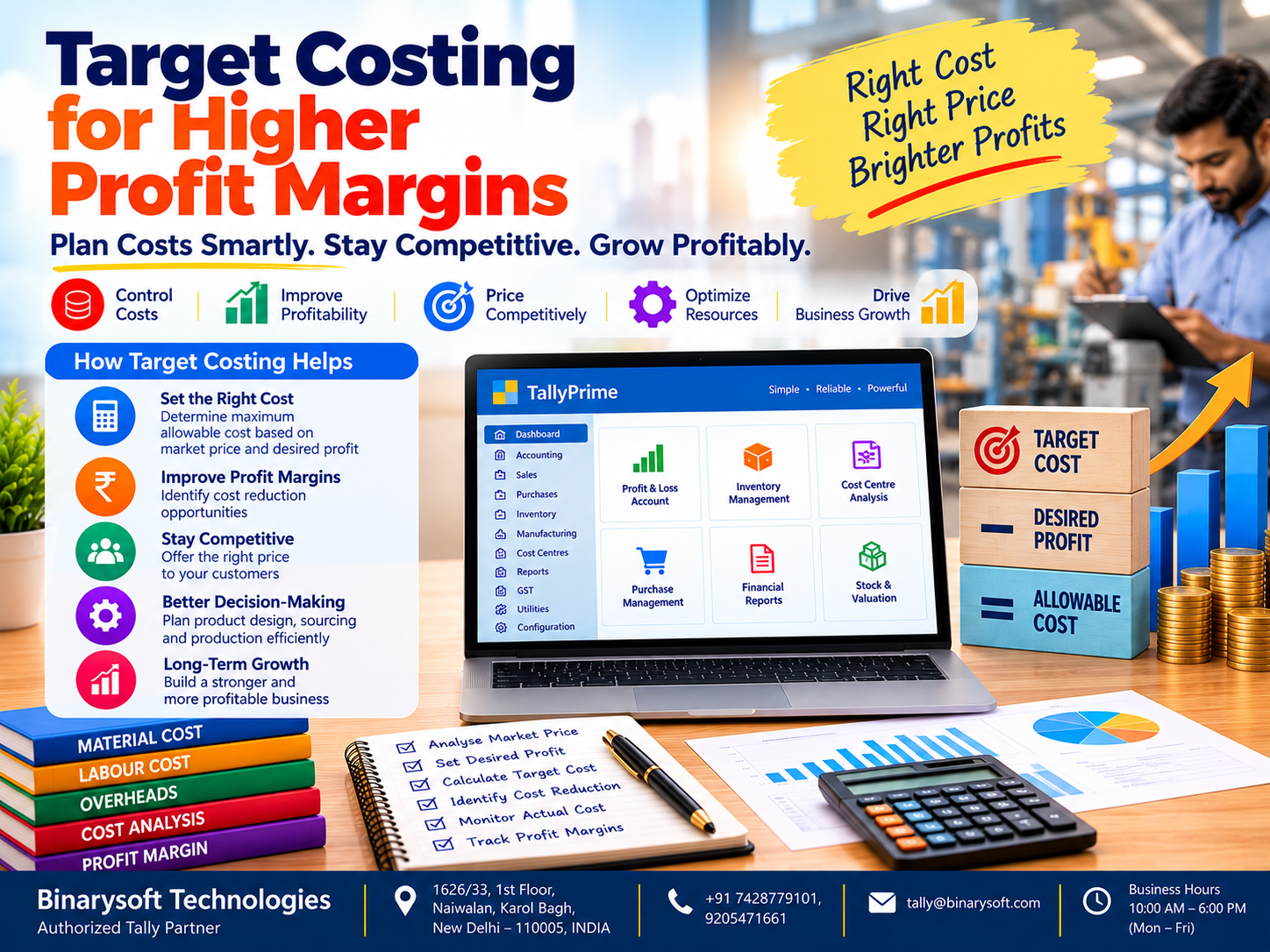
Introduction: Why Increasing Sales Is Not Always Enough to Increase Profits
Every business owner wants higher sales, satisfied customers and sustainable profits.
However, increasing revenue does not automatically improve profitability.
A manufacturing company may receive more orders but struggle with rising raw material prices. A retailer may attract customers through competitive pricing but earn very little on each sale. A service provider may expand its client base while operational expenses continue increasing.
These situations reveal an important business reality:
Profitability depends not only on how much a business sells but also on how effectively it manages costs.
Traditional pricing often begins by calculating product costs and adding a desired profit margin.
But modern markets do not always allow businesses to increase selling prices whenever costs rise.
Customers compare alternatives, competitors introduce attractive offers, and market demand influences acceptable prices.
This is where target costing becomes an important financial management strategy.
Target costing helps businesses determine the maximum cost they can afford while achieving a desired profit at a competitive market price.
Instead of allowing costs to determine prices, businesses use market prices and profit objectives to guide cost decisions.
Accounting software such as TallyPrime supports this process by providing financial records, inventory information, purchase analysis, cost-centre reporting and profitability insights.
This comprehensive guide explains target costing, its formula, importance, implementation methods and practical applications for Indian businesses.
1. What Is Target Costing?
Target costing is a cost management technique used to determine the maximum allowable cost of a product or service while achieving a desired profit.
It is particularly useful when the market largely determines the selling price.
The business first identifies an acceptable selling price, determines its required profit and calculates the cost it must achieve.
Target Costing Formula
Target Cost = Target Selling Price − Desired Profit
For example, suppose a furniture manufacturer plans to sell an office chair for ₹5,000.
The company wants to earn a profit of ₹1,000 per chair.
Target Cost = ₹5,000 − ₹1,000
Target Cost = ₹4,000
The manufacturer must therefore aim to keep the relevant cost within ₹4,000 per chair.
If the estimated cost is ₹4,500, management must identify opportunities to reduce costs by ₹500 without compromising essential quality or customer requirements.
Target costing encourages businesses to plan profitability before committing to production.
2. Why Is Target Costing Important for Businesses?
Target costing helps organizations balance customer expectations, market competition and profitability.
Improved Profit Margins
By establishing cost limits in advance, businesses can work toward their desired profit margins.
Competitive Pricing
Businesses can develop products around prices customers are willing to pay.
Better Cost Control
Target costing encourages management to identify unnecessary expenses before they become recurring costs.
Efficient Resource Utilization
Companies can review material consumption, labor requirements and production processes to reduce waste.
Product Development Efficiency
Design and production teams can consider cost implications during product development.
Stronger Financial Planning
Target costing creates measurable financial objectives for purchasing, production and management teams.
Sustainable Business Growth
A business that manages costs effectively may be better positioned to maintain profitability during competitive market conditions.
3. An Emotional Business Story: How a Small Manufacturer Protected His Family's Future
For nearly sixteen years, Ramesh had operated a small furniture manufacturing business in Delhi.
He began with a rented workshop, two workers and a dream of building a secure future for his family.
Over time, his dedication helped the business grow.
He supplied office furniture to local businesses, educational institutions and commercial establishments.
His employees depended on the factory for their livelihoods.
However, rising material prices gradually created financial pressure.
Plywood, hardware, transportation and labor expenses increased.
At the same time, customers demanded competitive prices.
Ramesh believed that accepting more orders would solve his problems.
He worked longer hours, negotiated with customers and expanded production.
Yet his bank balance continued shrinking.
One evening, after reviewing supplier bills, he discovered that some of his most popular products were generating very little profit.
He felt devastated.
Years of hard work had created a busy factory, but the business was struggling financially.
His daughter, who had recently completed her commerce education, suggested reviewing the cost of each product.
Together, they examined material consumption, labor expenses, production wastage and selling prices.
They discovered that certain furniture designs used more materials than necessary.
Some suppliers charged higher prices for comparable components.
Production delays also increased labor costs.
Instead of increasing selling prices immediately, Ramesh introduced a target costing approach.
He established acceptable market prices, calculated desired profit margins and identified maximum allowable costs.
The team redesigned selected products, improved material planning and negotiated better purchasing arrangements.
They also organized accounting and inventory records using TallyPrime.
Gradually, Ramesh gained better visibility into costs and profitability.
The factory continued serving customers without sacrificing essential product quality.
More importantly, he regained confidence in the future.
Ramesh realized that protecting profit margins was not simply about earning more money. It was about protecting the business, employees and family who depended on him.
This is an illustrative story created to explain the importance of target costing.
4. How Does Target Costing Work?
Target costing follows a structured process.
Step 1: Understand Market Prices
Businesses research customer expectations, competitor pricing and market demand.
The objective is to identify a realistic selling price.
Step 2: Determine Desired Profit
Management establishes a profit target based on financial objectives and investment requirements.
Step 3: Calculate Target Cost
The desired profit is deducted from the target selling price.
Step 4: Estimate Current Cost
The business estimates material, labor, production and other relevant costs.
Step 5: Identify the Cost Gap
The difference between estimated cost and target cost indicates the reduction required.
Step 6: Develop Cost Improvements
Teams evaluate product design, procurement, operational efficiency and waste reduction.
Step 7: Implement Changes
Approved improvements are introduced into production or service delivery.
Step 8: Monitor Actual Performance
Management compares actual costs with targets and investigates significant differences.
This process makes cost management an ongoing business activity.
5. Practical Example of Target Costing
Consider an electronics manufacturer planning to introduce a new product.
| Particulars | Amount |
|---|
| Expected Selling Price |
₹8,000 |
| Desired Profit Margin |
25% of Sales |
| Desired Profit |
₹2,000 |
| Target Cost |
₹6,000 |
| Estimated Current Cost |
₹6,800 |
| Required Cost Reduction |
₹800 |
The company must reduce its estimated cost by ₹800 per unit to achieve the desired margin.
Management may examine component sourcing, packaging costs, material wastage and production efficiency.
However, cost reductions should not compromise product safety, reliability or essential quality.
The target provides a financial objective rather than a guarantee of profitability.
6. Target Costing vs Traditional Cost-Plus Pricing
Target costing and cost-plus pricing use different approaches.
| Basis | Target Costing | Cost-Plus Pricing |
|---|
| Starting Point |
Market selling price |
Estimated product cost |
| Profit Treatment |
Desired profit determined first |
Profit added to cost |
| Cost Objective |
Maximum allowable cost |
Cost calculated before price |
| Market Orientation |
Customer and competition focused |
Cost focused |
| Main Purpose |
Achieve profit at market price |
Recover cost plus markup |
| Common Application |
Competitive products and new designs |
Suitable cost-based pricing situations |
Example
A business estimates product cost at ₹900 and wants ₹300 profit.
Under cost-plus pricing, it may set the price at ₹1,200.
However, if customers are willing to pay only ₹1,100, the proposed price may be uncompetitive.
Under target costing, the business starts with ₹1,100 and subtracts the desired ₹300 profit.
The resulting target cost is ₹800.
Management must then determine whether the product can be produced economically at that cost.
7. Major Components of Target Costing
Market-Based Selling Price
The expected selling price should reflect realistic market conditions.
Desired Profit Margin
Businesses establish a target return according to financial objectives.
Allowable Product Cost
The maximum cost is calculated after deducting desired profit.
Estimated Product Cost
Management calculates the expected cost using available operational information.
Cost Reduction Gap
The gap identifies the improvement required to achieve the target.
Continuous Cost Monitoring
Actual costs must be reviewed throughout product development and production.
Together, these components create a structured approach to profitability management.
8. How TallyPrime Helps Businesses Implement Target Costing
TallyPrime provides accounting and inventory information that supports target costing decisions.
Although TallyPrime is not a dedicated target-cost engineering platform, its financial features help businesses understand actual costs and monitor performance.
8.1 Purchase Cost Analysis
Businesses can record purchase transactions and review supplier-related information.
Historical purchasing data helps identify material cost trends.
8.2 Inventory Management
TallyPrime supports stock items, stock groups, units of measurement and inventory reports.
These features help businesses review inventory movements and relevant stock costs.
8.3 Cost-Centre Accounting
Cost centres help allocate income and expenses to departments, activities or projects.
This supports internal cost analysis.
8.4 Profit & Loss Reporting
The Profit & Loss account provides information about revenue, expenses and overall profitability.
8.5 Expense Monitoring
Businesses can maintain separate ledgers for manufacturing expenses, transportation, salaries and other operating costs.
8.6 Budgeting and Control
Relevant budgeting features can help businesses establish financial targets and monitor performance.
8.7 Sales Analysis
Sales reports provide information that helps management evaluate revenue patterns and product demand.
8.8 Manufacturing and Inventory Records
Where appropriate inventory and manufacturing features are configured, businesses can maintain production-related stock records and analyze material consumption.
Accurate cost calculations may still require additional allocation schedules or external financial models.
9. Step-by-Step: Using TallyPrime for Cost Monitoring
Businesses can use the following workflow.
Step 1: Create expense ledgers. Organize raw materials, labor, transportation and other relevant costs.
Step 2: Configure inventory. Create stock items, units and appropriate inventory settings.
Step 3: Record purchases. Maintain accurate supplier invoices and material costs.
Step 4: Record production transactions. Use relevant manufacturing and inventory features where applicable.
Step 5: Configure cost centres. Allocate appropriate income and expenses to business activities.
Step 6: Establish cost targets. Maintain approved target costs in a suitable costing worksheet or financial model.
Step 7: Review actual costs. Examine accounting and inventory reports.
Step 8: Compare actual and target costs. Identify unfavorable differences and investigate their causes.
Step 9: Implement improvements. Review purchasing, production and operational procedures.
Step 10: Monitor profitability. Evaluate whether cost improvements contribute to desired financial results.
This approach connects accounting information with practical cost management.
10. Case Study 1: Furniture Manufacturer Improves Product Profitability
Business Background
A furniture manufacturer produced office chairs and desks for corporate customers.
Increasing raw material prices reduced profit margins.
Challenges
The company experienced rising plywood, hardware and transportation expenses.
Its selling prices remained competitive, leaving limited room for price increases.
Solution Using Target Costing
Management identified market selling prices and established desired profit margins.
The team calculated allowable costs for major products.
Purchasing and production records were reviewed using TallyPrime.
The company evaluated alternative suppliers, improved cutting plans and reduced material wastage.
Illustrative Results
Suppose a chair previously cost ₹3,600 to manufacture and sold for ₹4,000.
Its gross profit was ₹400, representing a 10% margin.
After process improvements, manufacturing cost declined to ₹3,200.
Gross profit increased to ₹800, representing a 20% margin.
These figures demonstrate the potential effect of cost reduction, not guaranteed results.
Key Learning
Reducing avoidable production costs can improve profit margins without increasing selling prices.
This is an illustrative case study, not a documented customer implementation.
11. Case Study 2: Food Packaging Business Reduces Operating Costs
Business Background
A food packaging company supplied customized packaging materials to restaurants and food manufacturers.
The business faced strong price competition.
Challenges
Material wastage, packaging defects and inconsistent purchasing costs affected profitability.
Management needed to maintain competitive prices while improving margins.
Solution Using Target Costing
The company established target costs for selected packaging products.
Production teams reviewed material consumption and wastage.
The finance team used TallyPrime accounting and inventory reports to analyze relevant costs.
Purchasing procedures and production planning were improved.
Illustrative Results
For a packaging product sold at ₹100, the original cost was ₹85.
The gross profit was ₹15, or 15%.
After operational improvements, the cost declined to ₹78.
Gross profit increased to ₹22, or 22%.
The improvement demonstrates how disciplined cost management can support profitability.
Key Learning
Target costing encourages businesses to identify cost-saving opportunities throughout their operations.
This is an illustrative case study intended to demonstrate potential business benefits.
12. Benefits of Target Costing for Indian Businesses
Better Profitability
Target costing encourages businesses to maintain a clear relationship between selling prices, costs and desired profits.
Improved Purchasing Decisions
Businesses can evaluate suppliers and material alternatives more systematically.
Reduced Operational Waste
Production teams can identify unnecessary material consumption and inefficient processes.
Stronger Product Planning
Cost targets help guide product design and development.
Improved Financial Discipline
Departments work toward measurable cost objectives.
Greater Market Competitiveness
Businesses can maintain competitive pricing while pursuing acceptable profit margins.
Better Management Decisions
Reliable cost information supports pricing, production and expansion planning.
13. Common Challenges in Target Costing
Unrealistic Cost Targets
Targets that are too aggressive may be difficult to achieve without compromising quality.
Inaccurate Cost Information
Incorrect material, labor or overhead estimates can lead to poor decisions.
Supplier Limitations
Alternative materials or lower purchase prices may not always be available.
Quality Concerns
Excessive cost reduction may damage customer satisfaction.
Employee Resistance
Production teams may require training and support when implementing new procedures.
Changing Market Conditions
Selling prices and customer expectations may change over time.
Overlooking Indirect Costs
Businesses must consider relevant overheads when evaluating product profitability.
Successful target costing requires realistic assumptions, reliable data and cooperation across departments.
14. Target Costing and Profit Margin Analysis
Understanding profit margins is essential when establishing target costs.
Gross Profit Margin
Gross Profit Margin = (Gross Profit ÷ Revenue) × 100
Gross profit is calculated after deducting the cost of goods sold.
Net Profit Margin
Net Profit Margin = (Net Profit ÷ Revenue) × 100
Net profit reflects the effect of relevant operating and other expenses.
Example
A product sells for ₹2,000.
Its cost of goods sold is ₹1,400.
Gross profit = ₹600.
Gross profit margin = 30%.
If management wants a 35% gross profit margin at the same selling price, the target cost of goods sold becomes ₹1,300.
The business must identify a cost reduction of ₹100 per unit.
Businesses should clearly define whether their target refers to gross profit, operating profit or net profit.
15. Best Practices for Successful Target Costing
Research market prices. Use realistic customer and competitor information.
Define profit objectives. Establish clear margin targets.
Maintain accurate cost records. Record material, labor and overhead information consistently.
Review product designs. Identify opportunities to reduce unnecessary complexity.
Improve purchasing. Compare suppliers while maintaining quality requirements.
Reduce wastage. Monitor production losses and inefficient material usage.
Use financial reports. Review costs and profitability regularly.
Involve employees. Encourage production, purchasing and finance teams to cooperate.
Protect product quality. Avoid reductions that compromise safety or customer expectations.
Monitor results continuously. Compare actual costs with targets and revise plans when necessary.
These practices make target costing more effective and sustainable.
16. Target Costing vs Standard Costing
Target costing and standard costing both support cost management, but their purposes differ.
| Basis | Target Costing | Standard Costing |
|---|
| Main Objective |
Achieve desired cost based on market price |
Establish expected operating costs |
| Primary Focus |
Product planning and cost reduction |
Cost measurement and variance analysis |
| Starting Point |
Selling price and profit target |
Production standards |
| Typical Application |
Product development and competitive pricing |
Ongoing production control |
| Main Analysis |
Cost gap |
Actual-versus-standard variance |
Businesses may use both methods.
Target costing helps determine what a product should cost, while standard costing helps monitor production performance against established standards.
17. How Target Costing Supports Long-Term Business Growth
Target costing is more than a short-term cost reduction technique.
It encourages businesses to examine how products are designed, manufactured and delivered.
When applied responsibly, it can support innovation, operational efficiency and customer value.
For growing businesses, the approach provides a structured method for balancing competitive prices with profitability.
However, target costing should not focus exclusively on reducing expenses.
Businesses must also consider quality, reliability, employee well-being and long-term customer relationships.
The most effective cost improvements eliminate unnecessary expenditure without weakening the value customers receive.
Reliable accounting information makes these decisions easier.
18. How Binarysoft Technologies Helps Businesses with TallyPrime
Binarysoft Technologies, an Authorized Tally Partner, helps businesses explore TallyPrime solutions according to their accounting, inventory and financial management requirements.
Accounting Setup
Assistance with company configuration, ledgers and voucher settings.
Inventory Management
Guidance on stock items, stock groups, inventory transactions and reports.
Purchase and Expense Tracking
Understanding how purchasing and operating expenses can be recorded and reviewed.
Cost-Centre Management
Exploring cost allocation for departments and business activities.
Financial Reporting
Using Profit & Loss, Balance Sheet and relevant reports to evaluate business performance.
Budgeting and Financial Control
Reviewing suitable budgeting features and financial monitoring practices.
TallyPrime Cloud
Exploring hosted arrangements for businesses requiring authorized remote access.
Data Management
Understanding appropriate accounting data backup and protection practices.
A properly organized accounting system helps businesses obtain more reliable information for cost analysis and profitability management.
19. Conclusion: Target Costing Helps Businesses Protect Profits and Build Sustainable Growth
Target costing is an important financial management technique for businesses operating in competitive markets.
It begins with the price customers are willing to pay and determines the maximum cost a business can afford while achieving its desired profit.
This approach encourages organizations to control costs before they become permanent operational commitments.
For manufacturers, target costing supports better material planning and production efficiency.
For retailers, it helps evaluate purchasing costs and product margins.
For service businesses, it encourages more disciplined management of delivery costs and operating expenses.
However, successful target costing requires accurate financial information, realistic cost targets and continuous performance monitoring.
TallyPrime supports these activities through accounting, inventory management, purchase records, cost-centre reporting and financial analysis.
Businesses can use these reports alongside dedicated costing calculations to identify opportunities for improvement.
Ultimately, target costing is not simply about spending less.
It is about creating greater value from available resources while protecting product quality and customer satisfaction.
When businesses understand their costs, protect their margins and make informed decisions, they create a stronger foundation for sustainable profitability.
Powered by Binarysoft Technologies
Authorized Tally Partner
Location: 1626/33, 1st Floor, Naiwalan, Karol Bagh, New Delhi – 110005, INDIA
Contact Us: +91 7428779101, 9205471661
Email Us: tally@binarysoft.com
Business Hours: 10:00 AM – 6:00 PM, Monday to Friday
Frequently Asked Questions
How frequently should businesses review target costs?
Target costs should be reviewed when market prices, material costs, product designs or operational conditions change.
What is the difference between target costing and standard costing?
Target costing determines allowable costs based on market prices and profit objectives. Standard costing establishes expected costs for operational control.
How does inventory management support target costing?
Inventory records help businesses understand material consumption, stock costs and potential wastage.
Can TallyPrime help track manufacturing expenses?
Yes. Relevant accounting, inventory and cost-centre features can support manufacturing expense tracking, depending on configuration.
CA. Ishaan Bagaria works closely with traders and service enterprises on accounting systems, GST compliance, and reporting processes. His focus is on improving record accuracy and simplifying day-to-day financial management.