Call CA Tally HelpDesk
+91 9205471661,
7428779101
Introduction: Why Carbon Accounting Is Becoming Important for Businesses
For years, businesses have measured success through revenue, profitability, productivity and customer satisfaction.
Today, another important consideration is gaining attention: environmental performance.
Manufacturing operations consume electricity, transportation requires fuel, warehouses use energy, and supply chains generate emissions.
These activities contribute to greenhouse gas emissions that influence climate change.
Customers, investors and large corporate buyers increasingly seek information about the environmental impact of business operations.
For many businesses, this creates an important question:
How can a company measure its greenhouse gas emissions and identify opportunities to reduce them?
The answer begins with GHG accounting, also known as greenhouse gas accounting or carbon accounting.
GHG accounting provides a structured approach to identifying, measuring and reporting greenhouse gas emissions associated with business activities.
It helps organizations understand their carbon footprint, improve environmental data management and support sustainability decisions.
For Indian businesses, especially manufacturers, exporters and suppliers serving larger organizations, maintaining reliable emissions information can also support customer reporting requirements.
Accounting software such as TallyPrime can contribute by organizing electricity expenses, fuel purchases, transportation costs, inventory records and other relevant business information.
However, specialized emissions calculations and reporting methodologies are required to convert operational data into reliable greenhouse gas inventories.
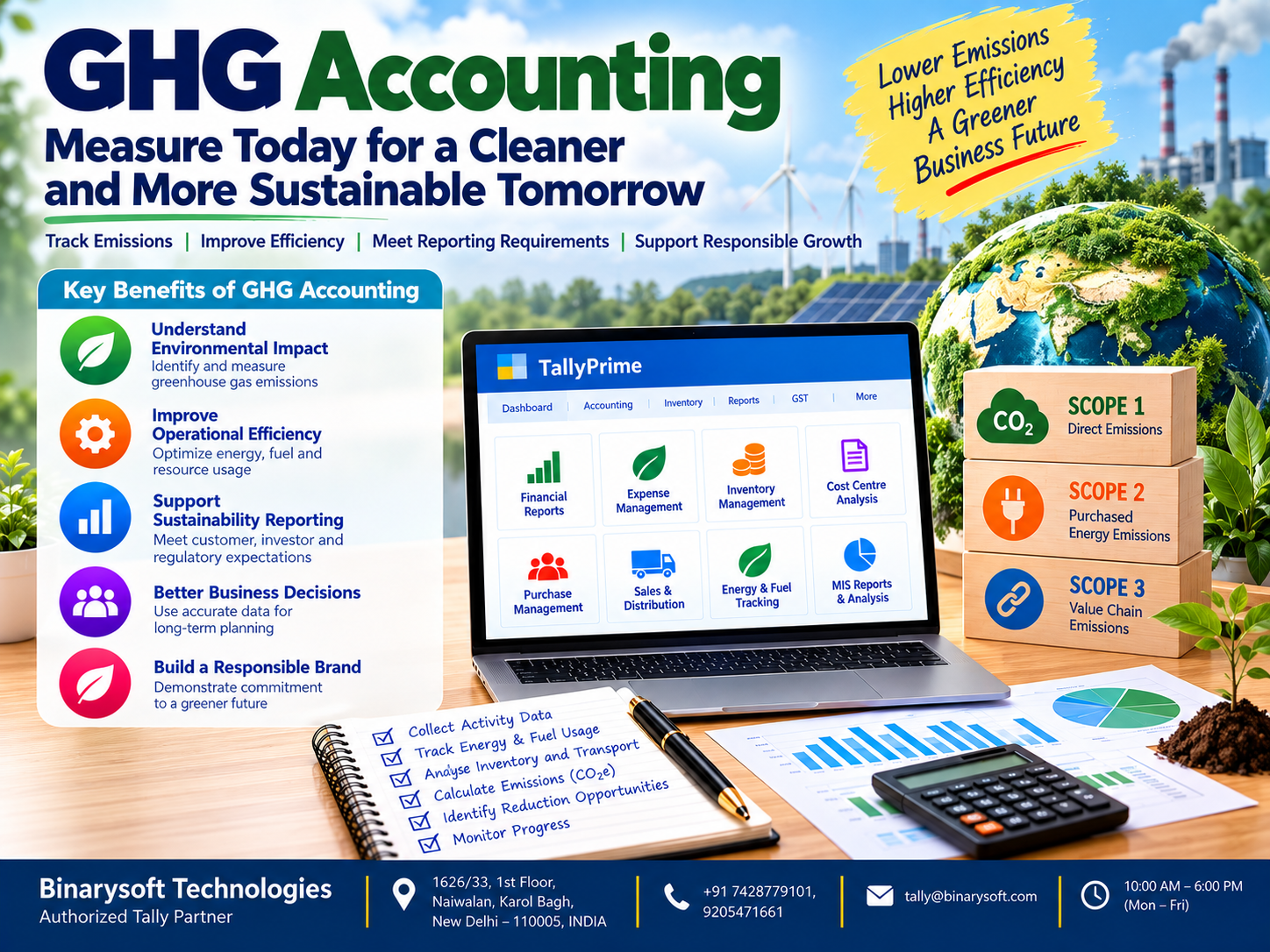
This guide explains GHG accounting, emission categories, calculation methods, carbon reporting procedures, practical examples and how TallyPrime can support the process.
1. What Is GHG Accounting?
GHG accounting is the process of identifying, quantifying, recording and reporting greenhouse gas emissions associated with an organization.
It measures emissions generated directly by business operations and indirectly through purchased energy and other value-chain activities.
The objective is to create a reliable emissions inventory that can support environmental management and reporting.
GHG accounting commonly covers gases such as:
-
Carbon dioxide (CO₂)
-
Methane (CH₄)
-
Nitrous oxide (N₂O)
-
Hydrofluorocarbons (HFCs)
-
Perfluorocarbons (PFCs)
-
Sulphur hexafluoride (SF₆)
-
Nitrogen trifluoride (NF₃)
Different greenhouse gases have different effects on global warming.
To make emissions comparable, they are commonly expressed as carbon dioxide equivalent (CO₂e).
For example, emissions from diesel consumption, electricity generation and refrigerant leakage may be converted into CO₂e using appropriate calculation methods.
This allows businesses to understand their overall greenhouse gas footprint.
2. Why Is GHG Accounting Important?
GHG accounting helps businesses move from general environmental commitments toward measurable performance.
Understanding Environmental Impact
Businesses can identify activities responsible for significant emissions.
Improving Energy Efficiency
Emissions analysis can highlight opportunities to reduce electricity and fuel consumption.
Supporting Sustainability Reporting
Reliable emissions information supports applicable sustainability disclosures and customer reporting requests.
Improving Operational Decisions
Management can compare the environmental implications of equipment, transportation and energy choices.
Strengthening Customer Relationships
Large customers may request emissions information from suppliers as part of their sustainability programs.
Supporting Long-Term Planning
GHG accounting helps organizations establish emission reduction targets and monitor progress.
Improving Data Transparency
Documented calculations and supporting records improve the reliability of environmental reporting.
3. An Emotional Story: A Factory Owner's Promise to His Daughter
For twenty years, Sandeep operated a textile manufacturing unit near Delhi.
He started with a few machines and gradually developed a successful business supplying fabrics to garment manufacturers.
His factory provided employment to numerous families.
Sandeep was proud of what he had built.
However, his daughter often asked him questions about the environment.
One evening, while returning from school, she noticed smoke rising from industrial buildings.
She asked, “Papa, can factories grow without harming the environment?”
Sandeep did not know how to answer.
He had always focused on production, employee salaries and customer orders.
He had never measured the environmental impact of his factory.
A few months later, an important customer requested information about the company's electricity consumption, fuel use and greenhouse gas emissions.
Initially, Sandeep felt overwhelmed.
He had financial statements and purchase records, but no organized emissions inventory.
His accountant suggested beginning with available business information.
They reviewed electricity bills, diesel purchases, production quantities and transportation expenses.
The team then worked with a sustainability professional to identify relevant emission sources and calculate an initial carbon footprint.
The results helped Sandeep understand which activities contributed most significantly to emissions.
He discovered opportunities to improve energy efficiency and reduce unnecessary fuel consumption.
The company introduced better maintenance practices and began monitoring electricity usage more carefully.
Sandeep understood that environmental improvement would require continued effort.
But he was no longer making decisions without information.
One evening, he told his daughter that the factory had started measuring its environmental impact and planning improvements.
She smiled.
For Sandeep, that moment meant more than a business achievement.
He realized that building a successful company was important, but building a responsible company was part of the legacy he wanted to leave behind.
This is an illustrative story created to explain the human importance of environmental responsibility.
4. Understanding Scope 1, Scope 2 and Scope 3 Emissions
A widely used greenhouse gas accounting framework classifies emissions into three scopes.
These categories help businesses distinguish direct emissions from different types of indirect emissions.
Scope 1: Direct Emissions
Scope 1 includes emissions from sources owned or controlled by the reporting organization.
Examples include:
-
Diesel consumed in company-controlled generators.
-
Fuel used by company-owned vehicles.
-
Natural gas burned in factory boilers.
-
Emissions from certain industrial processes.
-
Refrigerant leakage from equipment under company control.
Scope 2: Purchased Energy Emissions
Scope 2 includes indirect emissions associated with the generation of purchased or acquired electricity, steam, heating and cooling consumed by the organization.
For example, electricity purchased for operating factory machinery generally contributes to Scope 2 emissions.
Scope 3: Value-Chain Emissions
Scope 3 includes other indirect emissions occurring throughout the company's value chain.
Examples may include:
-
Production of purchased raw materials.
-
Third-party transportation.
-
Employee business travel.
-
Waste treatment by external providers.
-
Use of sold products.
-
End-of-life treatment of sold products.
Scope 3 calculations can be more complex because relevant information may be held by suppliers, customers and other organizations.
5. Difference Between Scope 1, Scope 2 and Scope 3
| Category | Meaning | Example |
|---|
| Scope 1 |
Direct emissions from owned or controlled sources |
Diesel generator |
| Scope 2 |
Indirect emissions from purchased energy generation |
Purchased electricity |
| Scope 3 |
Other indirect value-chain emissions |
Third-party transportation |
| Data Sources |
Operational and supporting records |
Fuel bills, electricity bills, supplier information |
| Management Approach |
Direct operational control or value-chain engagement |
Equipment efficiency, energy sourcing, supplier collaboration |
The appropriate classification depends on the organization's reporting boundaries and applicable accounting methodology.
6. How Are Greenhouse Gas Emissions Calculated?
A common calculation approach uses activity data and emission factors.
Basic GHG Calculation Formula
GHG Emissions = Activity Data × Appropriate Emission Factor
Where necessary, emissions of individual gases are converted into CO₂e using their global warming potential values.
Activity data describes the quantity of an activity.
Examples include electricity consumed in kilowatt-hours, diesel consumed in litres and materials purchased in kilograms.
An emission factor estimates the emissions associated with a unit of activity.
Practical Example: Electricity Consumption
Suppose a factory consumes 20,000 kWh of electricity during a reporting period.
Assume an illustrative emission factor of 0.70 kg CO₂e per kWh.
GHG Emissions = 20,000 × 0.70
GHG Emissions = 14,000 kg CO₂e
This equals 14 metric tonnes of CO₂e.
The factor is hypothetical and is used only to demonstrate the calculation.
Actual reporting requires an appropriate, documented emission factor for the relevant geography, reporting year and methodology.
7. What Is the Carbon Reporting Process?
Carbon reporting is the structured process of documenting and communicating an organization's greenhouse gas emissions.
A reliable reporting process includes several stages.
Step 1: Define Reporting Objectives
Determine why the organization is preparing an emissions inventory.
Objectives may include internal management, customer requests or applicable disclosure requirements.
Step 2: Establish Organizational Boundaries
Identify the business entities, facilities and operations included in the inventory.
Recognized approaches may consider operational control, financial control or equity share.
Step 3: Identify Emission Sources
List relevant fuel consumption, purchased energy, industrial processes and value-chain activities.
Step 4: Collect Activity Data
Gather electricity bills, fuel records, meter readings, production information and supplier data.
Step 5: Select Emission Factors
Choose appropriate factors that match the activity, geography, reporting period and calculation methodology.
Step 6: Calculate Emissions
Apply relevant calculation methods and convert results into CO₂e.
Step 7: Review Data Quality
Check completeness, accuracy, consistency and supporting evidence.
Step 8: Prepare the GHG Inventory
Summarize emissions by scope, source and reporting period.
Step 9: Report and Review
Prepare disclosures according to the applicable reporting framework and arrange independent verification where required or appropriate.
8. Important Principles of GHG Accounting
Reliable greenhouse gas reporting generally emphasizes five principles.
Relevance: Include information that appropriately reflects the organization's emissions.
Completeness: Account for relevant emissions within the selected reporting boundaries and explain exclusions.
Consistency: Apply methodologies consistently to support comparisons.
Transparency: Document assumptions, data sources and calculation methods.
Accuracy: Reduce uncertainty and avoid systematic overstatement or understatement.
These principles help businesses prepare more credible emissions information.
9. How TallyPrime Can Support GHG Accounting
TallyPrime is primarily business accounting and inventory management software.
It does not automatically function as a complete greenhouse gas inventory or carbon reporting platform.
However, it can help businesses organize financial and operational records that provide useful inputs for emissions calculations.
Electricity Expense Records
Businesses can maintain electricity expense ledgers and supporting bills.
Electricity consumption quantities should be obtained from invoices, meters or other reliable sources.
Fuel Purchase Records
Diesel, petrol and other fuel purchases can be recorded through appropriate accounting entries.
Fuel quantities may be used in emissions calculations when reliable consumption information is available.
Transportation Expenses
Freight and transportation ledgers can help identify logistics expenditure and relevant service providers.
Additional information, such as distance, vehicle type and fuel consumption, may be needed.
Inventory Management
Stock records can provide information about purchased materials and quantities.
These records may support selected Scope 3 calculations when combined with suitable emissions data.
Cost-Centre Reporting
Cost centres can help businesses allocate relevant expenses across departments, factories or activities.
Financial Reporting
Accounting reports can support reconciliation between financial transactions and environmental data collection.
Supporting Documentation
Organized accounting records help businesses identify relevant invoices and transactions for review.
TallyPrime provides supporting business data; emissions calculations, scope classification and formal carbon reporting require additional methodology and verification.
10. Step-by-Step: Using TallyPrime Data for Carbon Accounting
Businesses can follow a practical workflow.
Step 1: Create relevant expense ledgers. Maintain separate records for electricity, diesel, petrol, transportation and other relevant activities.
Step 2: Record transactions accurately. Enter purchase invoices and operating expenses using appropriate vouchers.
Step 3: Maintain supporting documents. Preserve bills containing consumption quantities and relevant dates.
Step 4: Review inventory information. Examine material purchases and stock quantities where applicable.
Step 5: Use cost centres. Allocate relevant expenses to facilities or departments when useful.
Step 6: Export required reports. Prepare accounting and transaction data for environmental analysis.
Step 7: Collect missing operational data. Obtain meter readings, fuel consumption records and supplier information.
Step 8: Calculate emissions separately. Apply appropriate emission factors using a suitable emissions calculation tool or spreadsheet.
Step 9: Reconcile information. Compare emissions activity data with accounting and operational records.
Step 10: Prepare the carbon report. Document calculations, assumptions, reporting boundaries and results.
This approach helps businesses connect financial recordkeeping with environmental data management.
11. Case Study 1: Manufacturing Company Improves Energy Monitoring
Business Background
A manufacturing company operated machinery requiring substantial electricity consumption.
Management wanted to understand the environmental impact of its operations.
Challenges
Electricity bills were recorded in accounting software, but energy consumption was not regularly analyzed for environmental reporting.
Solution
The finance team organized electricity expense records in TallyPrime.
Facility-level consumption information was collected from utility bills and meter readings.
A sustainability professional helped calculate emissions using appropriate factors.
Illustrative Results
Suppose annual electricity consumption was initially 2,40,000 kWh.
After operational improvements, consumption declined to 2,10,000 kWh.
The reduction was 30,000 kWh, or 12.5%.
Using the same illustrative factor of 0.70 kg CO₂e per kWh, the calculated emissions reduction would be 21 tonnes CO₂e.
Actual emissions reductions depend on the applicable factors and reporting methodology.
Key Learning
Combining reliable electricity data with appropriate emissions calculations helps businesses identify and measure efficiency improvements.
This is an illustrative case study, not a documented customer implementation.
12. Case Study 2: Logistics Business Begins Carbon Reporting
Business Background
A logistics company operated a fleet of delivery vehicles serving commercial customers.
Several customers requested information about transportation-related emissions.
Challenges
The company maintained fuel expenses but lacked a structured process for collecting and analyzing fuel consumption quantities.
Solution
The business reviewed fuel purchase records and vehicle-related expenses in TallyPrime.
Operational teams collected fuel quantities, vehicle details and relevant distance information.
The data was used in a separate emissions calculation process.
Illustrative Results
The company developed a more organized approach to monitoring fuel consumption and identifying inefficient routes.
Management could begin evaluating opportunities to improve vehicle utilization and reduce unnecessary fuel use.
Key Learning
Accurate operational records are essential for meaningful transportation emissions reporting.
This is an illustrative case study intended to demonstrate potential business benefits.
13. GHG Accounting vs Financial Accounting
Although both involve structured recordkeeping, their purposes differ.
| Basis | Financial Accounting | GHG Accounting |
|---|
| Primary Objective |
Measure financial performance and position |
Measure greenhouse gas emissions |
| Main Measurement |
Monetary values |
CO₂e and activity quantities |
| Typical Records |
Sales, purchases, expenses and assets |
Fuel, electricity and value-chain activities |
| Reporting Output |
Financial statements |
Greenhouse gas inventory |
| Main Standards |
Applicable financial reporting standards |
Relevant GHG accounting frameworks |
| Business Use |
Financial management |
Environmental performance management |
Financial accounting records may support GHG data collection, but they cannot replace the emissions calculation process.
14. Common Challenges in Carbon Accounting
Incomplete Activity Data
Businesses may record electricity expenses without preserving consumption quantities.
Inaccurate Emission Factors
Using inappropriate or outdated factors can distort results.
Complex Supply Chains
Scope 3 information may require cooperation from numerous suppliers.
Inconsistent Reporting Boundaries
Changes in organizational coverage can affect comparability.
Limited Internal Expertise
GHG accounting requires specialized knowledge of calculation methods and reporting standards.
Double Counting
Incorrect classification can result in emissions being counted more than once within an inventory.
Weak Documentation
Missing invoices and calculation records can make verification difficult.
Businesses should establish clear data collection responsibilities and maintain documented calculation procedures.
15. Benefits of GHG Accounting for Indian Businesses
Better Environmental Visibility
Businesses can understand which activities contribute significantly to emissions.
Improved Operational Efficiency
Energy and fuel analysis can identify opportunities for cost savings.
Stronger Sustainability Planning
Measured emissions provide a starting point for reduction targets.
Better Customer Communication
Reliable emissions information can support customer sustainability questionnaires.
Improved Supply Chain Engagement
Businesses can work with suppliers to understand relevant environmental impacts.
Greater Management Accountability
Regular reporting encourages departments to monitor environmental performance.
Long-Term Business Resilience
Understanding energy dependence and emissions exposure can support strategic planning.
16. GHG Accounting and Sustainability Reporting in India
Environmental reporting requirements vary according to an organization's size, listing status, sector and applicable regulations.
Certain Indian listed entities are subject to sustainability disclosure requirements under the relevant regulatory framework.
Other businesses may collect emissions information voluntarily or in response to customer and supply-chain requirements.
Not every Indian business is required to prepare the same type of greenhouse gas report.
Businesses should determine which reporting obligations apply to them and which standards are relevant.
They should also distinguish between mandatory disclosures, voluntary reporting and customer-specific information requests.
Professional guidance may be appropriate when preparing regulated sustainability disclosures.
17. Best Practices for Accurate Carbon Reporting
Establish clear reporting boundaries. Define the entities and operations covered.
Identify material emission sources. Review direct and indirect emissions systematically.
Collect reliable activity data. Use meter readings, invoices and operational records.
Document emission factors. Record factor sources, units and reporting periods.
Maintain consistent methods. Apply recognized calculation procedures.
Review data quality. Investigate missing or unusual values.
Assign responsibilities. Identify employees responsible for data collection and review.
Preserve supporting documents. Maintain evidence for calculations.
Monitor emissions trends. Compare results across reporting periods using consistent boundaries.
Seek expert verification when appropriate. Independent review can strengthen confidence in reported information.
These practices improve the credibility and usefulness of greenhouse gas inventories.
18. How Binarysoft Technologies Helps Businesses Use TallyPrime
Binarysoft Technologies, an Authorized Tally Partner, helps businesses explore TallyPrime solutions for accounting, inventory and financial data management.
Accounting Configuration
Assistance with relevant ledger and voucher settings.
Expense Management
Guidance on organizing electricity, fuel, transportation and operating expense records.
Inventory Management
Exploring stock items, purchase quantities and inventory reports.
Cost-Centre Accounting
Configuring cost centres for department-wise or facility-wise financial analysis.
Purchase Reporting
Reviewing purchasing records and supplier transactions.
Financial Data Export
Understanding how relevant accounting information can be prepared for further analysis.
TallyPrime Cloud
Exploring suitable hosted arrangements for authorized remote accounting access.
Data Backup and Management
Understanding appropriate accounting data protection and backup practices.
These services can help businesses maintain organized financial records that support broader sustainability data collection.
Specialized GHG calculations and formal environmental assurance remain separate professional activities.
19. Conclusion: GHG Accounting Helps Businesses Measure Environmental Responsibility
GHG accounting is an important process for businesses seeking to understand and manage their greenhouse gas emissions.
It provides a structured approach to identifying emission sources, collecting activity data, calculating emissions and preparing carbon reports.
The classification of emissions into Scope 1, Scope 2 and Scope 3 helps organizations understand direct operational emissions, purchased energy emissions and wider value-chain impacts.
For manufacturers, GHG accounting can support energy efficiency initiatives.
For logistics businesses, it can help identify opportunities to reduce fuel consumption.
For suppliers, organized emissions information can support customer sustainability requirements.
However, reliable reporting requires appropriate boundaries, accurate activity data, suitable emission factors and consistent calculation methods.
TallyPrime can support this process by organizing financial transactions, fuel purchases, electricity expenses, inventory information and relevant operational records.
These records can provide useful inputs for specialized emissions calculations and reporting systems.
Ultimately, GHG accounting is not simply about preparing another business report.
It is about understanding environmental impact and using reliable information to make better decisions.
Businesses that measure their emissions carefully are better positioned to identify improvements, use resources responsibly and plan for a more sustainable future.
Frequently Asked Questions
How often should businesses prepare GHG reports?
Annual reporting is common, although the appropriate frequency depends on management needs, applicable standards and reporting obligations.
How can businesses reduce greenhouse gas emissions?
Businesses can improve energy efficiency, reduce unnecessary fuel consumption, optimize logistics and evaluate lower-emission technologies.
What are the biggest challenges in carbon accounting?
Common challenges include incomplete activity data, complex supply chains, inconsistent methodologies and limited technical expertise.
Can small businesses use GHG accounting?
Yes. Small businesses can begin by identifying major emission sources and collecting reliable operational information.
CA. Rohin Mehtaal is a Chartered Accountant with experience in accounting systems, audit support, and GST compliance. He has assisted businesses in adopting structured financial processes and improving inventory accuracy. His writing emphasizes clarity, control, and data-driven decision making.