Call CA Tally HelpDesk
+91 9205471661,
7428779101
Introduction: Why Every Small Business Needs Accurate Financial Records
Running a small business requires more than generating sales and managing daily expenses. Business owners must also understand their financial position, monitor liabilities, verify assets and ensure that every transaction is recorded correctly.
However, maintaining accurate accounting records becomes challenging when businesses handle hundreds of transactions, multiple bank accounts, customer payments, supplier invoices and inventory movements.
This is where balance sheet reconciliation becomes essential.
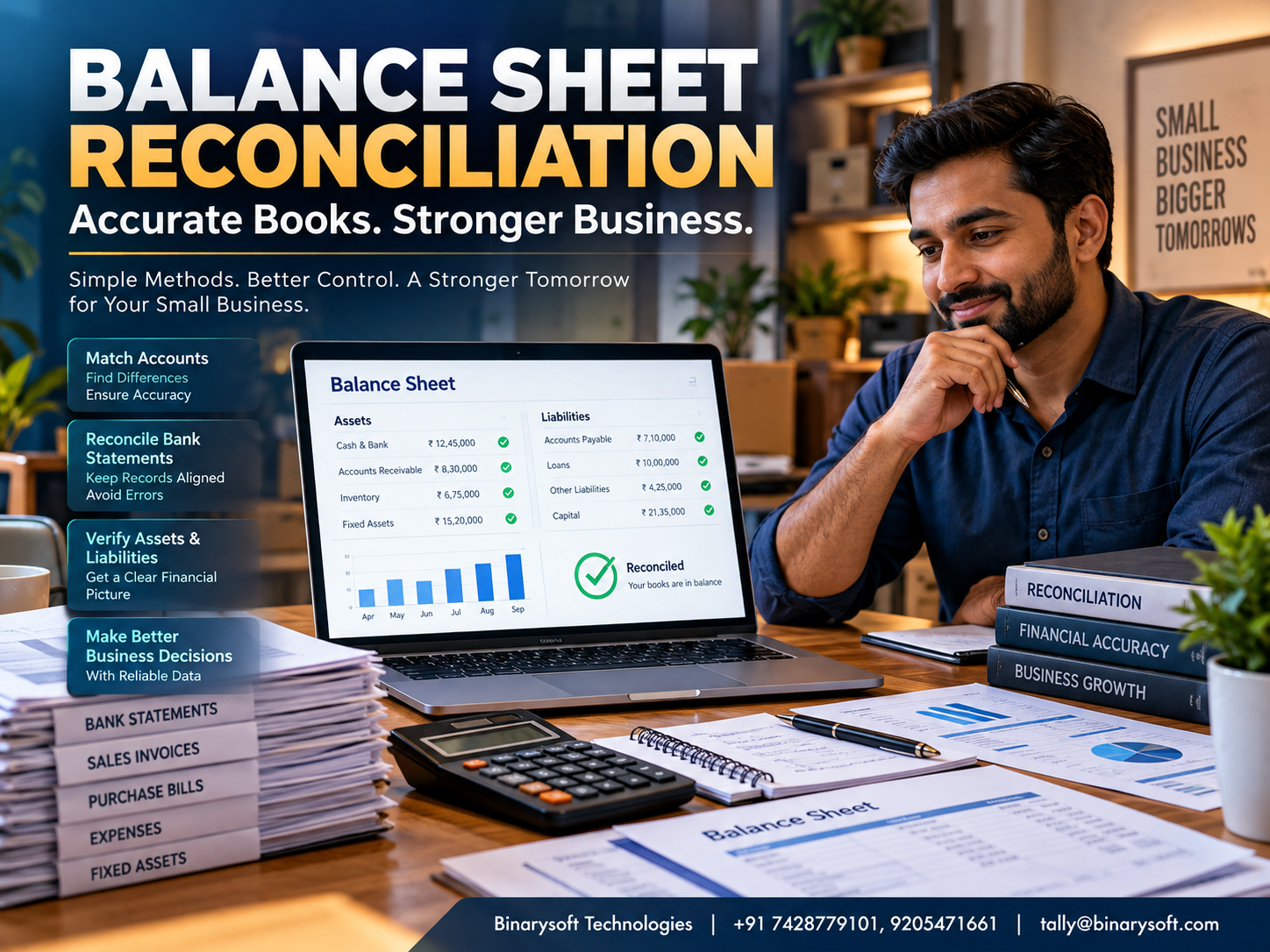
Balance sheet reconciliation is the process of comparing balances recorded in accounting books with supporting documents and independent financial records to identify discrepancies.
It helps businesses confirm that their assets, liabilities and owner's equity are accurately represented.
For small businesses, regular reconciliation improves financial transparency, reduces accounting mistakes and strengthens financial decision-making.
Modern accounting software such as TallyPrime makes this process more efficient by providing bank reconciliation facilities, ledger reports, inventory records and detailed financial statements.
Understanding the right reconciliation methods can help business owners avoid unexpected financial problems and build a stronger foundation for sustainable growth.
A Business Owner's Story: How One Accounting Error Nearly Destroyed Years of Hard Work
Rajesh Sharma owned a small electrical equipment distribution business in Delhi.
For almost twelve years, he had worked tirelessly to build relationships with suppliers, expand his customer base and provide financial security for his family.
His business appeared successful.
Sales were increasing, customers were placing regular orders and his warehouse remained busy.
However, Rajesh frequently struggled to understand why his bank balance was lower than expected.
His accountant assured him that everything was recorded correctly.
One afternoon, Rajesh approached his bank for additional working capital to expand his business.
The bank requested updated financial statements and supporting documents.
During verification, several discrepancies appeared.
Some customer payments had been recorded twice, supplier advances were incorrectly classified and a few outstanding bank transactions had never been reconciled.
The business appeared financially stronger in its books than it actually was.
Rajesh was devastated.
He had spent years building his company, yet inaccurate accounting records threatened an important opportunity for expansion.
Instead of ignoring the problem, he decided to introduce monthly balance sheet reconciliation.
His accounting team reviewed bank balances, customer ledgers, supplier accounts, inventory valuations and outstanding liabilities.
They also improved transaction recording and reporting through TallyPrime.
Within a few months, Rajesh had clearer financial information and a more reliable picture of his company's financial position.
He could identify outstanding customer payments, verify supplier obligations and prepare better financial reports.
Most importantly, he regained confidence in his business decisions.
The lesson is simple: A profitable business can still face serious financial difficulties when its accounting records are inaccurate.
This is an illustrative story created to explain the importance of reconciliation.
What Is Balance Sheet Reconciliation?
Balance sheet reconciliation is an accounting control process used to verify whether balances appearing in a company's balance sheet are accurate, complete and supported by reliable documentation.
A balance sheet contains three major components:
1. Assets
Assets represent resources owned or controlled by a business.
Examples include:
-
Cash and bank balances
-
Accounts receivable
-
Inventory
-
Machinery and equipment
-
Buildings and furniture
-
Prepaid expenses
-
Advances and deposits
2. Liabilities
Liabilities represent financial obligations payable by the business.
Examples include:
3. Owner's Equity
Owner's equity represents the residual interest in the business after deducting liabilities from assets.
The fundamental accounting equation is:
Assets = Liabilities + Owner's Equity
Although a balance sheet may satisfy this equation, individual account balances can still contain errors.
For example, a business may record a customer payment in the wrong ledger while maintaining balanced debit and credit entries.
Reconciliation helps detect such problems by examining supporting records rather than relying only on mathematical agreement.
Why Balance Sheet Reconciliation Is Important for Small Businesses
1. Improves Financial Accuracy
Reconciliation identifies incorrect entries, missing transactions and classification errors.
Accurate financial records help business owners understand their actual financial position.
2. Prevents Financial Losses
Unrecorded payments, duplicate transactions and incorrect supplier balances can cause unnecessary financial losses.
Regular verification helps businesses identify these issues before they become serious.
3. Strengthens Cash Flow Management
When bank balances and outstanding receivables are accurate, businesses can make better payment and investment decisions.
4. Supports Tax Compliance
Accurate accounting records provide a stronger foundation for GST reconciliation, tax calculations and financial reporting.
Balance sheet reconciliation complements, but does not replace, statutory tax reconciliation requirements.
5. Improves Loan Eligibility
Banks and financial institutions generally require reliable financial statements when evaluating business loan applications.
Properly reconciled accounts help businesses provide consistent financial information.
6. Builds Business Confidence
When financial records are trustworthy, business owners can make decisions about expansion, hiring, inventory purchases and borrowing with greater confidence.
Major Balance Sheet Reconciliation Methods for Small Businesses
1. Bank Reconciliation
Bank reconciliation compares transactions recorded in accounting books with transactions appearing in bank statements.
Differences may occur because of:
-
Cheques issued but not presented
-
Deposits awaiting clearance
-
Bank charges
-
Interest credited by the bank
-
Duplicate accounting entries
-
Incorrect payment amounts
-
Unrecorded bank transactions
Example
A company's accounting records show a bank balance of ₹4,50,000.
However, its bank statement shows ₹4,35,000.
The difference of ₹15,000 may arise from outstanding cheques, bank charges or other transactions.
The accountant must investigate and explain the difference rather than automatically treating it as an error.
How TallyPrime Helps
TallyPrime provides bank reconciliation functionality that helps businesses compare bank transactions with accounting entries.
Depending on the supported bank, configuration and product release, bank statement import and connected banking features may also be available.
Businesses can identify unreconciled transactions, verify clearing dates and maintain better control over bank balances.
2. Accounts Receivable Reconciliation
Accounts receivable reconciliation verifies amounts customers owe to the business.
The process involves comparing customer ledger balances with invoices, receipts, credit notes and other supporting records.
Common Problems
-
Duplicate sales invoices
-
Customer payments recorded incorrectly
-
Unadjusted credit notes
-
Incorrect opening balances
-
Payments allocated to the wrong customer
-
Unrecorded sales returns
How TallyPrime Helps
TallyPrime supports customer ledger management, bill-wise tracking and outstanding receivables reports.
Businesses can review unpaid invoices, verify customer balances and identify overdue payments.
Regular reconciliation also helps improve collection efficiency and reduce disputes.
3. Accounts Payable Reconciliation
Accounts payable reconciliation verifies amounts payable to suppliers and other creditors.
It involves comparing supplier ledger balances with purchase invoices, payment records, debit notes and supplier statements.
Example
A supplier statement shows an outstanding amount of ₹1,80,000.
However, the business ledger shows ₹2,00,000.
The ₹20,000 difference may be caused by an unrecorded purchase return, an incorrectly posted payment or another adjustment.
The accountant must review supporting documents to identify the actual reason.
TallyPrime Benefits
TallyPrime helps businesses maintain supplier ledgers, track bill-wise payables and review outstanding obligations.
This improves payment planning and reduces the risk of duplicate or incorrect supplier payments.
4. Inventory Reconciliation
Inventory reconciliation compares stock quantities and values recorded in accounting systems with physical inventory and supporting stock records.
This method is especially important for retailers, wholesalers, manufacturers and distributors.
Common Inventory Differences
-
Damaged goods
-
Theft or stock shortages
-
Incorrect purchase quantities
-
Unrecorded sales
-
Wrong stock classifications
-
Incorrect valuation
-
Goods returned but not recorded
How TallyPrime Helps
TallyPrime provides stock item management, inventory reports, stock summaries and physical stock adjustment facilities.
Businesses can compare physical quantities with recorded stock and investigate discrepancies.
Correct inventory valuation is essential because inventory directly affects current assets and business profitability.
5. Fixed Asset Reconciliation
Fixed asset reconciliation verifies the existence, ownership, cost and recorded value of business assets.
Examples include computers, machinery, furniture, vehicles and office equipment.
Businesses should compare their fixed asset records with purchase invoices, disposal documents, depreciation schedules and physical verification results.
Important Checks
-
Whether all assets physically exist
-
Whether new purchases are recorded
-
Whether sold assets are removed
-
Whether depreciation is calculated correctly
-
Whether asset values are classified appropriately
TallyPrime can maintain fixed asset ledgers and record depreciation through suitable accounting entries.
Businesses should maintain a detailed fixed asset register separately or through an appropriate integrated solution when asset-wise tracking is required.
6. Loan and Liability Reconciliation
Loan reconciliation verifies outstanding loan balances against lender statements.
Important elements include:
A business should ensure that loan repayments are correctly divided between principal and interest.
TallyPrime supports loan ledger accounting, journal entries and financial reports that help businesses verify outstanding liabilities.
7. Tax and Statutory Liability Reconciliation
Tax reconciliation helps businesses verify tax-related balances recorded in their accounting books.
For Indian businesses, important accounts may include GST payable, GST input tax credit, TDS payable and other statutory obligations.
Businesses should compare relevant ledger balances with returns, challans and official tax records.
TallyPrime provides GST reports and transaction-level information that can support this verification.
However, businesses must independently verify applicable statutory requirements and reconcile discrepancies with the relevant government records.
Step-by-Step Balance Sheet Reconciliation Process
Step 1: Collect Supporting Documents
Gather bank statements, customer invoices, supplier statements, loan records, inventory reports and other supporting documents.
Step 2: Review the Trial Balance
Generate the trial balance and identify accounts requiring reconciliation.
Prioritise accounts with large balances, frequent transactions or higher financial risk.
Step 3: Compare Ledger Balances
Compare each selected ledger balance with the corresponding independent record.
For example, compare bank ledger balances with bank statements and supplier balances with supplier confirmations.
Step 4: Identify Differences
Prepare a reconciliation statement showing the recorded balance, supporting balance and any reconciling items.
Step 5: Investigate Discrepancies
Review vouchers, invoices, payment records and supporting documentation to determine why differences exist.
Step 6: Record Necessary Adjustments
Pass correction entries only after identifying the underlying issue and obtaining appropriate approval.
Some timing differences require explanation rather than adjustment.
Step 7: Verify Final Balances
Review the updated reports and confirm that all material differences have been resolved or properly documented.
Step 8: Maintain Reconciliation Records
Save supporting documents, reconciliation statements, explanations and approval records for future reference.
Case Study 1: How a Retail Business Improved Inventory Accuracy Through Reconciliation
Business Background
A medium-sized retail business in Jaipur operated three stores selling electronic accessories.
The company handled numerous daily sales and maintained inventory across multiple locations.
Despite strong sales, management frequently encountered unexpected stock shortages.
The Problem
During an internal review, the accounting team discovered that physical inventory did not match recorded stock quantities.
Some purchase returns were missing, and certain stock transfers had not been recorded correctly.
The resulting discrepancies made inventory valuation unreliable.
The Solution
The business introduced monthly inventory reconciliation and strengthened stock recording procedures.
Its accounting team used TallyPrime inventory reports to review stock movements and compare recorded quantities with physical counts.
They also improved purchase return recording and established approval procedures for stock adjustments.
The Results
Over the following months, management gained better visibility into inventory differences.
The company could identify recording mistakes earlier, investigate shortages and make purchasing decisions using more reliable information.
Key Learning
Regular inventory reconciliation improves stock control and helps prevent inaccurate balance sheet reporting.
This is an illustrative case study; results are not presented as independently verified business outcomes.
Case Study 2: How a Manufacturing Business Improved Financial Control
Business Background
A small manufacturing company in Faridabad supplied packaging materials to local businesses.
The company purchased raw materials on credit and provided payment terms to several customers.
The Challenge
Its accounting team struggled with mismatched customer balances, outstanding supplier payments and differences between bank statements and accounting records.
Management could not confidently estimate available working capital.
The Solution
The company implemented a structured monthly reconciliation process.
Using TallyPrime, the accounting team reviewed customer outstanding reports, supplier ledgers, bank reconciliation statements and financial summaries.
They also established a monthly closing checklist and assigned responsibility for verifying major balance sheet accounts.
The Results
The business developed more reliable receivables and payables information.
Management gained better visibility into upcoming supplier payments and overdue customer collections.
The improved accounting process also supported more accurate financial discussions with lenders.
Key Learning
A disciplined reconciliation process helps manufacturing businesses strengthen cash flow planning and financial reporting.
This case study is illustrative and demonstrates a practical application of reconciliation controls.
How TallyPrime Simplifies Balance Sheet Reconciliation
TallyPrime helps small businesses organise financial information and perform several important reconciliation activities.
1. Centralised Accounting Records
TallyPrime maintains accounting transactions through ledgers and vouchers.
This provides a structured foundation for reviewing financial balances.
2. Bank Reconciliation Facilities
Businesses can compare recorded bank transactions with bank statements and identify uncleared or unmatched entries.
3. Bill-Wise Outstanding Tracking
Customer and supplier balances can be monitored using bill-wise accounting.
This helps identify unpaid invoices, advances and incorrectly allocated receipts.
4. Inventory Management
Stock summaries and inventory reports help businesses review quantities, stock movements and valuations.
5. Balance Sheet and Trial Balance Reports
TallyPrime provides financial statements that allow users to examine account balances and drill down into supporting transactions.
6. GST Reporting
GST-related reports support the verification of tax transactions and recorded statutory balances.
7. Voucher Verification
Detailed voucher records help accountants investigate suspicious or incorrect entries.
8. Cost Centre Reporting
Where configured, cost centre reports can help businesses review expenses and allocations across departments or business activities.
9. User Access Controls
Appropriate user permissions can help businesses restrict sensitive accounting activities and reduce unauthorised changes.
10. Backup and Data Protection
Regular backups help protect important accounting information.
Businesses should also maintain secure access controls and periodically test backup restoration.
Important: TallyPrime supports reconciliation through accounting records, reports and available banking features. It does not automatically verify every balance sheet account against independent third-party evidence. Proper reconciliation still requires document review and accounting judgement.
Best Practices for Effective Balance Sheet Reconciliation
Small businesses should follow a consistent reconciliation policy.
Reconcile Important Accounts Monthly
Bank accounts, receivables, payables and other high-risk balances should generally be reviewed every month.
Assign Clear Responsibilities
Designate responsible employees for preparing and reviewing reconciliation statements.
Maintain Supporting Documents
Preserve invoices, statements, receipts, confirmations and adjustment records.
Investigate Unusual Transactions
Large adjustments, unexpected balances and old outstanding items should receive additional attention.
Avoid Unnecessary Manual Entries
Use structured accounting processes and appropriate software features to reduce avoidable recording errors.
Review Opening Balances
Incorrect opening balances can affect financial reporting throughout the year.
Perform Independent Reviews
Where staffing permits, reconciliation preparation and approval should be handled by different individuals.
Use Consistent Reporting Periods
Ensure that supporting statements and ledger reports relate to the same accounting period.
Common Balance Sheet Reconciliation Mistakes to Avoid
Even experienced accounting teams can make reconciliation mistakes.
Common examples include:
Ignoring small differences: Repeated minor discrepancies may indicate larger process weaknesses.
Reconciling only bank accounts: Customer balances, inventory, loans and statutory liabilities also require verification.
Passing unexplained adjustment entries: Adjustments without supporting evidence can hide accounting problems.
Delaying reconciliation: Old discrepancies become harder to investigate as time passes.
Using incomplete documents: Missing statements or invoices may lead to incorrect conclusions.
Failing to review reconciliations: Independent review helps identify errors overlooked during preparation.
Not maintaining documentation: Without proper records, businesses may struggle to explain historical adjustments.
Avoiding these mistakes helps create a more reliable financial control system.
How Often Should Small Businesses Reconcile Their Balance Sheets?
The appropriate reconciliation frequency depends on transaction volume, business complexity and financial risk.
Businesses handling frequent banking transactions may benefit from daily or weekly bank reviews.
Customer and supplier accounts should generally be reviewed monthly, with more frequent attention to significant outstanding balances.
Inventory reconciliation may be performed monthly, quarterly or through a continuous cycle-counting programme.
Loan balances, tax liabilities and other important accounts should be checked at least during relevant monthly or quarterly closing procedures.
A comprehensive balance sheet reconciliation should also form part of the financial year-end closing process.
Businesses should establish a written schedule identifying the responsible employee, review frequency and supporting documents for each account.
Conclusion: Build a Financially Stronger Business Through Accurate Reconciliation
Balance sheet reconciliation is not simply an accounting formality. It is an essential business control that protects financial accuracy, improves transparency and supports confident decision-making.
For small businesses, even minor accounting discrepancies can create unexpected cash flow difficulties, supplier disputes and financial reporting problems.
Regular reconciliation helps identify these issues before they affect business stability.
By verifying bank accounts, customer balances, supplier liabilities, inventory, fixed assets and statutory obligations, businesses can maintain a more dependable understanding of their financial position.
TallyPrime supports this process through structured accounting records, bank reconciliation functionality, ledger reports, inventory management and financial statements.
However, technology delivers the best results when combined with disciplined accounting procedures, supporting documentation and regular management review.
Accurate financial records do more than explain where your business stands today. They help you make better decisions about where your business can go tomorrow.
Powered by Binarysoft Technologies
Authorized Tally Partner
Binarysoft Technologies helps businesses implement and use TallyPrime for accounting, inventory management, GST reporting, financial visibility and efficient day-to-day operations.
Location: 1626/33, 1st Floor, Naiwalan, Karol Bagh, New Delhi – 110005, INDIA
Contact Us: +91 7428779101, 9205471661
Email: tally@binarysoft.com
Business Hours: Monday to Friday, 10:00 AM – 6:00 PM
Frequently Asked Questions
Can TallyPrime help with balance sheet reconciliation?
Yes. TallyPrime provides accounting ledgers, bank reconciliation features, outstanding reports, inventory records and financial statements that support reconciliation activities.
What are the main methods of balance sheet reconciliation?
Common methods include bank reconciliation, accounts receivable reconciliation, accounts payable reconciliation, inventory reconciliation, fixed asset reconciliation and loan reconciliation.
What is the difference between bank reconciliation and balance sheet reconciliation?
Bank reconciliation focuses specifically on matching bank transactions and balances. Balance sheet reconciliation covers a broader range of accounts, including assets, liabilities and equity.
Can reconciliation help prevent accounting fraud?
Reconciliation can help detect unusual transactions, unsupported adjustments and unexplained differences. However, it should be combined with access controls, approvals and independent reviews.
CA. Aaryan Kanodia focuses on GST reporting, bookkeeping systems, and financial process improvement. He works with businesses to simplify routine accounting activities and maintain records suitable for compliance and internal review.