Call CA Tally HelpDesk
+91 9205471661,
7428779101
Introduction: Why Modern Businesses Need More Than Basic Accounting Software
Running a successful business involves much more than selling products or providing services. Every organization must manage financial transactions, inventory, customer relationships, supplier payments, employee responsibilities and daily operational activities.
For small and medium-sized businesses, handling these activities efficiently can become increasingly challenging.
A retailer may struggle to maintain accurate stock records. A wholesaler may experience delayed customer payments. A manufacturing company may find it difficult to monitor production-related costs, while a consultancy firm may spend excessive time preparing invoices and financial reports.
When different business activities are managed through disconnected spreadsheets, manual registers and separate software applications, employees often repeat the same work.
This creates unnecessary administrative effort, increases the risk of errors and makes important business information difficult to access.
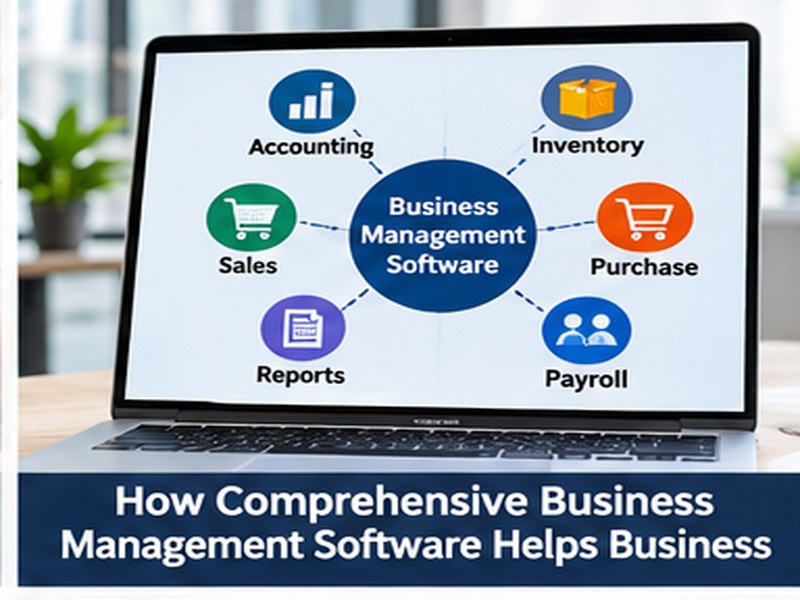
Comprehensive business management software helps organizations bring essential financial and operational processes into a more organized system.
Instead of maintaining separate records for accounting, sales, purchases and inventory, businesses can use integrated software to connect relevant activities.
Tally Prime provides accounting, invoicing, inventory management, banking, GST-related functionality and financial reporting capabilities that support everyday business operations.
By maintaining structured records, business owners can understand financial performance, monitor outstanding balances, review inventory and make better-informed decisions.
In this guide, we explore how comprehensive business management software works, its major benefits, the challenges it addresses and how Tally Prime helps businesses improve productivity and financial control.
We also include two illustrative case studies and an emotional business-owner story highlighting the human impact of better business management.
1. What Is Comprehensive Business Management Software?
Comprehensive business management software is a system designed to help organizations manage several important business functions through connected processes.
Rather than maintaining separate information for each department, an integrated system allows relevant transactions to contribute to accounting and operational records.
Typical business management functions include financial accounting, sales invoicing, purchasing, inventory tracking, banking, expense management and business reporting.
Some software platforms also include specialized customer relationship management, human resources, production planning or project management capabilities.
However, not every business management application provides every function.
Businesses should evaluate software according to their actual requirements.
How Tally Prime fits into business management
Tally Prime primarily provides integrated accounting and related business management capabilities.
It helps organizations maintain financial transactions, manage stock records, prepare invoices and review business performance.
Additional requirements, such as advanced CRM or specialized production planning, may need separate systems or suitable integrations.
2. An Emotional Story: The Business Owner Who Was Losing Control of His Growing Company
When Business Growth Became a Daily Struggle
For almost twenty years, Sanjay Gupta managed a small electrical equipment distribution business in Delhi.
His father had established the company with a single rented shop and a handful of customers.
Sanjay worked hard to expand the business.
Over time, he developed relationships with contractors, retailers and commercial customers.
Sales increased, employees joined and the business moved into a larger warehouse.
From the outside, everything appeared successful.
But behind the scenes, Sanjay was struggling.
The sales team maintained customer invoices in one system, warehouse employees updated stock quantities in spreadsheets and the accounts department recorded financial transactions separately.
Whenever a customer requested an urgent order, employees sometimes struggled to confirm whether the required products were available.
Supplier payments were occasionally delayed because outstanding balances were not reviewed consistently.
At the end of each month, Sanjay spent several evenings trying to understand the company's actual financial position.
One evening, his father visited the office and found him surrounded by invoices and registers.
His father asked a simple question.
"You have worked so hard to grow this business. Why does managing it seem more difficult now than when we started?"
Sanjay had no immediate answer.
He realized that increasing sales had not necessarily created better business control.
After discussing the situation with his accountant, Sanjay decided to reorganize the company's processes.
The business introduced Tally Prime for integrated accounting, invoicing, inventory records and financial reporting.
Employees received training, responsibilities were clarified and transaction recording became more consistent.
The accounts team began reviewing customer outstanding balances and supplier obligations regularly.
Warehouse employees maintained stock records through a structured process.
Gradually, Sanjay gained clearer visibility into the business.
He could review financial reports without waiting for several disconnected spreadsheets to be reconciled.
More importantly, he began spending less time resolving avoidable administrative problems.
This illustrative story demonstrates an important lesson: business growth becomes more sustainable when owners have reliable information and effective control over daily operations.
3. Why Businesses Need Integrated Management Software
As businesses grow, the number of transactions, customers, products and employees generally increases.
Manual processes that work for a small startup may become difficult to maintain when operations expand.
Integrated business management software can address several common challenges.
Reducing duplicate work
When accounting and inventory transactions are connected, employees may not need to enter the same information into multiple registers.
Improving financial visibility
Business owners can access structured reports instead of waiting for manual summaries.
Supporting operational coordination
Sales, purchasing and accounting teams can work from more consistent records.
Improving transaction accuracy
Standardized processes can reduce some manual errors, although correct data entry remains essential.
Supporting business decisions
Financial and inventory reports help management understand current performance and identify areas requiring attention.
4. Important Features of Comprehensive Business Management Software
The usefulness of business management software depends on the capabilities it provides.
|
Feature
|
Business purpose
|
Tally Prime application
|
|---|
|
Financial Accounting
|
Record income, expenses, assets and liabilities
|
Ledgers, vouchers and financial statements
|
|
Sales Invoicing
|
Prepare and record customer invoices
|
Sales vouchers and invoicing
|
|
Purchase Management
|
Record supplier transactions
|
Purchase vouchers and purchase orders
|
|
Inventory Management
|
Monitor stock quantities and values
|
Stock items, groups and godowns
|
|
Banking
|
Review payments and receipts
|
Banking and reconciliation features
|
|
GST Accounting
|
Support applicable tax records
|
GST-related vouchers and reports
|
|
Receivables
|
Monitor customer dues
|
Bill-wise outstanding reports
|
|
Payables
|
Track supplier obligations
|
Supplier ledger and payable reports
|
|
Financial Reporting
|
Evaluate business performance
|
Profit and Loss Account, Balance Sheet
|
|
User Security
|
Restrict unauthorized access
|
Security levels and user permissions
|
A suitable system should support the company's current requirements while allowing for reasonable future growth.
5. How Tally Prime Simplifies Financial Accounting
Financial accounting is one of the most important activities in every business.
Organizations must maintain records of sales, purchases, receipts, payments, expenses, assets and liabilities.
When these records are maintained manually, preparing financial statements can require substantial time.
Tally Prime provides a structured accounting environment using ledgers, groups and vouchers.
Important accounting capabilities
Businesses can record financial transactions, maintain customer and supplier accounts, review expense ledgers and generate relevant financial statements.
The Profit and Loss Account helps management understand income and expenses.
The Balance Sheet provides information about assets, liabilities and capital.
Other accounting reports help investigate transactions and balances.
By maintaining financial information within a consistent system, businesses can reduce unnecessary manual compilation.
6. Faster Sales Invoicing and Billing Management
Sales invoicing directly affects customer service and financial recordkeeping.
Businesses must prepare accurate invoices containing relevant customer, product, pricing and tax information.
Tally Prime supports accounting invoices and item-based invoices according to business requirements.
For inventory-based transactions, appropriately configured sales vouchers can record accounting information and stock movements together.
Practical example
A wholesale distributor processes 100 sales invoices every day.
If an improved workflow saves an average of two minutes per invoice, the potential saving is 200 minutes daily.
That represents approximately three hours and twenty minutes.
This is a hypothetical illustration rather than a guaranteed software performance result.
Actual productivity improvements depend on transaction complexity, employee training and existing processes.
7. Inventory Management for Better Stock Control
Inventory is a major investment for retailers, wholesalers, distributors and manufacturers.
Excess stock can trap working capital, while insufficient stock can result in missed sales.
Tally Prime provides inventory management features such as stock items, stock groups, units of measurement, godown management and Stock Summary.
Businesses can maintain relevant inventory transactions and review recorded stock availability.
How this helps
Stock reports provide information about quantities and values.
Location-wise records can support businesses operating multiple warehouses.
Inventory movement reports help management investigate product activity.
Reorder-related functionality can support replenishment planning.
However, businesses should conduct periodic physical stock verification and review supplier lead times before making purchasing decisions.
8. Purchase Management and Supplier Coordination
Purchasing decisions directly affect profitability and working capital.
Businesses must maintain records of supplier orders, purchase invoices, goods received and outstanding payments.
Without an organized purchasing process, companies may accidentally order unnecessary inventory or overlook supplier obligations.
Tally Prime supports purchase vouchers, purchase orders and relevant inventory transactions.
Businesses can review supplier ledgers, purchase registers and payable information.
Practical benefits
A purchasing manager can examine previous transactions before placing new orders.
The accounts department can monitor supplier balances and record authorized payments.
Management can also investigate purchasing patterns and review significant procurement expenses.
These capabilities help establish greater discipline in purchasing activities.
9. GST Accounting and Compliance Preparation
GST accounting is an important responsibility for registered businesses in India.
Organizations must maintain accurate records of taxable sales, purchases, credit notes, debit notes and other relevant transactions.
Tally Prime provides GST-related accounting and reporting capabilities.
When tax information is correctly configured, businesses can record applicable GST details and review tax-related reports.
Supported reconciliation and connected services may also help with compliance-related activities, depending on the software version and eligibility.
However, businesses must verify current tax rates, classifications, statutory requirements and filing obligations.
Accounting software supports compliance preparation but does not replace professional tax advice.
10. Banking and Financial Reconciliation
Banking activities are closely connected with everyday business operations.
Customer receipts, supplier payments, salaries and other expenses must be recorded accurately.
Bank reconciliation helps businesses compare accounting entries with actual bank transactions.
Tally Prime provides banking and reconciliation functionality that can reduce manual effort.
Depending on the bank and software configuration, supported bank statement import and connected banking capabilities may offer additional convenience.
Regular reconciliation helps identify missing entries, incorrect amounts and unmatched transactions.
It also provides management with a clearer understanding of recorded cash and bank balances.
11. Case Study One: Integrated Business Management for a Wholesale Trading Company
Illustrative case study based on common wholesale business operations
Business Background
A wholesale electrical goods distributor in Karol Bagh, New Delhi, supplied products to retailers and contractors.
The company maintained hundreds of stock items and regularly processed customer invoices and supplier purchases.
Business Challenges
Sales invoices, inventory records and financial accounts were maintained through disconnected systems.
Employees frequently spent time reconciling stock information.
Customer outstanding balances were also difficult to review consistently.
Tally Prime Implementation
The company introduced Tally Prime for accounting, sales invoicing, purchasing and inventory records.
Customer and supplier ledgers were organized, stock items were classified into suitable groups and employees received training on transaction recording.
Management introduced regular reviews of the Stock Summary, Sales Register and outstanding reports.
Business Improvements
The integrated process reduced unnecessary duplicate entry and improved access to financial information.
Purchasing decisions became more closely connected to recorded inventory.
Management could also investigate customer balances and supplier obligations more systematically.
Key Lesson
Integrated accounting and inventory processes help trading businesses improve coordination and maintain clearer operational records.
12. Case Study Two: Business Management Software for a Manufacturing Company
Illustrative case study based on typical manufacturing operations
Business Background
A small manufacturing company in Faridabad produced industrial packaging materials.
Its operations involved raw material purchasing, inventory storage, production activities and finished goods sales.
Challenges
Management struggled to understand the relationship between inventory investment, production-related expenses and profitability.
Financial reports required manual compilation from several records.
Tally Prime Implementation
The company organized accounting and inventory information in Tally Prime.
Relevant stock masters, purchase vouchers, sales transactions and expense ledgers were configured.
Management began reviewing financial statements and inventory reports regularly.
Where suitable, manufacturing-related inventory features were used to record material consumption and finished goods activity.
Business Benefits
The business developed a clearer view of recorded inventory values and financial performance.
Purchasing and accounting information became easier to review.
Management could investigate expense increases and compare financial results across periods.
Key Lesson
Comprehensive business management software helps manufacturers connect operational records with financial information, supporting more informed decisions.
13. Customer Outstanding and Credit Management
Credit sales are common in wholesale trading, distribution and business-to-business services.
However, delayed customer payments can create working capital pressure.
Tally Prime supports customer ledgers and bill-wise receivables.
Businesses can record invoices, adjust receipts against relevant bills and review outstanding balances.
Example
Suppose a distributor has total customer receivables of ₹12,00,000.
Of this amount, ₹4,00,000 is overdue.
Management can use outstanding reports to identify customers requiring follow-up and evaluate whether existing credit policies need attention.
Better receivables visibility supports payment collection planning, although it cannot guarantee that customers will pay on time.
14. Financial Reporting for Smarter Business Decisions
One of the most important advantages of integrated software is access to structured financial reports.
Tally Prime provides financial statements and transaction reports based on recorded accounting information.
Business owners can review profitability, expenses, sales performance and outstanding balances.
Important management reports
The Profit and Loss Account helps evaluate profitability.
The Balance Sheet explains financial position.
The Cash Flow report supports liquidity analysis.
Sales and Purchase Registers help investigate trading activities.
Stock Summary provides recorded inventory information.
Receivables and payables reports support working capital reviews.
These reports help management identify issues that may not be obvious from daily sales figures alone.
15. Cost Control and Profitability Improvement
Increasing sales is important, but profitability also depends on managing expenses.
Businesses must monitor transportation costs, rent, utilities, salaries, purchasing expenses and other operating commitments.
Tally Prime organizes financial transactions through accounting ledgers and groups.
Management can review expenses and compare performance across selected periods.
Example
A company generates monthly revenue of ₹20,00,000 and incurs total expenses of ₹18,00,000.
Its resulting profit is ₹2,00,000.
If management identifies avoidable costs of ₹40,000, reducing those expenses could improve profit to ₹2,40,000, assuming other factors remain unchanged.
Accounting reports help identify areas for investigation, while management must determine which cost reductions are commercially appropriate.
16. Improving Employee Productivity Through Integrated Workflows
Employees become more productive when they can complete tasks without repeatedly entering the same information.
Integrated accounting software can reduce unnecessary coordination between departments.
Sales employees can record authorized invoices.
Purchasing employees can maintain relevant procurement transactions.
Accounts personnel can review ledgers, reconcile payments and prepare financial reports.
Managers can access structured information without repeatedly requesting manual summaries.
Tally Prime also supports user security and access controls, helping businesses assign appropriate permissions.
Clear responsibilities and employee training remain essential for achieving productivity improvements.
17. How Comprehensive Software Supports Business Growth
As businesses expand, they may introduce additional products, customers, employees and operating locations.
This creates greater complexity in accounting and inventory management.
An integrated system provides a more consistent foundation for recording transactions and reviewing financial information.
Tally Prime supports accounting and inventory requirements across different business activities.
Businesses can maintain relevant records and use financial reports to understand changing operational requirements.
However, growth planning should also consider licensing, infrastructure, data security, employee training and specialized software needs.
Comprehensive software supports business expansion, but successful growth still requires effective management and financial planning.
18. Data Security and Business Information Protection
Financial records contain sensitive information about customers, suppliers, employees and business transactions.
Businesses should protect this information through suitable security procedures.
Tally Prime provides user management and security features that can restrict access to relevant functions.
Organizations should establish individual user accounts, assign appropriate permissions and avoid unnecessary sharing of administrative credentials.
Reliable backups are equally important.
Where software is accessed remotely, businesses should evaluate the security of the hosting or remote-access environment.
Regular reviews of user permissions and accounting changes help maintain stronger financial controls.
19. How to Implement Tally Prime for Comprehensive Business Management
Businesses can follow a structured implementation process.
Step 1: Evaluate business requirements. Identify accounting, inventory, banking, tax and reporting needs.
Step 2: Create the company. Configure relevant company and financial-year information.
Step 3: Set up accounting masters. Create appropriate ledger groups, customer accounts, supplier accounts and expense ledgers.
Step 4: Configure inventory. Create stock items, groups, units of measurement and locations where required.
Step 5: Configure applicable taxes. Review relevant GST registration details and tax settings.
Step 6: Establish transaction workflows. Define how sales, purchases, receipts and payments will be recorded.
Step 7: Assign user permissions. Provide employees with access appropriate to their responsibilities.
Step 8: Verify opening balances. Confirm accounting and inventory information before regular operations begin.
Step 9: Train employees. Ensure that users understand the functions they need.
Step 10: Review reports regularly. Monitor financial and operational information and correct identified discrepancies.
A phased implementation can help reduce disruption and improve adoption.
20. Common Mistakes Businesses Should Avoid
One common mistake is purchasing software without clearly identifying business requirements.
Another is configuring accounting masters incorrectly.
Some organizations transfer incomplete records into a new system and assume that the resulting reports will be accurate.
Others provide unrestricted access to employees who only need limited functions.
Businesses may also neglect training, backups and periodic reconciliation.
A successful implementation requires more than installing software.
It involves creating reliable procedures, assigning responsibilities and maintaining accurate records.
21. Why Choose Binarysoft Technologies for Tally Prime Business Management Support?
Binarysoft Technologies, an Authorized Tally Partner, helps businesses understand and implement Tally Prime for accounting and operational requirements.
Organizations can seek assistance with company setup, accounting configuration, inventory management, invoicing, GST-related settings, banking features and financial reporting.
Businesses can also discuss suitable software configurations for their operational requirements.
The objective is to help retailers, wholesalers, manufacturers, service providers and startups maintain organized financial information and use Tally Prime effectively.
Conclusion: Better Business Management Begins with Connected Information
Comprehensive business management software helps organizations improve coordination between accounting and everyday operations.
By bringing relevant financial and inventory activities into a structured environment, businesses can reduce repetitive work and improve access to important information.
Tally Prime provides capabilities for accounting, invoicing, purchasing, inventory management, banking, GST-related processes and financial reporting.
These features can support greater productivity, better financial visibility and more informed decisions.
For small businesses, integrated management can reduce administrative pressure.
For growing organizations, it can provide a stronger foundation for managing increasing transaction volumes and operational complexity.
However, software delivers the greatest value when supported by accurate records, trained employees, appropriate security and disciplined management practices.
A successful business does not simply generate more transactions. It understands those transactions and uses the information to make better decisions.
Powered by Binarysoft Technologies
Authorized Tally Partner
Location: 1626/33, 1st Floor, Naiwalan, Karol Bagh, New Delhi – 110005, INDIA
Contact us: +91 7428779101, 9205471661
Email us: tally@binarysoft.com
Business Hours: 10:00 AM – 6:00 PM, Monday–Friday
Frequently Asked Questions
Is Tally Prime suitable for manufacturing businesses?
Yes. It supports accounting, inventory and relevant manufacturing-related inventory records, although specialized production requirements may need additional solutions.
Can Tally Prime improve business productivity?
It can reduce duplicate data entry and simplify reporting when implemented with suitable processes and accurate records.
Can Tally Prime improve business productivity?
It can reduce duplicate data entry and simplify reporting when implemented with suitable processes and accurate records.
How can a business get help implementing Tally Prime?
Businesses can contact Binarysoft Technologies for assistance with Tally Prime configuration, accounting, inventory and reporting requirements.
CA. Arvindh Khetwaani is a Chartered Accountant with experience in financial reporting, compliance management, and accounting software implementation. He has assisted businesses in adopting structured inventory and billing practices, and his articles focus on accuracy, controls, and sustainable business growth.