Call CA Tally HelpDesk
+91 9205471661,
7428779101
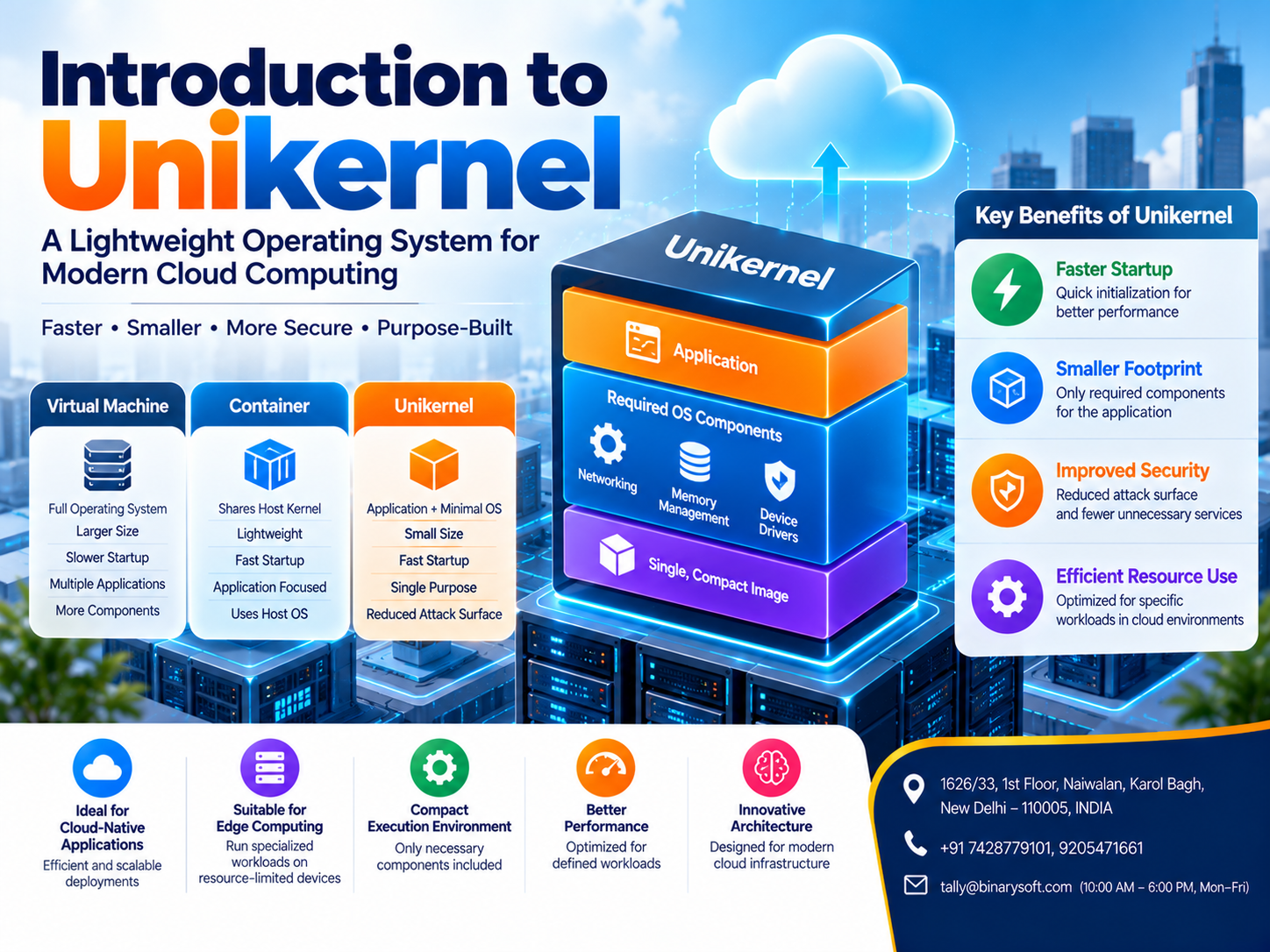
Introduction: Why Modern Cloud Infrastructure Needs Smarter Technology
Cloud computing has transformed how businesses develop applications, manage infrastructure and deliver digital services.
Organizations increasingly depend on cloud platforms for websites, enterprise applications, databases, customer services and business operations.
However, running applications efficiently requires careful management of computing resources.
Traditional operating systems contain numerous components designed to support different applications, users and hardware configurations.
Although these capabilities provide flexibility, many specialized cloud applications do not require every operating-system feature.
For example, a small application designed to process a specific type of request may need only networking, memory management and a limited set of system functions.
Running a complete general-purpose operating system for such a workload may introduce unnecessary components and maintenance responsibilities.
This challenge has encouraged researchers and developers to explore alternative operating-system architectures.
One such approach is the unikernel.
A unikernel is a specialized software image that combines an application with only the operating-system functionality required for its execution.
Unlike a traditional operating system designed to run many different applications, a unikernel is generally built for a specific workload.
This approach can produce compact, specialized execution environments.
Unikernels offer an alternative way to package and run applications, with potential advantages in resource efficiency, startup behavior and reduced software exposure.
However, unikernels also introduce development, compatibility and operational challenges.
Understanding both their benefits and limitations is essential before considering them for production environments.
A Developer's Story: When a Small Application Required Too Much Infrastructure
Aman was a software engineer working for a technology startup in Bengaluru.
His company developed lightweight services for processing information from industrial monitoring devices.
The application performed a relatively simple task.
It received data, validated the information and returned a response.
However, the development team deployed the service using a conventional operating-system environment.
As the number of devices increased, the company needed additional application instances.
Management began reviewing infrastructure efficiency.
Aman noticed that the application used only a small portion of the capabilities available in its operating-system environment.
He wondered whether a more specialized approach could reduce unnecessary components.
During his research, he discovered unikernel architecture.
The idea interested him.
Instead of deploying a small application inside a complete general-purpose operating system, the team could investigate building a specialized image containing the application and its required system functionality.
Aman created an experimental environment.
He worked with a suitable unikernel framework, adapted a simple service and tested it under virtualization.
The initial experiments were challenging.
Some familiar debugging tools were unavailable.
Certain dependencies required additional work.
The team also had to reconsider how updates, monitoring and application failures would be handled.
Nevertheless, the experiment helped Aman understand a different approach to operating-system design.
He realized that infrastructure efficiency was not simply about purchasing faster servers.
It was also about selecting an architecture appropriate for the workload.
The experience changed his perspective.
He began evaluating applications according to their actual requirements rather than assuming every workload needed the same operating-system environment.
The lesson: better technology decisions begin with understanding what an application genuinely needs and what complexity can safely be avoided.
This is an illustrative story created to explain the motivation behind unikernel development.
What Is a Unikernel?
A unikernel is a specialized, single-purpose machine image created by combining an application with the operating-system components it requires.
The resulting image is commonly designed to run directly on a supported virtual machine or hypervisor environment.
Traditional operating systems provide a broad collection of services.
A unikernel instead includes selected functionality needed by a particular application.
For example, a simple network service may require memory allocation, network communication, scheduling and basic input/output functionality.
A unikernel framework can combine the application with suitable implementations of these components.
The resulting image may not contain a conventional shell, package manager or general-purpose user environment.
This makes unikernels fundamentally different from ordinary Linux server installations.
Simple Definition
A unikernel is a specialized application image that includes the necessary operating-system functionality and runs as a tightly integrated execution environment.
Unikernels are particularly relevant to research, specialized services and certain cloud or embedded workloads.
They are not a universal replacement for conventional operating systems.
Understanding Traditional Operating-System Architecture
To understand unikernels, it is useful to examine conventional operating systems.
A typical server environment includes:
The operating system manages processes, memory, networking, storage and other resources.
This architecture provides flexibility because multiple applications can share the same system.
Administrators can install additional packages, run diagnostic utilities and manage services.
However, the environment may contain functionality that a particular application never uses.
A specialized service may require only a subset of the available operating-system capabilities.
Unikernel architecture attempts to address this difference by creating an execution environment tailored to the application.
How Does a Unikernel Work?
Unikernel development generally begins with an application and a set of specialized operating-system libraries.
The build system combines the application with required components.
These components may provide networking, memory management, device access and other necessary functionality.
The output is a specialized executable image.
This image can then run in a compatible virtualized environment.
Step 1: Identify Application Requirements
Developers determine what the application needs to operate.
For example, a network service may require TCP/IP networking, memory allocation and request processing.
Step 2: Select a Suitable Framework
The development team chooses a unikernel framework compatible with its programming language and deployment environment.
Step 3: Include Required System Components
The framework supplies or links the necessary operating-system functionality.
Step 4: Build the Unikernel Image
The application and selected components are compiled or packaged into a specialized image.
Step 5: Deploy the Image
The image runs on a supported virtualization platform or other compatible execution environment.
Step 6: Monitor and Maintain the Workload
The organization must establish suitable procedures for monitoring, updating and recovering the application.
Unlike a conventional server, a unikernel may not provide familiar administrative tools.
Operational requirements must therefore be considered during development.
Important Characteristics of Unikernel Architecture
Single-Purpose Design
Unikernels are generally designed for a specific application or workload.
This differs from general-purpose operating systems that support many unrelated programs.
Specialized Operating-System Functionality
Only the required system components are included in the image.
The exact components depend on the application and framework.
Compact Execution Environment
Some unikernels can produce relatively small images.
However, image size varies according to application dependencies and included functionality.
Reduced General-Purpose Services
A unikernel may omit shells, package managers and background services.
This can reduce unnecessary components, but it also changes how developers troubleshoot and maintain applications.
Virtualization Support
Many unikernels are designed to run on supported hypervisors.
Compatibility depends on the selected framework and deployment environment.
7 Major Benefits of Unikernel Technology
1. Reduced Software Footprint
Traditional operating systems include numerous components supporting different workloads.
A unikernel can include a more limited set of functionality.
This may reduce image size and unnecessary software dependencies.
For organizations deploying specialized services, a smaller software footprint can simplify certain aspects of deployment.
However, a small image does not automatically guarantee lower total resource consumption.
Actual results depend on the application and execution environment.
2. Potentially Faster Startup
Some unikernel implementations can start quickly because they initialize fewer components than a conventional operating system.
This can be useful for workloads requiring rapid instance creation.
Examples may include specialized services or certain event-driven applications.
Startup performance should be measured under realistic conditions.
Different frameworks and virtualization platforms may produce different results.
3. Reduced Attack Surface
A unikernel may exclude unnecessary services, utilities and system interfaces.
This can reduce the number of components exposed to potential attacks.
For example, an image without a conventional shell may eliminate certain administrative interfaces.
However, vulnerabilities can still exist in application code, libraries, networking components or the virtualization platform.
A smaller attack surface can support security, but it does not make a unikernel automatically secure.
4. Specialized Resource Usage
Unikernels can be designed around specific application requirements.
Some workloads may benefit from reduced operating-system overhead.
This can be relevant in resource-constrained environments.
However, performance advantages are workload-dependent.
Organizations should compare real measurements rather than assume unikernels always outperform conventional systems.
5. Simplified Application Packaging
A unikernel image can combine application code and required system functionality into a specialized deployment artifact.
This may reduce certain dependency-management problems.
However, development teams must still maintain build tools, libraries and deployment configurations.
6. Greater Control Over Execution
Developers can select an environment designed specifically for the application's requirements.
This may provide useful control in specialized deployments.
The trade-off is reduced flexibility compared with a general-purpose operating system.
7. Opportunities for Cloud Infrastructure Optimization
Unikernels may be useful where organizations operate many small, specialized services.
Potential advantages include compact images, controlled dependencies and efficient startup behavior.
Nevertheless, operational complexity, monitoring requirements and development costs must be included in any infrastructure evaluation.
Unikernel vs Virtual Machine vs Container
Unikernels, virtual machines and containers are different approaches to packaging and executing workloads.
| Feature | Unikernel | Traditional Virtual Machine | Container |
|---|
| Operating-System Design |
Specialized application and OS components |
General-purpose guest OS |
Shares host kernel |
| Primary Purpose |
Specific workload |
Broad application support |
Application packaging and isolation |
| Image Size |
Can be compact |
Often comparatively larger |
Varies by image |
| Startup Time |
Can be fast |
Depends on guest OS and platform |
Often fast |
| Application Compatibility |
Framework-dependent |
Broad within guest OS |
Broad within supported environment |
| Debugging Tools |
May be limited |
Generally familiar |
Generally familiar |
| Maintenance |
Specialized build and update process |
Standard OS maintenance |
Image and host maintenance |
| Best Use |
Selected specialized workloads |
General-purpose infrastructure |
Modern application deployment |
No single approach is best for every workload.
Virtual machines remain valuable for operating-system isolation and broad application compatibility.
Containers are widely used for application packaging and deployment.
Unikernels provide an alternative for applications that can benefit from specialized execution environments.
Where Are Unikernels Used?
Cloud-Native Applications
Certain small services may be suitable for unikernel experimentation.
Examples include specialized network applications and narrowly defined processing tasks.
Edge Computing
Edge devices often operate with limited resources.
Some specialized edge workloads may benefit from compact execution environments.
However, hardware compatibility and maintenance requirements are important considerations.
Network Services
Unikernels can be used to investigate specialized networking applications.
These may include proxies, network-processing services and related infrastructure components.
Research and Development
Operating-system researchers use unikernels to explore alternative system architectures.
This can support experimentation with memory management, isolation and application execution.
Specialized Embedded Systems
Certain embedded applications may benefit from a tightly controlled software environment.
Suitability depends on hardware support and operational requirements.
Popular Unikernel Frameworks and Approaches
Several projects have explored unikernel development.
MirageOS
MirageOS is associated with building specialized systems using the OCaml programming language.
It emphasizes library-based operating-system components.
IncludeOS
IncludeOS explored lightweight virtualized application environments using C++.
Its architecture demonstrated how application functionality could be combined with specialized system components.
OSv
OSv is a specialized operating-system approach designed around running application workloads in virtualized environments.
It is often discussed alongside unikernel technologies.
Unikraft
Unikraft provides a framework for constructing specialized operating-system images using configurable components.
Its approach emphasizes modularity and application compatibility.
Before selecting any framework, organizations should evaluate its current maintenance status, documentation, supported platforms and security update practices.
Security Considerations for Unikernel Deployments
Security is one of the frequently discussed advantages of unikernel architecture.
However, a secure deployment requires more than removing unnecessary components.
Minimize Unnecessary Functionality
Only required components should be included.
Maintain Application Dependencies
Libraries and application code must receive appropriate security updates.
Secure the Hypervisor
A unikernel depends on its execution environment.
Hypervisor vulnerabilities can affect workload security.
Protect Network Communication
Sensitive communication should use appropriate encryption and authentication mechanisms.
Implement Monitoring
Security teams need visibility into application behavior and failures.
Monitoring may require specialized tools.
Establish Update Procedures
Because unikernel images are often rebuilt for changes, organizations need reliable build and deployment processes.
Test Recovery
Application failures should not cause prolonged service disruption.
Appropriate restart and recovery mechanisms are important.
Security benefits must be evaluated through testing and threat analysis.
Performance Optimization with Unikernels
Performance is an important consideration in cloud infrastructure.
Unikernels may offer advantages for selected workloads because they can avoid certain general-purpose operating-system components.
However, performance depends on many factors.
These include application architecture, networking requirements, memory usage, storage access and virtualization overhead.
Organizations should evaluate:
Startup Time: How quickly the application becomes ready to serve requests.
Memory Consumption: The amount of memory required during normal and peak activity.
CPU Utilization: How efficiently the workload uses available processing resources.
Network Performance: Throughput and latency under realistic traffic.
Reliability: Behavior during failures, restarts and changing workloads.
Operational Cost: Development, deployment, monitoring and maintenance expenses.
A benchmark should compare equivalent application functionality under comparable conditions.
A smaller image alone is not sufficient evidence of better performance.
Challenges and Limitations of Unikernel Technology
Limited Application Compatibility
Not every application can be deployed easily as a unikernel.
Some applications depend on operating-system features that are difficult to reproduce in specialized environments.
Different Development Processes
Developers may need to learn framework-specific build procedures.
Debugging Complexity
Traditional tools may be unavailable.
This can make troubleshooting more challenging.
Monitoring Requirements
Organizations need suitable methods for collecting logs and operational metrics.
Update Management
Changes may require rebuilding and redeploying the image.
Smaller Ecosystems
Certain unikernel frameworks have smaller communities and fewer integrations than mainstream operating systems.
Production Support
Organizations must evaluate maintenance, documentation and support availability.
These limitations explain why unikernels remain a specialized option rather than a universal replacement for Linux servers or containers.
How Unikernel Technology Relates to Tally Prime Cloud Infrastructure
Tally Prime is primarily a Windows-based accounting and business management application.
It is not designed to run natively as a unikernel.
Therefore, adopting unikernel technology does not directly convert Tally Prime into a unikernel application.
However, unikernel concepts can be relevant to certain supporting components within broader cloud infrastructure.
1. Specialized Network Services
A hosting environment may use separate services for networking, routing or traffic processing.
Certain specialized services could potentially be evaluated for unikernel deployment.
2. Infrastructure Security Research
Unikernel architecture can help infrastructure engineers explore methods for reducing unnecessary software components.
These ideas may inform broader security planning.
3. Supporting Service Optimization
Cloud infrastructure may include monitoring agents, communication services or other specialized applications.
Some narrowly defined workloads could be candidates for experimentation.
4. Resource Planning
Understanding different operating-system architectures helps hosting providers evaluate infrastructure efficiency.
However, any optimization should be based on realistic testing.
5. Application Availability
Businesses using Tally Prime through a cloud-hosted arrangement need reliable application access.
Availability depends on hosting architecture, connectivity, monitoring, backups and operational support.
Unikernel technology alone does not guarantee improved uptime.
6. Backup and Recovery Infrastructure
Specialized infrastructure components may support broader backup or recovery workflows.
However, accounting data must be protected using appropriate Tally Prime-compatible backup procedures.
7. Business Continuity
A well-designed hosting environment should include suitable recovery planning.
Unikernel-based components, if used, must be included in those plans.
The important distinction is that unikernels may be relevant to selected supporting infrastructure services, while Tally Prime itself should remain in an appropriately supported application environment.
Practical Example: Evaluating a Specialized Cloud Service
Consider a technology company operating a small network-processing service.
The service performs a limited set of functions.
Management wants to evaluate whether a specialized execution environment could reduce unnecessary dependencies.
The engineering team creates two test deployments.
One uses a conventional operating-system environment.
The other uses a suitable unikernel framework.
Both implementations provide equivalent application functionality.
The team measures startup time, memory consumption, CPU usage, network latency and operational complexity.
It also evaluates debugging, monitoring and security update procedures.
The company discovers that technical performance is only one part of the decision.
Even if the unikernel performs well, the organization must consider developer expertise and long-term maintenance.
This example demonstrates the importance of evaluating architecture according to total operational requirements.
Case Study 1: Technology Startup Explores Lightweight Cloud Infrastructure
Business: Illustrative software technology startup
Location: Bengaluru, Karnataka
Challenge: Managing specialized application workloads efficiently
A technology startup developed small services for processing information from connected devices.
The company wanted to understand whether a specialized execution environment could simplify deployment.
Solution
The engineering team selected a suitable unikernel framework for an experimental service.
Developers created a test image containing the application and required system components.
They compared its behavior with an equivalent conventional deployment.
The evaluation included startup performance, memory usage, application compatibility and maintenance requirements.
Illustrative Results
The project helped the team:
-
Understand specialized operating-system architecture
-
Identify unnecessary application dependencies
-
Evaluate alternative deployment methods
-
Improve performance-testing procedures
-
Document operational trade-offs
Key Lesson
Unikernels can provide useful opportunities for specialized application development, but production adoption requires careful evaluation.
This case study is hypothetical and does not represent verified customer results.
Case Study 2: Cloud Services Company Evaluates Application Isolation
Business: Illustrative cloud infrastructure services company
Location: Hyderabad, Telangana
Challenge: Evaluating execution environments for specialized network applications
A cloud services company operated several infrastructure services.
Its engineering team wanted to investigate whether selected workloads could benefit from specialized operating-system images.
Solution
The company established a controlled testing environment.
Developers built a small network service using a suitable unikernel framework.
The team reviewed image composition, application behavior and deployment requirements.
Security engineers evaluated exposed components and dependency maintenance.
Operations staff assessed logging, monitoring and recovery procedures.
Illustrative Results
The evaluation helped the company:
-
Better understand application-specific operating systems
-
Identify potential security and maintenance trade-offs
-
Improve infrastructure benchmarking
-
Document monitoring requirements
-
Establish clearer criteria for selecting deployment architectures
Key Lesson
A technology should be adopted because it solves a specific operational problem, not simply because it offers a different architecture.
This case study is illustrative.
Best Practices for Adopting Unikernel Technology
Organizations should begin with a clearly defined workload.
The application should have manageable dependencies and well-understood requirements.
A suitable framework should be selected based on compatibility and maintenance status.
Development teams should create reproducible builds.
Security testing should cover the application, libraries and virtualization environment.
Monitoring and debugging procedures should be established before production deployment.
Organizations should compare unikernels with conventional virtual machines and containers.
Performance testing should use realistic workloads.
Recovery and update procedures must be documented.
Finally, the total cost of development and maintenance should be considered alongside infrastructure efficiency.
The Future of Unikernels in Cloud Computing
Cloud infrastructure continues to evolve toward more specialized and automated deployment models.
Unikernels represent one approach to reducing unnecessary operating-system functionality.
Their future depends on improvements in application compatibility, developer tools, debugging, monitoring and operational support.
They may remain useful for selected network services, edge applications and specialized cloud workloads.
At the same time, containers and conventional virtual machines will continue to provide flexibility for a broad range of applications.
The most effective infrastructure strategies are likely to use different technologies according to workload requirements.
For businesses, the important objective is not adopting every emerging technology.
It is selecting solutions that provide appropriate performance, security, reliability and long-term maintainability.
Conclusion: Unikernels Offer a Different Approach to Cloud Infrastructure
Unikernels are specialized execution environments that combine an application with the operating-system functionality it requires.
They represent an alternative to traditional general-purpose operating-system deployments.
Potential benefits include compact images, reduced unnecessary components, fast startup behavior and opportunities for specialized resource optimization.
However, these advantages depend on the workload and implementation.
Unikernels also introduce challenges involving application compatibility, debugging, monitoring and maintenance.
For cloud infrastructure engineers, understanding unikernels provides valuable insight into application-specific operating-system design.
For businesses using Tally Prime, unikernel technology is not a direct replacement for the supported application environment.
Nevertheless, the broader principles of minimizing unnecessary components, improving resource efficiency and designing secure infrastructure remain relevant.
The future of cloud computing is not simply about using more powerful servers. It is about designing systems that deliver the required functionality with appropriate efficiency, security and reliability.
Unikernels demonstrate how reconsidering traditional operating-system architecture can create new opportunities for specialized computing environments.
Improve Your Business Efficiency with Tally Prime and Cloud Solutions
Simplify business accounting, GST-related recordkeeping, inventory management, invoicing and financial reporting with professional Tally Prime assistance.
Explore suitable Tally Prime cloud-access arrangements to support authorized users working from different locations.
Powered by Binarysoft Technologies
Authorized Tally Partner
Location: 1626/33, 1st Floor, Naiwalan, Karol Bagh, New Delhi – 110005, INDIA
Contact Us: +91 7428779101, 9205471661
Email: tally@binarysoft.com
Business Hours: 10:00 AM – 6:00 PM, Monday to Friday
Frequently Asked Questions
Are unikernels more secure than traditional operating systems?
Unikernels may reduce unnecessary software exposure, but security depends on implementation, dependency maintenance, virtualization security and operational controls.
Can unikernels improve application performance?
They may improve performance for selected workloads, but results depend on application requirements and deployment architecture.
Are unikernels suitable for all applications?
No. Some applications require operating-system features or dependencies that are difficult to support in unikernel environments.
What are popular unikernel frameworks?
Examples include MirageOS, Unikraft and other specialized operating-system projects. Framework suitability and maintenance status should be evaluated before use.
CA. Shivesh Khandelwaal is a practicing Chartered Accountant experienced in accounting automation, compliance management, and audit support. He has worked with trading and distribution businesses to improve inventory visibility and financial reporting. His articles focus on real-world applicability.