Call CA Tally HelpDesk
+91 9205471661,
7428779101
Introduction: The Future of Accounting Begins with Smarter Invoice Processing
Every growing business dreams of increasing sales, serving more customers and expanding into new markets. But behind every successful transaction lies a responsibility that often receives little attention: recording invoices accurately.
For thousands of Indian retailers, wholesalers, manufacturers and service providers, invoice processing remains a repetitive daily activity.
Purchase bills arrive through emails, printed documents, scanned PDFs and mobile messages. Accountants must identify supplier details, enter invoice numbers, calculate taxes, verify item quantities and create accounting vouchers.
During busy periods, these responsibilities can become overwhelming.
A single incorrect invoice amount can affect supplier balances. A missing GST detail can create reconciliation difficulties. Duplicate entries can distort financial reports and lead to unnecessary payment confusion.
Docs by Ira introduces a smarter approach to invoice processing by combining artificial intelligence with TallyPrime's accounting capabilities.
Instead of manually typing every detail, businesses can scan or upload invoices, allow AI to extract relevant information and review accounting-ready draft vouchers before posting them.
The objective is not to remove accountants from the process. It is to reduce repetitive work so accounting professionals can concentrate on accuracy, compliance and financial decisions.
For businesses handling hundreds or thousands of invoices, AI-assisted document processing can become an important step towards more efficient financial management.
This guide explains how Docs by Ira works, its major capabilities, implementation requirements, practical benefits and how TallyPrime supports the entire accounting workflow.
1. What Is Docs by Ira in TallyPrime?
Docs by Ira is an AI-powered document processing capability designed to convert business invoices and other supported transaction documents into accounting-ready vouchers in TallyPrime.
It uses document recognition and artificial intelligence to identify information contained in invoices.
Instead of manually copying data from a document, users can upload the invoice and allow the system to prepare a draft transaction.
The extracted information may include:
-
Supplier or customer name.
-
Invoice number and invoice date.
-
GSTIN and applicable GST information.
-
Product or service descriptions.
-
Quantities, rates and amounts.
-
Taxable value and total invoice amount.
-
Individual line-item details.
The system then attempts to match extracted information with existing accounting and inventory masters.
Where information is missing, inconsistent or uncertain, the user can review and correct the draft.
The important distinction is that AI prepares the transaction, while the accountant remains responsible for verification and approval.
This combination helps businesses improve processing speed without surrendering control over their accounting records.
2. Why Traditional Invoice Processing Creates Challenges
Manual invoice entry is familiar to most accounting departments, but it becomes increasingly difficult as transaction volumes grow.
Time-Consuming Data Entry
Consider a trading business receiving 150 purchase invoices every day.
If each invoice requires four minutes of manual entry, the team spends approximately ten working hours entering documents.
This calculation excludes the additional time needed for verification, corrections and supplier communication.
Human Errors
Manual data entry can result in incorrect invoice numbers, supplier selection, amounts or GST classifications.
Even experienced accountants can make mistakes when processing large volumes of repetitive documents.
Duplicate Invoice Entries
The same invoice may arrive through multiple channels.
For example, a supplier might send a PDF by email and later provide a printed copy.
Without proper checking, the invoice could accidentally be entered twice.
Delayed Financial Reporting
When purchase invoices remain unrecorded, the accounting system may not reflect the latest supplier liabilities and expenses.
This can affect cash flow planning and management decisions.
Month-End Pressure
Accounting teams frequently face heavy workloads near GST return deadlines, financial closing dates and audit preparation periods.
AI-assisted invoice processing helps address these challenges by shifting much of the repetitive transcription work into an automated workflow.
3. How Docs by Ira AI Invoice Processing Works
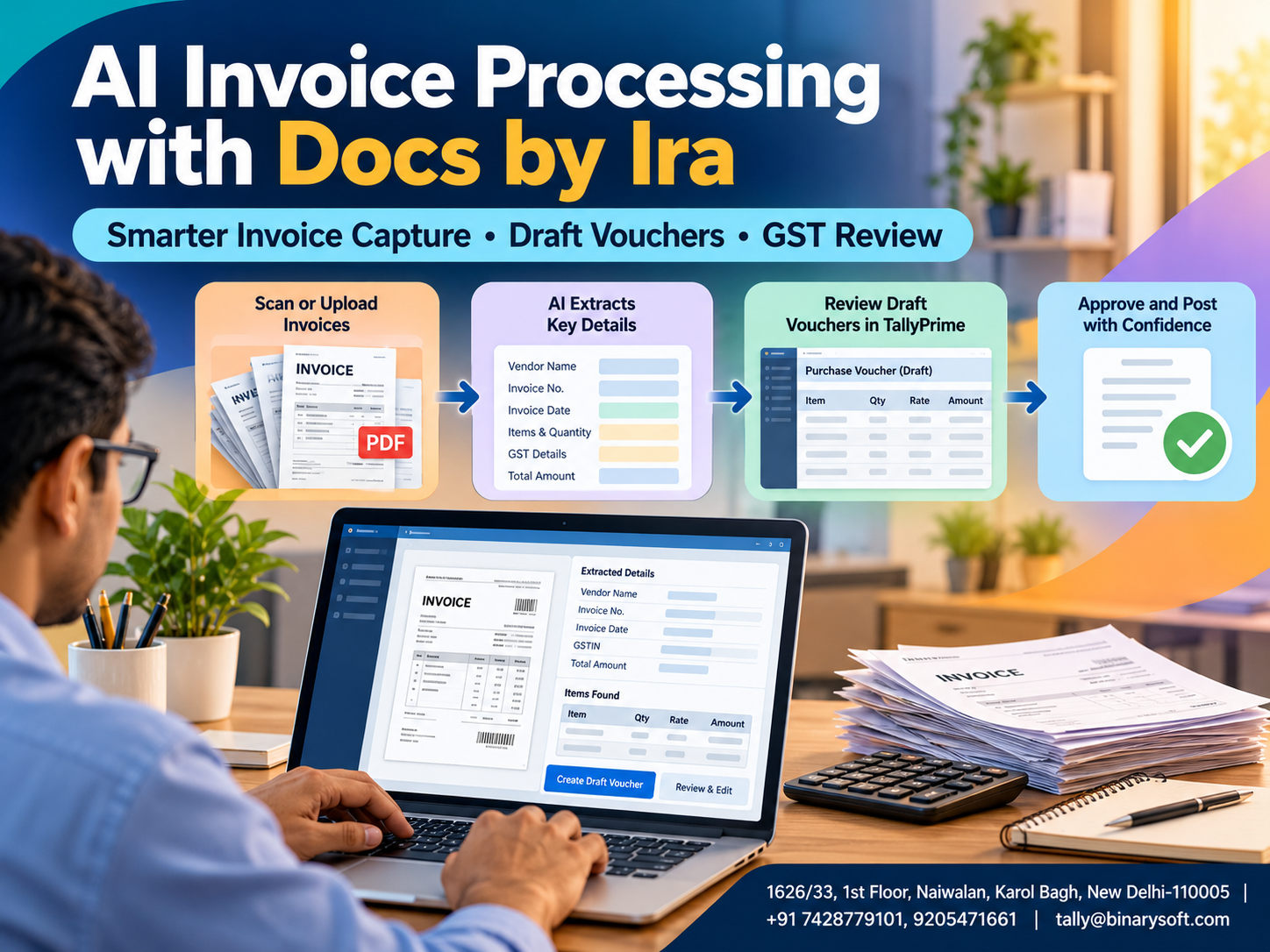
AI-assisted invoice processing workflow in TallyPrime
The process follows a structured sequence that combines automated data extraction with user verification.
Step 1: Scan or Upload the Invoice
Businesses can capture invoices using the supported mobile application or import files through TallyPrime.
Supported document formats include PDF, JPG, JPEG and ZIP packages for applicable bulk-import workflows.
Invoices may originate from supplier emails, document folders or physical bills converted into digital images.
Step 2: AI Extracts Invoice Information
The document processing system analyses the invoice and identifies relevant transaction fields.
It attempts to recognise supplier details, invoice references, taxable amounts, GST information and item descriptions.
Step 3: Draft Voucher Preparation
After extracting the information, the system prepares an accounting-ready draft voucher.
This eliminates the need to begin every transaction by manually typing all invoice details.
Step 4: Review and Correct Exceptions
The accountant reviews extracted information, master mappings and any flagged exceptions.
Incorrect or incomplete fields can be corrected before finalisation.
Step 5: Approve and Record the Transaction
After verification, the user approves the voucher for conversion into a regular accounting entry.
This approval stage is essential because AI extraction is not guaranteed to be error-free.
4. Major Features of Docs by Ira for Business Accounting
AI-Powered Data Extraction
The system reads supported documents and extracts relevant information automatically.
This can reduce manual transcription, especially for invoices containing several product lines.
Bulk Invoice Processing
Businesses can process multiple documents together instead of entering invoices individually.
This is particularly useful for wholesalers, distributors and accounting firms managing high transaction volumes.
Smart Ledger and Inventory Mapping
The system can match extracted party and item information with existing masters.
Where required, users can review proposed master creation and mapping changes.
Corrections can also help improve consistency in subsequent processing.
Duplicate Invoice Detection
Duplicate detection helps identify documents that may already have been processed.
This can reduce the risk of recording the same supplier invoice more than once.
Exception Identification
Potential problems such as missing information, inconsistent amounts or uncertain mappings can be highlighted for review.
Human Approval
Draft vouchers are not automatically treated as final accounting entries.
Users retain responsibility for reviewing and approving transactions.
Mobile Document Capture
Mobile-based invoice capture allows businesses to digitise documents without waiting for physical bills to reach the accounts department.
5. How to Get Started with Docs by Ira in TallyPrime
Before beginning, businesses should confirm their eligibility and software requirements.
Current guidance indicates that the feature requires a valid Indian TallyPrime licence, active TSS and a compatible software release. The detailed setup guidance specifies Release 7.1 or later, although some general eligibility information references Release 7.0. Using the latest supported release and checking activation eligibility is advisable.
Step 1: Complete Registration
Register the eligible TallyPrime serial number through the designated Docs by Ira registration process.
Complete the required verification and accept the applicable terms.
Step 2: Update the TallyPrime Licence
After successful registration, update the licence information so the available plug-in can be loaded.
Step 3: Verify Plug-In Availability
Check the relevant TallyPrime plug-in or document import options.
The feature must be enabled for the applicable licence before use.
Step 4: Prepare Invoice Files
Collect readable supplier invoices and organise them according to the intended voucher type.
Avoid combining unrelated transactions in the same document.
Step 5: Import Documents
Use the supported document import workflow in TallyPrime or the companion mobile application.
Step 6: Review Draft Transactions
Verify extracted amounts, supplier details, GST classifications and inventory mappings.
Step 7: Approve Vouchers
After checking the information, convert approved drafts into regular vouchers.
Businesses should initially test the process with a small set of invoices before adopting bulk processing.
6. An Emotional Story: The Accountant Who Finally Reached Home on Time
Consider the illustrative story of Amit, an accountant working for a growing wholesale business in Delhi's Sadar Bazaar.
For almost fifteen years, Amit had managed purchase bills, supplier accounts and GST records with dedication.
His colleagues trusted his accuracy, and the business owner depended on him for reliable financial information.
However, as the business expanded, the number of invoices increased dramatically.
Every evening, Amit faced a growing stack of supplier bills.
He would enter invoice numbers, calculate taxable amounts, select ledgers and verify purchase transactions long after other employees had left the office.
His daughter often called around dinner time.
“Papa, will you come home early today?”
Amit wanted to say yes, but month-end accounting deadlines rarely allowed it.
One evening, after discovering a duplicate supplier invoice, he realised that the problem was not a lack of effort. The business needed a more efficient process.
The company decided to evaluate AI-assisted invoice processing through Docs by Ira in TallyPrime.
Instead of entering every invoice from scratch, Amit began reviewing automatically prepared draft vouchers.
He checked supplier information, corrected exceptions and approved verified entries.
The technology did not eliminate his responsibilities. It helped him spend less time typing and more time exercising professional judgment.
Gradually, the accounting workload became easier to organise.
One evening, Amit finished his scheduled work earlier than expected.
He reached home in time to have dinner with his family.
The story illustrates a powerful idea: business automation is not only about saving working hours. It can also help people reclaim time for the relationships that matter most.
7. Case Study 1: Electronics Wholesaler Improves Purchase Invoice Processing
Illustrative business case study — results are hypothetical
Business Background
An electronics distributor operating in Nehru Place, New Delhi, purchases computer accessories and electronic components from multiple suppliers.
The company receives approximately 2,500 purchase invoices every month.
Its accounts department previously entered most supplier invoices manually.
Major Challenges
The business experienced delays in purchase accounting, repeated supplier verification and occasional duplicate entries.
During busy periods, the accounting team struggled to complete invoice processing before internal reporting deadlines.
Implementation Using Docs by Ira
The distributor introduced a structured invoice processing workflow.
Supplier invoices were collected digitally and imported in manageable batches.
Docs by Ira extracted transaction details and prepared draft vouchers.
The accounting team reviewed exceptions, verified GST details and approved the transactions.
Illustrative Performance Comparison
|
Parameter
|
Manual process
|
AI-assisted target
|
|---|
|
Monthly invoices
|
2,500
|
2,500
|
|
Average processing time
|
4 minutes
|
1.5 minutes
|
|
Monthly processing effort
|
167 hours
|
63 hours
|
|
Potential time saving
|
—
|
104 hours
|
These figures demonstrate a possible scenario, not guaranteed or independently measured results.
Business Benefits
The distributor could potentially reduce repetitive data entry and improve the consistency of purchase accounting.
The accounts team would also have more time to review supplier balances, investigate discrepancies and prepare management reports.
8. Case Study 2: Manufacturing Company Streamlines GST Purchase Accounting
Illustrative business case study — not a documented customer implementation
Business Background
A packaging manufacturer in Bawana Industrial Area purchases raw materials, printing supplies, chemicals and packaging accessories.
The company handles invoices from suppliers with different billing formats.
Existing Challenges
The accounting department frequently needed to verify item descriptions, GST rates and supplier details.
Invoices received late in the month created additional pressure during GST reconciliation.
AI-Assisted Solution
The company evaluated Docs by Ira for importing purchase invoices.
The workflow involved collecting readable invoice files, extracting relevant transaction information and matching it with existing supplier and inventory masters.
The accountant reviewed draft vouchers before approval.
Expected Operational Improvements
The business established three internal improvement targets:
-
Reduce manual invoice transcription by 60%.
-
Complete routine invoice processing within two working days of receipt.
-
Review all AI-flagged exceptions before voucher approval.
These are illustrative targets, not verified outcomes.
Key Learning
AI invoice processing can be particularly valuable for manufacturers because purchase transactions affect accounting, inventory valuation, supplier liabilities and GST reporting.
However, automation should be supported by accurate masters, proper invoice verification and disciplined accounting controls.
9. How TallyPrime Supports AI-Powered Invoice Processing
Docs by Ira becomes more useful when integrated with TallyPrime's broader business management capabilities.
Purchase Accounting
Approved purchase vouchers contribute to purchase accounts and supplier balances.
This helps businesses maintain more current accounting records.
Inventory Management
When applicable item-based transactions are correctly recorded, inventory quantities and valuations can be updated according to the company's configured inventory methods.
GST Accounting
Extracted tax information can assist voucher preparation.
Accountants must still verify GST classification, tax rates, place of supply and input tax credit eligibility.
Supplier Outstanding Management
TallyPrime's bill-wise accounting and outstanding reports help businesses monitor amounts payable to suppliers.
Financial Reporting
Properly recorded transactions contribute to financial statements, including the Profit and Loss Account and Balance Sheet.
GST Reconciliation
Businesses can use applicable TallyPrime GST reporting and reconciliation features to compare purchase records with relevant GST information.
AI extraction should not be treated as a substitute for statutory reconciliation.
10. Important Best Practices for Accurate AI Invoice Processing
AI-based document recognition works best when businesses maintain consistent procedures.
Use clear, readable invoice files and avoid blurred images.
Prefer one transaction per file wherever possible.
Organise bulk imports by voucher type and process large collections in manageable batches.
Review supplier names, invoice dates, GSTINs, quantities and tax amounts before approval.
Maintain accurate ledger and stock item masters to reduce mapping errors.
Check for duplicate invoices, especially when documents arrive through multiple channels.
Businesses should also verify the current document size limits, supported formats, usage quotas and subscription conditions before large-scale implementation.
AI can reduce repetitive work, but final accounting accuracy remains the responsibility of the business.
11. Can AI Replace Accountants in TallyPrime?
AI is becoming increasingly capable of performing repetitive accounting tasks.
However, accounting involves interpretation, compliance, financial judgment and business understanding.
AI may extract an invoice amount correctly but cannot independently establish every aspect of tax eligibility or commercial validity.
For example, an accountant may need to determine whether an expense is capital or revenue in nature, whether input tax credit is available or whether a supplier transaction requires investigation.
These decisions often require professional judgment.
The most effective approach is to combine AI-assisted document processing with experienced accounting supervision.
The technology handles repetitive extraction while accountants focus on verification, analysis, reconciliation and financial control.
12. Why Growing Indian Businesses Should Consider AI Invoice Automation
As transaction volumes increase, manual accounting processes become more difficult to scale.
Businesses expanding into new locations may receive invoices from numerous suppliers and departments.
AI-assisted processing offers an opportunity to standardise document handling while reducing repetitive work.
It can also support more timely accounting records, improve document organisation and help teams manage month-end workloads.
The benefits are particularly relevant for wholesale trading, manufacturing, distribution, professional accounting services and other document-intensive operations.
However, the financial value of implementation depends on invoice volumes, document quality, software eligibility, usage charges and the amount of human review required.
Businesses should evaluate these factors before adopting the solution.
13. How Binarysoft Technologies Can Help Your Business
Binarysoft Technologies supports businesses using TallyPrime for accounting, GST compliance, inventory management and financial operations.
Businesses exploring Docs by Ira can seek assistance with understanding TallyPrime requirements, reviewing their invoice workflows and preparing for AI-assisted accounting.
A structured implementation should begin with a review of current processes, followed by a small pilot, user training and ongoing verification.
The objective is to introduce automation without compromising accounting accuracy or business control.
Conclusion
Docs by Ira represents an important development in AI-assisted accounting for businesses using TallyPrime.
By converting supported invoices into draft accounting vouchers, the technology can reduce repetitive data entry and help accounting teams process documents more efficiently.
Its capabilities, including AI data extraction, bulk document processing, master mapping, duplicate detection and exception review, address common challenges faced by Indian businesses.
The greatest benefit comes from combining automation with responsible human oversight.
For retailers, wholesalers, manufacturers and accounting professionals, smarter invoice processing can improve productivity and provide more time for meaningful financial work.
The future of accounting is not simply about entering transactions faster. It is about creating accurate financial information with less repetitive effort and better control.
Powered by Binarysoft Technologies Authorized Tally Partner
Location: 1626/33, 1st Floor, Naiwalan, Karol Bagh, New Delhi – 110005, INDIA
Contact us: +91 7428779101, 9205471661
Email: tally@binarysoft.com
Business Hours: 10:00 AM – 6:00 PM, Monday to Friday
Frequently Asked Questions
Does Docs by Ira support bulk invoice processing?
Yes. It supports importing multiple invoices together, subject to applicable document formats, size limits and processing conditions.
Can Docs by Ira automatically create purchase vouchers?
Yes. It can extract relevant invoice information and prepare draft vouchers. Users must review and approve the transactions before they become regular accounting entries.
What is Docs by Ira in TallyPrime?
Docs by Ira is an AI-powered document processing capability that reads supported business invoices and prepares draft accounting vouchers in TallyPrime.
Is Docs by Ira available to every TallyPrime user?
Availability depends on licence eligibility, compatible software release, active subscription requirements and activation conditions.
CA. Aarav Bhandari specializes in GST compliance, accounting systems, and business advisory services. He regularly writes about tax updates, accounting automation, and financial best practices to help businesses improve efficiency and maintain statutory compliance.