Call CA Tally HelpDesk
+91 9205471661,
7428779101
Introduction: Why the Future of Business Accounting Matters in 2026
Running a successful business in India now requires much more than recording sales and expenses. Entrepreneurs must manage GST compliance, inventory movements, banking transactions, customer payments, financial reporting and growing expectations for faster business decisions.
In 2026, the pressure to modernize financial operations continues to increase. Businesses that once depended on spreadsheets and manual bookkeeping are exploring connected accounting systems that reduce repetitive work and improve visibility.
A product roadmap helps businesses understand how accounting technology may evolve and which capabilities deserve attention when planning future investments.
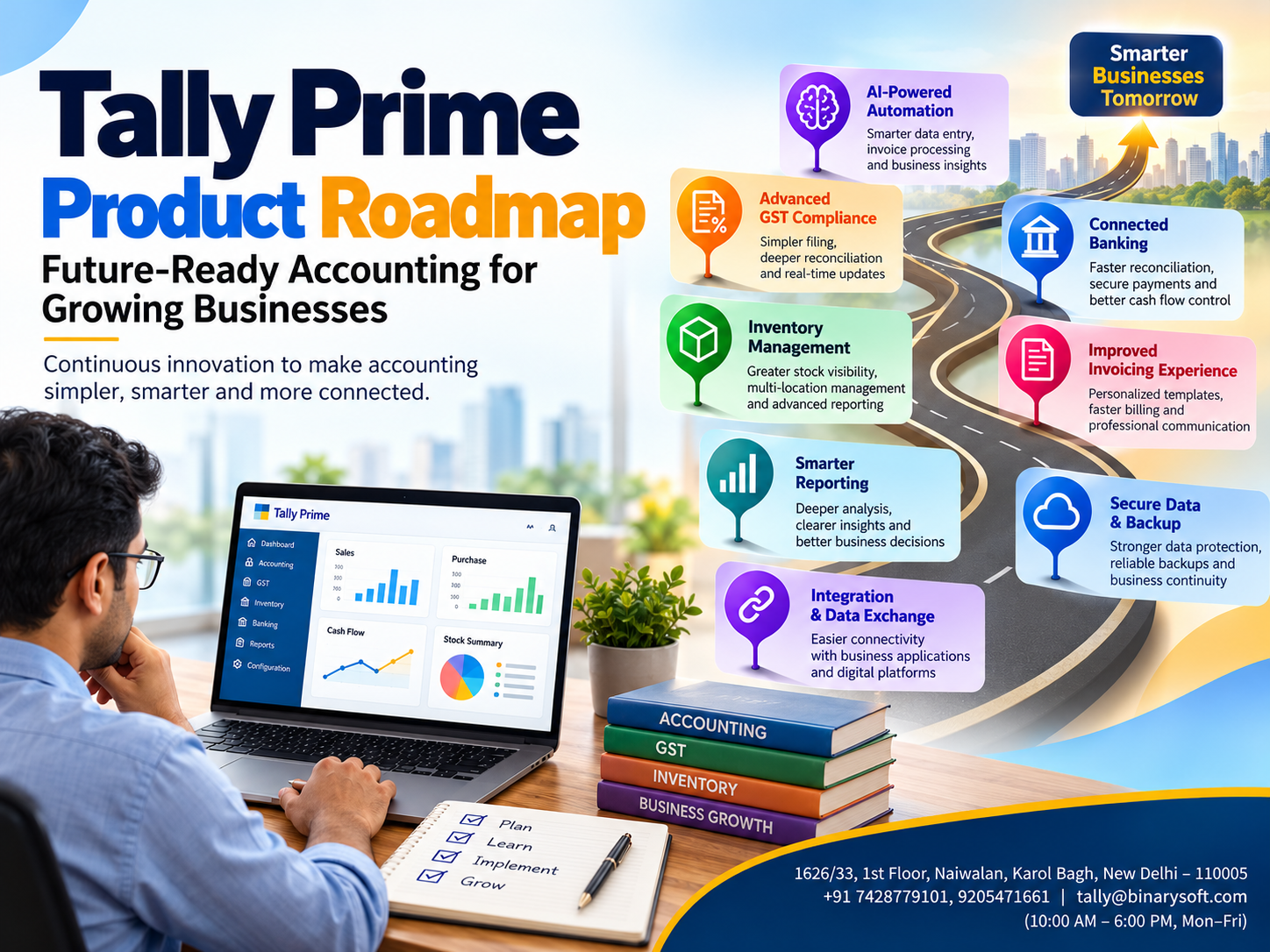
For Tally Prime users, important development themes include simplified accounting workflows, GST-related improvements, connected banking, inventory management, security and better access to business information.
Understanding these priorities helps organizations prepare employees, improve internal processes and make more informed technology decisions.
This guide examines the role of a product roadmap, practical business benefits, potential future innovations and how Tally Prime can support sustainable growth.
A Business Owner's Story: When Growth Created New Accounting Challenges
Amit owned a wholesale electrical equipment business in Delhi. During the early years, he managed invoices, supplier payments and stock records with a small accounting team.
As the company expanded, its daily transactions increased considerably.
Customers expected faster invoices. Suppliers requested timely payments, and the sales team needed accurate stock information before confirming orders.
One evening, Amit discovered that several customer payments had not been correctly allocated against outstanding invoices. At the same time, the warehouse team reported stock discrepancies involving fast-selling products.
Although the business was generating healthy sales, disconnected processes were making financial management increasingly difficult.
Amit began reviewing how the company's accounting system could better support inventory, billing, banking and financial reporting.
He introduced structured transaction procedures, trained employees and expanded the use of Tally Prime's available features.
The improvement was not simply about adopting software. It was about preparing the organization for more integrated financial operations.
Amit's experience is an illustrative story, but the underlying challenge is familiar to growing businesses: operational complexity often increases faster than administrative capacity.
1. What Is a Product Roadmap in Accounting Software?
A product roadmap is a strategic plan that describes the direction in which software may develop.
It helps communicate priorities, planned improvements and longer-term objectives.
For accounting software, roadmap themes may include improved user experience, compliance support, business reporting, data protection, system integration and transaction automation.
A roadmap is different from a release announcement.
A release announcement confirms functionality made available in a particular version. A roadmap may include proposed capabilities that are still being evaluated, designed or developed.
Businesses should therefore distinguish between existing features, officially announced plans and broader industry expectations.
For Tally Prime users, this distinction is important when making decisions about software upgrades, employee training and operational investments.
2. Simplifying Everyday Accounting Operations
One of the most valuable directions for accounting software is reducing unnecessary complexity in everyday transactions.
Small businesses frequently handle repetitive entries involving sales, purchases, expenses, receipts and payments.
When employees must repeatedly enter similar information, the risk of errors increases.
Simplified workflows can help reduce administrative effort and make accounting software easier for new users.
How Tally Prime Helps
Tally Prime provides structured accounting vouchers, ledger management and financial reports.
Businesses can record transactions through appropriate voucher types and review their impact on accounting statements.
Potential future improvements in this area could focus on more efficient navigation, stronger validations and reduced repetitive data entry.
Such enhancements would be particularly valuable for businesses processing large numbers of daily transactions.
3. GST Compliance and Digital Tax Management
GST remains a major area of attention for Indian businesses.
Companies must manage tax classification, input tax credit, sales reporting, purchase records and reconciliation.
Changes in statutory requirements can create additional work for accounting teams.
Businesses therefore benefit from accounting systems that support accurate transaction recording and relevant compliance workflows.
How Tally Prime Helps
Tally Prime supports GST configuration, GST invoices and related reports.
Depending on the installed release and eligibility, connected GST capabilities may support additional compliance activities.
Important areas for continued development include transaction validation, reconciliation assistance, exception identification and simplified reporting.
Businesses should always confirm current statutory requirements and supported software capabilities before relying on automated compliance processes.
4. Connected Banking and Faster Reconciliation
Banking transactions form a critical part of business accounting.
Companies regularly process supplier payments, customer collections, bank charges and transfers between accounts.
Manual bank reconciliation can become time-consuming when transaction volumes increase.
Connected banking technology offers opportunities to reduce repetitive work and improve transaction visibility.
How Tally Prime Helps
Tally Prime supports bank-related accounting and reconciliation.
Available banking functionality varies by release, configuration and supported bank or service.
Future development priorities across accounting technology may include improved transaction matching, payment workflows and reconciliation assistance.
For businesses, the practical objective is to identify discrepancies earlier and maintain more accurate cash and bank balances.
5. Inventory Management and Stock Visibility
Inventory management directly affects profitability, customer satisfaction and working capital.
A business may lose sales when products are unavailable or experience unnecessary financial pressure when excess stock remains unsold.
Accurate inventory records help organizations balance purchasing decisions with customer demand.
How Tally Prime Helps
Tally Prime supports stock items, units of measurement, stock groups, godowns and inventory reports.
Depending on business requirements and configuration, organizations can also manage batches and inventory valuation.
Future-facing inventory priorities may include improved exception reporting, easier stock analysis and stronger integration with purchasing and sales workflows.
These capabilities could help wholesalers, retailers and manufacturers make more informed inventory decisions.
6. AI-Powered Invoice Processing and Accounting Automation
Artificial intelligence is becoming increasingly relevant to document processing and accounting workflows.
Traditional invoice entry requires employees to read documents, identify supplier information, select ledgers and enter transaction details manually.
AI-assisted document processing can help reduce this effort by extracting information and preparing draft entries for review.
Docs by Ira and Tally Prime
Docs by Ira is an AI-powered document-processing capability associated with Tally Prime. It is designed to extract information from uploaded invoices and help prepare accounting transactions.
Its described capabilities include identifying invoice numbers, dates, supplier details, GST information and stock items, along with highlighting exceptions and detecting possible duplicates.
Businesses should verify availability, access requirements and supported document types before implementation.
Importantly, extracted information should be reviewed before vouchers are finalized. AI assistance does not remove the need for accounting judgment.
7. IMS Enhancements and Input Tax Credit Reconciliation
The Invoice Management System is an important development area for GST compliance.
Businesses need to compare purchase records with information available through GST systems to identify mismatches and manage eligible input tax credit.
Roadmap priorities include highlighting mismatched fields, simplifying reconciliation actions and improving the handling of supplier information.
Other described improvements include automatically accepting reconciled vouchers, retrieving party details using GSTIN and simplifying the copying of document references.
These developments could help accounting teams identify discrepancies earlier instead of waiting until month-end reconciliation.
8. Creating Accounting Vouchers from GST Portal Data
Manual entry of missing purchase invoices can be repetitive and error-prone.
One important automation direction is creating draft book vouchers using authenticated transaction information downloaded from GST systems.
Such a workflow can help accountants identify missing purchase records and prepare entries for review.
However, GST portal information may not contain all the inventory and accounting details needed to complete a transaction.
Users must verify ledger mapping, tax treatment, stock items and supporting documentation before finalizing entries.
9. Invoice Personalization and Professional Business Communication
Invoices are more than accounting documents. They also represent a business's professional identity.
Tally Prime 7.1 introduced enhanced invoice personalization capabilities, including predefined layouts and options for branding and presentation.
All Product updates in One Place
+1
Businesses can use suitable invoice designs to improve readability and present essential commercial information clearly.
The practical objective is to create accurate, professional invoices without repeatedly editing separate document templates.
10. Secure Backup and Business Data Protection
Accounting information is among the most valuable records maintained by a business.
Data loss, unauthorized changes and system failures can disrupt operations and create compliance difficulties.
Tally Prime 7.0 introduced scheduled backup capabilities, including supported cloud and local backup options.
All Product updates in One Place
+1
Businesses should combine available backup tools with regular restoration testing, access controls and documented recovery procedures.
A reliable backup strategy helps protect business continuity, particularly for organizations handling large transaction volumes.
11. Better Financial Reporting and Management Decisions
Business owners need accurate financial information to make decisions about purchasing, pricing, credit and expenses.
Tally Prime provides financial statements, ledger reports, outstanding balances and inventory information.
Recent product development has also included Schedule III reporting capabilities for relevant financial statement requirements.
All Product updates in One Place
Further improvements in reporting usability, data analysis and exception identification could help organizations understand financial performance more efficiently.
12. Integration and Data Exchange
Businesses increasingly use multiple applications for sales, e-commerce, inventory, customer management and financial operations.
Integration helps reduce repeated data entry between systems.
Tally Prime 7.0 introduced JSON data exchange capabilities alongside existing supported formats.
Businesses considering integration should evaluate data accuracy, synchronization frequency, security and compatibility with their installed software release.
Custom integration requirements may need additional development or specialized technical support.
13. Case Study One: GST Reconciliation for a Growing Distributor
Illustrative case study
A distribution company in Delhi purchased goods from dozens of suppliers every month.
Its accounting team spent considerable time comparing purchase records with GST-related information.
Differences in invoice numbers, dates and taxable values frequently required manual investigation.
The company improved supplier master data, introduced regular reconciliation procedures and trained employees to use supported GST reporting features.
It also established a process for reviewing discrepancies before completing return-related activities.
The result was a more organized accounting workflow and clearer responsibility for resolving supplier-related issues.
Key lesson: GST automation is most effective when businesses maintain accurate source records and review exceptions regularly.
14. Case Study Two: Connected Accounting for a Multi-Location Business
Illustrative case study
A retail and wholesale company operated from three locations in Delhi NCR.
Each location maintained sales and inventory information, while the central accounts department prepared financial reports.
The company faced delays in consolidating information and identifying stock differences.
Management standardized item masters, accounting procedures and inventory reporting.
It then evaluated suitable Tally Prime configurations and secure access arrangements for its operating structure.
With improved transaction discipline and more consistent reporting, management gained better visibility into stock movements and customer outstanding balances.
Key lesson: Business expansion requires reliable processes, accurate master data and an accounting system suited to the organization's operating model.
15. How Businesses Should Prepare for Future Tally Prime Updates
A successful software upgrade requires more than installing a new release.
Businesses should first review their current accounting processes and identify the capabilities that would provide meaningful operational benefits.
Before upgrading, they should create verified backups and assess compatibility with existing customizations, integrations and connected services.
Testing should cover invoices, GST calculations, inventory reports, banking transactions and financial statements.
Employees should receive practical training on relevant changes before the updated system becomes part of daily operations.
Businesses should also distinguish between released functionality and roadmap announcements when planning implementation dates.
16. Existing Features vs Future Development Priorities
|
Area
|
Existing or announced capabilities
|
Future-facing priority
|
|---|
|
GST
|
Connected GST and IMS functionality
|
Easier reconciliation and exception handling
|
|
Banking
|
Connected banking and reconciliation
|
More streamlined payment workflows
|
|
Invoicing
|
Personalized invoice templates
|
Improved document workflows
|
|
Accounting
|
Voucher entry and financial reporting
|
Reduced repetitive entry
|
|
AI processing
|
Docs by Ira initiative
|
Broader assisted document processing
|
|
Inventory
|
Stock and godown management
|
Improved inventory analysis
|
|
Data protection
|
Scheduled backup capabilities
|
Stronger recovery and continuity
|
|
Integration
|
Supported data exchange formats
|
More efficient application connectivity
|
Future-facing priorities are discussion areas, not confirmed delivery commitments.
17. Why a Product Roadmap Matters for Small Businesses
Small businesses often have limited time and resources for technology changes.
A product roadmap helps them identify areas where accounting software may become more efficient and understand which existing processes deserve improvement.
It can also guide employee training and budgeting decisions.
However, organizations should not delay necessary operational improvements while waiting for unconfirmed future features.
The most effective approach is to use available capabilities properly and adopt new functionality when it is officially released, tested and suitable for the business.
18. The Future of Accounting Technology in India
Accounting technology is moving toward greater connectivity, more automated document handling and improved financial visibility.
AI-assisted data extraction, digital banking integration and compliance-oriented workflows are important development areas.
For Indian businesses, these innovations may reduce administrative effort and help accounting professionals spend more time on analysis and decision-making.
At the same time, human review, internal controls and statutory awareness will remain essential.
Technology can improve the speed of processing, but accurate financial management still depends on reliable business records.
Conclusion
The Tally Prime product roadmap reflects broader changes in business accounting, including automation, connected services, GST reconciliation, financial reporting and secure data management.
Businesses can benefit from understanding both existing software capabilities and potential future developments.
The most valuable improvements are those that solve practical problems: reducing repetitive work, identifying discrepancies, improving stock visibility and supporting better financial decisions.
For growing organizations, successful digital accounting requires the right combination of software, structured processes, employee training and dependable support.
By preparing carefully for new capabilities and making full use of existing functionality, businesses can build more efficient and reliable financial operations.
Powered by Binarysoft Technologies
Authorized Tally Partner
Location: 1626/33, 1st Floor, Naiwalan, Karol Bagh, New Delhi – 110005, INDIA
Contact: +91 7428779101, 9205471661
Email: tally@binarysoft.com
Business Hours: 10:00 AM – 6:00 PM, Monday–Friday
Frequently Asked Questions
Where should businesses focus before adopting future features?
They should prioritize accurate master data, reliable accounting processes, employee training, reconciliation and data protection.
Why is accounting automation important?
It can reduce repetitive data entry, improve consistency and allow accounting teams to focus more on verification and financial analysis.
How can businesses prepare for a Tally Prime upgrade?
They should verify backups, review release requirements, test critical transactions, assess customization compatibility and train employees.
What is Docs by Ira?
Docs by Ira is an AI-assisted document-processing initiative designed to extract invoice information and help prepare accounting transactions for review.
CA. Aviraj Kothari focuses on business accounting, GST compliance, and management reporting. He helps businesses organize financial data and establish practical accounting processes for better visibility and smoother compliance.