Call CA Tally HelpDesk
+91 9205471661,
7428779101
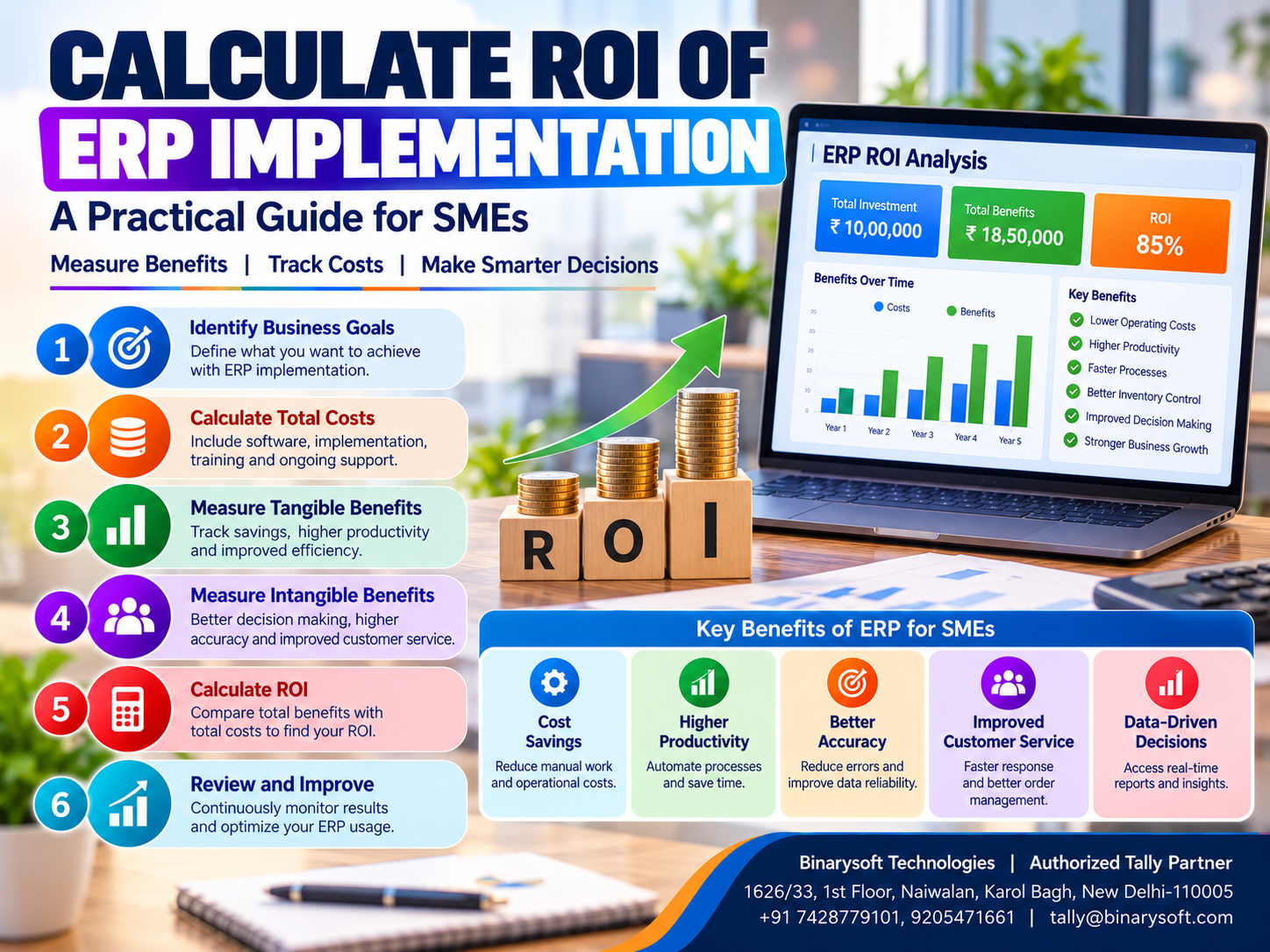
How to Calculate ROI of ERP Implementation for SMEs: A Complete Guide to Costs, Savings and Business Growth
Introduction: Is Your ERP Investment Really Worth the Money?
Every business owner wants technology investments to produce measurable results.
Whether a company purchases accounting software, introduces inventory management or implements an Enterprise Resource Planning (ERP) system, the ultimate objective is to improve business performance.
However, many small and medium enterprises invest in software without calculating its actual financial value.
A business may spend money on software licences, implementation services, employee training and cloud hosting.
After installation, employees may work faster, inventory records may become more accurate and financial reporting may improve.
But an important question remains:
How much financial benefit is the business receiving compared with the amount invested?
This is where Return on Investment, commonly known as ROI, becomes important.
ERP ROI measures the financial return generated by an ERP investment relative to its cost.
It helps business owners evaluate whether the implementation is producing sufficient value.
For Indian SMEs, understanding ERP ROI is particularly important because financial resources are often limited.
Businesses must balance technology investments against inventory purchases, salaries, operating expenses and expansion requirements.
Tally Prime can help many businesses improve accounting, inventory management, invoicing and financial reporting.
When these improvements reduce measurable costs or improve financial outcomes, they contribute to ERP ROI.
This guide explains how to calculate ERP ROI, identify implementation expenses, estimate financial benefits and evaluate whether an ERP investment supports sustainable business growth.
A Business Owner's Story: The Software Investment That Initially Felt Like a Mistake
Vikas operated an electrical equipment distribution business in Karol Bagh, New Delhi.
His company supplied electrical accessories to retailers and contractors across Delhi NCR.
For years, employees maintained accounting records using an older application and several spreadsheets.
As the business expanded, managing transactions became increasingly difficult.
Invoices took longer to prepare.
Inventory records required frequent corrections.
Customer outstanding balances were reviewed manually.
At the end of every month, the accountant spent several days preparing financial summaries.
Vikas decided to modernize the business by introducing better accounting and inventory software.
The implementation involved software costs, configuration, employee training and improvements to the company's computing infrastructure.
During the first month, Vikas felt disappointed.
Employees were still learning the new system.
Some transactions required correction.
The business had spent money, but the financial benefits were not immediately visible.
One evening, Vikas reviewed the implementation expenses and wondered whether he had made the right decision.
His accountant suggested comparing the company's operating processes before and after implementation.
They began measuring invoice preparation time, accounting corrections, inventory discrepancies and reporting effort.
Over the following months, employees became more comfortable with the software.
Routine tasks required less manual effort.
Management could review financial information more consistently.
Vikas realized that evaluating the investment only through its initial cost had overlooked the value of improved processes.
He began tracking measurable savings and comparing them with ongoing software expenses.
The exercise helped him understand which improvements were generating financial benefits and which processes still required attention.
This illustrative story highlights an important lesson:
The true cost of business software is not simply what you pay for it. Its value depends on what it helps your business save, improve or earn.
What Is ERP Return on Investment?
ERP Return on Investment measures the financial benefit generated by implementing ERP software compared with the total investment required.
It is generally expressed as a percentage.
Businesses use ERP ROI to evaluate whether their software investment is financially worthwhile.
ERP ROI may include measurable improvements such as reduced administrative costs, lower inventory losses, fewer transaction errors and additional contribution profit from improved operations.
However, not every operational improvement can be converted directly into financial savings.
For example, faster report generation may improve management convenience without immediately reducing expenditure.
Therefore, businesses should distinguish measurable financial benefits from qualitative improvements.
ERP ROI Calculation Formula
The standard formula is:
ERP ROI (%) = [(Total Financial Benefits − Total ERP Costs) ÷ Total ERP Costs] × 100
Where:
Total Financial Benefits represent the measurable financial value generated during the evaluation period.
Total ERP Costs include implementation expenses and relevant operating costs during the same period.
Example
Suppose a business invests ₹3,00,000 in ERP implementation and related expenses.
Over the evaluation period, the company identifies financial benefits worth ₹4,50,000.
Net financial benefit:
₹4,50,000 − ₹3,00,000 = ₹1,50,000
ROI:
(₹1,50,000 ÷ ₹3,00,000) × 100
ERP ROI = 50%
This means the measured net benefit equals 50% of the ERP investment over the selected period.
It does not mean that the company earned a 50% annual return unless the evaluation period was one year.
Step 1: Identify the Total Cost of ERP Implementation
Before calculating ROI, businesses must determine the complete cost of the ERP project.
The purchase price of software is only one component.
Software Licensing
Businesses may need to purchase software licences or pay recurring subscription charges.
Costs depend on the selected application and licensing arrangement.
Implementation Services
Implementation may involve company setup, accounting configuration, inventory structure and workflow design.
Data Migration
Existing records may need to be transferred from older applications or spreadsheets.
Complex migration requirements can increase project costs.
Employee Training
Employees need training to use the software correctly.
Training may involve external assistance and employee working time.
Infrastructure
Businesses may require computers, servers, network improvements or cloud-hosting services.
Integration and Customization
Additional costs may arise when ERP software must connect with other applications or support specialized workflows.
Maintenance and Support
Ongoing technical support, software maintenance and hosting charges should be included.
Temporary Productivity Loss
Employees may initially work more slowly while learning the new system.
Where measurable, this transition cost should be considered.
Step 2: Calculate Direct Financial Savings
Direct savings are relatively easy to identify because they reduce actual business expenses.
Reduced Administrative Costs
ERP software may reduce repetitive manual activities.
However, time savings should be counted as financial savings only when they produce measurable economic value.
For example, reducing paid overtime is a direct saving.
Lower Printing and Documentation Expenses
Digital workflows may reduce paper, printing and document storage expenses.
Reduced Error Correction Costs
More consistent transaction procedures may reduce time spent correcting invoices and accounting records.
Lower External Processing Expenses
Some businesses may reduce spending on outsourced data processing or reporting activities.
Reduced Inventory Losses
Improved stock records and controls may help reduce avoidable losses.
Businesses should use verified historical figures rather than assumptions.
Step 3: Estimate Productivity Improvements
Productivity improvements can contribute significantly to ERP ROI.
For example, an employee may previously spend three hours preparing a weekly report.
After implementation, the same activity may require one hour.
The business saves two hours per week.
However, the financial value depends on how that time is used.
If the company reduces paid overtime, the saving may be measurable.
If employees use the time for additional productive activities, the benefit should be estimated conservatively.
Businesses should avoid counting the same productivity improvement more than once.
Step 4: Calculate Inventory-Related Benefits
Inventory management is particularly important for wholesalers, distributors, retailers and manufacturers.
ERP implementation may improve stock visibility and transaction accuracy.
Reduced Excess Inventory
Better purchasing decisions may help businesses reduce unnecessary stock.
Lower Inventory Holding Costs
Reduced inventory levels may decrease financing, storage, insurance and handling expenses.
Reduced Stock Losses
Improved records may help identify discrepancies earlier.
Better Stock Availability
Accurate inventory information can support order fulfillment.
Important ROI Consideration
A reduction in inventory value is not automatically a profit.
Releasing ₹5,00,000 from excess stock improves working capital, but businesses should not count the entire amount as income.
The measurable financial benefit may include avoided financing costs, reduced storage expenses and lower inventory losses.
Step 5: Measure Improvements in Cash Flow
ERP software may support better visibility into customer outstanding balances and supplier obligations.
Businesses can use this information to improve payment follow-up procedures.
Example
Suppose a distributor reduces average receivables by ₹4,00,000 through better credit management.
If its annual financing cost is 12%, the approximate annual financing benefit may be:
₹4,00,000 × 12% = ₹48,000
The actual benefit depends on the company's financing arrangements and whether the improvement is sustained.
Businesses should avoid treating the entire reduction in receivables as additional profit.
Step 6: Evaluate Revenue-Related Benefits
ERP implementation may help businesses respond to customer requirements more efficiently.
For example, improved inventory visibility may reduce missed sales opportunities.
Faster invoicing may also support better customer service.
However, additional sales should not automatically be counted as equivalent financial benefits.
Businesses should generally consider the incremental contribution profit generated by additional sales.
Example
Suppose better stock availability helps a distributor generate ₹5,00,000 in additional annual sales.
If the incremental contribution margin is 20%, the estimated contribution benefit is:
₹5,00,000 × 20% = ₹1,00,000
This calculation is more meaningful than treating the entire sales increase as profit.
Step 7: Calculate the ERP Payback Period
The payback period estimates how long an investment takes to recover its initial cost.
A simple formula is:
Payback Period = Initial Investment ÷ Annual Net Cash Benefit
Example
Initial ERP investment: ₹2,40,000
Estimated annual net cash benefit after recurring costs: ₹1,20,000
Payback period:
₹2,40,000 ÷ ₹1,20,000 = 2 years
This simplified calculation assumes benefits remain consistent.
If savings vary significantly over time, businesses should calculate cumulative cash flows instead.
The payback period does not replace ROI analysis because it does not fully account for the value of benefits occurring after the investment has been recovered.
Step 8: Calculate ERP Total Cost of Ownership
Total Cost of Ownership, or TCO, represents the overall cost of using ERP software during a defined period.
It includes initial implementation and recurring expenses.
Example: Three-Year ERP Cost
| Cost Component | Amount |
|---|
| Software licensing |
₹60,000 |
| Implementation and configuration |
₹45,000 |
| Data migration |
₹25,000 |
| Employee training |
₹20,000 |
| Cloud hosting over three years |
₹1,08,000 |
| Additional support and maintenance |
₹42,000 |
| Total Three-Year Cost |
₹3,00,000 |
These figures are illustrative and do not represent a quotation for any specific product or service.
Businesses should calculate TCO using actual vendor proposals and expected operating requirements.
Step 9: Calculate Three-Year ERP ROI
Consider a business that incurs total ERP costs of ₹3,00,000 over three years.
Suppose its verified or reasonably estimated financial benefits are:
| Financial Benefit | Three-Year Value |
|---|
| Reduced administrative expenses |
₹1,20,000 |
| Reduced inventory losses |
₹90,000 |
| Lower financing costs |
₹75,000 |
| Reduced error correction expenses |
₹45,000 |
| Additional contribution profit |
₹1,20,000 |
| Total Benefits |
₹4,50,000 |
Net benefit:
₹4,50,000 − ₹3,00,000 = ₹1,50,000
ROI:
(₹1,50,000 ÷ ₹3,00,000) × 100
Three-Year ERP ROI = 50%
This example assumes that the benefit categories are independent and do not overlap.
The calculation represents a simple undiscounted ROI.
Larger investments may require discounted cash flow analysis to account for the timing of costs and benefits.
How Tally Prime Can Help Improve ERP ROI
Tally Prime provides several capabilities that may help businesses improve operational efficiency.
1. Faster Accounting Processes
Tally Prime supports routine accounting activities, including sales, purchases, receipts, payments and financial reporting.
Standardized transaction entry can reduce repetitive manual work.
2. Inventory Management
Stock groups, stock items, units and godowns help businesses maintain structured inventory records.
Accurate information can support purchasing and stock management decisions.
3. Outstanding Payment Management
Bill-wise accounting and outstanding reports help businesses monitor customer and supplier balances.
This information can support credit control and payment planning.
4. GST-Related Accounting
Tally Prime supports GST-related transaction recording, invoicing and reporting.
Proper configuration can help employees maintain consistent tax records.
5. Financial Reporting
Profit and loss statements, balance sheets and other reports help management review financial performance.
6. Banking and Reconciliation
Supported banking and reconciliation capabilities can help accounting teams review relevant transactions.
7. Multi-Location Inventory
Godown management supports location-wise stock records.
8. Remote Access Through Suitable Hosting
Tally Prime can be used through appropriate cloud-hosting arrangements, subject to licensing and infrastructure requirements.
Remote access may reduce operational delays for distributed teams.
Important Consideration
Tally Prime is not a universal replacement for every specialized ERP module.
Businesses requiring advanced production planning, enterprise CRM or complex automation should evaluate whether additional applications are necessary.
Case Study 1: ERP ROI for an Electronics Distributor in Nehru Place
Business Type: Electronics wholesale distribution
Location: Nehru Place, New Delhi
Primary Challenges: Manual inventory reconciliation, delayed outstanding reviews and administrative workload.
Business Background
Consider an electronics distributor handling thousands of stock items and supplying retailers across Delhi NCR.
The company uses spreadsheets alongside older accounting software.
Employees spend considerable time reconciling inventory and preparing management reports.
Implementation Strategy
The company introduces Tally Prime with structured accounting and inventory records.
Employees receive practical training.
Management establishes regular outstanding reviews and stock verification procedures.
Illustrative Annual Benefits
Reduced paid administrative overtime: ₹45,000
Reduced inventory losses: ₹35,000
Lower financing costs through improved collections: ₹25,000
Additional contribution profit from improved order fulfillment: ₹40,000
Total estimated annual benefits: ₹1,45,000
Suppose the initial implementation costs ₹1,20,000 and recurring annual expenses are ₹30,000.
First-year net benefit:
₹1,45,000 − ₹1,50,000 = −₹5,000
First-year ROI:
(−₹5,000 ÷ ₹1,50,000) × 100 = −3.33%
Although the first-year ROI is slightly negative, the business may achieve a positive cumulative return in subsequent years if benefits continue and recurring costs remain controlled.
Key Learning
ERP investments may require time before their financial benefits exceed initial implementation expenses.
This is an illustrative case study, not a verified customer implementation.
Case Study 2: ERP ROI for a Manufacturing SME in Faridabad
Business Type: Industrial components manufacturing
Location: Faridabad, Haryana
Primary Challenges: Inventory discrepancies, repetitive accounting tasks and delayed financial reporting.
Business Background
Consider a manufacturing business producing industrial components for domestic customers.
The company maintains accounting records and separate material registers.
Management wants to improve reporting consistency and reduce avoidable operational expenses.
Implementation Strategy
The organization standardizes inventory classifications and accounting procedures.
Tally Prime is configured for relevant accounting and inventory workflows.
Employees receive training, and management introduces regular reconciliation.
Illustrative Financial Results
Initial ERP implementation investment: ₹2,00,000
Annual recurring expenses: ₹40,000
Estimated annual measurable benefits: ₹1,50,000
Over three years:
Total costs = ₹2,00,000 + (₹40,000 × 3) = ₹3,20,000
Total benefits = ₹1,50,000 × 3 = ₹4,50,000
Net benefit = ₹4,50,000 − ₹3,20,000 = ₹1,30,000
ROI = (₹1,30,000 ÷ ₹3,20,000) × 100
Three-Year ERP ROI = 40.63%
Key Learning
A realistic ROI assessment should include recurring expenses and measure benefits over a defined period.
Tangible and Intangible Benefits of ERP Implementation
ERP benefits can be divided into two categories.
Tangible Benefits
These benefits can be assigned a reasonably measurable financial value.
Examples include reduced overtime expenses, lower inventory losses and avoided financing costs.
Intangible Benefits
These benefits improve business operations but may be difficult to measure financially.
Examples include better employee confidence, improved management visibility, more consistent procedures and reduced dependence on manual reporting.
Intangible benefits are valuable.
However, businesses should not assign arbitrary monetary values simply to make ROI calculations appear more attractive.
Common Mistakes When Calculating ERP ROI
Ignoring Recurring Costs
Software subscriptions, hosting and support expenses should be included.
Counting Revenue as Profit
Additional sales should generally be evaluated using incremental contribution profit.
Double-Counting Savings
A single improvement should not be included under multiple benefit categories.
Ignoring Employee Training
Training requires time and resources.
Assuming Every Saved Hour Reduces Costs
Time savings must be connected to measurable financial value.
Overestimating Benefits
ROI calculations should use conservative and defensible assumptions.
Ignoring Implementation Delays
Delays may increase costs and postpone benefits.
Comparing Different Time Periods
Costs and benefits must cover the same evaluation period.
How to Improve ERP ROI After Implementation
Businesses can improve returns by monitoring actual system usage and operational outcomes.
Train Employees Regularly
Employees should understand the software features relevant to their responsibilities.
Standardize Business Processes
Consistent procedures reduce confusion and improve data quality.
Review Outstanding Payments
Regular receivables analysis can support credit control.
Monitor Inventory
Businesses should review stock levels, discrepancies and slow-moving products.
Use Management Reports
Financial and operational reports help identify areas requiring attention.
Avoid Unnecessary Customization
Customization should solve clearly defined business problems.
Review Software Utilization
Management should evaluate whether employees are using the capabilities included in the implementation.
Measure Results Periodically
Actual savings should be compared with the original ROI estimates.
ERP ROI vs ERP Payback Period: What Is the Difference?
ROI measures the financial return relative to investment cost.
The payback period estimates how long it takes to recover the initial investment.
A project may have a short payback period but limited long-term benefits.
Another project may take longer to recover its costs but generate greater value over several years.
Businesses should consider both measures.
For larger investments, Net Present Value and other discounted cash flow methods can provide additional insight.
When Should an SME Invest in ERP Software?
ERP implementation may be worth evaluating when a business experiences recurring operational problems.
These may include frequent accounting errors, unreliable inventory records, delayed financial reports, excessive manual work or difficulty coordinating multiple locations.
However, not every business requires a complex ERP platform.
Smaller organizations may achieve meaningful improvements through suitable accounting and inventory software.
The investment decision should be based on actual requirements, expected benefits and total costs.
The Future of ERP ROI for Indian SMEs
As Indian businesses adopt more digital processes, software investment decisions will increasingly depend on measurable outcomes.
Cloud infrastructure, connected applications and improved reporting can create opportunities for operational efficiency.
Advanced analytics and AI-assisted tools may provide additional capabilities when supported by appropriate applications and integrations.
However, businesses should avoid assuming that advanced technology automatically produces higher ROI.
The most valuable improvements often come from accurate accounting, better inventory control, timely collections and consistent employee procedures.
A disciplined approach to measurement helps organizations identify which investments genuinely improve performance.
Conclusion
Calculating ERP Return on Investment helps businesses understand whether technology spending is producing meaningful financial benefits.
For small and medium enterprises, ERP ROI should include software expenses, implementation costs, training, infrastructure and ongoing support.
Financial benefits may arise from reduced administrative expenses, lower inventory losses, improved collections and additional contribution profit.
However, estimates should be realistic and supported by business records.
Tally Prime can help Indian businesses improve accounting, inventory management, invoicing, outstanding monitoring and financial reporting.
When implemented correctly, these capabilities may contribute to measurable operational improvements.
The key is to evaluate actual results rather than relying on assumptions.
Business owners should calculate ROI over a clearly defined period, monitor implementation performance and review the figures regularly.
The best ERP investment is not necessarily the cheapest software. It is the solution that delivers useful capabilities, reliable operations and sustainable financial value at an appropriate total cost.
Powered by Binarysoft Technologies
Authorized Tally Partner
Location: 1626/33, 1st Floor, Naiwalan, Karol Bagh, New Delhi – 110005, INDIA
Contact: +91 7428779101, 9205471661
Email: tally@binarysoft.com
Business Hours: 10:00 AM – 6:00 PM, Monday to Friday
Frequently Asked Questions
What is the best method for ERP training?
A combination of role-based instruction, practical exercises, documented procedures and ongoing support is generally effective.
How can Binarysoft Technologies help with Tally Prime employee training?
Binarysoft Technologies, an Authorized Tally Partner, can assist businesses with Tally Prime training, accounting and inventory configuration, implementation guidance and related software support.
Can ERP employee training improve inventory accuracy?
Training can help employees record inventory transactions consistently and follow stock verification procedures.
What are ERP champions?
ERP champions are trained employees who provide guidance and support to colleagues within their departments.
CA. Shivesh Khandelwaal is a practicing Chartered Accountant experienced in accounting automation, compliance management, and audit support. He has worked with trading and distribution businesses to improve inventory visibility and financial reporting. His articles focus on real-world applicability.