Call CA Tally HelpDesk
+91 9205471661,
7428779101
What Changed in 2026: Why Better Business Control Matters Now
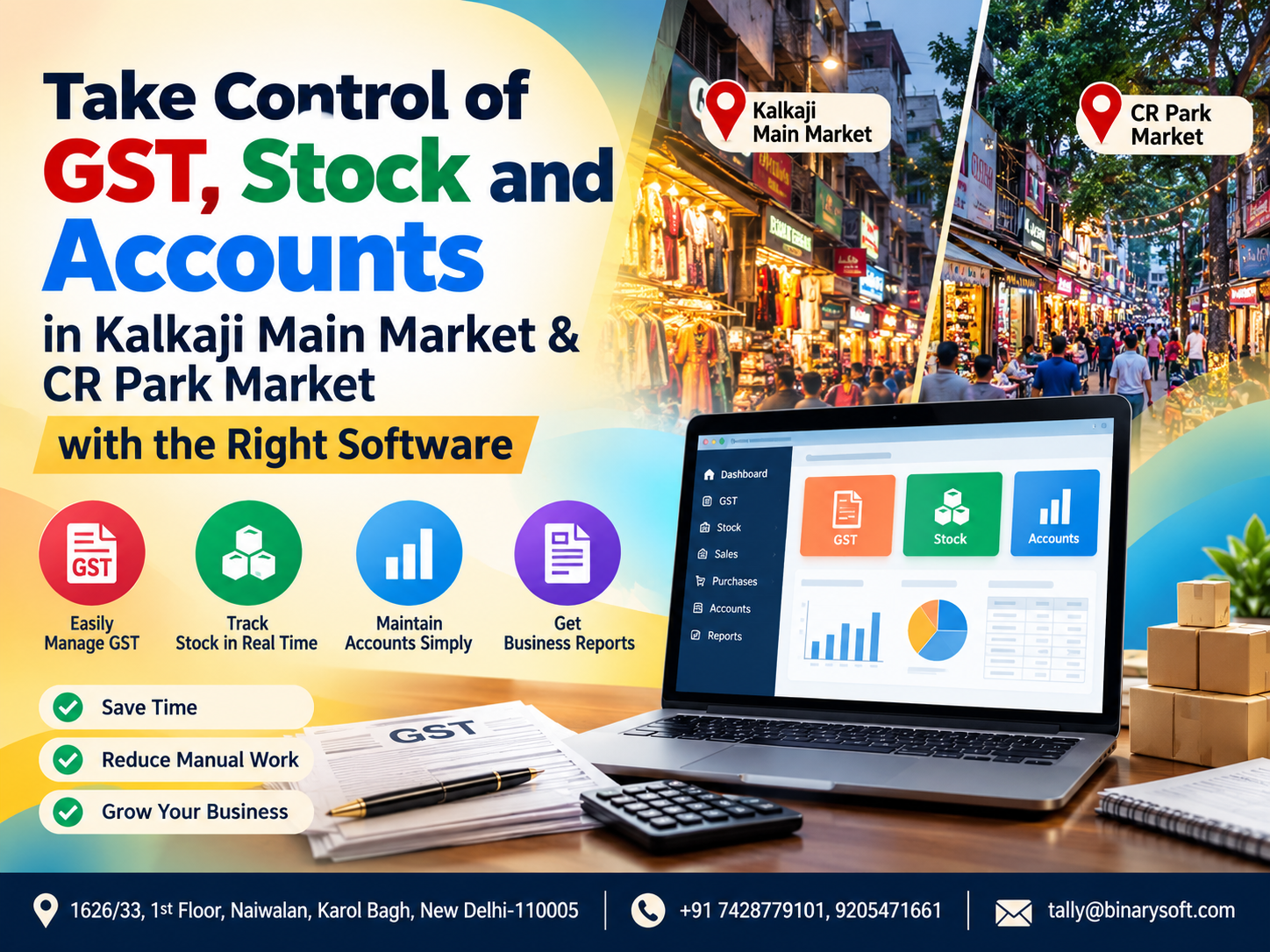
In 2026, running a business in busy commercial areas such as Kalkaji Main Market and CR Park Market requires much more than recording daily sales and checking the cash counter at closing time. GST compliance, inventory movement, outstanding payments, purchase costs, bank transactions and profitability are increasingly connected, while customers expect faster billing and businesses need reliable information without waiting until month-end. A small mistake in GST classification, stock entry or customer ledger can create a much larger reconciliation problem later. At the same time, maintaining separate Excel sheets, manual registers and disconnected billing systems makes it difficult to know the true financial position of the business. The right accounting and inventory software can bring GST, stock, sales, purchases, receivables, banking and financial reports together, helping businesses in Kalkaji and CR Park reduce repetitive work, improve accuracy and make faster decisions based on current business data.
The Changing Business Environment in Kalkaji and CR Park
Kalkaji Main Market and CR Park Market are important commercial areas of South Delhi, serving both local residents and customers from surrounding neighbourhoods.
From retailers, wholesalers and distributors to restaurants, service businesses, professional firms and specialised stores, businesses in these markets deal with different accounting challenges every day.
A typical business may need to handle:
GST invoices
Purchase bills
Cash and credit sales
Customer outstanding balances
Supplier payments
Inventory quantities
Multiple product categories
HSN/SAC information
Discounts
Returns and adjustments
Bank transactions
Business expenses
GST reports
Profit and loss
Cash flow
Stock valuation
Handling these activities through different systems creates unnecessary complexity.
The real requirement is not simply accounting software.
Businesses need an integrated system that connects transactions with inventory, taxation and financial reporting.
Why Manual Business Management Is Becoming Difficult
Imagine a retailer recording sales through billing software, maintaining purchases in Excel, checking stock through a separate register and asking the accountant to prepare GST information at the end of the month.
Every system may individually appear manageable.
The problem becomes visible when the information has to be reconciled.
The sales figure in the billing system may not match accounting records. Physical stock may differ from the Excel stock sheet. A purchase invoice might have been entered in one system but missed in another.
This creates repeated questions:
What is the correct closing stock?
Which customers have not paid?
How much GST liability is expected?
Which supplier invoices are pending?
What is the actual gross profit?
Which products are selling quickly?
Which products have remained unsold?
How much cash is available?
Is the business actually profitable?
If answering these questions requires searching through several spreadsheets, registers and applications, management loses valuable time.
The right business software changes this situation by creating a single, structured source of financial and operational information.
A Kalkaji Business Owner's Story: When Sales Increased but Control Decreased
Consider the example of a fictional business owner, Rajiv, operating a growing electrical and home-appliance shop near Kalkaji Main Market.
For years, Rajiv had managed his business using a combination of handwritten notes, Excel files and basic billing software.
The method worked when the business was smaller.
His employees knew the customers. Rajiv personally handled major purchases. The number of daily invoices was manageable, and he could remember many customer balances without checking records.
Then the business started growing.
More customers began visiting the shop. Product varieties increased. More suppliers offered credit. Online payments became common, and the number of GST invoices increased significantly.
On paper, everything looked positive.
Sales were growing.
But Rajiv felt increasingly uncomfortable.
One Saturday evening, a regular customer asked for a product that the computer showed as available.
An employee went to the shelf.
Nothing was there.
Another employee checked the storeroom.
Still nothing.
The system showed six units in stock, but the physical quantity was zero.
A few days later, Rajiv discovered another problem. Several customer payments had been received through bank and UPI, but their ledger balances had not been updated correctly.
Then his accountant asked for clarification on several purchase and GST entries.
Rajiv realised something important.
His business had grown, but his control over the business had not grown with it.
He was earning more revenue while spending more time checking numbers.
Instead of focusing on customers, purchasing and expansion, he was repeatedly trying to understand discrepancies.
That was the point when he decided that software should not merely create invoices.
It should help him control the business.
After moving towards an integrated accounting and inventory approach, the biggest improvement was not simply faster billing. It was visibility.
He could review stock, receivables, purchases, sales and financial information without depending on several disconnected records.
For a growing business, that confidence can be extremely valuable.
What Does the "Right Software" Actually Mean?
There is no single feature that makes software right for every business.
A small service provider has different requirements from a supermarket. A distributor needs different inventory controls from a professional consultancy.
However, businesses in Kalkaji Main Market and CR Park Market should generally look for software capable of bringing several important functions together.
These include accounting, GST compliance, inventory management, invoicing, receivables, payables, banking and management reporting.
More importantly, these functions should work together.
When a sales invoice is entered, the accounting impact, customer balance, applicable taxes and inventory movement should be reflected appropriately.
This reduces duplicate entry and improves consistency.
1. GST Management Without Creating Separate Work
GST compliance is an important part of business accounting.
The accounting system should help businesses correctly record GST-related transactions during normal voucher entry instead of creating a separate compliance exercise later.
Depending on the nature of the business, this may include:
GSTIN details
Taxable value
CGST
SGST
IGST
HSN/SAC details
Tax rates
Place of supply
B2B transactions
B2C transactions
Credit notes
Debit notes
Purchase transactions
Sales returns
Purchase returns
When GST information originates from properly maintained accounting transactions, preparing and reviewing GST-related information becomes easier.
Why GST Errors Often Start at the Transaction Level
Many GST problems do not begin while preparing a return.
They begin much earlier.
For example, an incorrect GSTIN may be entered for a customer. A product may be mapped to an incorrect tax rate. An interstate transaction might be classified incorrectly. A purchase entry could be omitted.
If such errors remain unnoticed, they eventually appear during reconciliation or return preparation.
Therefore, GST control should start when transactions are recorded.
2. Inventory Management for Better Stock Visibility
For traders and retailers in Kalkaji and CR Park, inventory represents working capital.
Money invested in stock remains blocked until products are sold and payment is realised.
Businesses therefore need visibility into both quantity and value.
Good inventory software can help monitor:
Opening stock
Purchases
Sales
Sales returns
Purchase returns
Stock transfers
Closing quantities
Stock valuation
Item-wise movement
Category-wise stock
Location-wise inventory where applicable
Instead of asking employees whether an item is available, the business owner should be able to check inventory information directly.
Fast-Moving and Slow-Moving Products
Knowing total stock value is useful, but knowing how individual products move is even more valuable.
Suppose a store has ₹25 lakh worth of inventory.
That number alone does not reveal whether the stock is healthy.
Perhaps ₹15 lakh is concentrated in products that sell quickly.
Or perhaps a substantial amount is blocked in slow-moving products that have remained unsold for months.
Better inventory information helps management make smarter purchasing decisions.
3. Prevent Over-Stocking
Over-stock can quietly reduce business liquidity.
A business owner may negotiate a favourable supplier rate and purchase a large quantity, believing that the lower purchase price will increase margins.
But if the product takes six months to sell, the business may lose flexibility.
Capital remains blocked.
Storage space is occupied.
Newer products cannot be purchased easily.
Some products may become obsolete or lose market value.
Inventory reports can help businesses identify where excessive stock is accumulating.
4. Reduce Stock-Out Situations
The opposite problem is equally serious.
A customer walks into a shop ready to buy.
The employee checks the shelf and discovers that the item is unavailable.
The customer purchases it somewhere else.
A single stock-out may look insignificant, but repeated stock-outs can lead to lost customers.
Businesses should therefore maintain suitable reorder levels for important products and review stock availability regularly.
5. Bring Sales and Accounts Together
Sales should not remain isolated from accounting.
Every sale affects multiple areas of the business.
It may increase revenue.
It may create GST liability.
It may reduce inventory.
If it is a credit sale, it creates a receivable.
If payment is immediate, it affects cash or bank balances.
Integrated software reduces the need to enter the same transaction repeatedly.
This can significantly improve efficiency in businesses with large numbers of invoices.
6. Know Exactly Who Owes You Money
A business can report excellent sales and still face cash-flow problems.
Why?
Because sales and collections are different.
Suppose monthly sales are ₹30 lakh, but ₹12 lakh remains outstanding from customers.
The business may still need money for:
Supplier payments
Employee salaries
Rent
Electricity
GST obligations
Loan instalments
Purchases
Operating expenses
This is why receivables management is essential.
Business software should make it easy to identify customer-wise outstanding balances and, where appropriate, bill-wise outstanding amounts.
Ageing Matters
A ₹1 lakh receivable that is five days old is different from a ₹1 lakh receivable pending for five months.
Ageing reports help businesses prioritise collection efforts.
Management can focus attention on older balances instead of calling customers randomly.
7. Manage Supplier Payables Properly
Businesses also need visibility into amounts payable to suppliers.
Missing payment commitments can affect supplier relationships and future credit terms.
At the same time, paying every supplier immediately may unnecessarily reduce available working capital.
A structured payable system can help management understand:
Which suppliers need payment?
How much is payable?
Which bills are overdue?
What is due shortly?
What purchases generated the liability?
Good payable management creates a balance between maintaining supplier relationships and protecting cash flow.
8. Improve Billing Speed During Busy Hours
In a busy market, billing speed matters.
Customers generally do not want to wait while employees repeatedly enter information or calculate taxes manually.
The billing process should make commonly used items, customer details, tax information and transaction information easy to access.
Faster billing can reduce queues while improving customer experience.
But speed should never come at the cost of accuracy.
The ideal system combines both.
9. Track Cash, Bank and Digital Payments
Modern businesses receive payments through several modes.
These may include:
Cash
UPI
NEFT
RTGS
IMPS
Cheque
Debit or credit card
Payment gateways
When transaction volumes increase, matching receipts with invoices becomes increasingly important.
Without proper accounting, the business owner may know that money has reached the bank but may not know which invoice or customer balance it relates to.
Structured accounting makes financial tracking much clearer.
10. Bank Reconciliation Should Not Be Ignored
Bank reconciliation is one of the most important financial controls.
The bank statement and accounting records should be reviewed regularly so that differences can be identified.
Possible discrepancies may include:
Unrecorded bank charges
Missing receipts
Duplicate entries
Incorrect amounts
Cheque timing differences
Unrecorded transfers
Interest entries
Regular reconciliation improves the reliability of accounting information.
11. Understand Real Profit, Not Just Sales
High sales do not automatically mean high profits.
Consider two months:
Month A sales: ₹20 lakh
Month B sales: ₹25 lakh
At first glance, Month B appears better.
But what if:
Purchase costs increased sharply?
Discounts increased?
Operating expenses increased?
Gross margins declined?
Returns increased?
Then higher sales may not result in higher net profit.
Businesses need proper financial statements to understand actual performance.
12. Profit and Loss Account
A Profit and Loss Account helps management understand income and expenses over a particular period.
It can provide insight into:
Sales
Direct costs
Gross profit
Indirect income
Administrative expenses
Selling expenses
Finance costs
Net profit or loss
Business owners should review profitability periodically rather than waiting only for year-end accounts.
13. Balance Sheet
The Balance Sheet provides another important perspective.
It helps show the financial position of the business through assets and liabilities.
Depending on the business structure and accounting configuration, this may include:
Capital
Loans
Fixed assets
Inventory
Receivables
Payables
Cash
Bank balances
Duties and taxes
Other assets and liabilities
For management, the Balance Sheet can reveal problems that sales reports alone cannot show.
14. Cash Flow Visibility
A profitable business can still experience a cash shortage.
For example, a business might make profitable credit sales but receive customer payments after 60 days.
Meanwhile, suppliers may demand payment within 30 days.
That creates a working-capital gap.
This is why business owners should monitor cash and bank positions alongside profitability.
15. Better Purchase Planning
Purchasing decisions should be based on information rather than intuition alone.
Before placing an order, a business owner should ideally know:
Current stock
Recent sales movement
Pending customer orders
Existing purchase commitments
Supplier pricing
Expected demand
When this information is available, businesses can purchase more intelligently.
16. Item-Wise Profitability
Two products selling at the same price may generate very different margins.
Suppose Product A sells for ₹1,000 and costs ₹700.
Product B also sells for ₹1,000 but costs ₹900.
The sales report treats both as ₹1,000 revenue.
Management sees a completely different picture when margins are considered.
This is why sales analysis should be combined with cost and profitability information wherever appropriate.
17. Customer-Wise Analysis
Every customer contributes differently.
Some customers purchase frequently.
Some purchase large quantities.
Some pay immediately.
Others require extended credit.
A business should understand not only total sales but also customer behaviour.
Customer-wise information can support decisions about credit limits, follow-ups, pricing and relationship management.
18. Supplier-Wise Analysis
The same principle applies to suppliers.
Management should know:
How much is purchased from each supplier?
What balances are outstanding?
Which suppliers offer better pricing?
What credit periods are available?
Which product categories come from which supplier?
Accurate accounting records make supplier negotiations more informed.
19. Reduce Dependence on Excel for Core Accounting
Excel is an extremely useful business tool.
It is excellent for analysis, customised calculations and reporting.
However, relying entirely on spreadsheets for core accounting and inventory operations can become difficult as transaction volumes increase.
Typical problems include:
Multiple file versions
Accidental formula changes
Manual duplication
Missing entries
Weak audit trails
Difficulty maintaining master information consistently
A better approach is to maintain structured transactions in accounting software and use Excel when additional analysis is required.
20. Why TallyPrime Can Be Considered
For businesses evaluating accounting and business management software, TallyPrime can be considered for requirements involving accounting, inventory, taxation, banking and business reporting.
The suitability of any software, however, should be evaluated according to the actual workflow of the business.
A retailer may prioritise inventory and billing.
A distributor may need detailed receivables and stock controls.
A service business may focus more heavily on accounting, GST and outstanding management.
The important point is to configure the system according to business requirements rather than simply installing software and expecting every problem to disappear automatically.
21. Accounting Software Needs Proper Configuration
Software is only as reliable as the data and processes behind it.
A business may purchase excellent software and still experience problems if:
Ledgers are incorrectly created.
Opening balances are inaccurate.
GST details are wrongly configured.
Stock items are duplicated.
Units of measurement are inconsistent.
Employees follow different entry methods.
Old outstanding balances are incorrect.
Bank accounts are not reconciled.
Therefore, implementation matters.
22. Start with Clean Masters
Before regular transaction entry begins, businesses should review master data carefully.
This may include:
Customer ledgers
Supplier ledgers
Expense ledgers
Sales ledgers
Purchase ledgers
Bank accounts
Stock items
Stock groups
Units
GST details
Opening balances
Clean masters create the foundation for clean reports.
23. Standardise the Billing Process
Employees should follow a consistent process.
If one employee records a transaction one way and another employee uses a different method, reports can become inconsistent.
Businesses should define standard procedures for:
Sales
Purchases
Receipts
Payments
Returns
Discounts
Expenses
Stock adjustments
Consistency reduces errors.
24. Give Access According to Responsibility
Not every employee needs access to every part of business information.
Where the selected software and configuration support appropriate controls, businesses should structure access according to employee responsibilities.
For example, a billing employee may need sales-entry functions while senior management may require access to financial and profitability reports.
Proper access management also supports data discipline.
25. Maintain Reliable Backups
Accounting data is one of the most valuable digital assets of a business.
Imagine losing months or years of:
Invoices
Customer balances
Supplier balances
Stock records
Bank entries
GST transactions
Financial statements
Backups should therefore be treated as a business necessity rather than an optional IT task.
Businesses should establish a regular backup procedure appropriate to their systems and verify that recovery is possible when needed.
26. Business Owners Need Dashboards, Not Data Overload
Owners generally do not need to inspect every voucher every day.
They need important indicators.
For example:
Today's sales
Monthly sales
Cash balance
Bank position
Customer outstanding
Supplier outstanding
Stock value
Major expenses
Profitability indicators
The purpose of software is not simply to generate more data.
It is to turn transaction data into useful information.
27. Benefits for Retail Businesses in Kalkaji Main Market
Retail businesses may particularly benefit from improved control over:
Daily billing
Stock availability
Fast-moving products
Purchase planning
Customer balances
GST invoices
Cash and digital collections
Product profitability
For businesses handling many products, accurate stock records can be especially important.
28. Benefits for Businesses in CR Park Market
CR Park has a diverse commercial ecosystem that includes retail stores, food businesses, speciality shops and service providers.
Depending on the business model, integrated software can help with:
Sales tracking
Expense control
Inventory management
GST accounting
Supplier payments
Receivables
Bank reconciliation
Financial reporting
The configuration should reflect the actual operational requirements of each business.
29. Wholesalers and Distributors Need Deeper Controls
Wholesalers and distributors generally handle larger quantities and more credit transactions than small retailers.
They may require:
Item-wise inventory
Customer-wise credit
Bill-wise outstanding
Supplier balances
Purchase planning
Sales analysis
Stock valuation
GST reporting
Profitability monitoring
Even small improvements in inventory and receivable management can become significant when transaction values are large.
30. Service Businesses Need Financial Visibility Too
Inventory may not be the primary concern for every business.
Consultants, agencies, repair businesses and other service providers still need accurate control over:
Invoices
Receivables
Expenses
GST
Bank transactions
Profitability
Customer accounts
The software should therefore be configured according to the nature of the business.
31. What Happens When GST, Stock and Accounts Are Connected?
This is where integrated business management becomes powerful.
Imagine a correctly configured sales transaction.
The business records the invoice.
That transaction can contribute to:
Sales revenue
Customer balance
GST information
Inventory reduction
Financial reports
Instead of maintaining several disconnected records, one structured transaction supports multiple business functions.
This can reduce duplication and improve reporting consistency.
32. From Reactive Management to Proactive Management
Without timely information, owners react after problems happen.
Stock finishes, then they reorder.
A customer becomes seriously overdue, then they follow up.
Cash becomes tight, then they investigate.
Margins decline, then they examine pricing.
Good software enables a more proactive approach.
Management can identify warning signs earlier and respond before they become larger problems.
33. Questions Every Kalkaji and CR Park Business Owner Should Be Able to Answer
A well-managed business should be able to answer important questions quickly:
What were today's sales?
What are month-to-date sales?
How much money do customers owe?
How much do we owe suppliers?
Which stock items are running low?
Which items are not moving?
What is our current stock value?
What is our bank position?
What expenses are increasing?
How is profitability changing?
If answering these questions requires several hours of manual work, the business information system may need improvement.
34. How to Choose the Right Software
Do not choose business software only because it is popular or inexpensive.
Start with your requirements.
Consider:
Number of users
Daily invoice volume
Inventory complexity
Number of stock items
GST requirements
Number of business locations
Reporting requirements
Security requirements
Remote-working needs
Backup requirements
Integration requirements
Future business growth
Then evaluate whether the software can support these requirements effectively.
35. Avoid Choosing Software Only on Price
Price matters, but it should not be the only consideration.
Suppose Software A costs less but requires hours of manual reconciliation every week.
Software B costs more but reduces repetitive work and gives management better control.
The cheaper option may actually cost more when employee time, mistakes and delayed decisions are considered.
Businesses should evaluate total value rather than only purchase price.
36. Implementation Is as Important as Selection
Once software has been selected, implementation should be planned carefully.
A structured implementation can include:
Requirement analysis
Company configuration
Ledger creation
Inventory setup
GST configuration
Opening balance verification
User configuration
Data migration where necessary
Testing
Employee training
Backup planning
Initial report verification
Moving too quickly without checking these areas can create problems later.
37. Train Employees Properly
Employees should understand not only which buttons to press but also why accurate entry matters.
A wrong quantity affects stock.
A wrong ledger affects financial statements.
A wrong GST classification affects tax information.
A receipt entered against the wrong customer affects outstanding reports.
Training improves the quality of business data.
38. Review Reports Regularly
Software cannot improve decision-making if nobody reviews its reports.
Business owners should establish a reporting routine.
Daily reviews may focus on:
Sales
Cash
Bank collections
Major receipts and payments
Weekly reviews may focus on:
Customer outstanding
Supplier payments
Stock movement
Major expenses
Monthly reviews can focus on:
Profitability
Stock valuation
GST information
Receivables ageing
Expense trends
Business performance
39. The Real Benefit Is Control
Businesses often purchase accounting software because they want faster invoicing or easier accounting.
Those are useful benefits.
But the larger benefit is control.
Control means knowing what is happening without waiting for someone to prepare a spreadsheet.
Control means knowing whether stock records are reliable.
Control means seeing customer dues before they become seriously overdue.
Control means understanding whether higher sales are producing higher profits.
Control means making decisions from data rather than assumptions.
40. Prepare Your Business for Growth
A business with 20 invoices per day may survive with informal processes.
When the same business reaches 100 or 200 transactions per day, those informal methods become difficult to maintain.
Growth increases complexity.
More sales create more entries.
More products create more stock movements.
More customers create more receivables.
More suppliers create more payables.
More employees create greater need for structured processes.
The right accounting and inventory system provides a foundation that can support this growth.
41. Better Data Can Improve Business Decisions
Consider two businesses with similar sales.
Business A knows:
Its fastest-selling products
Its slow-moving inventory
Customer outstanding
Supplier liabilities
Current bank balance
Monthly expenses
Approximate profitability
Business B knows only its total sales.
Which owner can make better decisions?
Most likely, Business A.
The difference is not necessarily the size of the business.
It is the quality of information available to management.
42. Moving Towards a More Organised Business
Digital transformation does not always require complicated technology.
For many businesses in Kalkaji Main Market and CR Park Market, transformation can begin with something simple:
Record transactions properly.
Connect accounts with inventory.
Maintain GST information accurately.
Reconcile banks.
Monitor receivables.
Review stock.
Analyse reports.
Maintain backups.
Train employees.
When these basic controls are implemented consistently, the improvement can be substantial.
Conclusion
Businesses in Kalkaji Main Market and CR Park Market operate in an environment where speed, accuracy and financial visibility matter more than ever. Managing GST in one place, inventory somewhere else, customer outstanding in Excel and financial accounts through another process can make even a successful business unnecessarily difficult to control.
The right software can bring accounting, GST, stock, billing, purchases, receivables, payables, banking and reporting into a more structured system.
However, technology alone is not enough.
Correct configuration, clean master data, disciplined transaction entry, employee training, regular reconciliation, reliable backups and periodic management review are equally important.
For retailers, wholesalers, distributors and service businesses, the goal should not simply be to computerise existing work.
The goal should be to gain better control.
When business owners can quickly understand what they sold, what they earned, what they owe, what customers owe them and what inventory is available, everyday decisions become faster and more informed.
That is where the real value of accounting and business management software begins.
Powered by Binarysoft Technologies
Authorized Tally Partner
Location : 1626/33, 1st Floor, Naiwalan, Karol Bagh, New Delhi – 110005, INDIA
Contact us : +91 7428779101, 9205471661
Email us : tally@binarysoft.com
Business Hours: 10:00 AM – 6:00 PM, Mon–Fri
CA. Mayankh Singhaal is a Chartered Accountant experienced in accounting systems, statutory audits, and compliance advisory. He has worked with businesses across different sectors to improve reporting accuracy and inventory tracking. His writing focuses on structured growth and compliance-ready operations.