Call CA Tally HelpDesk
+91 9205471661,
7428779101

In 2026, the biggest change for wholesale traders is not one dramatic new rule. It is the speed at which orders, returns, online settlements, transport costs, payment follow-ups and GST records now collide in the same working day. A fabric trader in Bhilwara Industrial Estate, a yarn distributor near Bhilwara Main Market or a garment accessory wholesaler in Ichalkaranji MIDC may sell from the shop, through agents, to factories, on marketplaces and over phone orders. Each channel creates stock movement and accounting pressure. If the records are loose, profit becomes guesswork and tax preparation becomes stressful. If the records are organised, owners can see fast-moving items, blocked stock, return losses, party outstanding, marketplace deductions and cash flow before the month closes. Smart inventory software, when configured carefully in TallyPrime and accessed through Tally@Cloud, can turn daily chaos into reliable business control.
Suggested URL slug: smart-inventory-software-wholesale-traders-bhilwara-ichalkaranji-midc
Why Wholesale Inventory Has Become a Boardroom Issue for Textile and Trading Hubs
Wholesale traders in Bhilwara Industrial Estate, Bhilwara Main Market and Ichalkaranji MIDC operate in business environments where margins are often practical rather than luxurious. Many businesses deal in fabric rolls, yarn cones, grey cloth, suiting, shirting, denim, garment accessories, packaging material, dyes, chemicals, spare parts, mobile accessories, electrical goods or mixed trading lines. Even when the product category changes, the inventory problem feels similar. The owner wants to know what is available, what is already committed, what is lying dead, what is under return, what is pending from the supplier and what has been dispatched but not billed correctly.
Traditional accounting habits worked when most transactions happened through counter sales, hand-written challans and a limited set of known buyers. Today, the same wholesaler may receive a purchase order on WhatsApp, dispatch through a transporter, raise an invoice in TallyPrime, collect partial payment by bank transfer, sell selected items on Amazon, accept returns, and later find that the bank receipt is lower than expected because the marketplace deducted fees, TCS, possible TDS, shipping adjustments or return charges. The bank statement alone cannot explain the business. The sales register alone cannot explain the cash. The stock register alone cannot explain profit. The three must speak to each other.
Smart inventory software is not simply a stock counter. For a wholesale trader, it is a disciplined way to connect item masters, purchase cost, batch or lot tracking, godown location, sales invoicing, GST reporting, receivables, payables, return control and bank reconciliation. TallyPrime has long been used by Indian businesses for accounting and inventory, and many traders now want the same environment to be accessible from different locations through a hosted or cloud-enabled setup such as Tally@Cloud. The advantage is not in using more software for its own sake. The advantage is in creating one dependable source of truth for the owner, accountant, sales team and dispatch desk.
The most important idea is simple. A wholesaler should not discover stock problems after the buyer complains, after the accountant asks for missing bills or after the banker questions cash flow. Good inventory data should warn the business earlier. It should show a slow-moving shade before it becomes dead stock. It should show frequent returns on one SKU before the marketplace rating is affected. It should show that a transport claim is pending before the profit on an order is overstated. It should show that Amazon has paid a net settlement amount, but the original sale, fees, returns, TCS, TDS and GST treatment need separate accounting entries.
The Trading Reality in Bhilwara Industrial Estate, Bhilwara Main Market and Ichalkaranji MIDC
Bhilwara and Ichalkaranji are closely associated with textile manufacturing, processing, trading and ancillary supply chains. Traders in these hubs often work with mills, processors, garment units, retailers, brokers, transporters and outstation buyers. Business is relationship driven, but the paperwork is increasingly data driven. Buyers ask for item clarity, GST-compliant invoices, dispatch proof, timely credit notes and faster confirmation of pending quantities. Suppliers want payment discipline. Accountants want clean ledgers. Owners want daily visibility without waiting for month-end.
In Bhilwara Industrial Estate, many businesses manage bulk movement. A single invoice may carry multiple fabric qualities, shades, widths and lot numbers. In Bhilwara Main Market, there may be faster trading of mixed items with frequent part supplies. In Ichalkaranji MIDC, traders may supply to weaving, processing, garmenting and job-work chains where delays or wrong item selection can affect production schedules. The stock may move between shop, godown, processing unit, transporter warehouse and customer location. If the software structure is weak, the business may show stock on paper that is physically not available.
Common inventory challenges include wrong item naming, duplicate stock items, missing units of measure, inconsistent use of meters, kilograms, pieces and rolls, unrecorded sample dispatches, delayed purchase entry, unapproved sales returns, manual discounts, transport charges not allocated to cost, expired price lists and credit notes raised without matching original sales. These are not small clerical issues. Each one can distort margin, outstanding, GST reporting or reorder decisions.
For example, a fabric wholesaler may buy 10,000 meters of a particular suiting quality in several shades. If the item master is created only as Suiting Fabric and the shades are typed freely in narration, the owner cannot quickly know which shade is slow-moving. If the same item is later created as Suiting Grey, Grey Suiting and Suting Gray by different staff members, the stock report becomes unreliable. Smart inventory starts by making item creation disciplined enough that the software can produce useful answers.
Another example is return handling. A buyer may return goods because of shade mismatch, damage, late delivery or order cancellation. If the return is entered only as a financial credit note and not linked to physical stock condition, the software may show sellable stock even though the returned material is damaged or awaiting inspection. A smarter structure creates separate godowns or stock locations such as Saleable Stock, Return Pending Check, Damaged Stock and Supplier Return. The exact method should be decided with the accountant and based on current TallyPrime capabilities, but the business principle is clear. Returned goods should not silently merge with fresh goods unless they are actually saleable.
A Realistic Story from Gaffar Market: The Night a Seller Stopped Guessing
Consider an illustrative story. It is not presented as a real customer case, but it reflects a situation many Indian traders will recognise. Aamir ran a small but busy mobile accessories wholesale shop near Gaffar Market in Delhi. His father had built the business on trust, speed and sharp buying. Aamir added Amazon listings for chargers, cables, earphones and protective covers. At first, online orders looked exciting. Every morning, packets left the shop. Every week, money arrived in the bank. The staff celebrated the growing order count.
Then the questions started. Aamir noticed that the bank amount from the marketplace was lower than the value of the shipped orders. His accountant asked for fee breakup. His father asked why a fast-selling cable was never available for regular wholesale buyers. The packing boy said many pieces had returned. The Amazon dashboard showed sales, returns, cancellations, fees and settlement adjustments, but nobody had converted that data into clean accounting and inventory entries. The bank passbook showed only net receipts. The stock shelf showed gaps. The profit statement looked good until returns and deductions were included.
One evening, after a long argument with a regular buyer who had been promised 500 pieces but received only 320, Aamir sat alone behind the counter. The market noise had faded. He opened a notebook and wrote three numbers on a page: stock as per software, stock on shelf and stock actually sellable. None of them matched. He felt what many second-generation traders feel. The business had grown beyond memory, but the systems had not grown with it.
Over the next few weeks, he redesigned the way records were kept. Marketplace orders were no longer treated as equal to bank receipts. Sales were recorded separately from settlement. Returns were checked before being added back to saleable stock. Marketplace fees were posted to expense ledgers. TCS and possible TDS entries were reviewed with the accountant before final posting. Damaged returned goods were kept in a separate physical box and separate stock location. Duplicate item names were merged after careful review. Bank reconciliation was done against settlement reports rather than against sales invoices alone.
The emotional relief did not come from software screens alone. It came from the owner regaining confidence. When his father asked how much stock was available, Aamir could answer. When the accountant asked why the bank receipt was lower, he could explain. When a buyer complained, the team could check dispatch and return history. This story is about mobile accessories in Gaffar Market, but the lesson applies equally to a textile trader in Bhilwara or an industrial supplier in Ichalkaranji. Growth without record discipline creates pressure. Growth with clear records creates control.
What Smart Inventory Software Should Mean for a Wholesale Trader
The phrase smart inventory software can sound expensive or complicated, but the real meaning is practical. It should help the trader buy better, sell accurately, dispatch faster, collect money sooner and close accounts with fewer surprises. For Indian wholesale businesses that already depend on Tally, a smart setup often means configuring TallyPrime properly, training staff on consistent entry practices and using cloud access where multiple users or locations need the same data.
A smart inventory system should answer the questions owners ask every day. Which items are available for dispatch today. Which items are reserved against orders. Which lot or batch was sold to which customer. Which shade or size is slow-moving. Which buyer has exceeded credit terms. Which supplier shipment has quality issues. Which returns are pending inspection. Which Amazon settlement relates to which order period. Which deductions are marketplace fees and which are tax-related amounts. Which bank receipts are customer payments and which are marketplace net settlements.
The software should also support the accountant. GST reporting, sales returns, purchase returns, debit notes, credit notes, tax ledgers, e-way bill related workflow, bank reconciliation and year-end closing require consistent source data. Filing rules, tax rates, thresholds, TCS and TDS applicability and documentation requirements should always be verified with a qualified accountant and current government portals. The role of the inventory system is to organise the facts of the business so the accountant can apply the correct current treatment.
Good software does not remove business judgement. It improves the quality of judgement. A buyer may still get a special rate because the relationship is important. A slow-moving lot may still be held because a seasonal order is expected. A returned item may still be repaired or repacked. But these decisions should be made with visibility, not guesswork. The owner should know the cost of the decision.
Building the Right Inventory Structure in TallyPrime
TallyPrime can be used for accounting, inventory, GST reports and business management, depending on configuration, release, licensing and product documentation. Before implementing any specific feature, traders should verify the current TallyPrime release notes and consult their Tally partner or accountant. The following structure is a practical way to think about inventory organisation, not a substitute for professional configuration.
Start With Clean Stock Groups
Stock groups should match how the business buys, stores and analyses products. A textile wholesaler may use groups such as Suiting, Shirting, Denim, Grey Fabric, Dyed Fabric, Yarn, Packaging, Trims and Accessories. A mobile accessory wholesaler may use Chargers, Cables, Earphones, Covers and Adaptors. An industrial supplier may use Bearings, Belts, Electrical, Fasteners and Consumables. The purpose is to make reports meaningful without making the structure so complex that staff avoid using it.
A common mistake is to create too many groups based on temporary convenience. If every supplier becomes a group, every shade becomes a group and every customer naming style becomes a group, the structure becomes hard to manage. Supplier, shade, lot and customer information may be better handled through item names, batch details, godowns, categories, narration or other available features, depending on the current product capability and accounting design.
Create Stock Items With Naming Discipline
Item names should be consistent and searchable. A good item name may include quality, composition, width, GSM, size, colour, model or packing detail where relevant. For example, a fabric item may be named as Suiting Poly Viscose 58 Inch Navy Lot A, if that level of detail is required for trading. Another business may prefer a main item with batch or lot tracking. The right method depends on volume, reporting needs and staff capability.
Duplicate item creation is one of the biggest causes of stock confusion. If one staff member creates PV Suiting Navy, another creates Poly Viscose Navy Suiting and a third creates PV Navy 58, reports split the same stock across three names. Before migration or cleanup, businesses should create a controlled item master policy. New items should be approved by a responsible person. Abbreviations should be standard. Old duplicates should be reviewed carefully before merging or adjusting because historical transactions may be affected.
Use Units of Measure Consistently
Wholesale trading often involves multiple units. Fabric may be purchased in meters but stored in rolls. Yarn may be tracked in kilograms and cones. Accessories may be bought in cartons and sold in pieces. TallyPrime supports inventory units, but the exact method of compound units or alternate units should be verified in current documentation. The business should decide how it wants to see stock and how invoices must appear to customers.
Inconsistent units can create silent losses. If a carton of 100 pieces is entered as 1 piece by mistake, stock and cost are distorted. If fabric length is rounded casually, shortage claims become hard to investigate. If purchase and sale units differ, conversion must be reliable. Staff should not be allowed to guess conversions during billing.
Use Godowns or Locations to Reflect Physical Reality
Godown or location tracking can help traders distinguish shop stock, main warehouse, branch stock, return stock, damaged stock, sample stock and goods in transit, subject to current TallyPrime features and business setup. This is especially useful for traders operating between Bhilwara Industrial Estate and Main Market, or for owners who travel while staff dispatch from a godown.
The physical location should match the software location. If returned goods are placed near fresh stock but entered as damaged stock, confusion will continue. If software shows stock in the main godown but the material is actually with a transporter, the dispatch team may promise goods that cannot be delivered. Smart inventory is as much about discipline on the floor as it is about entries in software.
Design Ledgers for Clarity
Ledger structure should separate sales, purchases, discounts, freight, marketplace fees, packing charges, commission, GST ledgers, TCS, TDS, round-off, returns, damages and other expenses as needed. Traders should avoid dumping everything into a single general expense ledger. When deductions are separated, the owner can see whether profit is being eaten by freight, marketplace fees, discounts or returns.
Tax-related ledgers should be created in consultation with the accountant. Applicability of GST, TCS, TDS, e-invoicing, e-way bill, reverse charge or other compliance items depends on current law, turnover, transaction nature and buyer or seller status. Since rules and thresholds can change, the article does not state specific rates or limits. The safe practice is to verify current treatment before configuration and review it periodically.
Daily Workflow: From Purchase to Dispatch to Collection
A smart inventory system works only when daily workflow is clear. The best software cannot correct a business process where goods arrive without entry, sales happen before stock is updated, returns are kept aside without documentation and payments are adjusted by memory. Wholesale traders should map every movement of goods and money.
Purchase Entry and Goods Receipt
When goods arrive, the receiving team should compare supplier invoice, purchase order if used, transport receipt and physical quantity. Shortage, damage and quality differences should be noted before the purchase is accepted as clean stock. If the business uses purchase orders, the receipt should be matched against them. If not, the purchase entry should still capture item, quantity, rate, tax details, supplier invoice reference and location.
For textile traders, batch, lot, shade and width details may be important. For accessory traders, model, colour, warranty status and packing may matter. For chemical or dye traders, batch and expiry may be relevant. The software structure should reflect what customers may dispute later. If a buyer may complain about shade, shade should be trackable. If a buyer may complain about lot variation, lot should be trackable.
Sales Orders and Commitments
Many wholesalers promise stock before invoicing. If the software does not capture commitments, the same stock may be promised twice. Depending on current TallyPrime capabilities and business process, sales orders or internal reservation methods can help. The key is to distinguish available stock from stock already committed to a customer.
For example, a Bhilwara trader may have 5,000 meters of grey fabric. A garment unit confirms 3,000 meters for dispatch tomorrow. A counter buyer asks for 2,500 meters today. If the software only shows 5,000 meters in stock and not the committed 3,000, the trader may accept both orders and create a shortage. Smart inventory should support disciplined order confirmation.
Sales Invoice and Dispatch
The sales invoice should match actual dispatch. If invoice quantity, transport receipt and packed quantity differ, future disputes are almost guaranteed. Dispatch staff should have access to item details that prevent wrong picking. Businesses with multiple similar shades or sizes should use labels, shelf codes or lot codes. Software reports become stronger when physical identification is strong.
Wholesale traders should decide how to handle freight, packing and insurance. Sometimes these are charged separately. Sometimes included in rate. Sometimes paid by buyer. Sometimes paid by seller and recovered later. The accounting treatment affects profitability. Ledgers should be created so that owners can see real order margin after common costs.
Sales Returns and Credit Notes
Sales returns should never be treated as a purely financial event. The business must record why goods returned, what quantity returned, whether GST credit note is required, whether the item is saleable, whether it must go to damaged stock and whether the original buyer claim is valid. The correct GST and accounting treatment must be verified with the accountant based on current rules and documents.
Returned stock should be inspected. If saleable, it can be moved to saleable stock through the proper process. If damaged, it should remain separate. If to be sent back to supplier, it should be tracked. If to be written off, approval should be required. Without this discipline, the owner may believe stock exists while the dispatch team knows it cannot be sold.
Receipts and Outstanding Management
Wholesale cash flow depends on timely collection. TallyPrime can help track party outstanding, bill-wise details and ageing where configured. The business should use payment terms consistently. If a buyer is allowed 30 days, the software should show overdue status. If part payments are received, they should be adjusted against correct invoices rather than randomly.
Common mistakes include adjusting one payment against the wrong party, booking a marketplace settlement as customer receipt, failing to deduct credit notes from outstanding, and leaving old advances unadjusted. Regular review of receivables is as important as stock review because inventory stuck with customers as unpaid credit is still a business risk.
Organising Amazon Sales, Returns, Settlements, Fees, TCS, TDS and GST Data in TallyPrime
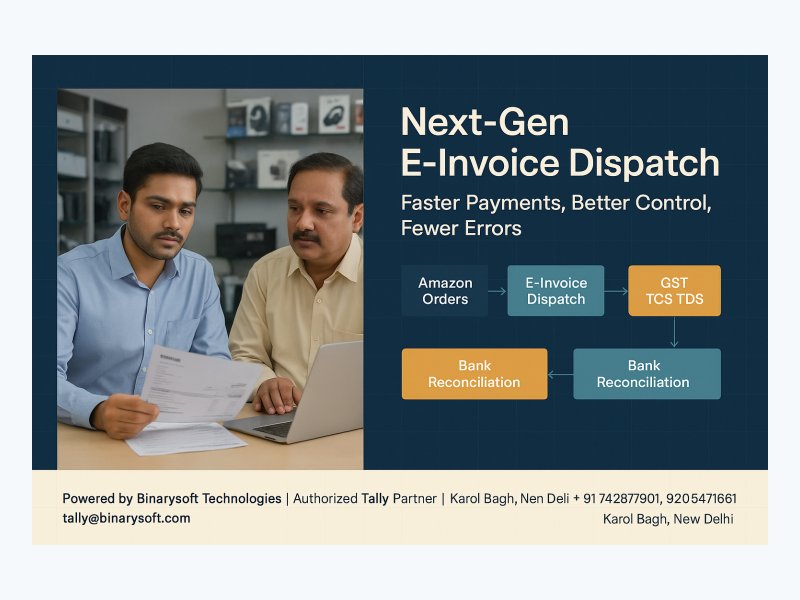
Many wholesale traders now use marketplaces to test retail demand, liquidate selected stock or create a direct-to-consumer channel. Amazon and similar marketplaces provide reports that include orders, returns, cancellations, settlements, fees, tax-related deductions and other adjustments. The most important accounting principle is that marketplace reports are not the same as bank receipts.
A bank receipt is the net money received. A marketplace report explains how that net amount was calculated. If a seller records only the bank receipt as sales, gross sales may be understated and expenses, returns, TCS, TDS or GST-related values may be missed. If the seller records every order as cash received, outstanding and bank reconciliation may be wrong. The correct method depends on the business model, tax status, marketplace reports and accountant advice, but the separation of gross transaction data and net settlement data is essential.
Understand the Main Data Sources
A seller should normally collect and preserve marketplace order reports, return reports, settlement reports, fee invoices or statements, tax deduction or collection certificates if applicable, GST-related documents, bank statements and internal dispatch records. Report names and formats can change, so sellers should verify the current marketplace dashboard and documentation. The accounting team should download reports for the same period and store them with clear file names.
The order report may show what was sold. The return report may show what came back or was refunded. The settlement report may show what the marketplace paid after deductions and adjustments. The fee statement may show commission, closing fee, shipping fee, storage fee, advertising or other charges depending on seller activity. Tax-related reports may show TCS and TDS where applicable. The bank statement shows only the final amount credited to the bank.
Map Marketplace Transactions Before Posting
Before entering data in TallyPrime, the seller should decide the posting design with the accountant. One approach is to record marketplace sales through a customer ledger representing Amazon marketplace or specific marketplace channels, record GST as applicable, record returns through sales return or credit note entries, record fees as expenses, record TCS and TDS in separate ledgers as recoverable or as advised, and reconcile net settlement against the bank receipt. The exact entries should be confirmed because tax treatment can depend on current rules and seller circumstances.
For example, assume a seller ships goods with a gross marketplace sale value. Later, the settlement statement shows marketplace fees, shipping adjustments, TCS, possible TDS, refund adjustment and net bank credit. The bank entry should not be forced to equal gross sales. Instead, the settlement should be broken into components. Sales remain sales. Fees become expenses. Returns reduce sales or are recorded through credit note depending on process. Tax collected or deducted is tracked separately. The final net figure should match the bank credit after all components are posted correctly.
Distinguish Sales Date, Settlement Date and Bank Date
Marketplace accounting becomes confusing because the order date, dispatch date, invoice date, return date, settlement date and bank credit date may be different. A sale may happen in one month and settlement may arrive in the next. A return may happen after the original tax period. A fee may be charged in settlement but relate to earlier activity. Sellers should not assume that bank date decides everything. The accountant should guide period recognition, GST reporting and return adjustment based on current rules and business records.
In TallyPrime, the business should maintain a consistent entry policy. If sales are posted daily, settlement reconciliation should be periodic. If marketplace volume is small, entries may be summarised with adequate supporting reports. If volume is high, integration or import tools may be considered, subject to verification. Regardless of method, supporting reports must be preserved because the bank statement alone is not enough evidence of gross marketplace activity.
Common Amazon Reconciliation Mistakes
- Booking net settlement as sales: This hides marketplace fees, returns and tax-related deductions, and can distort turnover and margin.
- Ignoring returns: Returned goods affect both financial records and physical inventory. Some returns may be saleable, some damaged and some never physically received by the seller depending on marketplace process.
- Posting TCS or TDS to wrong ledgers: Tax collected or deducted should be tracked as advised by the accountant so it can be matched with certificates, returns or credits where applicable.
- Mixing bank receipts and marketplace reports: The bank shows net receipt. The settlement report explains the net receipt. Both are needed.
- Not reconciling settlement period: A settlement may include orders, refunds and fees from different dates. Period mismatch can create false differences.
- Combining all fees into one unclear deduction: Commission, shipping, storage, advertising and other charges may need separate review for profitability.
- Adding returned items directly to saleable stock: Returned goods must be checked before resale.
- Not matching GST reports with marketplace data: GST treatment should be reviewed with current law and accountant guidance. Marketplace documents and seller invoices must be consistent.
Practical Marketplace Reconciliation Process
A practical reconciliation routine can reduce month-end stress. First, download marketplace reports for the defined period. Second, verify total orders, cancellations, returns and net shipped sales. Third, compare invoices raised in TallyPrime with marketplace sales data. Fourth, enter or import sales returns and credit notes as advised. Fifth, classify fees into suitable expense ledgers. Sixth, post TCS and TDS ledgers based on accountant-approved treatment and current documents. Seventh, match settlement net amount to bank credit. Eighth, investigate differences rather than forcing entries.
For wholesale traders who sell both offline and online, marketplace stock should be planned carefully. If the same stock is available for counter sale and Amazon orders, stockouts can happen. Some businesses maintain a separate marketplace stock location. Others reserve quantities for online orders. The right method depends on order volume and staff discipline. What matters is that the software should prevent accidental double selling.
GST, TCS, TDS and Compliance: What to Verify Before Configuration
Tax compliance is an area where accuracy matters and details can change. This article does not state specific GST rates, TCS rates, TDS rates, thresholds, filing rules, due dates, e-invoicing applicability or e-way bill limits because these must be verified from current official sources and the business accountant. Textile products, accessories, services, freight, marketplace transactions and deductions may have different treatment depending on facts.
Before configuring ledgers and voucher types, a trader should confirm key items with the accountant. Which GST rates apply to each product category. Whether HSN or SAC details are correctly maintained. Whether the business is required to generate e-invoices under current rules. When e-way bills are required. How sales returns and credit notes should be reported. How marketplace TCS and TDS should be accounted for. How input tax credit should be matched. Whether any reverse charge applies to specific expenses. How job work, branch transfers or consignment movements should be documented.
The role of smart inventory software is to support compliance by making transaction data accurate, searchable and timely. If item masters contain correct tax classification, if invoices are raised properly, if credit notes are linked to returns, if purchase entries are timely and if bank reconciliation is clean, the accountant can work faster and with fewer assumptions. If the data is messy, even the best accountant must spend time reconstructing facts.
Tally@Cloud for Multi-Location and Owner Visibility
Many wholesale owners are no longer sitting at one desk all day. They travel between factory areas, markets, warehouses, banks, transport offices and customer meetings. A business may have an office in Bhilwara Main Market, a godown in Industrial Estate and buyers in other cities. Another may operate from Ichalkaranji MIDC but coordinate with accountants in a different city. In such cases, access becomes a business issue.
Tally@Cloud, when implemented through a reliable service provider and used according to licensing and security requirements, can help authorised users access TallyPrime from different locations. The practical benefit is that the owner, accountant and staff can work on the same business data without sending files repeatedly through email or messaging apps. However, cloud access should be planned responsibly. User permissions, backup policy, password hygiene, data security, internet reliability and support response should be discussed before going live.
Cloud access does not replace good accounting practices. It amplifies them. If item masters are clean, cloud access makes them available to the right people. If entries are wrong, cloud access spreads wrong data faster. Therefore, implementation should combine technology, process and training.
Inventory Examples for Wholesale Traders
Example 1: Fabric Roll Tracking
A Bhilwara trader buys multiple rolls of fabric of the same quality but different lengths. If the business sells by meter and customers may ask for specific roll continuity, roll-level or lot-level tracking may be important. The trader can structure items and locations so that staff know how much remains in each lot or at least in each quality and shade. The exact method should be designed with current TallyPrime capabilities and practical staff workflow.
The benefit is visible during dispatch. Instead of cutting from any available roll and later discovering shade variation, the dispatch team can follow a controlled process. The owner can also identify remnants and plan discounts or bundling. Without tracking, remnants accumulate silently and become dead stock.
Example 2: Yarn and Weight-Based Stock
A yarn trader may buy and sell by weight, while physical handling happens through cones or bags. Moisture, packing and weighing differences can lead to disputes. A disciplined inventory system should capture purchase weight, sale weight, supplier lot and customer dispatch details. If shortage claims are common, weighment slips and transport documents should be stored with transaction references.
Software cannot prevent every dispute, but it can help the trader respond with evidence. It can show what was purchased, what was dispatched, what remains and which lot was involved. This strengthens negotiation and reduces emotional arguments.
Example 3: Garment Accessories
An Ichalkaranji supplier of buttons, zippers, labels and packing material may handle thousands of small SKUs. The risk is not only stock shortage but wrong item selection. A buyer may need a particular zipper length and colour. If the item master is vague, staff may ship the wrong item. Clear item names, categories and units reduce picking errors.
For small items, periodic physical verification is essential. Software stock can drift because of counting errors, samples, replacements and small unrecorded issues. A cycle count policy can check selected items daily or weekly instead of waiting for annual stocktaking.
Example 4: Marketplace Clearance Stock
A wholesaler may decide to sell old or excess stock on Amazon. This can be useful, but the stock should be separated from regular wholesale commitments. If clearance stock is not separated, staff may sell the same quantity offline. If marketplace returns come back after the stock has been considered liquidated, the business may not know whether returned items are fresh, damaged or obsolete.
A separate stock location or clear internal tagging can help. The accountant should also track marketplace fees and returns so the owner can see whether clearance sales are truly profitable after deductions.
Reports Owners Should Review Every Week
Smart inventory is useful only if reports are reviewed. Owners do not need to read every voucher, but they should review a focused set of reports. The exact report names and availability depend on TallyPrime configuration and release, so businesses should verify current product documentation and setup.
- Stock summary: Shows item-wise quantity and value. Review negative stock, unusually high stock and fast changes.
- Godown-wise stock: Helps compare shop, warehouse, return and damaged locations.
- Ageing of stock: Helps identify slow-moving and dead items. If not available directly in the desired form, ask the accountant or Tally partner about suitable reporting options.
- Gross profit by item or group: Helps identify items that sell but do not earn enough after discounts and costs.
- Sales return report: Shows products and customers with repeated return issues.
- Outstanding receivables: Shows overdue parties and credit risk.
- Purchase pending or supplier claims: Helps track goods ordered, received short or under dispute.
- Bank reconciliation: Confirms that receipts and payments match bank statements.
- Marketplace settlement reconciliation: Confirms that Amazon net receipts agree with sales, returns, fees, TCS, TDS and adjustments.
A weekly review meeting can be short. The owner, accountant and operations person can discuss stock exceptions, overdue payments, pending returns, slow-moving items and marketplace differences. The discipline of review is more important than the length of the meeting.
Useful Checklist Before Implementing Smart Inventory Software
Before moving to a smarter setup, traders should prepare. A rushed implementation often creates confusion because old mistakes are carried into the new system. The following checklist can help wholesale businesses in Bhilwara, Ichalkaranji and similar hubs.
- Clean item masters: Identify duplicate stock items, inconsistent spellings and inactive items.
- Define naming rules: Decide how quality, shade, size, width, model, batch or packing will appear in item names or related fields.
- Verify units: Confirm meters, kilograms, pieces, cartons, rolls, cones and conversion rules.
- Map stock locations: List shop, godown, branch, return area, damaged area, sample stock and goods in transit if applicable.
- Review ledgers: Separate sales, purchases, returns, discounts, freight, commission, marketplace fees, TCS, TDS and GST ledgers as advised.
- Confirm tax settings: Verify current GST rates, HSN details, e-invoice and e-way bill applicability, TCS and TDS treatment with the accountant.
- Plan user roles: Decide who can create items, change rates, approve returns, enter purchases, raise invoices and reconcile bank entries.
- Prepare opening stock: Conduct a physical stock count before relying on reports.
- Decide marketplace process: Define how Amazon sales, returns, fees, settlements and tax deductions will be downloaded, posted and reconciled.
- Set backup policy: Ensure data backup, access security and recovery process are clear, especially in cloud access setups.
- Train staff: Teach the daily process, not just software buttons.
- Schedule review: Fix weekly and monthly reporting routines for stock, receivables, returns and reconciliation.
Implementation Roadmap: 30, 60 and 90 Days
First 30 Days: Stabilise the Basics
The first month should focus on cleaning masters, confirming ledgers, verifying tax setup with the accountant and matching physical stock with software stock. Do not try to solve every advanced report on day one. First make sure purchases, sales, returns, receipts and payments are entered consistently. Identify duplicate items and freeze casual item creation. Train staff on units and naming.
If the business uses Amazon or other marketplaces, start downloading reports regularly even if full reconciliation is still being designed. Preserve evidence. Keep settlement reports, fee statements and bank credits together by period. This habit will reduce future confusion.
Next 60 Days: Improve Control
In the second month, focus on godown-wise stock, return handling, receivable ageing, sales order discipline and bank reconciliation. Create a routine for checking negative stock and unusual balances. Review fast-moving and slow-moving items. Start separating marketplace fees and tax-related deductions clearly.
Owners should begin using weekly reports. The goal is to make the software part of decision-making. If reports are ignored, data quality declines because staff feel entries do not matter. When owners ask informed questions from reports, staff become more careful.
By 90 Days: Use Data for Decisions
By the third month, the business should use inventory data for buying, pricing, clearance planning and credit control. Slow-moving stock can be discounted before it becomes dead. Repeat return reasons can be addressed. Marketplace profitability can be reviewed after fees and returns. Supplier claims can be tracked better. The owner can compare offline wholesale margin with online sales margin and decide where effort is justified.
This roadmap is flexible. A small trader may complete it faster. A large business with multiple branches may need more time. The principle is to implement in phases so that staff adopt the system rather than resist it.
Common Mistakes That Make Inventory Software Fail
Many businesses buy software or move to cloud access and still do not get reliable reports. The reason is usually not the software alone. It is the combination of unclear process, poor training and weak discipline.
- Using software only for invoice printing: If purchases, returns, stock transfers and payments are not recorded properly, reports will not help.
- Allowing anyone to create items: This creates duplicates and spelling variations.
- Ignoring physical stock count: Opening stock must be realistic. Otherwise all future reports begin with a wrong base.
- Not separating damaged and returned stock: Saleable quantity becomes overstated.
- Reconciling only the bank: Bank reconciliation is important, but marketplace settlement reconciliation is also needed for online sales.
- Posting deductions without classification: Fees, tax deductions, refunds and penalties should not be hidden in vague ledgers.
- Skipping accountant review: Tax configuration should be verified with current rules and professional advice.
- No backup or access control: Cloud access must be supported by user permissions, backup and security practices.
- Over-customising too early: First stabilise standard processes. Customisation should solve real problems, not imagined ones.
- No review rhythm: Reports that nobody reads quickly become unreliable.
How TallyPrime and Tally@Cloud Fit Together for Wholesale Traders
TallyPrime can be the core business accounting and inventory system, while Tally@Cloud can provide access flexibility for authorised users. For a wholesaler, this combination can support purchase entry, sales billing, inventory reports, GST-related records, receivables, payables, bank reconciliation and management review. The exact feature set, licensing model, remote access method and performance depend on the current product version, cloud setup and service provider arrangement, so businesses should verify details before purchase or migration.
A practical setup may allow the billing team to raise invoices, the accountant to review GST and bank entries, the owner to check reports and a remote consultant to assist when permitted. This can reduce dependency on one physical computer in the office. It can also help when a business has a shop, warehouse and accountant in different places.
However, cloud should not be chosen only because it sounds modern. The business should ask clear questions. How will data be backed up. Who can access it. What happens if internet is down. How are users controlled. How quickly is support available. Is the setup compliant with software licensing. Are printers and local devices supported as needed. Is performance suitable for the number of users. A reliable implementation partner should answer these questions plainly.
What Wholesale Owners Should Ask Their Accountant and Tally Partner
Before finalising a system, the owner should bring the accountant and Tally partner into the same conversation. The accountant understands compliance and reporting. The Tally partner understands configuration and workflow. The owner understands business reality. When these three perspectives align, implementation is stronger.
- For item masters: What level of detail is needed for stock, GST and profit analysis.
- For tax setup: Which GST rates, HSN codes and reporting settings should be verified currently.
- For marketplace sales: How should Amazon sales, returns, fees, TCS, TDS and settlements be posted and reconciled.
- For returns: What documents are needed for credit notes and stock movement.
- For branches or godowns: How should transfers, goods in transit and stock locations be recorded.
- For security: Which users need access and what permissions should they have.
- For reporting: Which weekly and monthly reports should owners review.
- For migration: How will opening stock, outstanding balances and old data be validated.
These questions save time because they prevent assumptions. A trader should not wait until year-end to discover that the inventory structure does not support required reporting.
Local Business Benefits for Bhilwara and Ichalkaranji Traders
For wholesale traders in Bhilwara Industrial Estate, Bhilwara Main Market and Ichalkaranji MIDC, the benefits of smart inventory are practical and local. Faster dispatch helps maintain trust with factories and retailers. Accurate stock prevents over-promising. Clear receivables support better cash flow. Proper return tracking reduces margin leakage. Marketplace reconciliation prevents online sales from becoming a black box. Cloud access helps owners remain connected even when they are away from the office.
The most important benefit is confidence. A wholesaler who knows stock, cost, outstanding and settlement status can negotiate better. He can decide whether to buy more of a fast-moving item, discount old stock, stop selling an item with high returns, press a buyer for payment or challenge a supplier on shortage. Without data, every decision becomes an argument. With data, decisions become conversations.
Practical Closing Call to Action
If your wholesale business is growing across shop sales, warehouse dispatch, Amazon orders, returns, bank settlements and GST documentation, this is the right time to review your inventory and accounting setup. The goal is not to make your business complicated. The goal is to make daily work clearer, reports more dependable and month-end closing less stressful.
For guidance on TallyPrime setup, inventory structure, cloud access and marketplace reconciliation workflow, contact Tally@Cloud powered by Binarysoft Technologies, Authorized Tally Partner. Visit 1626/33, 1st Floor, Naiwalan, Karol Bagh, New Delhi - 110005, INDIA. Call +91 7428779101, 9205471661 or email tally@binarysoft.com. Contact hours are 10:00 AM - 6:00 PM, Mon-Fri.
Conclusion
Smart inventory software is not only for large companies. It is increasingly necessary for wholesale traders who handle fast stock movement, multiple buyers, credit sales, returns, marketplace orders and GST records. Bhilwara Industrial Estate, Bhilwara Main Market and Ichalkaranji MIDC businesses operate in competitive supply chains where small errors can become expensive. A disciplined TallyPrime setup, supported by reliable Tally@Cloud access where suitable, can help owners connect stock, sales, purchases, returns, settlements, bank receipts and tax data in one practical workflow.
The key is to avoid shortcuts. Do not treat Amazon bank receipts as sales without reading settlement reports. Do not mix returned and saleable stock without inspection. Do not create item masters casually. Do not assume tax treatment without current verification. Build the system around real business movement, train staff, review reports weekly and involve your accountant. When records are right, the owner gains something more valuable than reports: the confidence to make timely decisions.
FAQ
What is smart inventory software for wholesale traders?
Smart inventory software helps a wholesaler track stock, purchases, sales, returns, locations, receivables, payables and reconciliation in a structured way. For many Indian traders, this can mean a properly configured TallyPrime system with disciplined item masters, ledgers, GST settings and reporting, optionally accessed through Tally@Cloud for multi-location convenience.
Can TallyPrime manage inventory for textile wholesalers in Bhilwara and Ichalkaranji?
TallyPrime can support inventory and accounting workflows for many trading businesses, including textile wholesalers, subject to correct configuration and current product capabilities. Traders should verify features such as stock groups, units, godowns, batches, GST reports and reconciliation options with current Tally documentation or an authorised Tally partner.
Why should Amazon settlement reports not be treated as bank receipts only?
The bank shows the net amount received, while the Amazon settlement report explains sales, returns, fees, adjustments, TCS, TDS if applicable and other deductions. If a seller records only the net bank receipt as sales, gross sales, expenses, returns and tax-related amounts may be misstated.
How should returns be handled in inventory software?
Returns should be recorded both financially and physically. The business should verify why goods returned, whether a credit note is needed, whether the item is saleable, damaged or supplier-returnable, and which stock location it should enter. GST treatment should be confirmed with the accountant based on current rules.
Do wholesale traders need cloud access for TallyPrime?
Cloud access is useful when owners, accountants or staff need secure access from different locations. Tally@Cloud can help reduce dependency on one office computer, but businesses should review licensing, security, backups, user permissions, internet reliability and support before implementation.
What are the most common inventory mistakes in wholesale trading?
Common mistakes include duplicate item names, wrong units, delayed purchase entry, unrecorded returns, mixing damaged stock with saleable stock, booking marketplace net receipts as sales, vague expense ledgers, weak bank reconciliation and lack of physical stock verification.
Should GST rates, TCS, TDS and filing rules be configured by the trader directly?
Traders should not rely on guesswork for tax settings. GST rates, HSN details, TCS, TDS, thresholds, e-invoicing and e-way bill applicability should be verified with a qualified accountant and current official sources before configuration in TallyPrime.
Who can help set up TallyPrime and Tally@Cloud for wholesale inventory?
Binarysoft Technologies is an Authorized Tally Partner powering Tally@Cloud. Wholesale traders can contact the team at 1626/33, 1st Floor, Naiwalan, Karol Bagh, New Delhi - 110005, INDIA, call +91 7428779101 or 9205471661, or email tally@binarysoft.com during 10:00 AM - 6:00 PM, Mon-Fri.
Frequently Asked Questions
What is smart inventory software for wholesale traders?
Smart inventory software helps a wholesaler track stock, purchases, sales, returns, locations, receivables, payables and reconciliation in a structured way. For many Indian traders, this can mean a properly configured TallyPrime system with disciplined item masters, ledgers, GST settings and reporting, optionally accessed through Tally@Cloud for multi-location convenience.
Can TallyPrime manage inventory for textile wholesalers in Bhilwara and Ichalkaranji?
TallyPrime can support inventory and accounting workflows for many trading businesses, including textile wholesalers, subject to correct configuration and current product capabilities. Traders should verify features such as stock groups, units, godowns, batches, GST reports and reconciliation options with current Tally documentation or an authorised Tally partner.
Why should Amazon settlement reports not be treated as bank receipts only?
The bank shows the net amount received, while the Amazon settlement report explains sales, returns, fees, adjustments, TCS, TDS if applicable and other deductions. If a seller records only the net bank receipt as sales, gross sales, expenses, returns and tax-related amounts may be misstated.
How should returns be handled in inventory software?
Returns should be recorded both financially and physically. The business should verify why goods returned, whether a credit note is needed, whether the item is saleable, damaged or supplier-returnable, and which stock location it should enter. GST treatment should be confirmed with the accountant based on current rules.
Do wholesale traders need cloud access for TallyPrime?
Cloud access is useful when owners, accountants or staff need secure access from different locations. Tally@Cloud can help reduce dependency on one office computer, but businesses should review licensing, security, backups, user permissions, internet reliability and support before implementation.
What are the most common inventory mistakes in wholesale trading?
Common mistakes include duplicate item names, wrong units, delayed purchase entry, unrecorded returns, mixing damaged stock with saleable stock, booking marketplace net receipts as sales, vague expense ledgers, weak bank reconciliation and lack of physical stock verification.
Should GST rates, TCS, TDS and filing rules be configured by the trader directly?
Traders should not rely on guesswork for tax settings. GST rates, HSN details, TCS, TDS, thresholds, e-invoicing and e-way bill applicability should be verified with a qualified accountant and current official sources before configuration in TallyPrime.
Who can help set up TallyPrime and Tally@Cloud for wholesale inventory?
Binarysoft Technologies is an Authorized Tally Partner powering Tally@Cloud. Wholesale traders can contact the team at 1626/33, 1st Floor, Naiwalan, Karol Bagh, New Delhi - 110005, INDIA, call +91 7428779101 or 9205471661, or email tally@binarysoft.com during 10:00 AM - 6:00 PM, Mon-Fri.
CA. Sagar Singh advises MSMEs on accounting accuracy, GST compliance, and internal controls. With exposure to high-volume transaction environments, he writes practical guidance on inventory management, billing discipline, and compliance-ready accounting systems.