Call CA Tally HelpDesk
+91 9205471661,
7428779101
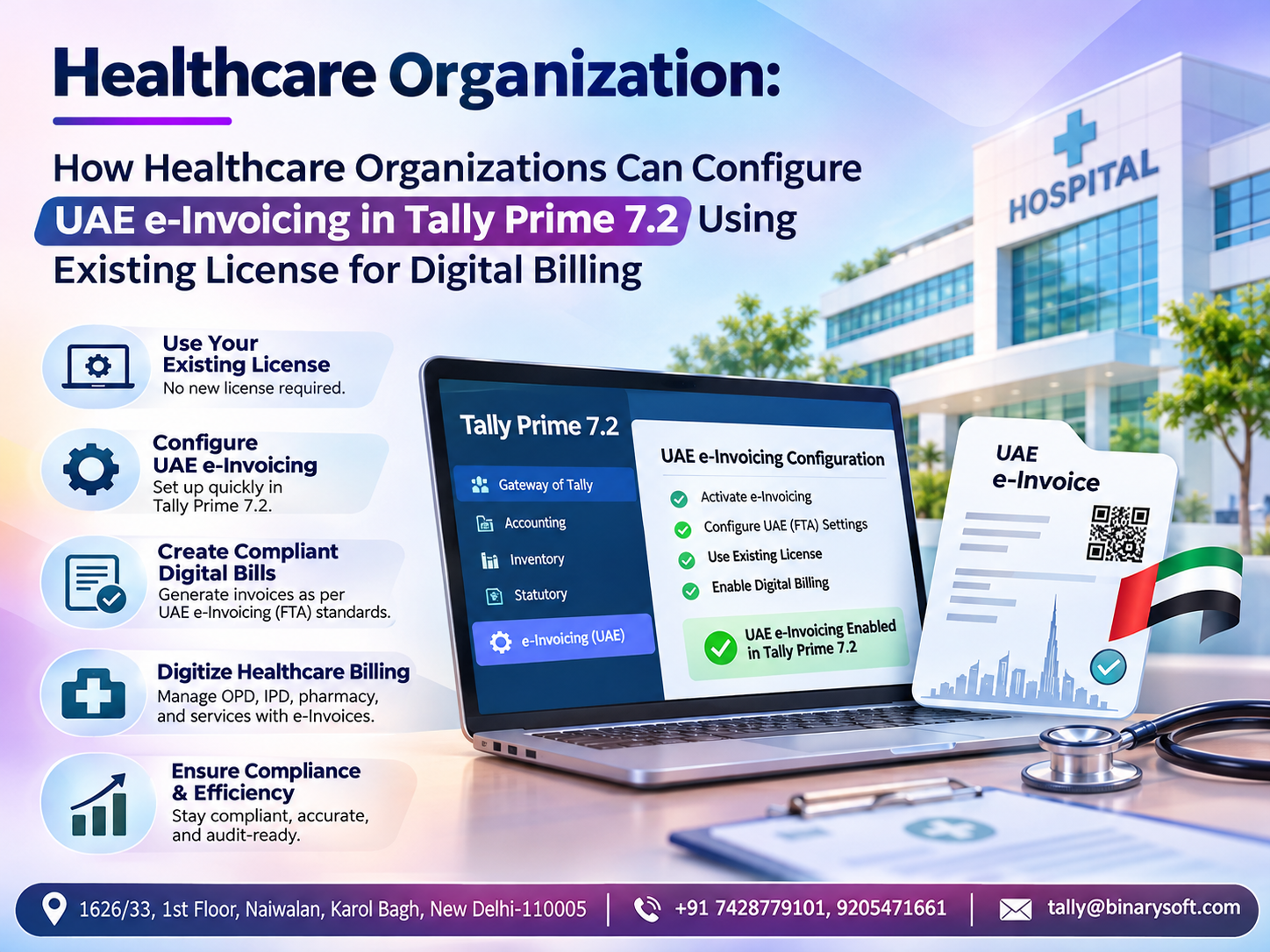
Healthcare organizations across the United Arab Emirates are embracing digital transformation to improve patient services, financial management, operational efficiency and regulatory compliance. From multi-specialty hospitals and diagnostic laboratories to dental clinics, pharmacies and independent medical centres, healthcare businesses require reliable accounting and invoicing solutions to manage their growing financial responsibilities.
With the introduction of the UAE electronic invoicing framework, healthcare organizations need to prepare their billing systems for structured electronic invoices, accurate VAT reporting and secure digital transaction management.
Tally Prime 7.2 can help healthcare organizations organize their accounting records, configure tax details, manage invoices and prepare financial information for electronic invoicing workflows. Organizations with an existing Tally Prime license can explore available upgrade and integration options without necessarily purchasing a completely new accounting system.
By combining digital billing, financial reporting, inventory management and electronic invoicing readiness, healthcare businesses can reduce administrative pressure and dedicate more resources to patient care.
Understanding UAE e-Invoicing for Healthcare Organizations
UAE e-Invoicing is a digital framework designed to standardize the creation, exchange and reporting of electronic invoices. It aims to improve financial transparency, strengthen tax compliance and reduce dependency on manual documentation.
Unlike traditional paper invoices or PDF bills, electronic invoices contain structured financial information that can be exchanged and processed electronically through compatible systems.
For healthcare organizations, electronic invoicing can support financial transactions involving hospitals, insurance companies, corporate customers, medical suppliers, diagnostic laboratories and government institutions.
Healthcare organizations can prepare their accounting infrastructure using Tally Prime 7.2 while integrating with an appropriate Accredited Service Provider (ASP) for compliant electronic invoice exchange.
UAE e-Invoicing Implementation Timeline 2026–2027
Healthcare organizations should understand the phased implementation schedule and prepare their accounting infrastructure accordingly.
|
Business Category
|
Mandatory Implementation
|
|---|
|
Pilot programme
|
1 July 2026
|
|
Voluntary implementation
|
1 July 2026
|
|
Businesses with annual revenue of AED 50 million or more
|
1 January 2027
|
|
Businesses with annual revenue below AED 50 million
|
1 July 2027
|
|
Government entities within scope
|
1 October 2027
|
The electronic invoicing framework primarily covers eligible business-to-business and business-to-government transactions. Direct patient billing generally falls under business-to-consumer transactions, which are currently outside mandatory electronic invoicing requirements. However, healthcare organizations receiving invoices from business suppliers may still have electronic invoicing obligations.
وزارة المالية - الإمارات العربية المتحدة+2
Healthcare businesses should evaluate their transaction categories, annual revenue and applicable regulatory requirements before implementing their electronic invoicing solutions.
An Emotional Story: When Healthcare Billing Became a Bigger Challenge Than Patient Care
Imagine a healthcare clinic in Dubai established by a doctor who spent years building a trusted relationship with the local community.
Every morning, dozens of patients visited the clinic for consultations, blood tests and medical treatments. The doctor wanted every patient to receive affordable and timely healthcare.
However, as the clinic expanded, its administrative responsibilities increased.
Insurance payments were delayed, supplier invoices were misplaced, and the accounts department struggled to reconcile daily transactions. Employees regularly worked late to prepare financial reports and verify outstanding payments.
One evening, the doctor noticed an accountant sitting alone, surrounded by medical bills and supplier invoices.
The accountant explained that maintaining accurate financial records had become increasingly difficult. Preparing for upcoming electronic invoicing requirements created additional pressure.
The management decided to modernize its accounting processes using its existing Tally Prime license and a compatible digital invoicing solution.
Gradually, financial transactions became more organized. The management gained better visibility into outstanding insurance payments, pharmacy stock and operating expenses.
The doctor could finally spend more time focusing on patients instead of worrying about administrative challenges.
This illustrative story reflects a common challenge faced by growing healthcare businesses. Digital transformation is not simply about adopting technology; it is about giving healthcare professionals more time to focus on improving people's lives.
Why Healthcare Organizations Need Digital Invoicing
Healthcare organizations manage multiple financial activities every day. These include consultation charges, medical procedures, laboratory investigations, pharmacy sales, insurance settlements and medical equipment purchases.
Managing these activities manually can increase operational costs and create financial inconsistencies.
Digital invoicing offers several advantages:
-
Reduced manual billing errors and duplicate entries.
-
Improved VAT classification and reporting.
-
Better insurance payment tracking.
-
Faster preparation of financial statements.
-
Organized medical supplier transactions.
-
Improved visibility into outstanding receivables.
-
Reduced dependency on paperwork.
-
Better financial transparency across departments.
-
Simplified audit preparation.
-
Improved regulatory compliance readiness.
With an organized accounting platform such as Tally Prime, healthcare organizations can establish a stronger foundation for sustainable digital growth.
Can Healthcare Organizations Use Their Existing Tally Prime License?
Healthcare businesses already using Tally Prime may not need to purchase an entirely new accounting license to prepare for UAE e-Invoicing.
Organizations can examine their existing license, subscription eligibility, software version and compatibility with available electronic invoicing integrations.
Businesses with eligible software update access may be able to upgrade to Tally Prime 7.2 or another compatible version while retaining their existing accounting data.
However, the existing license alone does not guarantee complete UAE e-Invoicing compliance. Additional integration, customization, Accredited Service Provider subscriptions and implementation services may be required.
Before proceeding, healthcare organizations should evaluate their license entitlement, active software services, data compatibility and technical requirements.
Step-by-Step Guide to Configure UAE e-Invoicing in Tally Prime 7.2
Step 1: Verify Your Existing Tally Prime License
Begin by reviewing the existing Tally Prime license and checking whether the organization is eligible to install the required software version.
Verify the license status, software update entitlement, existing customizations and multi-user requirements.
Take a complete backup of accounting data before upgrading the software. This helps protect historical financial records and allows recovery if compatibility issues arise during implementation.
Step 2: Configure Healthcare Organization Details
Accurate company information is essential for maintaining reliable electronic invoices.
Healthcare organizations should review the company profile in Tally Prime and configure the following information:
-
Registered healthcare organization name.
-
Official business address.
-
Country and emirate.
-
Tax Registration Number (TRN), where applicable.
-
Financial year and accounting period.
-
Business contact information.
-
Base currency as UAE Dirham (AED).
Ensure that the registered business information matches the organization's official tax and commercial registration records.
Step 3: Enable and Configure UAE VAT
Healthcare organizations should enable applicable VAT features through the company configuration settings in Tally Prime.
Qualifying healthcare services may attract zero-rated VAT treatment, while certain cosmetic treatments, non-qualifying services and other supplies may attract standard-rated VAT.
Healthcare businesses must carefully classify medical services and products according to their actual tax treatment.
Separate ledgers can be maintained for zero-rated supplies, standard-rated supplies, applicable exempt transactions, input VAT and output VAT.
Incorrect VAT classification can create reporting discrepancies. Therefore, healthcare organizations should consult a qualified UAE tax professional before finalizing their billing configurations.
Step 4: Create Healthcare-Specific Accounting Ledgers
Healthcare organizations can configure dedicated accounting ledgers for different income sources, expenses and business partners.
|
Ledger Name
|
Purpose
|
|---|
|
Consultation Income
|
Medical consultation charges
|
|
Diagnostic Income
|
Laboratory and diagnostic services
|
|
Pharmacy Sales
|
Medicine and healthcare product sales
|
|
Surgery Income
|
Surgical procedure revenue
|
|
Insurance Receivables
|
Outstanding insurance settlements
|
|
Medical Equipment
|
Equipment purchase records
|
|
Medical Consumables
|
Consumable expenses
|
|
Corporate Receivables
|
Corporate healthcare billing
|
|
Doctor Fees
|
Professional consultation expenses
|
|
VAT Payable
|
Applicable tax liabilities
|
Proper ledger classification helps management understand departmental performance and maintain accurate financial statements.
Step 5: Configure Customer and Supplier Masters
Healthcare organizations frequently transact with insurance providers, corporate clients, pharmaceutical suppliers and medical equipment distributors.
Each relevant party master should contain accurate legal names, business addresses, applicable tax registration numbers, payment terms and contact information.
Additional electronic invoicing identifiers required by the selected integration should also be maintained.
Accurate master data reduces invoice validation errors and helps improve communication between healthcare organizations and their business partners.
Step 6: Configure Sales Vouchers and Invoice Formats
Healthcare organizations can create separate voucher types for consultation services, corporate medical billing, pharmacy sales, diagnostic services and other transactions.
Invoice records should contain accurate invoice references, transaction dates, supplier and buyer information, service descriptions, taxable values, applicable tax amounts and final invoice totals.
Additional mandatory electronic invoice fields should be mapped through a compatible integration solution.
This approach helps healthcare organizations maintain consistent billing records across multiple departments and branches.
Step 7: Integrate an Accredited Service Provider
Healthcare organizations must establish connectivity with a UAE Accredited Service Provider where required under the electronic invoicing framework.
The integration should support structured invoice generation, data validation, electronic invoice exchange, transaction status updates and applicable reporting requirements.
Tally Prime can serve as the accounting data source, while the compatible integration manages the electronic invoicing communication process.
The UAE framework uses internationally recognized Peppol-based electronic document exchange standards.
Healthcare organizations should confirm that their selected integration meets the applicable technical, financial and security requirements.
Step 8: Test Electronic Invoice Processing
Before moving to live operations, healthcare organizations should test representative business transactions.
Testing should cover corporate invoices, medical supplier invoices, zero-rated transactions, standard-rated transactions, credit notes, invoice corrections and rejected transactions.
The accounts team should verify that invoice information matches the accounting records and that processing acknowledgements are appropriately recorded.
After successful testing, the organization can proceed with live electronic invoicing operations according to its applicable implementation schedule.
How Tally Prime 7.2 Helps Healthcare Organizations
1. Simplified Healthcare Billing
Tally Prime allows healthcare organizations to maintain detailed accounting transactions for different services and revenue categories.
Hospitals can organize financial records for consultations, diagnostic tests, surgical procedures and corporate healthcare packages.
Specialized hospital management software may still be required for clinical workflows, patient registration and treatment records, while Tally Prime manages the associated financial transactions.
2. Efficient Insurance Payment Management
Insurance settlements often involve extended payment cycles, deductions and multiple outstanding invoices.
Using bill-wise accounting and receivables reports, healthcare organizations can monitor pending payments, identify overdue invoices and reconcile insurance settlements.
Better receivables management supports healthier cash flow and reduces financial uncertainty.
3. Pharmacy and Medical Inventory Management
Healthcare facilities require continuous availability of medicines, surgical supplies and medical consumables.
Tally Prime inventory management features can help businesses maintain stock groups, batch details, expiry information, stock movements and reorder levels.
Better stock visibility can help reduce unnecessary purchases, expired inventory and shortages of essential medical supplies.
4. Automated Financial Reporting
Healthcare management requires accurate information to make informed operational decisions.
Tally Prime provides access to balance sheets, profit and loss accounts, cash flow reports, outstanding statements, stock summaries and other financial reports.
Management can use these reports to evaluate profitability, operating expenses and departmental performance.
5. Department-Wise Cost Management
Hospitals can use cost centres to monitor financial activities across different departments, including cardiology, dental care, radiology, pathology, pharmacy and administration.
Department-wise accounting helps management identify high operating costs, evaluate service profitability and allocate financial resources more effectively.
6. Banking and Payment Reconciliation
Healthcare organizations receive payments through bank transfers, cash, cards, insurance settlements and corporate payment arrangements.
Tally Prime banking and reconciliation features help accounts teams compare recorded transactions with bank statements.
Regular reconciliation improves financial accuracy and helps identify unmatched receipts and outstanding payments.
7. Data Security and User Access Management
Healthcare financial information requires appropriate security controls.
Tally Prime supports user-based access restrictions, password protection and accounting data backup arrangements.
Organizations should establish additional safeguards for confidential medical information, including secure integrations, restricted access and appropriate data retention policies.
Only necessary financial information should be shared through electronic invoicing systems. Sensitive patient diagnoses and unrelated clinical details should not be included unnecessarily.
Case Study 1: Multi-Specialty Hospital in Dubai
Business Background
Consider an illustrative multi-specialty hospital operating several medical departments, diagnostic laboratories and an in-house pharmacy.
The hospital processes corporate healthcare invoices, insurance settlements and supplier transactions every month.
Challenges
The hospital experienced difficulties managing outstanding insurance payments, departmental expenses, inconsistent invoice records and manual bank reconciliation.
Preparing its accounting infrastructure for upcoming UAE electronic invoicing requirements was another major concern.
Solution Using Tally Prime
The hospital decided to retain its existing accounting system and evaluate an eligible upgrade to Tally Prime 7.2.
Department-specific cost centres, separate revenue ledgers, insurance receivable accounts and standardized invoice configurations were established.
A compatible electronic invoicing integration was evaluated for connecting the accounting system with an Accredited Service Provider.
Expected Business Benefits
The proposed implementation would help the hospital improve financial visibility, organize insurance receivables, simplify supplier accounting and reduce duplicate billing entries.
Management could monitor departmental performance more effectively while preparing the organization for compliant electronic invoice processing.
Case Study 2: Diagnostic Laboratory and Healthcare Centre in Abu Dhabi
Business Background
Consider an illustrative diagnostic laboratory providing pathology services, medical investigations and corporate employee health check-up packages.
The laboratory works with healthcare clinics, corporate customers and medical consumable suppliers.
Challenges
The laboratory struggled with inconsistent customer records, delayed corporate payments, consumable inventory monitoring and time-consuming financial reporting.
Its management wanted to prepare for UAE e-Invoicing without completely replacing its existing accounting software.
Solution Using Tally Prime
The laboratory reviewed its existing Tally Prime license and configured separate service ledgers, corporate customer accounts, VAT classifications and inventory categories.
Bill-wise payment tracking and banking reconciliation processes were introduced.
The electronic invoicing integration was planned around the organization's eligible business transactions and applicable regulatory requirements.
Expected Business Benefits
The laboratory could benefit from improved corporate payment tracking, organized purchase records, better consumable inventory visibility and more efficient financial reporting.
Retaining the existing accounting infrastructure could also reduce unnecessary migration expenses and employee training requirements.
Tally Prime on Cloud for Healthcare Organizations
Healthcare organizations operating multiple branches can consider hosting Tally Prime in a securely managed cloud environment.
Cloud hosting can provide authorized employees with access to accounting information from different locations without maintaining separate accounting installations at every branch.
Potential benefits include centralized accounting, remote access, multi-user working, scheduled backups, reduced dependency on local computers and improved coordination between accounts departments.
Healthcare organizations should evaluate hosting locations, encryption, access restrictions, disaster recovery arrangements and applicable UAE healthcare data protection requirements before selecting a cloud solution.
A secure cloud accounting environment combined with electronic invoicing integration can help healthcare businesses manage financial operations more efficiently.
Cost Considerations for UAE e-Invoicing Implementation
Using an existing Tally Prime license may help reduce initial software investment. However, healthcare organizations should prepare a realistic implementation budget.
Potential expenses include software subscription renewal, electronic invoicing integration, Accredited Service Provider charges, customization, cloud hosting, employee training and ongoing technical support.
The actual cost depends on transaction volumes, organizational structure, existing software entitlements and integration complexity.
A planned implementation can help healthcare businesses avoid unnecessary expenditure while maintaining operational continuity.
Future of Digital Healthcare Accounting in the UAE
The future of healthcare accounting is increasingly connected with digital automation, centralized financial information and structured document exchange.
Hospitals, clinics and diagnostic laboratories that modernize their accounting infrastructure early may be better positioned to manage regulatory changes and business expansion.
Tally Prime can support this transformation by providing integrated accounting, inventory management, financial reporting and transaction management capabilities.
When combined with suitable electronic invoicing integration and security practices, it can become an important component of a healthcare organization's digital financial infrastructure.
Conclusion
UAE e-Invoicing represents an important step towards modernizing financial operations and strengthening business transparency across the healthcare sector.
Healthcare organizations using Tally Prime can prepare for this transformation by reviewing their existing licenses, upgrading eligible software, configuring VAT settings, improving master data and adopting compatible electronic invoicing integrations.
From insurance payment management and pharmacy inventory control to departmental accounting and financial reporting, Tally Prime 7.2 can help healthcare businesses simplify their everyday financial responsibilities.
By investing in reliable digital accounting infrastructure, healthcare organizations can reduce administrative pressure, strengthen financial management and dedicate more attention to delivering quality patient care.
Powered by Binarysoft Technologies
Authorized Tally Partner
Location: 1626/33, 1st Floor, Naiwalan, Karol Bagh, New Delhi – 110005, INDIA
Contact us: +91 7428779101, 9205471661
Email us: tally@binarysoft.com
Business Hours: 10:00 AM – 6:00 PM, Mon–Fri
Frequently Asked Questions
Can healthcare organizations configure UAE e-Invoicing using an existing Tally Prime license?
Yes. Organizations can evaluate their existing license and software upgrade eligibility. Compatible electronic invoicing integration and additional service subscriptions may be required.
Is UAE e-Invoicing mandatory for hospitals and healthcare organizations?
Healthcare organizations conducting transactions within the applicable regulatory scope must comply according to their implementation schedule and relevant obligations.
CA. Krishiv Bansode works closely with startups and MSMEs on accounting, taxation, and compliance matters. He regularly writes about cloud accounting, automation, and financial management strategies.