Call CA Tally HelpDesk
+91 9205471661,
7428779101
Introduction
The education sector in the United Arab Emirates is undergoing a significant digital transformation. From online admissions and virtual classrooms to automated fee collection and financial reporting, educational institutions are increasingly adopting technology to improve operational efficiency and deliver better services.
With the introduction of the UAE electronic invoicing framework, educational institutions must also evaluate their accounting systems, invoicing procedures and tax compliance practices.
Schools, universities, training institutes and professional education centres generate numerous financial transactions involving tuition fees, admission charges, transportation services, educational materials, corporate training and other activities.
Managing these transactions manually can increase administrative workloads, create accounting discrepancies and make regulatory compliance more challenging.
Tally Prime 7.2 can help educational institutions establish a structured accounting environment, manage financial transactions and prepare invoice data for electronic invoicing workflows.
Institutions already using Tally Prime may be able to continue with their existing license, subject to version eligibility, subscription validity, UAE configuration requirements and integration with an Accredited Service Provider.
This comprehensive guide explains how educational institutions can prepare for UAE e-Invoicing while improving accounting accuracy, financial transparency and administrative efficiency.
What Is UAE e-Invoicing for Educational Institutions?
UAE e-Invoicing is a digital framework designed to standardize the creation, exchange and reporting of electronic invoices between businesses and government entities.
Unlike conventional PDF invoices or printed receipts, electronic invoices contain structured, machine-readable information that can be exchanged through an approved digital network.
Educational institutions should distinguish between different categories of financial transactions, including:
-
Tuition fees collected directly from parents and students.
-
Corporate-sponsored educational programmes.
-
Professional training services provided to businesses.
-
Government-sponsored education programmes.
-
Educational equipment and stationery purchases.
-
Campus maintenance and outsourced services.
-
Consultancy and research services.
-
Educational material sales.
Under the UAE framework, business-to-business (B2B) and business-to-government (B2G) transactions generally fall within the electronic invoicing scope, subject to specified exclusions.
Business-to-consumer (B2C) transactions, such as ordinary tuition fees billed directly to individual parents, are currently excluded from mandatory electronic invoicing. However, institutions may still have compliance obligations arising from supplier purchases and other business transactions.
UAE e-Invoicing Implementation Timeline for Educational Institutions
Educational institutions should determine their implementation deadline based on their legal status, annual revenue and applicable regulatory requirements.
|
Institution category
|
ASP appointment deadline
|
Implementation date
|
|---|
|
Businesses with annual revenue of AED 50 million or more
|
31 October 2026
|
1 January 2027
|
|
Businesses with annual revenue below AED 50 million
|
31 March 2027
|
1 July 2027
|
|
In-scope government entities
|
31 March 2027
|
1 October 2027
|
The pilot and voluntary implementation phase commenced on 1 July 2026.
Institutions should review applicable amendments and confirm their obligations with qualified UAE tax professionals before implementing the system.
وزارة المالية - الإمارات العربية المتحدة+1
Why Educational Institutions Need Advanced Digital Accounting
Educational institutions manage considerably more than tuition fee collections. Their accounting departments must monitor multiple income sources, operational expenses, employee salaries, infrastructure investments and outstanding payments.
Traditional accounting methods often create difficulties during admissions, examination periods and financial year-end closing.
Common challenges include:
-
Incorrect student fee records.
-
Delayed payment reconciliation.
-
Inaccurate VAT classification.
-
Difficulty tracking outstanding fees.
-
Duplicate financial entries.
-
Inconsistent financial reporting across campuses.
-
Limited visibility into institutional profitability.
-
Time-consuming audit preparation.
Tally Prime helps integrate accounting, invoicing, taxation, inventory and financial reporting into a centralized environment.
This allows educational administrators to spend less time managing repetitive accounting activities and more time improving institutional performance.
Can Educational Institutions Use Their Existing Tally Prime License?
Educational institutions already using Tally Prime do not necessarily need to purchase an entirely new accounting license to access UAE e-Invoicing capabilities.
Institutions should verify their existing license eligibility, active Tally Software Services subscription, software version, user permissions and country-specific configuration.
An International Tally Prime license is recommended for continued access to UAE-specific electronic invoicing services.
Although the software's electronic invoicing feature may be available without an additional feature charge under an eligible active subscription, implementation, customization, cloud hosting and external service arrangements may involve separate expenses.
Institutions must also verify feature limitations, particularly where they are registered for Corporate Tax but not VAT.
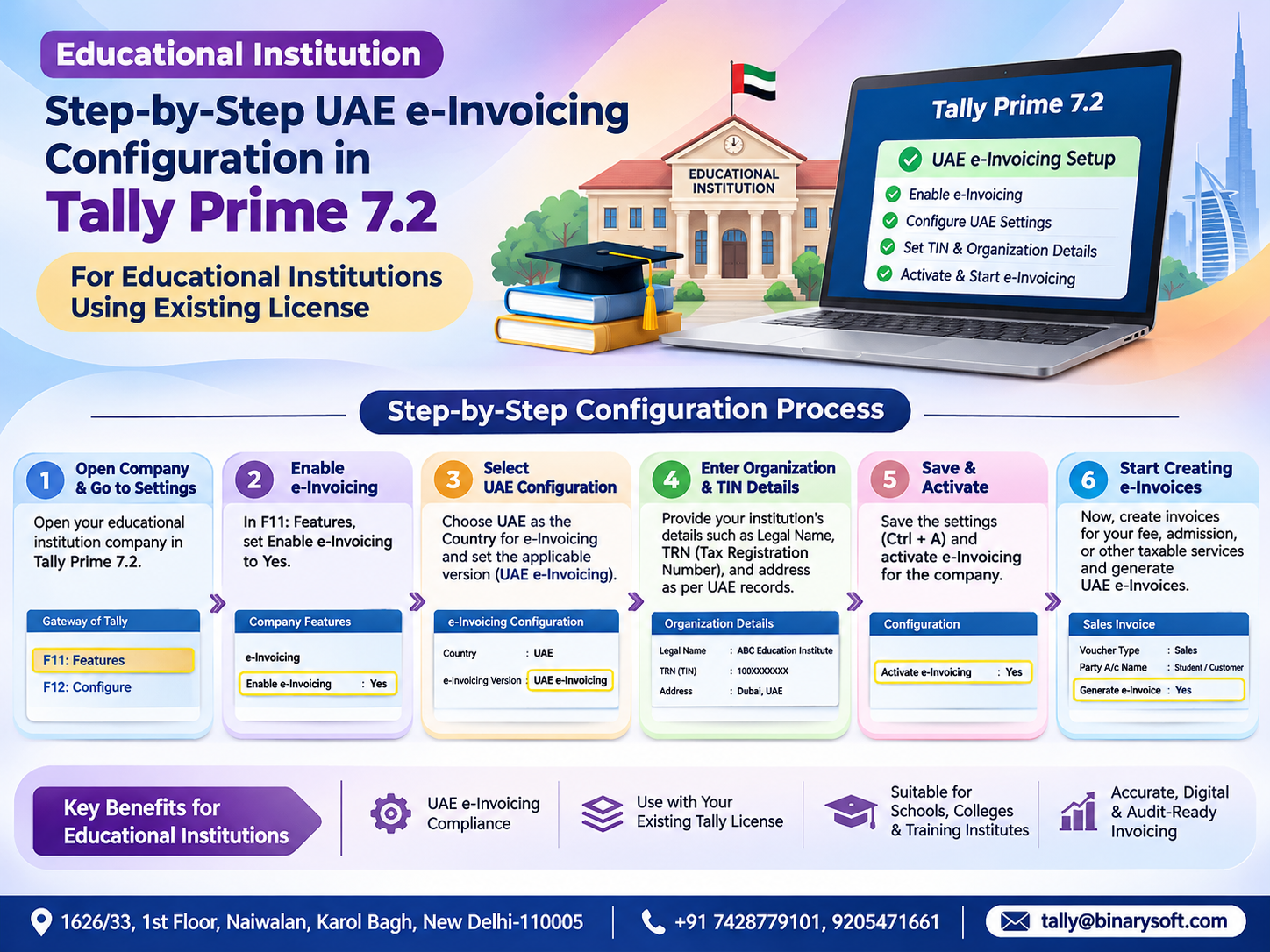
Step-by-Step UAE e-Invoicing Configuration in Tally Prime 7.2
Step 1: Upgrade Your Existing Tally Prime Installation
Begin by checking the currently installed version of Tally Prime.
Before upgrading:
-
Create a complete company data backup.
-
Verify your license serial number.
-
Check subscription validity.
-
Review existing customizations and TDL integrations.
-
Install Tally Prime 7.2 or a compatible subsequent version.
-
Open and verify existing accounting data.
Institutions should test customized admission, fee collection and student management integrations before upgrading their production environment.
Step 2: Configure Educational Institution Details
Open Tally Prime and select the relevant company.
Navigate to the company alteration screen and verify the institution's registered name, address, country, emirate, contact information and financial year.
Set the country to the United Arab Emirates and verify that the base currency is AED.
Accurate institutional information is important because company master details are used when preparing invoices and statutory reports.
Institutions operating multiple campuses should maintain consistent legal entity and branch information across their accounting systems.
Step 3: Enable UAE VAT and e-Invoicing
Open F11 Company Features and review the statutory configuration.
Enable the applicable VAT and electronic invoicing options.
Enter the required registration details, including the Tax Registration Number, Tax Identification Number and applicable electronic invoicing commencement date.
Institutions should select the applicable date based on their implementation obligations or voluntary participation.
The configuration should reflect the institution's actual tax registration status rather than applying VAT automatically to every transaction.
Step 4: Complete Electronic Invoicing Registration
Educational institutions must complete the relevant onboarding activities before exchanging electronic invoices.
In Tally Prime, navigate to:
Alt+Z (Exchange) → All VAT Options → e-Invoice Login & Logout.
Complete the required registration and authentication activities using authorized credentials.
The institution should also complete the applicable EmaraTax onboarding process and establish connectivity with an Accredited Service Provider.
Verify the registered business identity and electronic invoicing participant details before enabling live transactions.
Access to registration and invoice exchange should be restricted to authorized financial personnel.
Step 5: Create Educational Income Ledgers
Create separate accounting ledgers for different revenue categories.
These may include:
-
Tuition Fee Income.
-
Admission Fee Income.
-
Examination Fee Income.
-
Library Fee Income.
-
Laboratory Fee Income.
-
Transportation Fee Income.
-
Corporate Training Income.
-
Hostel Accommodation Income.
-
Educational Material Sales.
-
Research and Consultancy Income.
Separate ledgers help institutions understand revenue distribution and apply appropriate tax classifications.
For example, a qualifying educational service may receive different VAT treatment from a commercial consultancy assignment.
Institutions should not configure every income ledger with an identical VAT rate without reviewing its actual tax treatment.
Step 6: Configure Student, Corporate and Government Party Ledgers
Create appropriate party ledgers for students, parents, corporate clients, government agencies and suppliers.
For relevant business transactions, capture the registered organization name, billing address, city, country, TRN, TIN and electronic invoicing identification details wherever required.
Maintain a clear distinction between individual consumers and registered business customers.
For instance, a school collecting fees from an individual parent should classify that transaction differently from a university invoicing a company for employee training.
Accurate party information reduces validation errors and makes financial reporting more reliable.
Step 7: Configure VAT Rates for Educational Services
Qualifying educational services in the UAE may be zero-rated, subject to prescribed eligibility conditions.
However, not every educational institution, training programme or related supply automatically qualifies for zero-rated VAT.
Certain commercial training programmes, supplementary goods and ancillary services may attract standard-rated VAT at 5%, while other transactions may receive different treatment depending on their nature.
For illustration:
|
Transaction
|
Illustrative VAT treatment
|
|---|
|
Qualifying school tuition fees
|
0%
|
|
Qualifying educational textbooks
|
Potentially 0%
|
|
Non-qualifying commercial training
|
Generally 5%
|
|
Taxable consultancy services
|
Generally 5%
|
|
Qualifying local passenger transportation
|
Potentially exempt
|
These classifications are illustrative and should be verified against applicable UAE VAT legislation.
Use the VAT Rate Setup report in Tally Prime to review classifications across relevant ledgers and stock items.
Step 8: Configure Educational Materials and Inventory
Educational institutions frequently purchase and distribute books, uniforms, stationery, laboratory equipment and learning materials.
Tally Prime allows institutions to create inventory masters, define stock categories and monitor availability.
Configure the appropriate units of measurement and map them to recognized Unit Quantity Codes wherever required for electronic invoicing.
Inventory management helps prevent excessive purchasing, identify shortages and maintain accurate records of educational supplies.
Step 9: Generate Electronic Invoices
After completing the necessary configuration and registration, record eligible transactions using the appropriate sales voucher.
Select the corporate or government customer, enter the service description, specify the transaction value and verify the applicable tax classification.
For example, a professional training institution provides a taxable corporate training programme:
|
Particulars
|
Amount
|
|---|
|
Corporate training charges
|
AED 20,000
|
|
VAT at 5%
|
AED 1,000
|
|
Total invoice value
|
AED 21,000
|
Review the electronic invoicing information before submitting the eligible transaction through the configured service.
Tally Prime supports individual and bulk electronic invoice generation, subject to the applicable configuration and service availability.
Step 10: Manage Credit Notes and Invoice Status
Educational institutions occasionally need to revise charges, cancel training programmes or provide refunds.
Record the appropriate credit note against the original transaction and complete the electronic credit note process wherever applicable.
Use the e-Invoice report to identify pending submissions, validation errors and processing statuses.
The accounting team should verify successful invoice processing instead of assuming that recording a voucher automatically completes regulatory compliance.
How Tally Prime Helps Educational Institutions Beyond e-Invoicing
Automated Student Fee Management
Tally Prime can help educational institutions maintain student-wise outstanding balances, advance payments and installment collections.
Bill-wise accounting enables finance teams to monitor pending amounts and identify overdue payments.
Institutions requiring automated class-wise fee schedules, attendance-linked billing or parent portals can consider suitable customizations or student management integrations.
Budgeting and Cost Control
Educational institutions incur expenses relating to salaries, electricity, infrastructure, transportation, technology and campus maintenance.
Budgeting and cost centre features allow management to compare departmental expenditure against planned budgets.
A university can separately monitor its engineering department, management department, research centre and administration office.
Multi-Campus Financial Management
Institutions operating across Dubai, Abu Dhabi, Sharjah and other emirates can maintain organized branch accounts and consolidated financial information.
Authorized administrators can review campus-wise performance and identify areas requiring financial improvement.
Bank Reconciliation
Educational institutions receive payments through bank transfers, payment gateways, cards and other digital channels.
Supported bank statement import and reconciliation features help accounting teams match receipts against recorded transactions.
This reduces discrepancies and simplifies outstanding fee management.
Financial Reports and Audit Preparation
Tally Prime provides access to balance sheets, profit and loss statements, trial balances, cash flow reports, outstanding reports and VAT-related information.
These reports help management evaluate financial stability, prepare for audits and make informed decisions regarding institutional expansion.
Case Study 1: Dubai Private School Improves Fee Management
Consider an illustrative private school in Dubai serving approximately 1,800 students.
The school previously maintained separate spreadsheets for tuition fees, transportation charges, educational materials and supplier expenses.
During admission season, its accounting department struggled to reconcile payments and identify outstanding balances.
The school upgraded its existing Tally Prime installation and established separate income ledgers, student accounts and departmental cost centres.
It also classified parent-facing transactions separately from corporate and supplier transactions.
For eligible business activities, the school established an electronic invoicing workflow and reviewed its supplier-side compliance requirements.
Within this illustrative implementation, the school gained better visibility into outstanding fees, reduced repetitive accounting work and improved the quality of monthly financial reporting.
The management could focus more effectively on academic resources and campus development rather than resolving accounting discrepancies.
Case Study 2: Abu Dhabi Training Institute Simplifies Corporate Invoicing
Consider an illustrative professional training institute offering corporate development programmes and certification courses.
The institute regularly invoices companies for employee training, consultancy assignments and customized workshops.
Its previous accounting process involved manually preparing invoices and maintaining tax calculations in spreadsheets.
After implementing Tally Prime 7.2, the institute configured corporate customer ledgers, taxable training services, VAT classifications and electronic invoicing registration.
Finance personnel established a systematic invoice verification and submission process.
Outstanding reports also helped the institute monitor delayed corporate payments and forecast upcoming collections.
The improved workflow supported better cash flow management, reduced the risk of invoice errors and provided a stronger foundation for business expansion.
Both case studies demonstrate potential outcomes rather than verified customer performance or guaranteed results.
An Emotional Story: When Accounting Technology Protects an Educational Dream
Imagine a small educational institution established in Sharjah by a teacher named Ayesha.
Her dream was to provide quality education to children whose families could not afford expensive private schools.
As student admissions increased, managing finances became increasingly difficult. Parents paid fees through different channels, supplier invoices accumulated, and outstanding balances were maintained manually.
One evening, Ayesha remained in her office long after the classrooms had closed.
Instead of preparing new educational programmes, she was searching through spreadsheets to determine whether the institution could pay its teachers on time.
She realized that financial uncertainty was affecting the very purpose for which she had established the school.
After introducing a structured accounting system using Tally Prime, her finance team gained clearer visibility into fee collections, expenses and available funds.
The institution also began preparing for electronic invoicing requirements without disrupting everyday academic activities.
Gradually, Ayesha could devote more attention to teachers, scholarships and classroom development.
For her, digital accounting was not simply a technology upgrade. It was a way to protect the educational opportunities she had promised to hundreds of children.
Benefits of Tally Prime on Cloud for Educational Institutions
Cloud-hosted Tally Prime can provide educational institutions with greater operational flexibility, particularly when administrators and accountants work from different locations.
Depending on the hosting configuration, institutions can benefit from centralized accounting data, controlled multi-user access, scheduled backups, disaster recovery and reduced dependence on individual office computers.
However, cloud hosting should not be confused with the application's built-in remote access feature. Electronic invoicing compatibility must be verified for the selected hosting environment before implementation.
Institutions should also implement strong passwords, restricted permissions, encrypted backups and appropriate student data protection policies.
Common Mistakes Educational Institutions Should Avoid
Institutions should avoid assuming that all educational income is VAT-exempt or that electronic invoicing applies only to organizations registered for VAT.
Other common mistakes include recording incorrect customer identification details, overlooking incoming supplier invoices, duplicating electronic invoice submissions and upgrading software without creating backups.
Management should establish a documented accounting procedure, train authorized employees and periodically review regulatory compliance.
Preparing Educational Institutions for the Future
The future of educational accounting will increasingly depend on automation, connected financial services and reliable digital records.
Institutions that prepare early can reduce operational disruption and establish stronger financial controls.
Tally Prime provides a practical foundation for managing institutional accounting, digital invoicing, taxation, inventory, budgeting and financial reporting while supporting long-term growth.
Conclusion
UAE e-Invoicing represents an important step towards modernizing financial operations across the education sector.
By configuring Tally Prime 7.2 correctly, educational institutions can prepare for applicable electronic invoicing obligations while improving fee management, financial transparency, expense control and accounting efficiency.
Existing license holders should verify their subscription, license eligibility, tax registration and integration requirements before purchasing additional software.
Whether managing a small training institute or a large multi-campus university, adopting structured digital accounting can help educational organizations build a more financially sustainable future.
Powered by Binarysoft Technologies
Authorized Tally Partner
Location: 1626/33, 1st Floor, Naiwalan, Karol Bagh, New Delhi – 110005, INDIA
Contact us: +91 7428779101, 9205471661
Email us: tally@binarysoft.com
Business Hours: 10:00 AM – 6:00 PM, Mon–Fri
Frequently Asked Questions
Is UAE e-Invoicing mandatory for educational institutions?
Educational institutions conducting in-scope business or government transactions must comply according to their applicable implementation timeline and regulatory obligations.
Can educational institutions use their existing Tally Prime license?
Yes. Eligible existing licenses can be used subject to subscription validity, international license requirements and compatible software configuration.
Are all educational services zero-rated under UAE VAT?
No. Zero-rating applies only to qualifying educational services and eligible related supplies. Other services may attract VAT.
CA. T.R Venkat is a Chartered Accountant with extensive experience in accounting systems, GST compliance, and MSME advisory. He has worked closely with Indian traders and businesses on inventory control and accounting process improvement. His writing draws from real operational challenges faced by growing enterprises.